
Type a question into ChatGPT, Perplexity, or Google’s AI Mode now and you will usually get a direct answer instead of a list of links to click through. That shift is the reason a new term started showing up in SEO conversations over the past couple of years. Generative engine optimization, or GEO, is the practice of shaping content so AI models choose to use it when they build that answer.
GEO is often discussed alongside AI visibility, but they are not the same thing. GEO is the work you do to earn citations, while AI visibility is the result you measure afterward. I explain the distinction in my guide to AI Visibility vs GEO.
I have spent the last few months running my own site through this exact problem, checking citation counts across three different tools, comparing my numbers against competitors, and watching which of my own pages actually get pulled into an AI answer and which ones never do. This is the foundational piece in that work. What GEO actually is. Where it came from. How it differs from the SEO you already know. And what I have found, with real numbers, about what seems to move it.
Disclaimer: I may earn a small commission on purchases made through links on this page, at no extra cost to you. This supports honest, independent reviews.
Nena’s Quick Verdict
GEO is the practice of making content easier for AI systems like ChatGPT, Perplexity, Gemini, and Google AI Overviews to understand, extract, and cite. It does not replace SEO. The sites earning the most AI citations typically combine original data, direct answers, and strong topical authority.
Table of Contents
The Short Definition
GEO is the practice of writing and structuring content so generative AI systems, ChatGPT, Google AI Overviews, Perplexity, Gemini, Copilot, can find it, understand it, and use it when generating an answer to a user’s question.
That is the whole definition. The rest of this article is detail, examples, and the data that backs it up.
Different AI platforms do not generate answers in exactly the same way. My ChatGPT Review and Perplexity Review show how these systems approach citations, sources, and answer generation differently.
GEO is not a tool. It is not a single technique. It is a practice, made up of editorial and structural choices, aimed at a specific kind of reader that did not exist in the same form a few years ago. The reader is not a person scrolling search results. It is a model deciding, in real time, what to extract and repeat.
Where the Term Came From
GEO is modeled directly on SEO, and the naming is deliberate. Search engine optimization spent two decades teaching publishers how to satisfy Google’s ranking algorithm. Generative engine optimization is the same instinct, redirected at a different kind of engine, one that generates an answer instead of returning a ranked list.
The term picked up real traction once AI Overviews started appearing on a meaningful share of Google searches and ChatGPT crossed into hundreds of millions of weekly users, a growing number of whom were using it the way people used to use a search engine. Ask a question, get an answer, move on without ever opening a traditional search result. That behavior shift created a real audience for content that could be cited inside an answer, separate from content built only to rank.
The term started gaining traction around 2023 as researchers and publishers began exploring how content appears in AI-generated answers. The term has evolved since, but the core idea from that early work still holds. The content that gets used in an AI-generated answer is not always the content that ranks best in a traditional search result, and that gap is worth understanding and, where possible, closing.
GEO vs SEO: What Actually Changes
GEO and SEO share a lot of DNA. Both are about making content easier for a machine to evaluate and prefer. Both reward clarity, relevance, and topical depth. And both benefit from a site that publishes consistently and links its own content together in a coherent way.
The differences matter more than the similarities once you are trying to act on them. SEO optimizes for a ranking position, a slot in a list the user still has to click through. GEO optimizes for inclusion inside an answer the user may never click through at all. That single difference changes a lot of what “good” content looks like.
SEO content can afford to build an argument slowly, because a reader who clicked through has already shown some intent to read. GEO content needs to front-load the answer, because a model extracting a claim is not reading top to bottom, looking for the most efficient, accurate, well-supported claim it can find and use.
SEO rewards comprehensive coverage of a topic, the kind of page that tries to be the only resource a reader needs. GEO seems to reward something narrower and more specific, a clear, well-evidenced claim that answers one question precisely, even if the surrounding page is shorter than a comprehensive guide would be.
SEO has twenty years of documented ranking factors, however imperfectly understood. GEO is still being mapped in real time, by publishers like me running tests on our own sites and comparing notes, because the platforms themselves have not published anything close to a reliable playbook yet.
SEO vs GEO: Key Differences at a Glance
| SEO | GEO | |
|---|---|---|
| Optimizes for | Ranking position | Inclusion in an AI answer |
| Reader behavior | Clicks through to read | May never click through |
| Content shape | Comprehensive, builds an argument | Direct, front-loaded claims |
| Maturity | Well-documented, decades old | New, still being mapped |
| Primary engines | Google, Bing | ChatGPT, AI Overviews, Perplexity, Gemini, Copilot |
That said, GEO is not a replacement for SEO. They run alongside each other, and a lot of the editorial discipline that makes content rank well, clarity, originality, real expertise, also makes it more likely to get cited. The content practices overlap. The target surface and the way you measure success do not.
Another metric worth tracking alongside GEO is AI Share of Voice, which measures how much of the AI-generated conversation in your category belongs to your brand compared to competitors.
Why GEO Matters Right Now
A citation inside an AI answer does not automatically send a visitor to your site. That is the uncomfortable part of this whole topic, and worth saying plainly before getting into why it still matters. Sometimes the reader gets a complete answer and never opens the cited page at all. You got cited. You did not get the click.
So why does any of this matter. Because being cited inside an AI answer functions the way being quoted by a trusted source has always functioned. It builds a kind of authority that compounds over time, even on the visits that never happen, because being the source an AI model reaches for repeatedly is itself a signal of trust that outlasts any single answer. And on the visits that do happen, traffic referred from an AI answer tends to arrive with real intent, since the reader already trusted the source enough to click through after getting an answer they could have stopped at.
The bigger reason is more structural. Search behavior is shifting toward these surfaces, not away from them, and that shift shows no sign of reversing. A publisher who ignores GEO entirely is optimizing for a shrinking share of how people actually find information, even if their traditional rankings stay perfectly healthy.
What GEO Actually Looks Like in Practice
GEO is not a checklist you complete once. It is a set of editorial habits, applied consistently, that I have found make a real difference in my own testing.
Writing direct, extractable answers near the top of a section, rather than building up to the point slowly, gives a model something clean to pull without having to infer the claim from context. Structuring pages so a single clear claim sits close to the heading it answers, instead of scattering supporting information ahead of the actual point, makes the same information easier for a model to extract confidently.
Publishing original data is the single highest-leverage habit I have found. A page that only summarizes what other sites already say has nothing for a model to prefer it over the other versions of the same claim sitting elsewhere on the web. A page built around a named test, a specific result, a real screenshot, gives a model a reason to choose your version specifically, because it is the only version that exists.
Naming entities clearly, the actual brand, tool, or product under discussion, rather than talking around the subject in general category language, gives a model something concrete to anchor a claim to. Keeping content current matters too, since AI models appear to favor recently updated information on topics where recency is genuinely relevant.
None of these are exotic techniques. They read, individually, like good editorial practice that should have been happening anyway. The difference GEO introduces is treating them as deliberate, measured choices aimed at a specific outcome, rather than incidental good habits.
The Data That Shaped How I Think About This
I want to be specific here rather than just asserting that GEO matters, because the data I have gathered on my own site complicates the simple version of this story in a useful way.
I ran nenawow.com through three different AI visibility tools, Search Atlas, Semrush, and Ahrefs’ free checker. The numbers did not agree with each other. Search Atlas reported my AI Overview count at 7. At first, that number looked disappointing. It only became useful once I compared it against competitors.
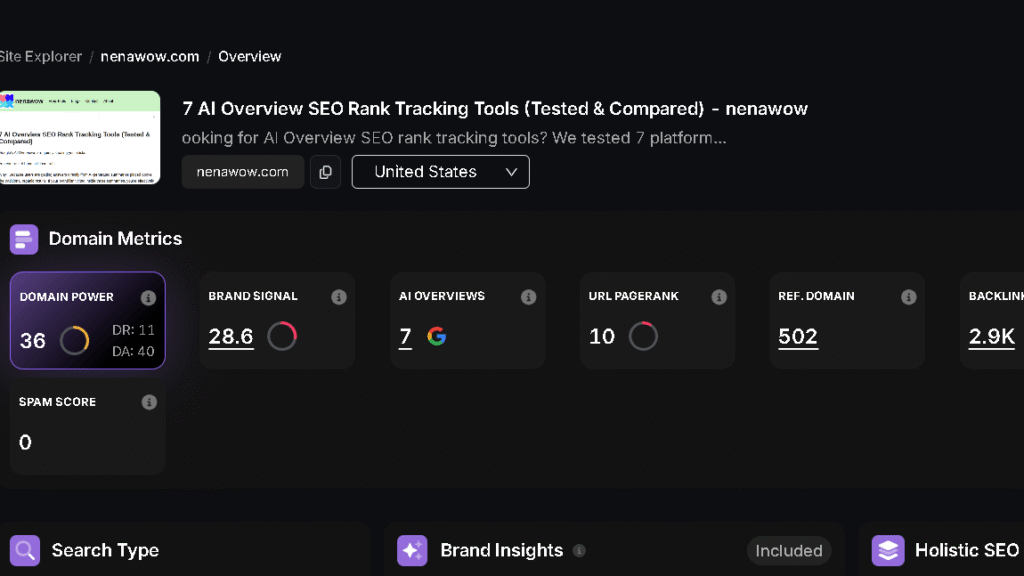
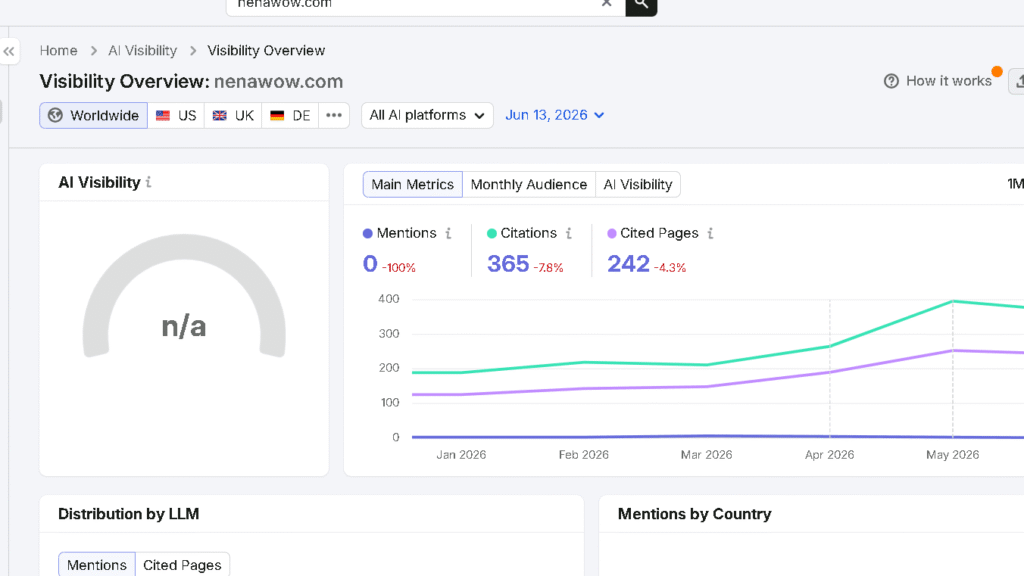
Semrush, depending on which view inside its own dashboard I looked at, reported either 365 total citations across 242 cited pages, or a more detailed breakdown of 283 citations split across four platforms.
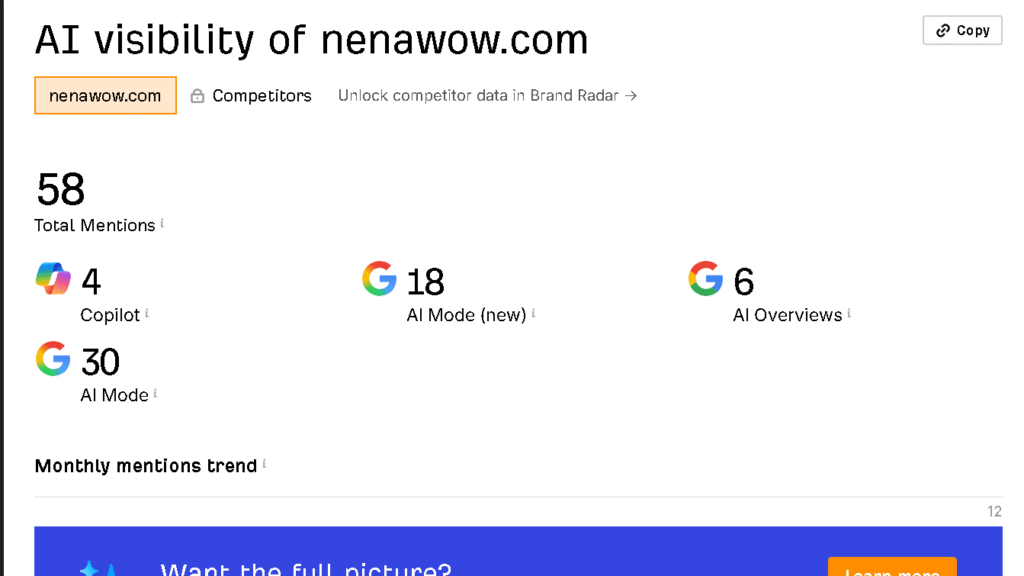
Ahrefs’ free checker landed at 58 total mentions. I covered the platform’s AI visibility tracking capabilities in my detailed Ahrefs Review.
If you’re curious about how Search Atlas measures AI visibility, citations, AI Overviews, and brand signals, you can read my full Search Atlas Review.
That disagreement is not a flaw in any one tool. It reflects how young and unsettled this measurement category still is. Three platforms, three different definitions of what counts as a citation, three different schedules for updating the count.
The more useful finding came from a competitor comparison using Search Atlas’s side-by-side view. I compared my site against three competitors in the AI tool directory space.
AI Overview Visibility Comparison Across Competing Sites
| Site | Domain Power | Brand Signal | AI Overviews |
|---|---|---|---|
| nenawow.com | 36 | 28.6 | 7 |
| Futurepedia | 49 | 48.9 | 179 |
| There’s An AI For That | 62 | 77.1 | 247 |
| Toolify | 48 | 75.6 | 1 |
Toolify is the outlier worth sitting with. Its Domain Power and Brand Signal scores are nearly as strong as the top performer in that table. By every traditional measure of site strength, the kind that usually correlates with strong content fundamentals, Toolify should be showing up in AI Overviews regularly. Its actual count came back as 1.
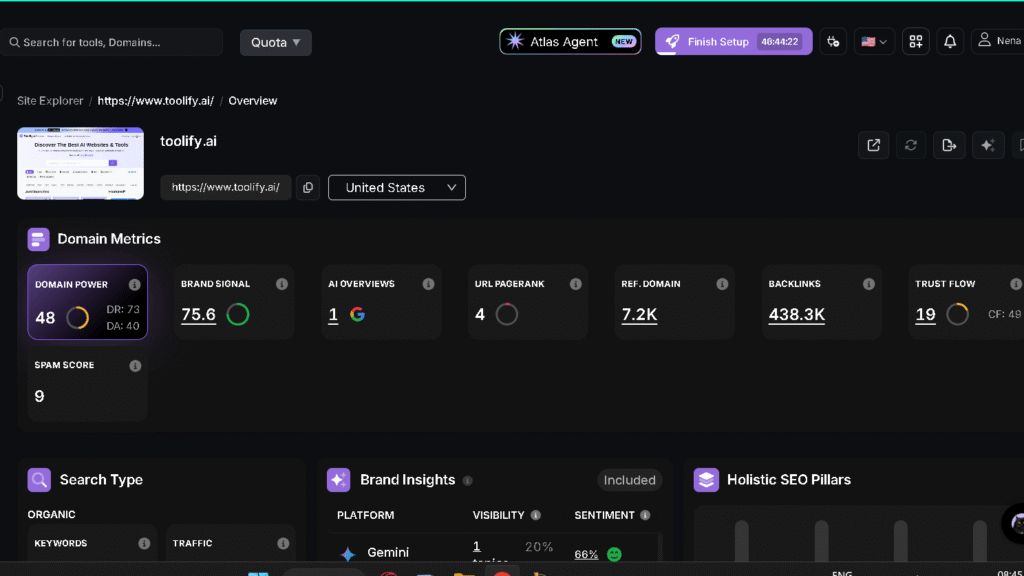
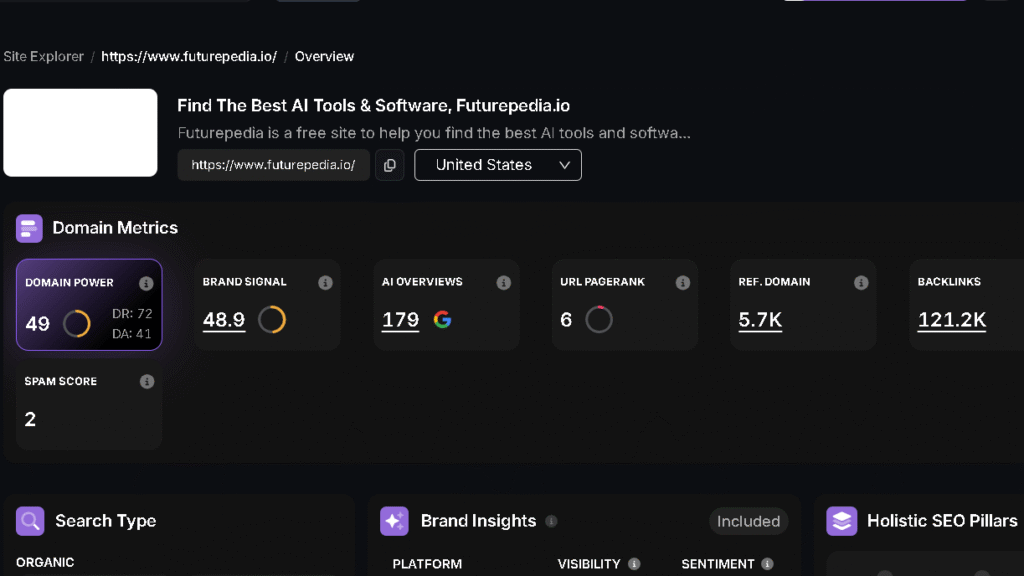
That result tells you something real about GEO specifically, not just about AI visibility as a measurement category. Strong traditional authority does not guarantee strong GEO outcomes. Whatever Toolify is doing with its actual content, the structure, the specificity, the extractability of its claims, is not converting into citations, despite real strength behind it. GEO is not simply downstream of general site authority. It depends on choices made at the content level that authority alone does not substitute for.
This is exactly the situation I explore in Why Your Site Ranks But Gets No AI Citations, where strong rankings fail to translate into AI visibility and citations.
A Closer Look: What Actually Seems to Get Cited
The clearest pattern I have found inside my own data sits at the page level, not the domain level. My single most cited page, by a clear margin across every tool I checked, is a head-to-head comparison built around an actual test I ran rather than a general overview of the topic. That page kept outperforming broader, more comprehensive pieces, even ones that ranked just as well in traditional search.
That pattern matches the theory laid out earlier in this article closely enough that I trust it. A specific, named claim, backed by original testing, sitting inside a page built around answering one clear question, performs better in AI citation checks than a wider page trying to cover more ground. The narrower, more evidenced page wins, not the more comprehensive one.
This is also where GEO and the rest of this content cluster connect directly. The distinction between GEO as the work you do and AI visibility as the result you measure afterward matters here specifically, because GEO is the input side of exactly this pattern, and the citation data is the output that confirms or contradicts whether the input is working.
How to Start Doing GEO on Your Own Site
You do not need a complicated plan to begin. Start by auditing a handful of your strongest-ranking pages and asking honestly whether each one contains a direct, extractable claim near the top, or whether the actual answer is buried several paragraphs into context-setting. That single check surfaces more opportunity than almost anything else I have found.
Look for pages that summarize existing information without adding anything original, and consider what first-party data, a real test, a specific number, a screenshot, could replace a generic claim with something only your page can say. Check whether your content names the actual brands, tools, or products under discussion, or whether it talks around the subject in vague category language that gives a model less to anchor to.
Build content in connected clusters rather than as isolated standalone pages, since a page sitting inside a coherent group of related articles seems to carry more topical weight than the same page published alone. And once you have made these changes, check your AI visibility using more than one tool, treating any single number as a directional sample rather than a precise verdict, and watch the trend over months rather than reacting to any single week’s snapshot.
What This Means Going Forward
GEO is still a young practice, young enough that nobody, including the platforms building the AI models themselves, has published anything close to a reliable, complete playbook. What exists right now is closer to a set of patterns publishers like me are finding through direct testing, openly comparing what worked against what did not.
That is also the opportunity. A category this early rewards publishers willing to treat it seriously now, before the practice matures and the gap between doing it well and doing it adequately narrows. The content habits underneath GEO, direct answers, original data, named entities, clear structure, are sound editorial practice regardless of whether any AI model ever cites the result. Building them now, while the measurement tools are still catching up to the practice, is the version of this work most likely to compound.
FAQ
Generative engine optimization. It is the practice of writing and structuring content so AI systems like ChatGPT, Google AI Overviews, Perplexity, and Gemini can find, understand, and use it when generating an answer to a user’s question.
No, though the two overlap. SEO optimizes content for ranking position in traditional search results. GEO optimizes content for inclusion inside an AI-generated answer, which rewards different things, direct extractable claims and original data in particular, more heavily than traditional ranking factors do.
Through AI visibility tools like Search Atlas, Semrush, or Ahrefs, which track whether your content appears inside AI-generated answers across different platforms. Treat any single tool’s number as a directional sample rather than a precise verdict.
No. In a competitor comparison I ran, a site with strong traditional authority metrics, the kind that usually accompanies strong rankings, had an AI Overview count of just 1, while sites with similar or even lower authority scores had citation counts in the hundreds.
Publishing original data. A page built around a named test, a specific result, or a real first-party number gives an AI model a reason to prefer your version of a claim over the many generic, unsourced versions of the same claim that likely already exist elsewhere.