
I did not sign up for Search Atlas to write a review. I signed up because I was already deep into an AI visibility investigation on my own site, and Search Atlas kept coming up as the tool that tracks Domain Power, Brand Signal, and AI Overview counts. So I tested it the way I actually use tools. On my own data, against real competitors, while trying to answer a real question.
This is not a feature list. It is what happened when I opened Site Explorer, ran my own site through it, compared it against three competitors, and then tried to use the AI visibility tools I had read so much about.
Disclaimer: I may earn a small commission on purchases made through links on this page, at no extra cost to you. This supports honest, independent reviews.
Table of Contents
Search Atlas Review 2026: Quick Verdict
| Category | Rating | My Take |
|---|---|---|
| AI Visibility Research | ⭐⭐⭐⭐☆ | The strongest part of Search Atlas. Domain Power, Brand Signal, and AI Overview comparisons revealed insights I could not easily get elsewhere. |
| Keyword Research | ⭐⭐⭐☆☆ | Solid, but Semrush still offers deeper keyword data and research workflows. |
| Backlink Analysis | ⭐⭐⭐☆☆ | Good enough for most users, but Ahrefs remains stronger for backlink depth. |
| Ease of Use | ⭐⭐⭐☆☆ | Setup is quick, but the dashboard feels crowded with 60+ tools. |
| Value for Money | ⭐⭐⭐⭐☆ | Starter delivers useful competitor research, but AI visibility tracking requires the more expensive Growth plan. |
| Overall Rating | ⭐⭐⭐⭐☆ | Best suited for SEO professionals and publishers interested in AI visibility and competitor benchmarking. |
Search Atlas is genuinely useful for one thing in particular. Comparing Domain Power, Brand Signal, and AI Overview counts across competitors gave me data I could not get the same way anywhere else. That part earned its place in my workflow.
The AI visibility tracking itself is a different story. On the Starter plan, LLM Visibility showed zero credits and zero projects. That is a real gap between what gets talked about and what you actually get.
Search Atlas Pros
The Site Explorer metrics are fast, and the competitor comparison view is the best part of the platform for AI visibility research. Brand Signal is a metric I had not seen anywhere else, and it turned out to matter more than I expected.
Search Atlas Cons
LLM Visibility tracking is locked out on the Starter plan, with zero credits and zero projects available. OTTO requires a CMS connection that takes more setup than the dashboard suggests, and some AI Overview numbers were hard to independently verify.
Who Should Use Search Atlas
Anyone doing competitor research for AI visibility, the way I did with Futurepedia, There’s An AI For That, and Toolify, will get real value from Site Explorer alone. Agencies on the Growth plan or higher, where LLM Visibility actually unlocks, get the fuller picture.
Who Should Avoid Search Atlas
If you are on a tight budget and specifically want AI visibility tracking, the Starter plan will not give you that. Beginners who just want backlink data are better served by Ahrefs Webmaster Tools, which is free.
What Is Search Atlas?
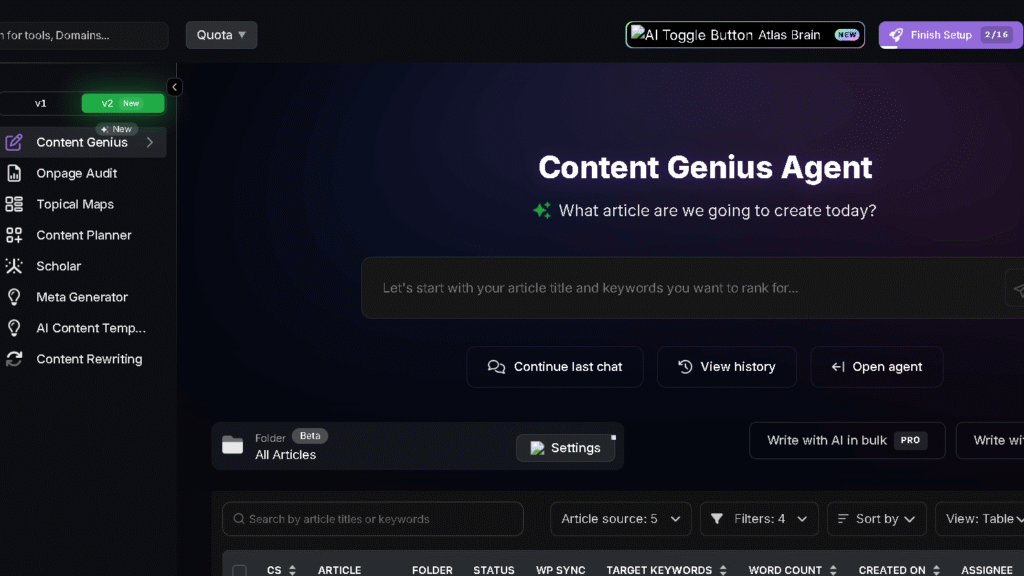
Search Atlas is an SEO platform built around an all-in-one pitch. Site audits, rank tracking, keyword research, content tools, and an automation layer called OTTO, all under one subscription.
The part that pulled me in was newer. Search Atlas reports Domain Power, Brand Signal, and AI Overview counts for any domain you check, including competitors. That is the part most reviews skip past, and it is the part I actually used.
Key Features at a Glance
| Feature | What It Does | Plan Needed |
|---|---|---|
| Site Explorer | Domain Power, Brand Signal, AI Overviews, competitor lookups | All plans |
| OTTO SEO | Automated technical fixes via CMS connection | Starter and up, 1 project on Starter |
| LLM Visibility | Tracks brand mentions in ChatGPT, Gemini, Perplexity | Growth and up |
| Content Genius | AI-assisted article drafts | All plans |
| Rank Tracking | Keyword position monitoring | All plans, limits vary |
Search Atlas vs Traditional SEO Tools
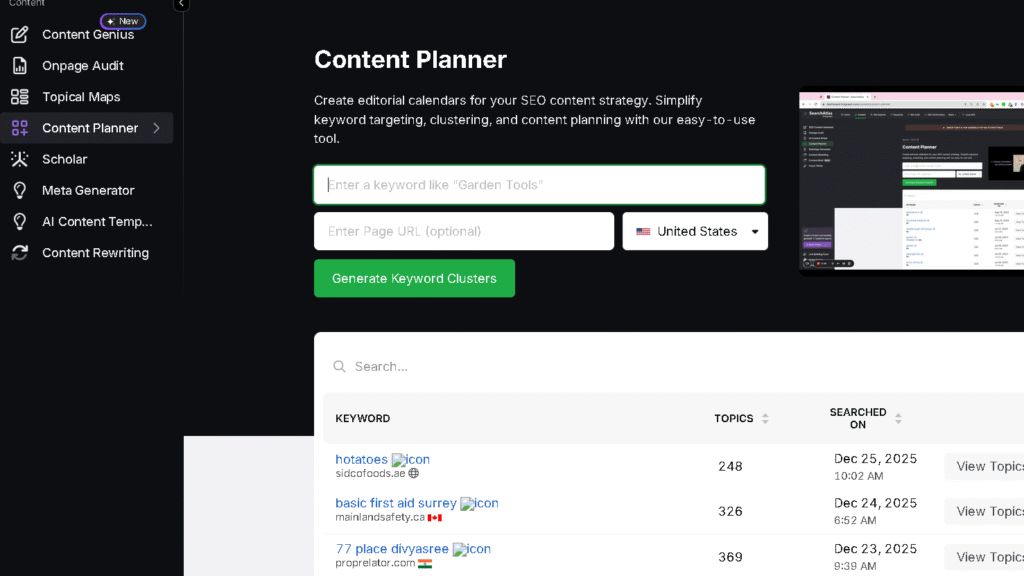
Ahrefs and Semrush both have deeper backlink indexes than Search Atlas. Neither of them reports Brand Signal or AI Overview counts the way Search Atlas does. That difference is the whole reason I kept using it past the trial.
How I Tested Search Atlas
I ran my own site, nenawow.com, through Site Explorer first. Then I ran the same check on three AI tool directories that show up constantly in my niche: Futurepedia, There’s An AI For That, and Toolify.
The question I wanted answered was simple. Does Search Atlas tell me anything I could not already get from Ahrefs or Semrush? For the AI visibility side, the answer turned out to be yes. For the LLM tracking side specifically, the answer turned out to be more complicated.
What I Wanted to Learn Before Writing This
I wanted to know if Domain Power tracked with AI Overview presence the way you would expect. I also wanted to know what LLM Visibility actually showed once I clicked into it, not just what the marketing page promised.
Search Atlas Dashboard and First Impressions
Setup was quick. I connected my domain, and Site Explorer started returning data within a couple of minutes, faster than I expected from a platform with this many tools bundled in.
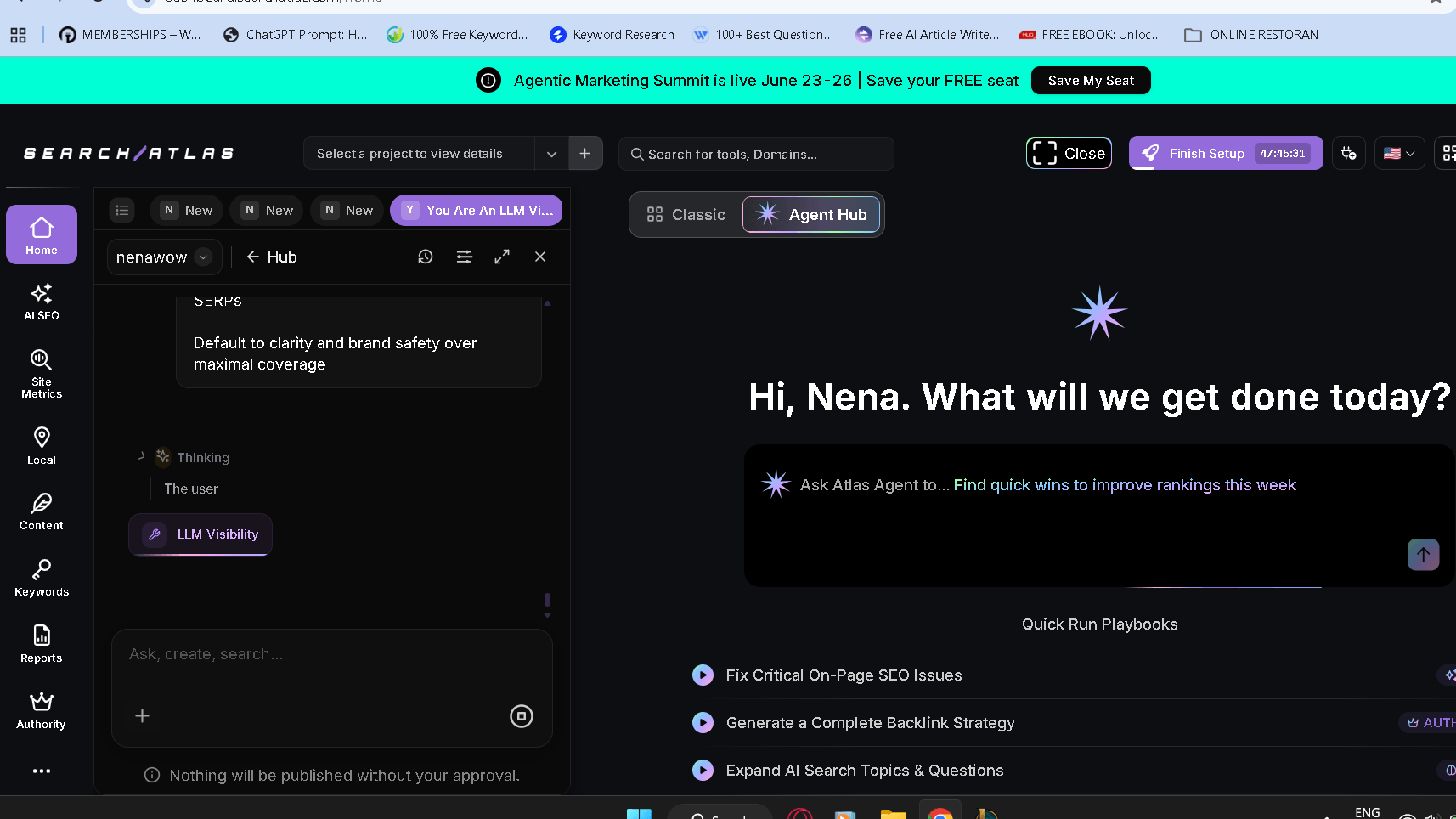
The dashboard itself is dense. Sixty-plus tools means a lot of menu items, and it took a few sessions before I stopped clicking into modules I did not need yet. Once I found Site Explorer and stayed there, the experience got much better.
Search Atlas Site Explorer: Domain Power, Brand Signal, and AI Overviews Explained
This is the section that matters most for anyone reading this for AI visibility reasons, so here is what each metric actually showed me.
Domain Power
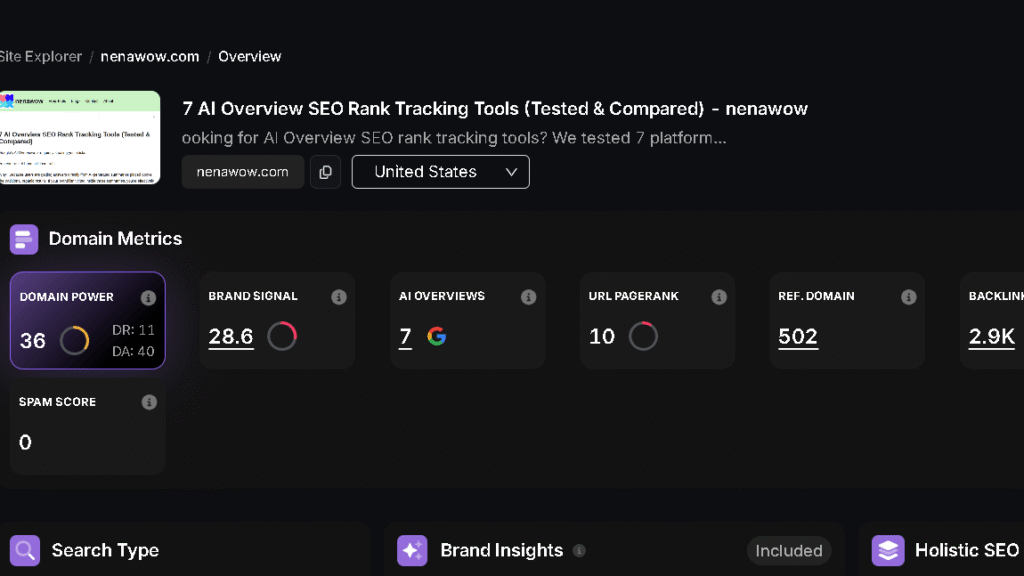
Domain Power is Search Atlas’s overall strength score, similar in spirit to Domain Rating or Authority Score. My site came back at 36. That is a small-site number, and it matched what Ahrefs had already told me through Webmaster Tools.
Brand Signal
Brand Signal is the metric I had not used before, and it turned out to be the most interesting number in this whole review. It appears to track brand recognition separately from links and rankings. My site scored 28.6, the lowest of every site I checked.
AI Overviews
This column shows how often a domain turns up in AI Overview results. My site came back at 7. Small number, but not zero, and that number is what kicked off the whole investigation in the first place.
What I Learned From Analyzing My Own Site
Before Search Atlas, the only AI visibility number I had was from Semrush. It reported 365 AI citations across 242 cited pages for my site, up from close to zero three months earlier.
Semrush was actually the tool that first helped me discover those AI citations. In my Semrush review, I break down how its AI visibility reports compare to traditional SEO metrics and where the platform still has an advantage.
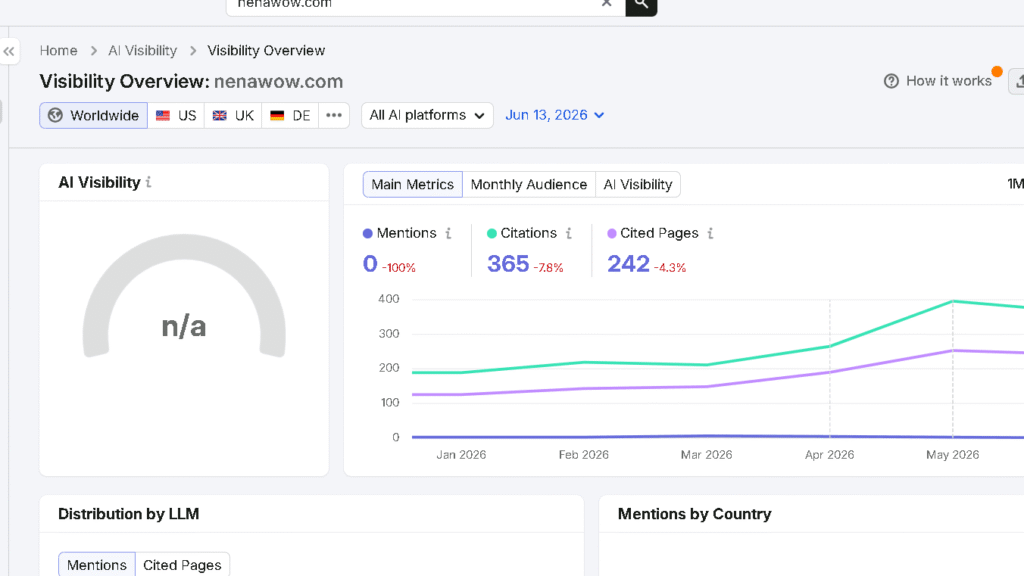
Search Atlas gave me a different angle on the same story. Domain Power 36, Brand Signal 28.6, AI Overviews 7. For context, Ahrefs shows my site at roughly 4.8K monthly organic traffic, 214 ranking keywords, and a Domain Rating of 11, with around 2K referring domains. Small site, by any measure, but the AI Overview number was not zero.
What the Search Atlas numbers did not tell me was why. They gave me a snapshot, not a reason. For the reason, I needed to look at other sites in the same space.
The Competitor Analysis That Surprised Me
This is where Search Atlas earned its place in my workflow. I pulled Domain Power, Brand Signal, and AI Overview counts for three AI tool directories that show up constantly in searches related to my niche.
| Website | Domain Power | Brand Signal | AI Overviews |
|---|---|---|---|
| Nena | 36 | 28.6 | 7 |
| Futurepedia | 49 | 48.9 | 179 |
| There’s An AI For That | 62 | 77.1 | 247 |
| Toolify | 48 | 75.6 | 1 |
Futurepedia
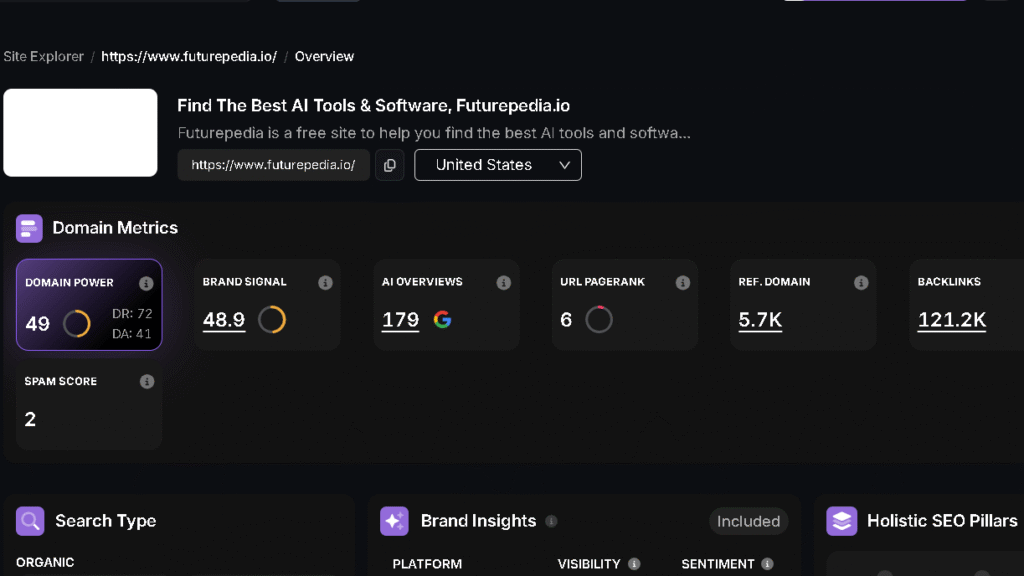
Futurepedia sits in the middle on Domain Power, but its AI Overview number is the second highest in the table. Its Brand Signal score is solid too. The combination looks balanced, not lopsided in one direction.
There’s An AI For That
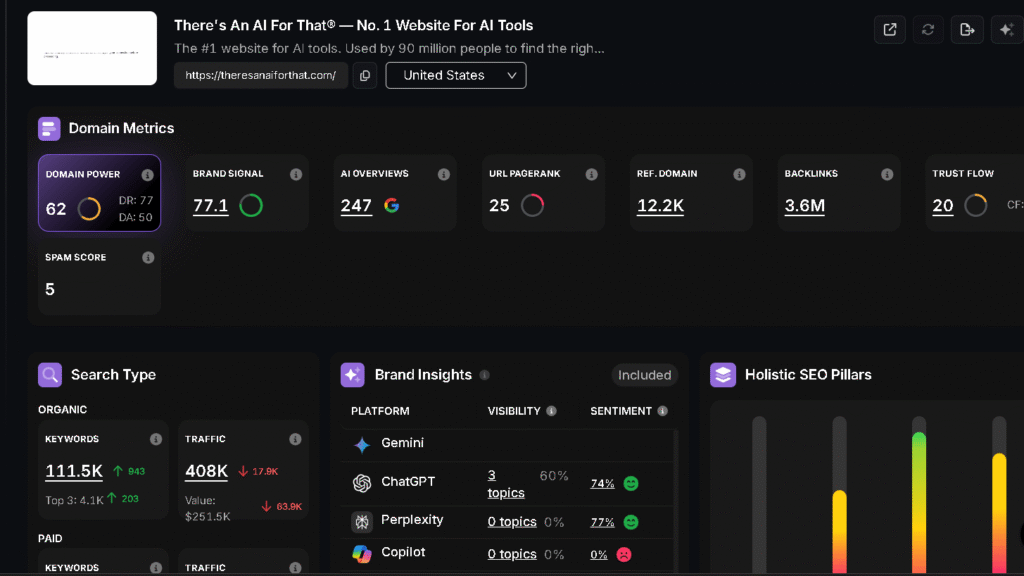
TAAFT leads on every metric here. Highest Domain Power, highest Brand Signal, highest AI Overviews. If you want one example of what full strength looks like across all three numbers, this is it.
Toolify
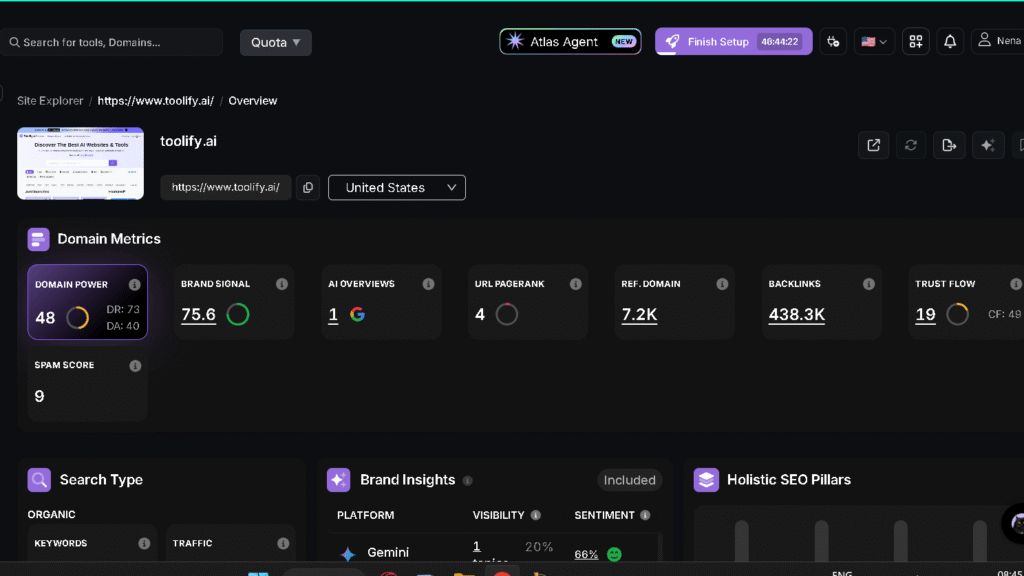
Toolify is the one that stopped me. Its Domain Power sits close to Futurepedia’s. Its Brand Signal score is nearly as high as TAAFT’s. And its AI Overview count is 1.
Why Toolify Changed How I Think About AI Visibility
Toolify has 117K ranking keywords and a Domain Rating of 73, according to the SEO data I cross-checked separately. Its Brand Signal score through Search Atlas is 75.6, the second highest in the table. And its AI Overview count is 1.
If AI visibility were simply a function of SEO strength, Toolify would dominate this table. It does not. That gap is the single most useful thing Search Atlas showed me, and I would not have found it without the competitor comparison feature.
That discovery reinforced something I discuss in my guide on how to improve brand visibility in AI search engines: rankings, backlinks, and AI citations do not always move together the way many people assume.
Can Search Atlas Track AI Visibility? The LLM Visibility Feature
Site Explorer is one thing. LLM Visibility, the feature that tracks brand mentions inside ChatGPT, Gemini, and Perplexity directly, is a separate tool under the QUEST tab. This is where things got frustrating.
What’s Available on the Starter Plan
On the Starter plan, which is what I tested, LLM Visibility showed zero credits and zero projects. The feature exists in the interface. It is just not usable at this tier.
The Free Trial Limitation Most Reviews Ignore
Most reviews mention LLM Visibility as a headline feature without mentioning that it requires the Growth plan or higher to actually run. If AI search visibility is the reason you are looking at Search Atlas, that detail changes the decision. Worth noting: the Growth plan is where LLM Visibility tracking across ChatGPT, Gemini, and Google AI actually turns on.
Search Atlas OTTO Review
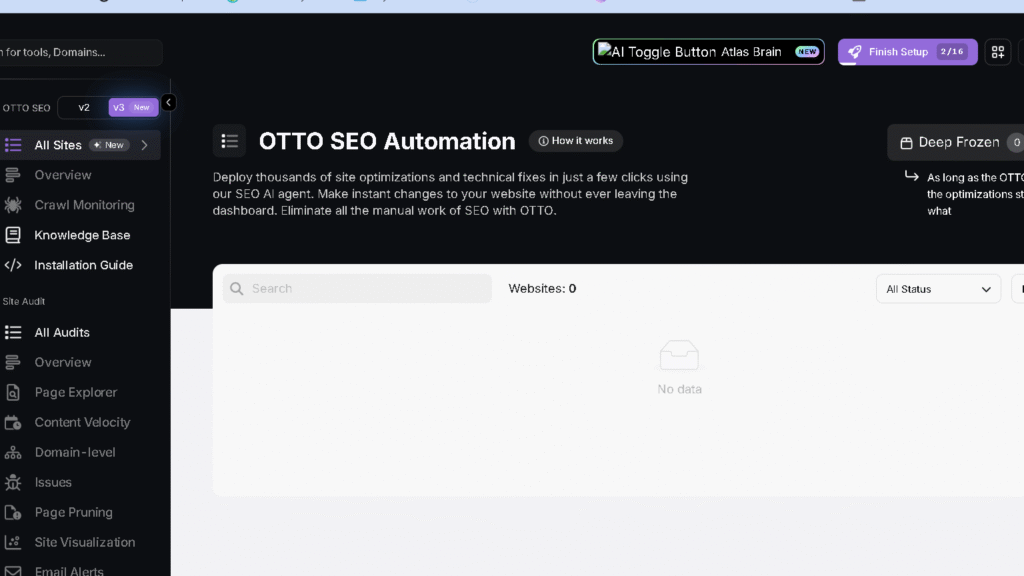
OTTO is the automation layer that is supposed to implement technical fixes directly through a script on your site.
Why OTTO Was Not Available During My Test
OTTO requires a CMS connection, in my case WordPress, before it can run. I had not completed that connection at the time of testing, so OTTO sat unavailable in the dashboard the whole time. That is on me, not the platform, but it is also a setup step that the dashboard does not make obvious upfront.
Is OTTO Worth It for Small Publishers?
For a site my size, with one OTTO project included on Starter, the automation could help with the kind of repetitive fixes that eat up time. I cannot speak to how well it performs yet, since I never got it connected during this test. That is its own gap, and I am noting it rather than guessing.
Search Atlas vs Semrush
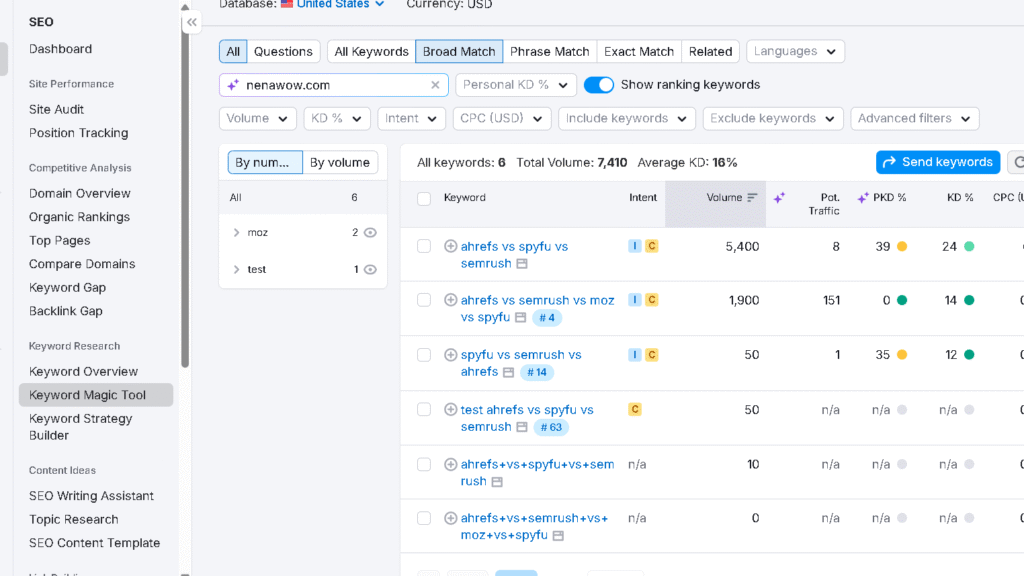
Semrush has the larger keyword database and a more mature AI Overview tracking feature for Google specifically. Search Atlas adds Brand Signal and direct competitor AI Overview comparisons, which Semrush does not show in the same format.
If you’re deciding between these two platforms specifically, I put together a detailed Search Atlas vs Semrush comparison where I tested both tools side by side and compared AI visibility tracking, keyword research, and competitor analysis in more depth.
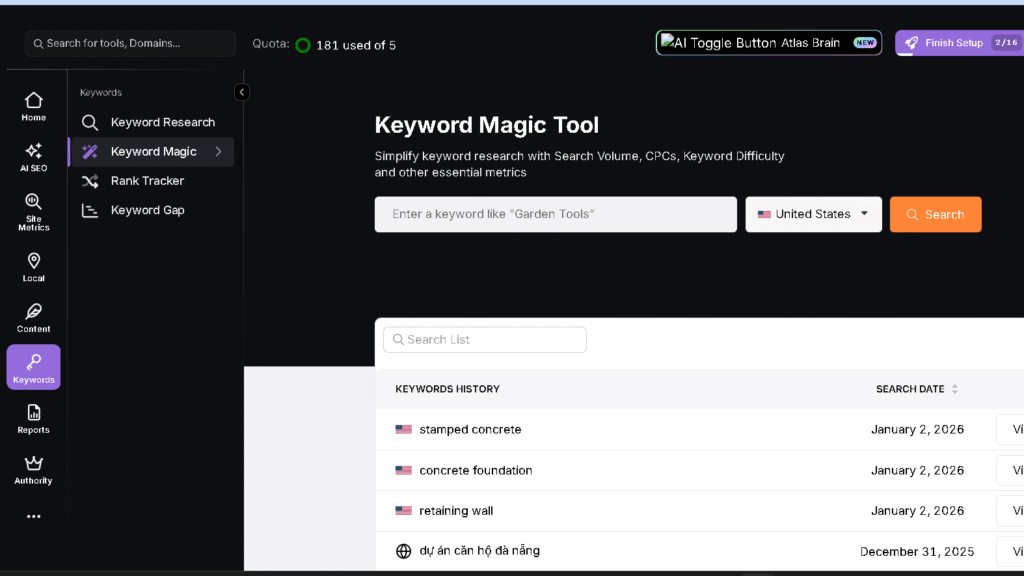
For pure keyword research depth, Semrush wins. For the specific competitor benchmarking I did in this review, Search Atlas gave me something Semrush did not.
Search Atlas vs Ahrefs
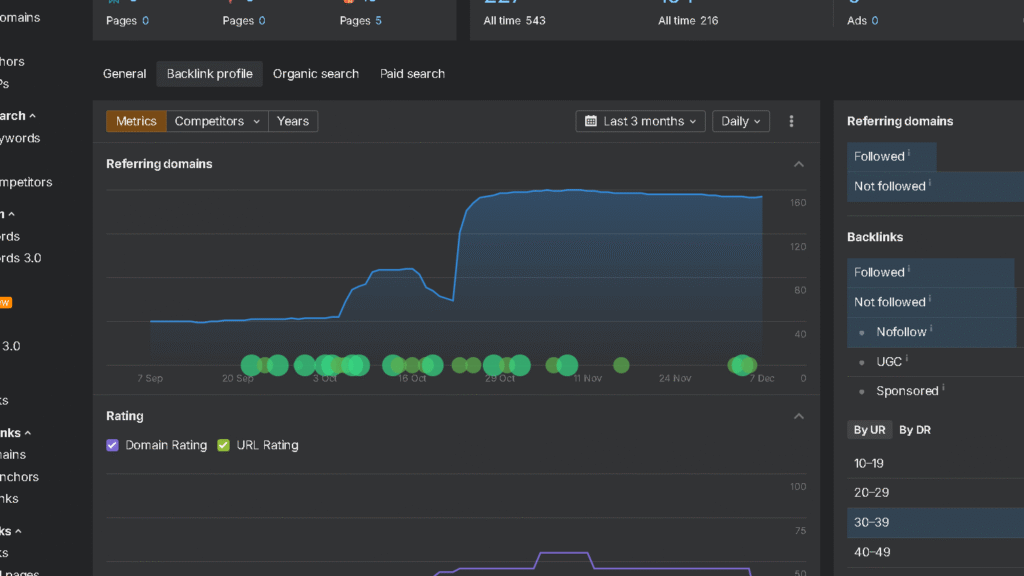
Ahrefs has a stronger backlink index, and its Webmaster Tools are free permanently, which is hard to beat for a small site. Search Atlas does not try to compete on backlink depth.
I also have a full Ahrefs review where I explain why I still use Ahrefs Webmaster Tools for backlink analysis, even while testing newer AI visibility platforms like Search Atlas.
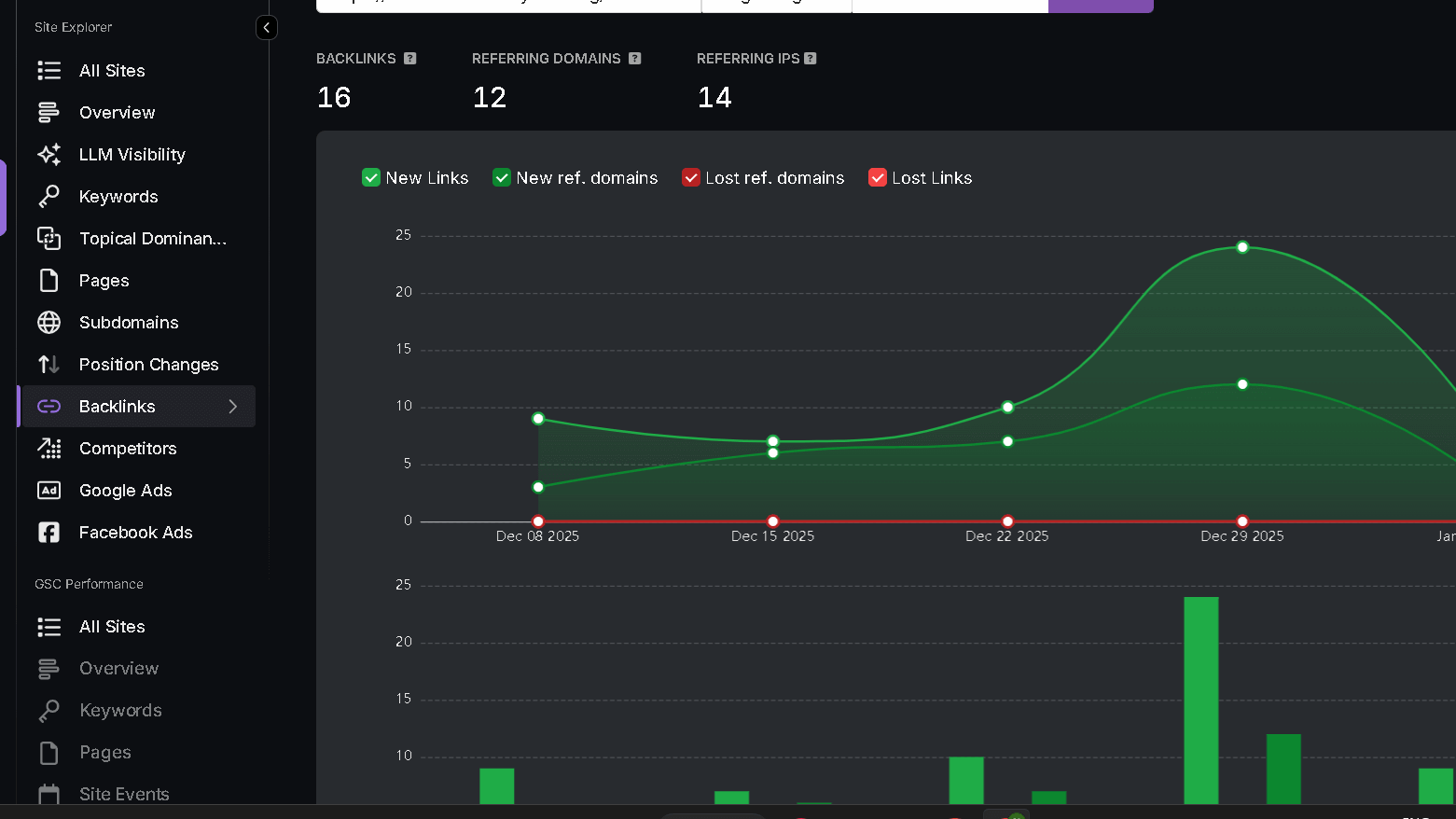
Where Search Atlas pulls ahead is the AI visibility layer. Domain Power, Brand Signal, and AI Overview counts, side by side for any domain, is not something Ahrefs offers in the same view.
| Tool | AI Visibility | Backlinks | Keyword Research |
|---|---|---|---|
| Search Atlas | ⭐⭐⭐⭐ | ⭐⭐⭐ | ⭐⭐⭐ |
| Semrush | ⭐⭐⭐ | ⭐⭐⭐⭐ | ⭐⭐⭐⭐⭐ |
| Ahrefs | ⭐⭐ | ⭐⭐⭐⭐⭐ | ⭐⭐⭐⭐ |
What Frustrated Me About Search Atlas
The LLM Visibility gap on Starter was the biggest one. Zero credits, zero projects, for a feature that gets discussed as if it is available from day one.
OTTO’s CMS requirement was the second. Not a dealbreaker, but it is a setup step that should be flagged earlier in onboarding. A few AI Overview numbers were also hard to independently verify against what I could see in actual AI tool outputs, which means I would treat them as directional rather than exact.
What Search Atlas Does Better Than Most SEO Tools
Brand Signal is genuinely new ground. I have not seen another platform report it, and the Toolify comparison would not have been possible without it.
The side-by-side competitor view, Domain Power next to Brand Signal next to AI Overviews, in one table, is the single feature that justified the time I spent on this platform.
Search Atlas Pricing
| Plan | Monthly Price | OTTO Projects | LLM Visibility |
|---|---|---|---|
| Starter | $99 | 1 | Not included |
| Growth | $199 | 2 | Included, ChatGPT, Gemini, Google AI |
| Pro | $399 | 4 | All LLM models, white-label |
| Agency | $999 | 25 plus | Full access plus Perplexity |
Starter Plan
Starter gets you Site Explorer, including Domain Power, Brand Signal, and AI Overview counts for any domain, plus one OTTO project and a limited keyword tracking allowance. For the competitor research in this review, Starter was enough.
Growth, Pro, and Agency Plans
Growth is the entry point for LLM Visibility tracking, and it roughly doubles the price. Pro and Agency add more seats, more OTTO projects, and broader model coverage for larger teams.
Is Search Atlas Worth the Price?
If your main interest is the Site Explorer and competitor benchmarking, Starter at $99 a month delivers real value, the kind I used throughout this review. If LLM Visibility tracking specifically is the reason you want this tool, budget for Growth at $199 instead. That is a real value either way, but only if you pick the right tier for what you actually need.
Who Should Use Search Atlas
AI visibility researchers, content publishers comparing themselves against niche competitors, and agencies on Growth or higher who want LLM tracking alongside SEO tools, all get real use out of this platform.
Who Should Avoid Search Atlas
Beginners on a tight budget who specifically want AI visibility tracking will hit the Starter wall immediately. Anyone who only needs backlink data is better served starting with Ahrefs Webmaster Tools, which is free.
Best Search Atlas Alternatives
Semrush remains the stronger pick for keyword research depth and Google AI Overview tracking. Ahrefs wins on backlink index size and has a free permanent option through Webmaster Tools. For dedicated AI visibility and citation tracking specifically, tools like Promptwatch, ARC AI Rank Checker, and Profound are worth comparing against Search Atlas’s LLM Visibility once you are past the Starter tier.
Final Verdict
Search Atlas gave me one thing nothing else did: a side-by-side Domain Power, Brand Signal, and AI Overview comparison that turned into the most useful finding of my entire AI visibility project. That alone justified the Starter plan for me.
The LLM Visibility gap on Starter is real, though, and if that feature is the reason you are reading this, plan for Growth instead. Worth it for the competitor research. Not yet worth it for full AI visibility tracking unless you upgrade.
Related Reading
- Search Atlas vs Semrush
- Semrush Review
- Ahrefs Review
- How to Improve Brand Visibility in AI Search Engines
FAQ
For Site Explorer and competitor AI visibility benchmarking, yes, even on the $99 Starter plan. For LLM Visibility tracking specifically, you need Growth at $199 or higher.
Yes, through the LLM Visibility feature under the QUEST tab, but only on Growth plans and above. On Starter, this showed zero credits and zero projects during my test.
Domain Power is Search Atlas’s overall domain strength score, similar in concept to Domain Rating or Authority Score. My site scored 36.
Brand Signal is a metric that appears to track brand recognition separately from links and rankings. In my competitor comparison, it lined up with AI Overview counts more closely than Domain Power did.
Not entirely. Semrush still leads on keyword research depth and Google AI Overview tracking. Search Atlas adds Brand Signal and competitor AI visibility comparisons that Semrush does not show in the same way.
No. Ahrefs has the stronger backlink index and a free permanent option through Webmaster Tools. Search Atlas’s value is the AI visibility layer, not backlink depth.
For competitor benchmarking through Site Explorer, yes, and that is where I found the most value. For full LLM Visibility tracking across ChatGPT, Gemini, and Perplexity, you need Growth or higher.