
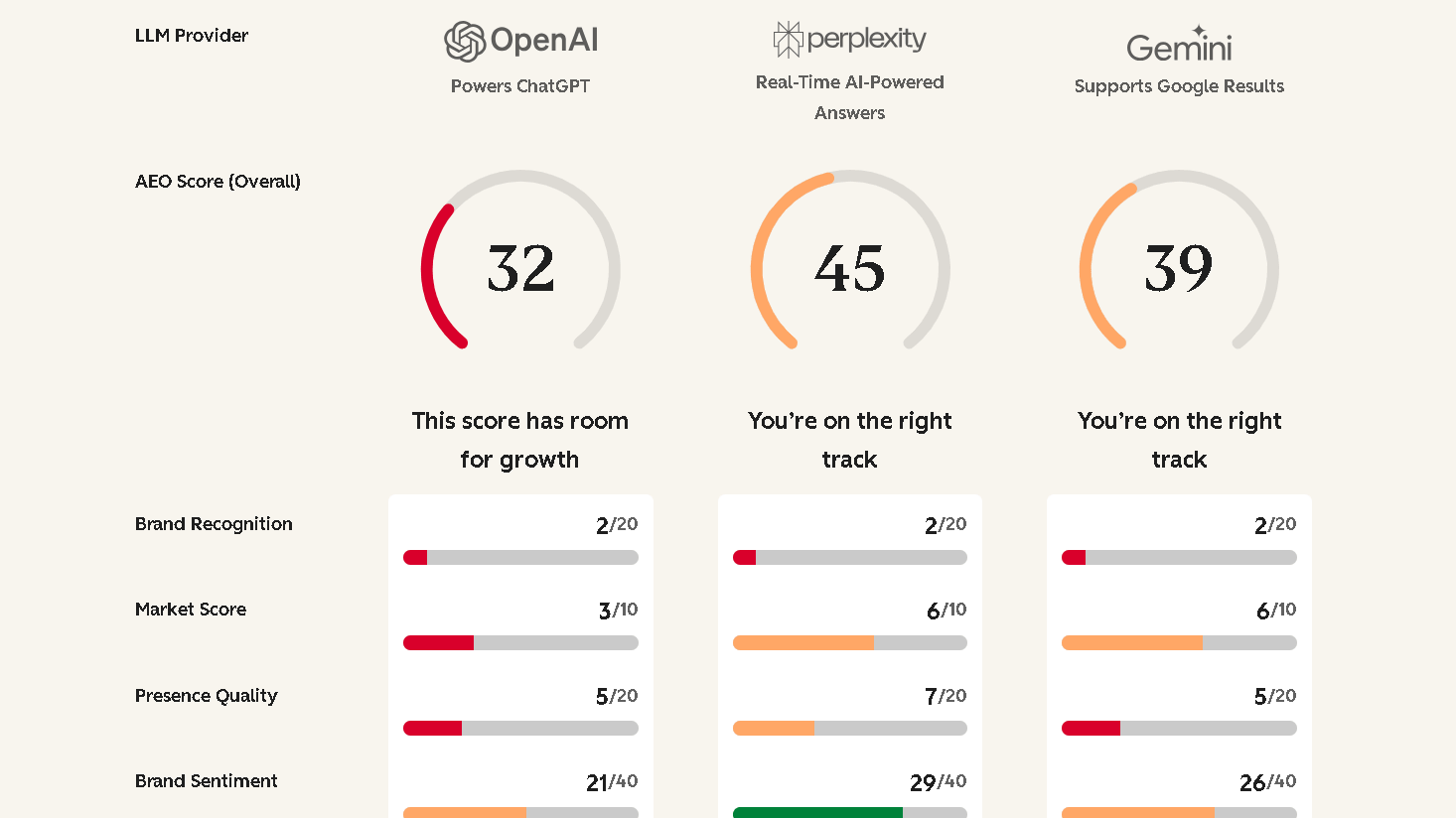
When I ran an AI visibility report on nenawow.com in June 2026, one number stopped me. ChatGPT had found 42 mentions of my site. Perplexity had found 1,420. Same site. The same day. Same report. That is not a small AI search visibility gap. That is a 33x difference. And it tells you something important about how these two systems actually work.
Here’s what the comparison looked like at a glance:
| ChatGPT | Perplexity |
|---|---|
| 42 mentions | 1,420 mentions |
| Training data | Live web |
| 72% confidence | 85% confidence |
| Review directories | AI software competitors |
Table of Contents
They Are Not Doing the Same Thing
Most people treat ChatGPT and Perplexity as variations of the same idea. Ask a question, get an answer. The difference feels like preference — which one you like the interface of, which one feels smarter on a given day.
In practice, they are built on fundamentally different architectures when it comes to finding your site. ChatGPT works from training data. Perplexity searches the live web. That distinction sounds technical but it has very real consequences for any small site trying to build AI visibility through Generative Engine Optimization (GEO). If you’re new to the concept, read my guide explaining what Generative Engine Optimization (GEO) is and how it differs from traditional SEO.
ChatGPT learned what it knows during training runs that end at a fixed date. The version that scored my site used GPT-5.4 mini with a knowledge cutoff of August 31, 2025. Whatever coverage nenawow.com had built by that date is what ChatGPT has to work with. Nothing published after that cutoff exists in its world.
Perplexity does not have that problem. Perplexity has no cutoff because it retrieves current web results each time someone asks a question. If my content is indexed and findable today, Perplexity can find it today. That is why it returned 1,420 mentions against ChatGPT’s 42.
What My Competitive Sets Revealed
The mention AI search visibility gap is one data point. The competitive set data made the picture much clearer.
Under ChatGPT, the report showed who my site competes with in AI answers. The list was G2 at 24 percent, Capterra at 20 percent, TrustRadius at 12 percent, Product Hunt at 10 percent. Every single competitor was a review directory or aggregator platform.
That is the problem in one list. ChatGPT does not file nenawow.com alongside independent reviewers. It files me alongside the platforms that aggregate reviews. That means when someone asks ChatGPT for an AI tool recommendation, it reaches for the directories first — not for a single-author site that has tested the tools firsthand.
Under Perplexity, the competitive set was completely different. Surfer SEO at 22 percent. NEURONwriter at 18 percent. Semrush at 15 percent. SE Ranking at 8 percent. These are actual tools in my niche, not directories. Perplexity sees nenawow.com as a content site competing in the AI and SEO software space. Those are different categories entirely.
The gap is real. And that gap has consequences for which AI system sends you traffic.
Why ChatGPT Files Small Sites Under Directories
Here is the issue with how training data works for independent review sites. By the time a small site has enough external coverage to register clearly in a training snapshot, the snapshot has already closed.
ChatGPT’s training data reflects what the web looked like at a fixed point. At that point, nenawow.com had limited third-party coverage. No G2 listing. No Product Hunt page. Few external roundups linking to specific reviews with authority. The signal was thin, so ChatGPT defaulted to the nearest category it could confirm — review aggregators — and filed the site there.
Perplexity does not have to make that inference. It searches for current evidence of what my site covers, finds it in indexed content, and returns a competitive picture based on what is actually there now. That is why the competitive sets are so different. One is working from a snapshot. The other is working from today.
The Confidence Level Difference
There is a third number in the report that most people skip past. Confidence level.
ChatGPT returned a confidence level of 72 percent on my data. Perplexity came in at 85 percent. Gemini was the lowest at 35 percent. Confidence here means how certain the system is about what it knows — how much verified, consistent data it found to support its conclusions.
A higher confidence score means the system has more to work with. A lower one means it is filling gaps with inference. Gemini’s 35 percent is the most honest number in the whole report — it is telling you it does not have enough data about nenawow.com to be sure about much of anything.
So when you look at scores, do not just read the headline number. Read the confidence level alongside it. A 39 with 35 percent confidence is much weaker than a 32 with 72 percent confidence. The score matters less than how sure the system is about where it came from.
What the Source Analysis Actually Said
The report breaks down where each AI system found data about my site. This section is the most actionable part of the whole report, and it is where the ChatGPT problem becomes very specific.
Under ChatGPT, source analysis marked “Reliable Data: No.” It scored third-party review platforms at 45 out of 100. That means ChatGPT looked for nenawow.com on the platforms it trusts most — G2, Clutch, Trustpilot, Product Hunt — and did not find strong coverage. Without that external validation, it cannot be confident in what it says about the site.
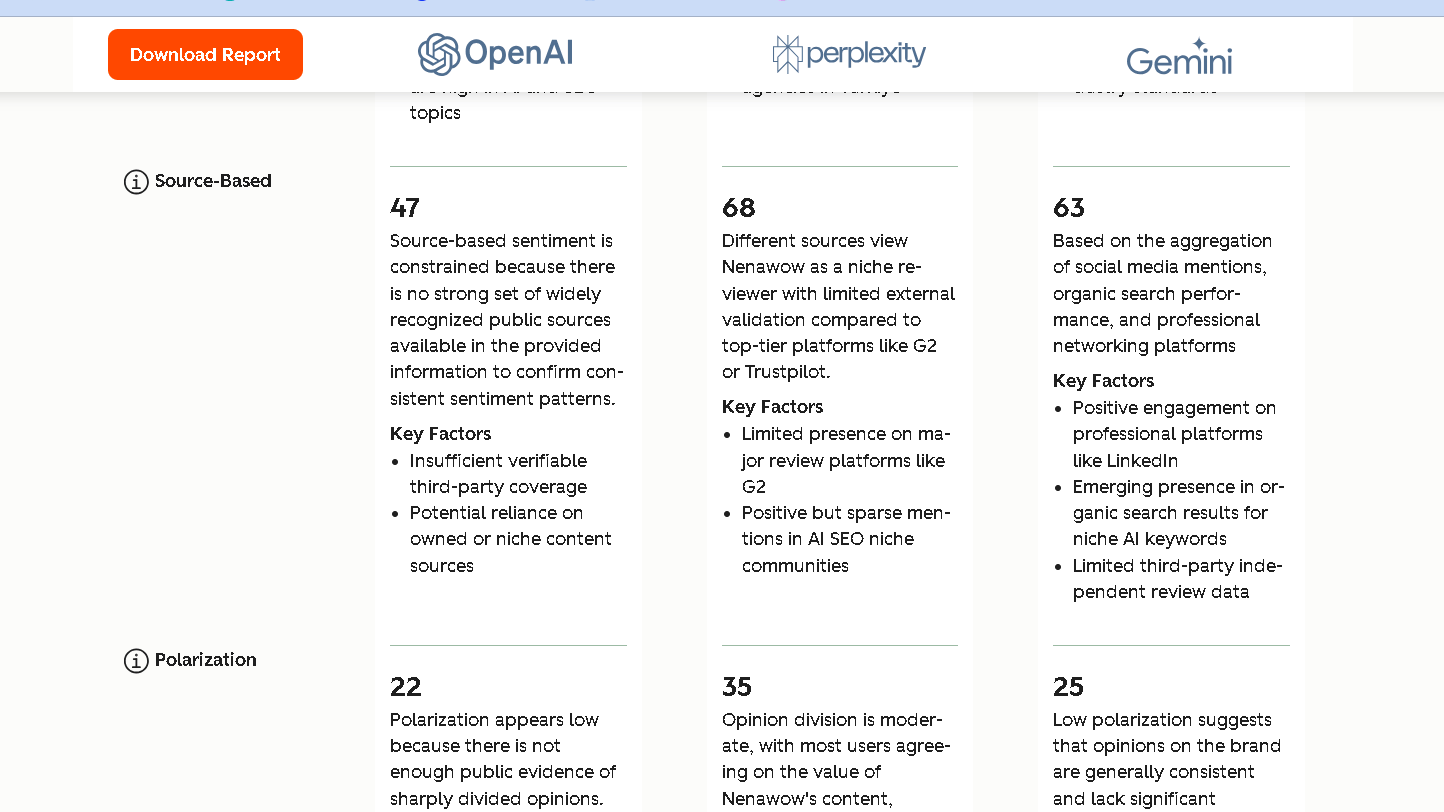
Under Perplexity, the source analysis marked “Reliable Data: Yes.” It found my blog content scoring 75, indirect references in a Reddit SEO community scoring 70, and a YouTube channel where my Koala AI review was linked scoring 65. Three external sources. That is enough for Perplexity to build a confident picture from.
The thing is, that YouTube link is doing more work than I realised. One external creator linking to one review is the difference between Perplexity having something to reference and having nothing. That margin is thin. But it is also actionable.
What This Means for Your Site
So what do you actually do with this information? The answer depends on which gap bothers you more.
If your Perplexity score is already decent but your ChatGPT score is low, the fix is off-site work. ChatGPT needs to find your brand referenced on platforms it already trusts. That means getting a Product Hunt listing. That means appearing in third-party roundups on sites with real domain authority, and earning YouTube mentions from creators in your space. None of that is quick, but all of it is targeted. You are not guessing at what to do. The source analysis tells you exactly what ChatGPT is looking for and not finding.
If both scores are low, the priority order is still the same. Start with the platforms ChatGPT trusts and work outward. Perplexity will pick up improvements faster because it works in real time. ChatGPT will take longer because it waits for the next training cycle. But the off-site work feeds both eventually.
Building external references is only part of the picture. Your content also needs to be structured in ways AI assistants can easily understand and cite. I explain the most important factors in my guide on what makes content more likely to be cited by AI.
If your Perplexity score is lower than your ChatGPT score, that is a different problem. It usually means your content is not well indexed or your live web presence is weaker than your historical footprint. In that case, technical indexing and fresh content are the priority, not off-site coverage.
The Brand Archetype Inconsistency
One more finding worth naming. The report returned different brand archetypes across the three platforms.
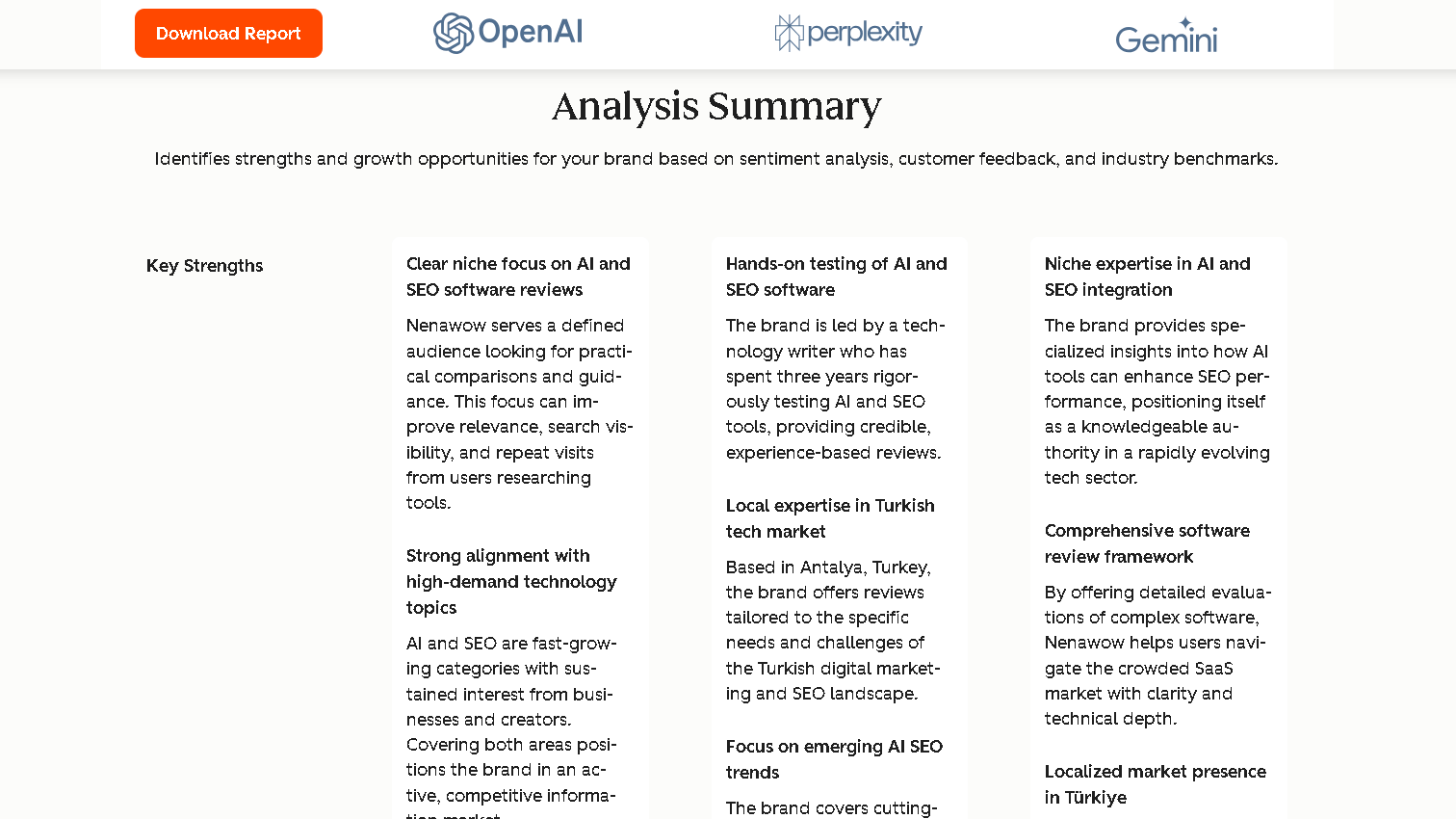
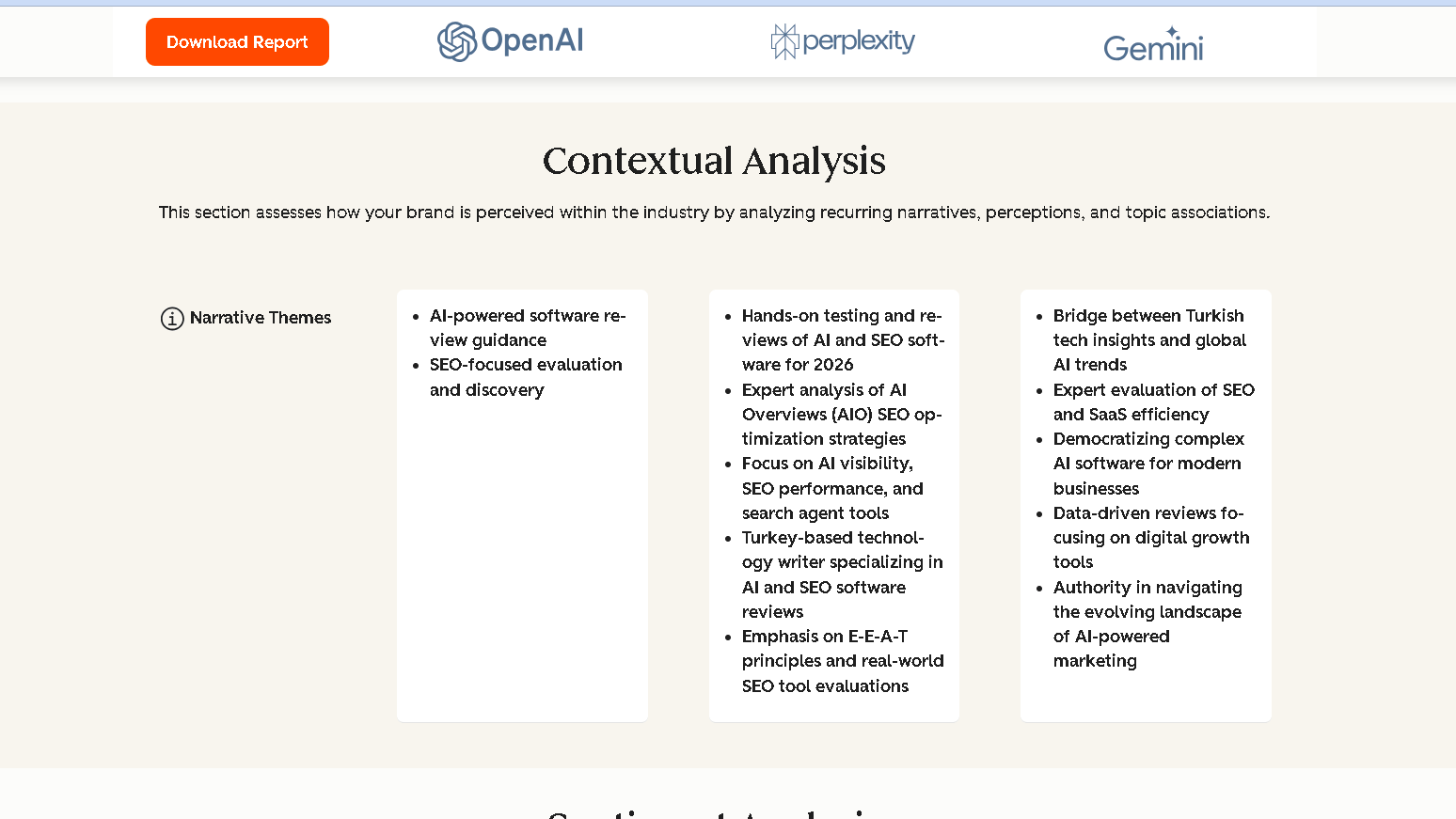
ChatGPT tagged nenawow.com as “Traditionalist.” Perplexity and Gemini both tagged it as “Innovator.” The same site. Three different reads. Same recognition score of 12 out of 100 across all three.
What this tells me is that ChatGPT’s impression of the site is based on older, thinner data — enough to classify it but not enough to characterise it accurately. Perplexity and Gemini, working with richer or more current signals, reached a different conclusion about what the site represents.
This kind of inconsistency is not a flaw in the tool. It is a real reflection of what the AI systems actually know. And it is the most honest argument I have seen for why small sites need to think about both training data signals and live web signals at the same time — not one or the other.
My 90-Day Test
I ran this report on June 23, 2026. I am going to run it again on September 23, 2026. Between now and then, I will publish the AI visibility content cluster I have mapped out, get nenawow.com listed on Product Hunt, and work on building more external references that ChatGPT can find in its next training snapshot.
The strategy is based on patterns I found while researching leading SEO websites for my AI Visibility Benchmark 2026, where I compared how visible major brands are across different AI search platforms.
The hypothesis is simple. If the off-site work lands, ChatGPT’s confidence level should rise and the mention gap should narrow. Perplexity should stay strong or improve as more content gets indexed. If the AI search visibility gap between 42 and 1,420 closes meaningfully in 90 days, that is a real data point about what actually moves these scores.
I will publish those results in a follow-up piece with all the numbers. Named scores. Named changes and actions that drove them.
That is how you turn a one-time snapshot into a useful editorial thread.
How to Check Your Own AI Search Visibility Gap
If you want to see your own ChatGPT versus Perplexity gap, the fastest way is the HubSpot AEO Grader. Free, no card, no sign-up. Enter your URL, your industry, your service type, and your location. The report takes about two minutes to generate and the market competition section will show you your mention counts on each platform.
Look at those two numbers first. If your Perplexity count is much higher than your ChatGPT count, you are in the same position as nenawow.com — good live-web presence, thin training-data coverage. If ChatGPT is higher or they are close, you likely have strong historical external coverage but less live-web content being picked up by Perplexity’s real-time search.
Either way, the gap tells you where to focus. That is the value. Not the score itself. The gap between the scores.
After checking your AI Search Visibility Gap, you can also use my free AI Visibility Toolkit to identify technical issues that may affect how AI systems discover and interpret your website.
Once you know your AI search visibility gap, the next metric to monitor is AI Share of Voice, which measures how often your brand appears compared with competitors across AI search engines.
Key takeaway
The AI Search Visibility Gap isn’t just an interesting metric. It shows whether AI systems understand and trust your website. If you track this gap over time—and improve both your live web presence and third-party references—you’ll have a much clearer picture of your AI visibility than rankings alone can provide.
AI Search Visibility Gap FAQs
Perplexity searches the live web every time it answers. It sees your current content right away. ChatGPT works from fixed training data with a cutoff date. It only knows what was public and well-referenced before that date. If your site grew recently, the gap will look large.
Not directly. A higher score means Perplexity is more likely to cite you when a relevant question comes up. Citing is not clicking. Even so, citation comes first. No mention means no click at all.
Build third-party references ChatGPT’s training data can find. Product Hunt listings, roundup articles, YouTube mentions, and citations on G2 or Clutch all help. On-site changes matter too, but they wait for the next training cycle to show up.
ChatGPT updates in cycles, not in real time. OpenAI does not publish the exact schedule. Changes made today may not appear for months. Perplexity moves faster because it checks the live web on each query.
Both matter, but they reward different things. Perplexity rewards fresh, specific content that answers real questions. ChatGPT rewards historical coverage on trusted platforms. Starting from zero on both? Fix off-site coverage first. It feeds ChatGPT directly and helps Perplexity too.
Confidence level shows how sure an AI system is about what it knows of your brand. High confidence means consistent data across sources. Low confidence means the system is filling gaps with guesswork. Read confidence next to the score. A lower score with high confidence beats a higher score built on guesses.