
Here is the wrong version, the one I see everywhere. AI visibility and GEO are the same thing, just two names for optimizing your content for AI search. Do enough GEO, your AI visibility goes up. Check your AI visibility, you are checking your GEO. Treat them as interchangeable and move on.
That is wrong, and not in a small way. GEO is the work. AI visibility is the result of that work, measured after the fact, by tools that do not even agree with each other on what they are measuring. If you are new to the concept, my guide on What Is AI Visibility explains how AI citations, mentions, and visibility tracking actually work. Collapse the two into one idea and you will misread your own results, sometimes badly enough to abandon a strategy that was actually working.
I did not learn this from a definition. I learned it by running my own site through three different AI visibility tools and watching the numbers disagree with each other, hard enough that I had to stop and work out why. That mess is where this article comes from.
Disclaimer: I may earn a small commission on purchases made through links on this page, at no extra cost to you. This supports honest, independent reviews.
Table of Contents
Why Smart People Still Mix These Up
The interchangeable version is not a dumb mistake. It is an understandable one, and worth taking seriously before knocking it down.
Both terms showed up around the same time, describing the same shift. Search moved from ten blue links to AI-generated answers, and a vocabulary scrambled into place to talk about it. GEO got coined first, modeled on SEO. AI visibility followed close behind, modeled on the older idea of brand visibility. They arrived together, pointed at the same general shift, and got used together.
Worse, they actually do move together a lot of the time. Good GEO work often does produce better AI visibility numbers eventually. If you only ever check loosely, the two ideas can look like the same thing for months before the gap between them shows up. That is exactly why the mistake survives. It is not obviously wrong most of the time. It is wrong in the specific weeks and months that matter most, when you are trying to judge whether a real strategy is working.
Here is the test I use now. If a sentence still makes sense after you swap one term for the other, you were using them as synonyms by accident. “I am working on my GEO” and “I am working on my AI visibility” do not mean the same thing, even though they sound close enough to swap without anyone noticing.
The Actual Distinction, Stated Plainly
| GEO | AI Visibility |
|---|---|
| Process | Outcome |
| Input | Measurement |
| You do it | You track it |
| Writing workflow | Reporting workflow |
| Direct control | Indirect control |
GEO is the work. AI visibility is the result of that work, measured after the fact, by a tool, on that tool’s own schedule and its own definitions.
GEO is something you do. AI visibility is something you check. Confusing the two is like confusing exercise with the number on a scale. Related, sure. Not interchangeable, and treating them as interchangeable will mislead you about what is actually happening.
That is the whole idea. Everything past this point is proof and detail.
What GEO Actually Is
GEO stands for generative engine optimization. If your goal is increasing citations and mentions across AI platforms, my guide on How to Improve Brand Visibility in AI Search Engines covers the practical tactics I have seen work in real-world testing.
It is the practice of writing and structuring content so AI models can find it, understand it, and pull it into an answer. Same general idea as SEO, aimed at a different kind of engine.
GEO is a process, not a number. Writing clear, direct answers to specific questions. Structuring pages so a model can extract a clean claim instead of inferring one. Publishing original data instead of summarizing what is already out there. Keeping pages current so a model has a reason to prefer your version over an older one sitting somewhere else.
You do GEO. You do not check your GEO the way you check a score. There is no GEO dashboard that hands you a single number, because GEO is not an outcome. It is the set of choices you make before any outcome shows up.
That distinction sounds small. It is not. It changes how you should think about your own work.
What AI Visibility Actually Is
AI visibility is the measurement. Whether your content actually shows up inside an AI-generated answer, and whether you get credited for it when it does.
This is the part you check, not the part you do. Tools like Search Atlas, Semrush, and Ahrefs all offer some version of an AI visibility report. They check whether your domain or your specific pages got pulled into a ChatGPT response, a Google AI Overview, a Gemini answer, a Perplexity citation. Then they count it up and hand you a number.
Perplexity is especially interesting because it surfaces sources directly in responses. My Perplexity Review explores how its citation-first approach differs from other AI search tools.
ChatGPT remains one of the most important AI discovery platforms today, and my detailed ChatGPT Review looks at how it sources information and references content.
AI visibility is downstream of GEO. It is also downstream of a dozen things you do not fully control. Domain age. Existing authority. What competitors in your space are publishing. Which model happened to get queried that week, and whether that model’s training data even includes your most recent page.
GEO is the input you can shape directly. AI visibility is the output, shaped by your input plus a lot of variables you cannot touch. So is it worth tracking a number you cannot fully control? Yes, the same way tracking your Google rankings is worth it even though you cannot directly control the algorithm. You are not controlling the scoreboard. You are reading it to figure out whether your process is working.
The Mess That Made This Click for Me
I ran nenawow.com through Search Atlas, Semrush, and Ahrefs’ free AI visibility checker, more or less in the same week. Three tools. One site. Three numbers that did not agree.
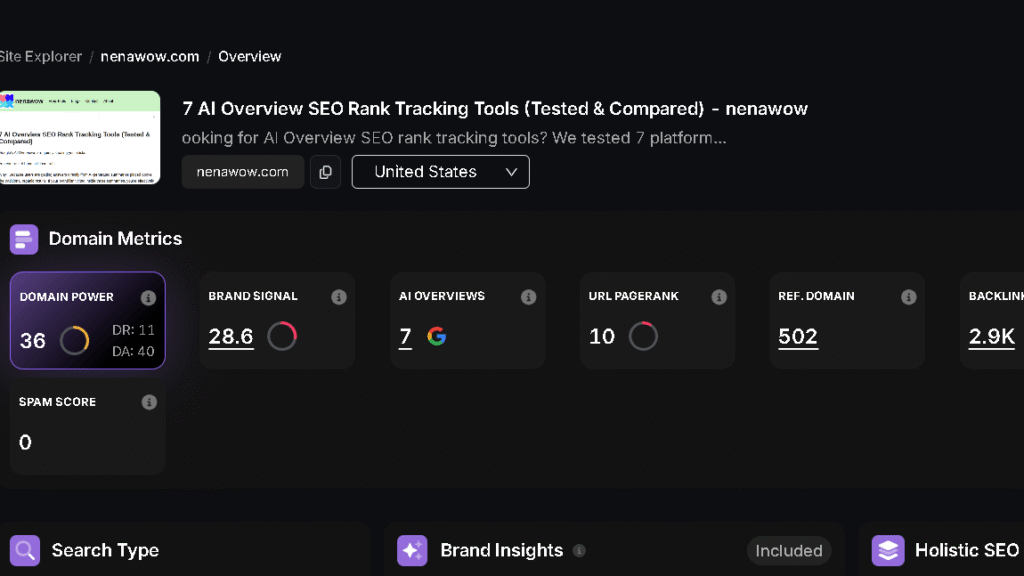
Search Atlas reported my AI Overview count at 7.
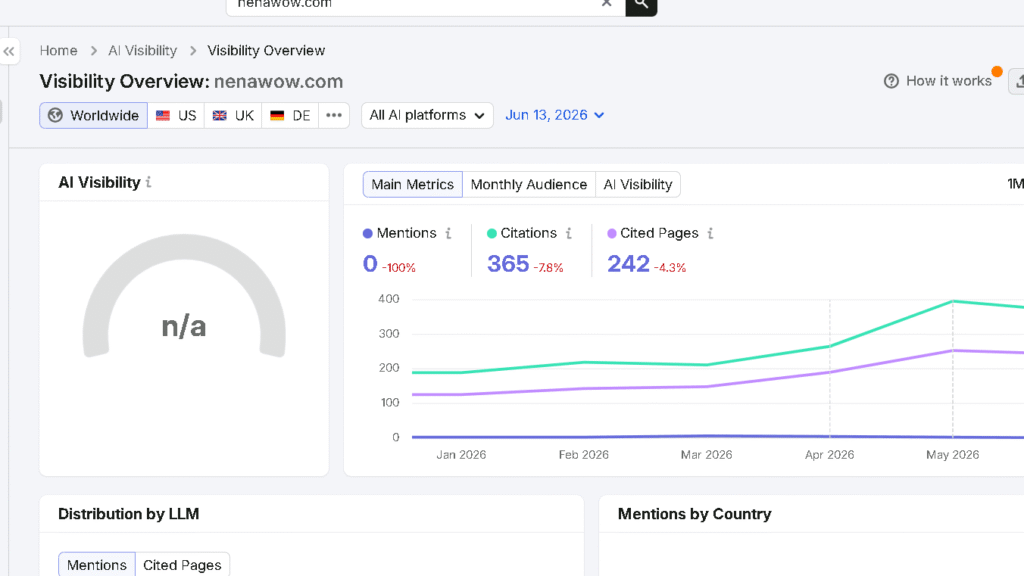
Semrush, in one part of its dashboard, showed 365 total AI citations across 242 cited pages. A more detailed breakdown elsewhere inside Semrush put it at 283 citations across platforms: 135 from Google AI Mode, 68 from ChatGPT, 59 from Gemini, 21 from AI Overviews.
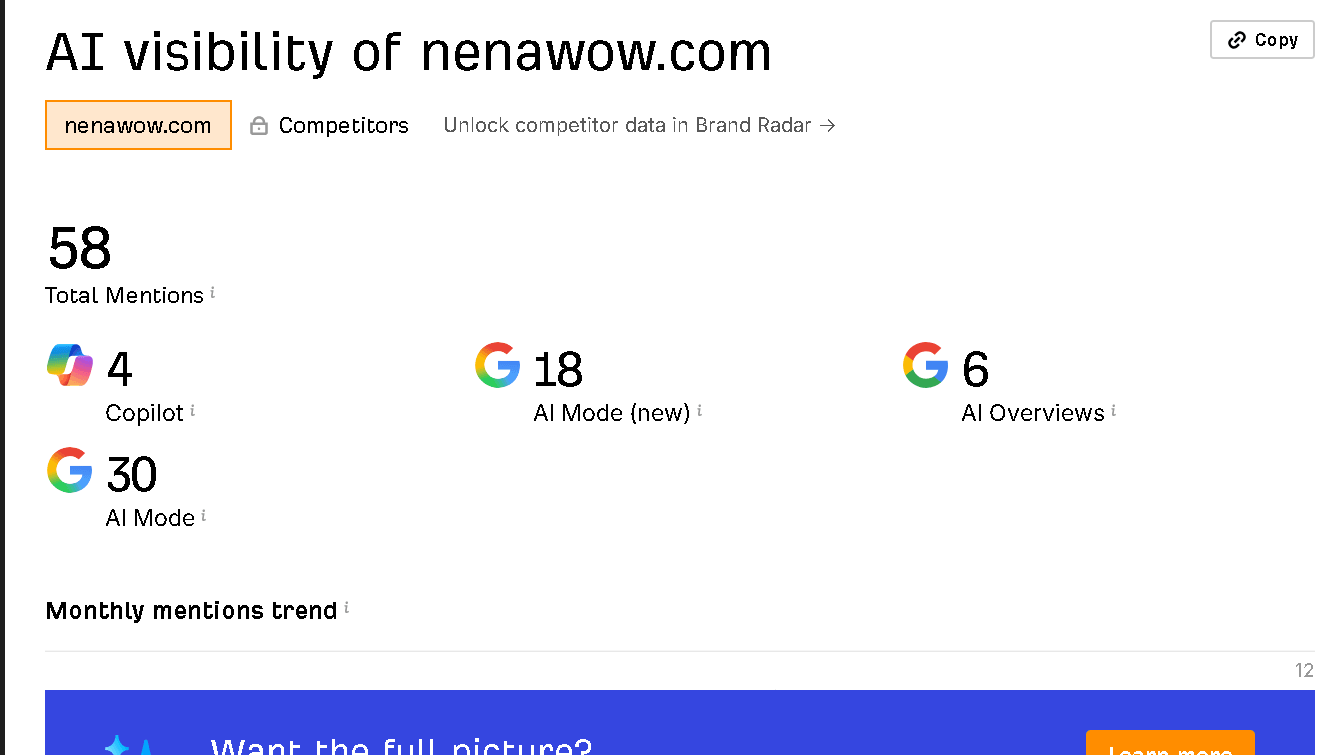
Ahrefs’ free checker landed at 58 total mentions, split into 30 from AI Mode, 18 from “AI Mode (new),” 6 from AI Overviews, and 4 from Copilot.
| Tool | What It Reported for nenawow.com |
|---|---|
| Search Atlas | AI Overviews: 7 |
| Semrush | 365 citations / 242 pages (one view); 283 across 4 platforms (another view) |
| Ahrefs (free checker) | 58 total mentions |
Three measurement tools. Three different counts of the same underlying activity. That gap is not a flaw in any single tool. Each platform runs its own definition of a citation, on its own schedule, across its own slice of AI platforms.
My GEO work did not change between those three checks. The content was identical. The reported numbers were not even close to each other. If I had treated any one number as proof my GEO was or was not working, I would have landed on a different, confident, wrong conclusion depending on which tool I happened to open first.
That is the trap. Treating AI visibility as a precise verdict on your GEO, when it is actually a noisy, tool-dependent estimate of something much harder to measure cleanly.
When Strong GEO Inputs Produced Almost No Output
The Search Atlas data made the gap concrete in a way no definition could. I compared my site against three competitors using its side-by-side view, and one result still stops me when I look at it.
| Site | Domain Power | Brand Signal | AI Overviews |
|---|---|---|---|
| nenawow.com | 36 | 28.6 | 7 |
| Futurepedia | 49 | 48.9 | 179 |
| There’s An AI For That | 62 | 77.1 | 247 |
| Toolify | 48 | 75.6 | 1 |
Look at Toolify. Domain Power close to Futurepedia’s. Brand Signal at 75.6, nearly the strongest in the table. By every traditional measure of site strength, the kind that usually correlates with solid GEO fundamentals, Toolify should be showing up in AI Overviews constantly.
Its AI Overview count came back as 1.
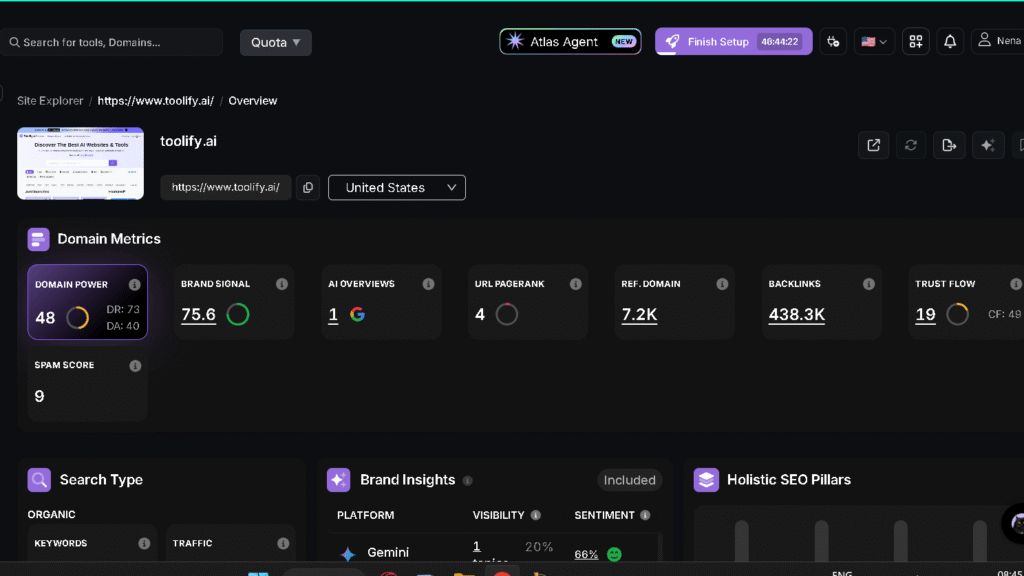
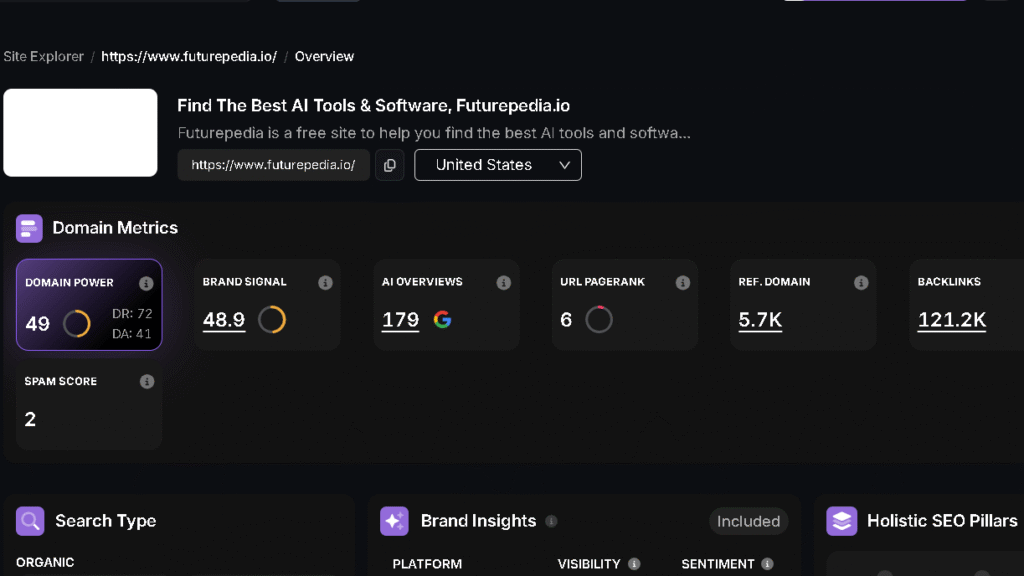
If GEO and AI visibility were actually the same thing, this should not be possible. Strong inputs should produce roughly proportional output. Here they did not. Whatever Toolify is doing with its specific content, structure, or topic coverage is not converting into AI citations, despite real authority behind it.
I do not know exactly what that something is. Nobody fully does yet, this early in the category. But notice what this example is actually proving, separately from the three-tool mess above. That gap showed three tools disagreeing about how much visibility existed. This one shows that strong, well-built inputs do not guarantee meaningful output at all, even when every tool agrees on the number. Different failure. Same underlying lesson: input and output are not the same thing, and you cannot infer one from the other.
A Simple Way to Keep These Straight
Think of it as exercise and a scale. GEO is the training, the specific things you do, the consistency you keep. AI visibility is the number that comes back when you step on the scale. Related, obviously. The training is supposed to move the number.
But the scale also reflects things outside your training entirely. Water weight. Timing. What you ate the day before. Which scale you happened to use.
Nobody serious about fitness treats one weigh-in as proof their training program failed. They watch the trend over weeks. The same logic applies here, and it is the single most useful shift I made once I separated these two terms properly.
GEO: the training. Something you control and do consistently. AI visibility: the scale. Something you check, that reflects your training plus a lot of noise.
Stop expecting the scale to move in a straight line and you stop misreading the data.
Why This Distinction Actually Changes What You Do
Collapse GEO and AI visibility into one idea and you end up chasing the wrong thing. You check a visibility number, see it has not moved in two weeks, and conclude your content strategy is not working. Then, you change direction. You abandon an approach that may have needed three more months to show up in a noisy, lagging metric.
Keep them separate and the response looks different. A flat number becomes a question, not a verdict. Is the GEO work itself actually solid, or is this measurement noise from a tool that counts citations its own way on its own schedule?
The reverse mistake happens too. A good number from one tool can make you complacent about GEO work that is actually thin. If Semrush hands you an impressive citation count while Search Atlas and Ahrefs show far less, which one earns your trust, and what does it cost you if you stop improving the content because one dashboard told you that you had already arrived?
Separate the two ideas and you ask a more honest question every time. Am I doing good GEO work? Separately: what is the visibility data telling me, knowing it is an estimate and not a verdict?
Where Each One Belongs in Your Actual Workflow
GEO belongs in your content process. Part of writing the article, not part of reviewing results afterward. A clear claim near the top. Specific numbers and named tests instead of vague summaries. Pages that still get traffic but have gone stale, updated rather than left alone. None of that requires a tool. It requires editorial discipline.
That preference for structured, evidence-backed content is something I also noticed while testing Claude, which I discuss in my Claude Review.
AI visibility belongs in your review process, on a schedule, not a constant check. Pull a number monthly, not daily. Compare it against your own past numbers from the same tool, never against a different tool’s number from a different week. Watch which specific pages are doing the work, not just whether the domain total moved.
Two workflows, not one. Writing on one side, reviewing on the other. That is the practical version of the conceptual split, and it is the part that actually changes what you do day to day.
What I Would Tell Someone Just Starting This
GEO is not measured directly. AI visibility is the closest available estimate of whether GEO is working, and it is a noisy one. Do the GEO work because it is sound practice on its own terms, the same way you would write a clear, well-sourced article even if no tool existed to score it afterward.
Check AI visibility on a schedule, as a directional signal, not a verdict. Never let one tool’s single snapshot talk you out of work you have good reason to believe in.
The two ideas need each other to be useful. GEO without any measurement is just hoping. AI visibility without solid GEO behind it is a number with nothing underneath it. Keep them distinct. Use each one for what it actually is.
If you remember one thing, remember this: GEO is something you do. AI visibility is something you measure.
FAQ
No. GEO is the practice of optimizing content for AI search engines. AI visibility is the measurement of whether that practice is working, tracked through tools that count citations and mentions across AI platforms.
GEO. It is the only one of the two you can directly control. AI visibility is something you check afterward to see whether your GEO work is showing results, not something you can act on directly.
Each tool tracks different AI platforms, defines a citation differently, and updates on its own schedule. In testing my own site, Search Atlas, Semrush, and Ahrefs each returned a different total for the same period, and none of them was simply wrong. They were measuring different slices of the same activity.
Yes, and this happens more than most people expect. A site can have strong content fundamentals and still show low AI Overview counts, depending on topic, competition, and which model gets queried. Strong inputs do not guarantee strong measured output, especially this early in the category.
No. GEO and SEO work alongside each other. Traditional SEO targets search rankings, GEO targets AI-generated answers, and the content practices that support one often support the other, even though the measurement and the target surface are different.