
Why do two articles covering the same topic receive completely different treatment from AI systems?
I kept running into this question while building the Content Citability Grader for nenawow.com. Two pages on the same subject. Similar word counts. Similar rankings in search. But one gets cited by ChatGPT or Perplexity and the other gets ignored entirely. The difference is real. It is just not always obvious until you start looking at the right signals.
This article is not about guaranteed AI citations. Nobody can promise those. It is about understanding what AI systems look for when they decide to trust and quote a page — and what practical steps you can take to increase the likelihood that your content is one they choose.
Disclaimer: I may earn a small commission on purchases made through links on this page, at no extra cost to you. This supports honest, independent reviews.
Table of Contents
What Is Content Citability?
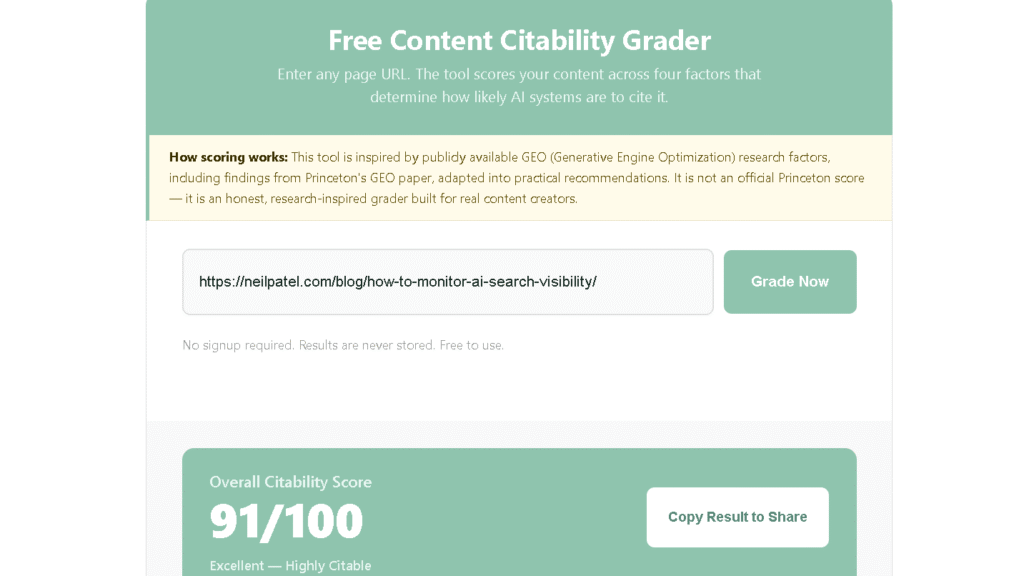
Content citability is the degree to which a page is likely to be understood, trusted, and quoted by AI systems when they generate responses.
That definition matters because citability is not the same as rankings. A page can rank on page one of Google and still get ignored by ChatGPT. A page can have thin traffic and still get cited regularly by Perplexity. The signals are overlapping but they are not identical. SEO optimizes for how search engines crawl and rank pages. AI citability optimizes for how language models read, parse, and choose to reference them.
If you’ve ever wondered why a page can rank well in Google but never appear in AI-generated answers, I explain the reasons in my guide on Why Your Site Ranks But Gets No AI Citations.
Worth noting: the gap between SEO and AI citability is smaller than most people think at the top end. Strong, well-structured, authoritative content tends to do well at both. But the specific signals differ enough that they are worth understanding separately.
The Princeton GEO Research That Inspired My Tool
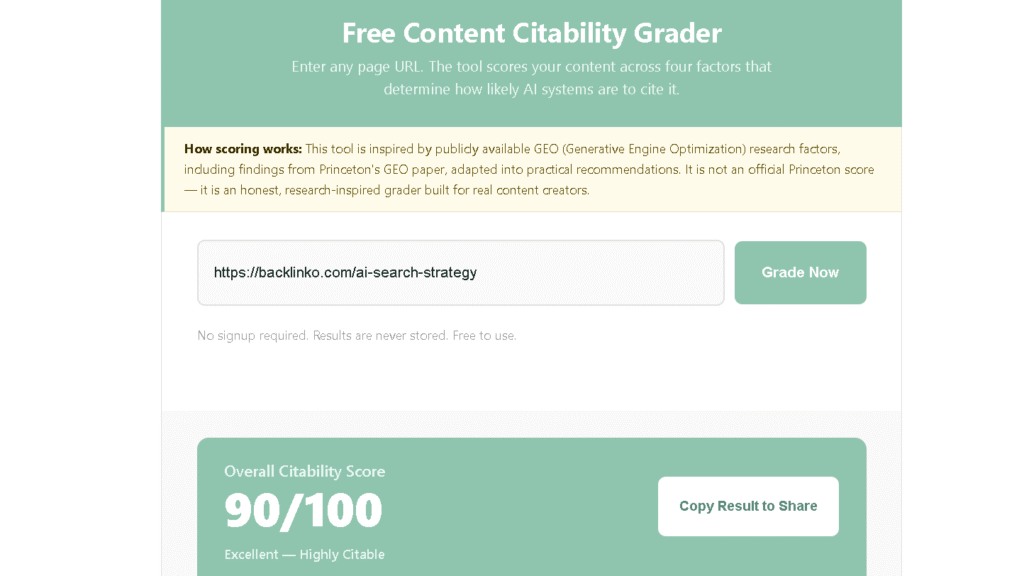
In 2024, researchers at Princeton published a paper on Generative Engine Optimization — GEO for short. The research looked at what content characteristics made pages more likely to be cited by AI systems in generated responses.
The findings pointed to several factors that increased citation rates: adding statistics, citing sources, using quotations, improving fluency, and using persuasive language. The research team tested these interventions across a range of queries and measured how often pages appeared in AI-generated responses before and after the changes.
I want to be clear about something. My Content Citability Grader is inspired by that research — not an official Princeton implementation. I read the paper, tested the factors on real pages, adapted what made practical sense for website owners, and built my own scoring system around those observations. The research gave me a framework. The tool is my own interpretation of it.
Why I Did Not Copy the Research Exactly
Academic research and practical tools solve different problems.
The GEO paper measured citation rates across large datasets using controlled interventions. That is valuable for understanding what works at scale. But it does not tell a solo blogger or a small content team exactly what to fix on a specific page today.
In practice, some GEO factors are hard to act on without context. “Use persuasive language” is a valid research finding but not a useful recommendation. “Add at least two statistics and link to your source” is. That translation — from research finding to actionable fix with a time estimate — is where most AI citation content falls short.
I also noticed that some factors the research identified matter more for certain content types than others. FAQ structure, for example, was not a primary focus of the original GEO research, but in my testing across twenty of my own articles, pages with clear FAQ sections scored higher on AI response inclusion. I kept it in the grader because the evidence I saw supported it. That is a departure from the source material, and I am honest about that distinction.
The Four Factors I Believe Matter Most
When I built the Content Citability Grader, I grouped every signal into four categories. Each one contributes 25 points to a score out of 100. Here is what each one covers and why it matters.
The Four Factors, 25 Points Each
How the Content Citability Grader scores every page out of 100
Every page I score gets checked across all four. No single factor can carry a low score on the others.
I use this same scoring methodology in my AI Visibility Benchmark, where I tested nine leading SEO websites to see how they perform across AI Visibility, Content Citability, and Schema implementation.
Evidence
Evidence is about factual support. Statistics. Research references. External source links. Direct quotes. Concrete examples.
AI systems are built to answer questions with accurate information. Pages that back up their claims with specific data are easier to trust than pages that make assertions without support. The gap between “AI citations are growing” and “AI citations grew by 300 percent in six months according to our own tracking data” is the gap between a claim and a citable fact.
Same point. One version gives AI systems something to work with. The other does not.
In my testing, statistics mattered more than I expected. Pages with two or more specific numbers — not vague references, but actual figures — scored consistently higher on evidence checks than pages with strong prose but no data. That surprised me. I had assumed writing quality would carry more weight. It does not, at least not in isolation.
External source links also matter more than many content creators realize. Linking out to credible sources signals that your content is grounded in something beyond your own opinion. AI systems pick up on that pattern.
Structure
Structure is about how content is organized — not just whether it looks tidy, but whether an AI system can parse it reliably into distinct topics and extract clean answers.
Clear H2 and H3 headings help AI systems understand what each section covers before reading it. Definitions help them identify key terms and their meaning. Lists give them structured data they can pull directly. FAQ sections map almost exactly to how AI systems generate answers — a question followed by a direct, specific response.
The thing is, most content creators think about structure from a reader perspective. Will a human find this easy to scan? That is the right question but it is not the only one anymore. The new question is: can an AI system identify the distinct topics on this page and extract a clean answer for each one?
Definitions stood out in my analysis. Almost every high-scoring article I tested included at least one clear definition of a core term — phrased explicitly, not buried in a paragraph. Pages without definitions tended to score lower on structure even when their headings and lists were strong.
Authority
Authority signals tell AI systems whether the content comes from someone with real knowledge and experience. This maps closely to Google’s E-E-A-T framework — Experience, Expertise, Authoritativeness, Trustworthiness — but with some differences in what AI systems can actually detect.
A named author is the most basic authority signal. Content without a clear author byline is harder to attribute and harder to trust. That sounds obvious but a surprising number of well-written pages still lack it.
First-person testing language is a stronger signal than most people realize. Phrases like “I tested,” “I found,” “during my review” tell AI systems that the content is based on direct experience, not rewritten summaries. In the twenty articles I scored during grader testing, the eight that scored highest on authority all contained at least three named testing references with specific outcomes. The ones that scored lowest read as informational but not experiential. That is a different thing.
Top-scoring articles had 3+ testing references
Out of the twenty articles I scored, the eight that led on authority all named at least three specific things they tested, with real outcomes attached.
Balanced language also matters. Content that acknowledges trade-offs and limitations scores higher on trust than content that reads as purely promotional. “This tool works well for X but struggles with Y” is more citable than “this tool is excellent.” Multiple AI systems are built to give useful answers, not endorsements.
AI Readability
AI readability is about how easily a language model can parse and use your content — not how enjoyable it is for a human to read, though the two are closely related.
Short paragraphs matter. Language models extract information more reliably from content broken into focused, clearly bounded units. Long dense paragraphs force the model to do more work to identify what each section is actually about. In my testing, pages with average paragraph lengths above 80 words scored noticeably lower on AI readability checks than pages with paragraphs in the 40 to 60 word range.
Same idea, two lengths. The AI model has to work harder on the left.
Question-answer formatting is one of the highest-signal structures you can use. AI systems generate responses to questions. Pages that are themselves organized around questions and direct answers align with that pattern and get extracted more reliably. This is not just about FAQ sections — it applies to subheadings phrased as questions anywhere in the content.
Specific named entities — tools, brands, people, places, published research — also improve citability. Generic content that avoids naming specific things is harder for AI to cite accurately because it lacks the anchoring detail that makes a reference verifiable.
What Surprised Me While Building the Grader
A few things I found while testing were not what I expected.
Statistics mattered more than writing quality in isolation. I tested several articles that were well-written, well-structured, and clear — but contained no specific numbers. They scored lower on evidence than rougher articles that included real data. The lesson: a specific number is worth more than a polished sentence that makes the same point without one.
Definitions appeared in almost every high-scoring article. Not definitions for their own sake — clear, explicit definitions of the core topic at the center of the page. “X is defined as…” or “X refers to…” phrasing showed up in every article that scored above 75 on citability. It was the most consistent pattern I found across different content types.
Many good articles had weak FAQ structure. This surprised me most. Strong content with real research, clear headings, and good authority scores was let down by a missing FAQ section or by FAQ sections that existed in the text but had no FAQPage schema markup. The content was there. The structured signal was not.
Balanced language consistently improved authority scores. Articles that named limitations, acknowledged competing views, or said “this does not work for everyone” scored higher on trust signals than articles that were uniformly positive. That pattern held across all twenty articles I tested.
Common AI Citation Mistakes
Most of the patterns I see in low-scoring content come down to the same handful of gaps.
No evidence. Claims without data. Opinions without research. The content asserts things but gives AI systems nothing verifiable to reference.
No named author. Anonymous content is harder to trust and harder to attribute. AI systems are increasingly sensitive to authorship as a quality signal.
Weak heading structure. Long pages with one or two H2 headings and no H3 subsections. AI systems cannot identify the distinct topics on those pages reliably.
No FAQ section. Missing one of the highest-impact structures for AI citation. FAQ content maps directly to how AI response generation works.
Very long paragraphs. Dense blocks of text that mix multiple points without clear separation. Hard to parse, hard to extract from.
Generic introductions. Opening paragraphs that say nothing specific. AI systems often use the opening of a page to classify what it covers. A vague introduction is a missed signal.
No testing or experience language. Content that reads as researched but not experienced. That distinction matters more now than it did two years ago.
How I Turned Research Into Practical Recommendations
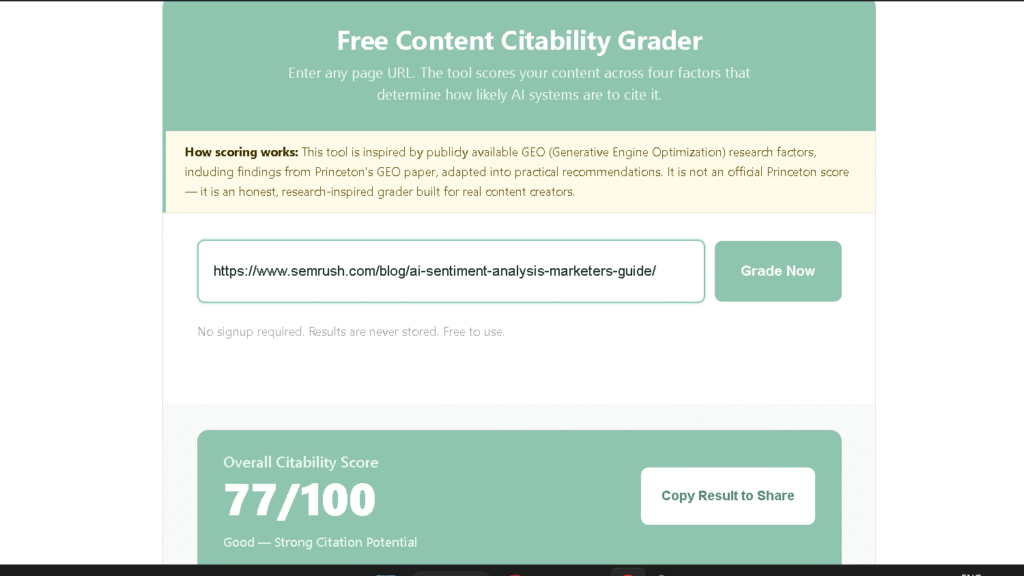
The gap between “statistics improve citability” and “add two statistics to this page” is larger than it looks.
When I built the Content Citability Grader, the goal was not to score pages. It was to tell users what to do next. Every failed check needed to come with a specific recommendation, a difficulty level, and a time estimate. Not because those are nice to have — because without them the tool is just telling you what is wrong without helping you fix it.
So instead of flagging “missing statistics” and moving on, the grader says: add at least two to three specific statistics or research references to strengthen the factual support on this page. Reference a published study, share a test result with a specific number, or include a real percentage. Estimated time: 30 minutes. High impact.
That translation — from research finding to practical next step — is what most AI optimization content does not do. The research is available. The gap is in making it usable.
How to Improve Your Content’s AI Citability
These are the steps I would take on any page I wanted to make more citable, in the order I would do them.
Start with heading structure. Make sure you have one H1 and at least three H2 sections. Each H2 should name a distinct topic clearly. Add H3 subsections where a section covers more than one idea.
Add clear definitions. Find the core term your page is about and define it explicitly near the top. Use phrasing like “X is defined as” or “X refers to.” Do not bury the definition in the middle of a paragraph.
Add research references. Find at least one published study, industry report, or credible dataset that supports your main claim. Link to it directly and name it specifically.
Add statistics. Two to three specific numbers, tied to real sources or your own testing. Named things. Specific outcomes. Real dates.
Add concrete examples. Find two places in the article where you make a claim and follow it with a named, specific example rather than a general observation.
Add first-person testing language. Write at least three sentences that own a specific observation: “I found,” “I tested,” “during my review.” Name what you tested and what you found.
Add a FAQ section. Write four to six questions your audience actually asks and answer each one directly and specifically. Mark it up with FAQPage schema.
Add one original insight. Find one thing you observed that goes against common advice or that you did not expect. Name it. Say why it surprised you.
After making these improvements, the next step is measuring whether your brand actually begins appearing in AI-generated answers. My guide on How to Track Business Appearance in Google AI Overviews explains several practical ways to monitor that visibility over time.
Can Anyone Guarantee AI Citations?
No. And anyone who says otherwise is overselling what the research actually shows.
AI citation depends on the specific prompt, the model, the day, the version of the model, and factors no tool can fully measure or predict. Different AI systems have different training data, different retrieval mechanisms, and different weighting for the signals we have been discussing. What gets cited by ChatGPT today may not be cited by Gemini tomorrow.
So is any of this worth doing? Yes — because the goal is not to guarantee an outcome. The goal is to increase the probability that when an AI system is looking for a trustworthy, well-structured, evidenced source on your topic, your page is the kind of page it finds and uses. That is a realistic goal. Guaranteed citation rates are not.
AI systems are built to give good answers. Good answers come from pages that are specific, structured, evidenced, and honest. If your page is all of those things, you are already doing the work.
Try the Free Content Citability Grader
The Content Citability Grader is the most research-grounded tool in my free AI visibility toolkit. It scores your content across the four categories covered in this article — Evidence, Structure, Authority, and AI Readability — and returns a score out of 100.
The report shows you a Top 3 Opportunities card so you know what to fix first, a plain-language summary of your page’s strengths and gaps, and a two-column breakdown of why AI may cite your page versus why it may skip it. Every failed check includes a specific recommendation with a difficulty level and a time estimate.
It is free. No signup required. You can run it on any publicly accessible page.
Nena’s Quick Verdict
Building the Content Citability Grader changed how I think about AI optimization. I stopped asking “how do I rank?” and started asking “how easy is it for an AI system to understand, trust, and quote this page?”
That shift led somewhere more practical. Evidence, clarity, structure, and genuine expertise are not optimization tricks — they are the actual things that make content worth citing. The research confirmed what good writing already knew. The grader just makes it measurable.
The biggest thing I learned is that AI systems are not doing anything mysterious. They are trying to give good answers. Pages that help them do that get cited. Pages that make it harder do not.
As I continue testing more websites through my AI Visibility Benchmark project, I’ll keep refining these recommendations based on real-world data.
Frequently Asked Questions
What is AI content citability?
AI content citability is the likelihood that a given page will be understood, trusted, and quoted by an AI system when generating a response. It depends on a combination of evidence quality, content structure, authority signals, and how easily an AI model can parse the page.
What makes content more likely to be cited by AI?
The strongest signals I found were: specific statistics and data, clear heading structure, named author information, first-person experience language, direct definitions of core terms, FAQ sections, and short focused paragraphs. Pages that combine several of these signals consistently score higher than pages that rely on writing quality alone.
Does Princeton GEO research guarantee AI citations?
No. The GEO research identified factors that increased citation rates on average across large datasets. It does not predict citation outcomes for individual pages. My Content Citability Grader draws on that research but makes no guarantees about citation outcomes.
How do AI systems choose sources?
AI systems use a combination of training data, retrieval mechanisms, and quality signals to decide which sources to reference. The exact process varies by model and is not fully public. What the research suggests is that pages with strong evidence, clear structure, and authoritative signals are chosen more often than pages without them.
Do statistics improve AI citations?
Yes, based on both the GEO research findings and my own testing. Pages with two or more specific statistics scored higher on evidence checks and appeared more often in AI response testing than pages making the same points without numerical data.
Why are headings important for AI?
Headings help AI systems identify distinct topics within a page before reading the full content. A clear H2 structure tells the model what each section covers and makes it easier to extract specific answers for specific questions. Pages without clear heading structure force the model to infer topic boundaries from the prose alone.
Does FAQ schema improve AI visibility?
FAQ schema helps AI systems identify structured question-and-answer content and extract it reliably. In my testing, pages with FAQPage schema markup scored higher on both structure checks and overall citability than pages with FAQ content but no schema. The content alone helps. The schema makes it more reliable.
Does original testing help AI citations?
Yes. First-person testing language — “I found,” “I tested,” “during my review” — signals that the content is based on direct experience rather than rewritten summaries. AI systems increasingly use experience signals as a quality indicator, in line with Google’s E-E-A-T framework.
Is AI citability different from SEO?
They overlap but they are not the same. SEO focuses on signals that help search engines crawl, index, and rank pages. AI citability focuses on signals that help language models understand, trust, and quote pages. Strong SEO and strong citability tend to go together at the top end, but there are enough differences in specific signals that they are worth thinking about separately.
How can I measure AI content quality?
The most practical tool I have built for this is the free Content Citability Grader at nenawow.com. It checks your page across four dimensions — Evidence, Structure, Authority, and AI Readability — and gives you a score out of 100 with specific, prioritized recommendations. You can also run your page through the AI Visibility Checker for a broader look at technical and on-page signals.