
This is my hands-on Ahrefs vs Semrush review.
Ahrefs wins for pure organic SEO — the largest backlink index I tested, the most accurate keyword difficulty scores, and multi-engine AI Overview tracking across Google, Bing Copilot, and more.
Semrush wins as a full marketing platform — stronger content production tools, complete paid search data, white-label client reporting, Core Web Vitals monitoring, local SEO management, and cross-channel competitor analysis. No other platform comes close to its breadth.
If organic search is your entire stack, choose Ahrefs. If you run paid and organic together — or manage clients — choose Semrush. The gap is real in both directions.
If you’re considering either platform individually, see my full Ahrefs Review and Semrush Review for a deeper breakdown of features, pricing, and real-world testing.
I ran both simultaneously on nenawow.com — a real niche site, 220 posts, roughly 1,000 monthly organic visits — for 30 days in April 2026. Identical keywords. Identical competitors, and identical crawl settings throughout. Here is what the data actually showed.
Disclaimer: I may earn a small commission on purchases through links on this page, at no extra cost to you.
Ahrefs vs Semrush 2026: Quick Scorecard
| Category | Winner |
|---|---|
| Backlinks | Ahrefs |
| Keyword Research | Ahrefs |
| Technical SEO | Semrush |
| Content Tools | Semrush |
| AI Tracking | Ahrefs |
| Reporting | Semrush |
| Overall Organic SEO | Ahrefs |
| Agencies | Semrush |
Quick Comparison: Ahrefs vs Semrush 2026
| Feature | Ahrefs | Semrush |
|---|---|---|
| Best For | Pure organic SEO, link building | Full marketing stack, agencies |
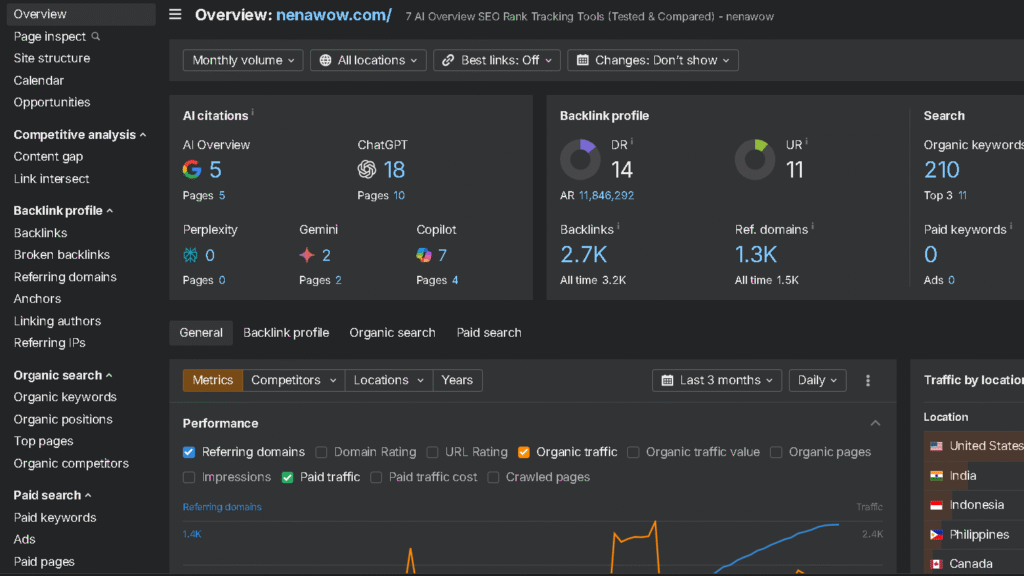
| Backlink Index | Largest (2,700 found) | Strong (1,500 found) |
| Referring Domains Found | 1,300 | 499 |
| Keyword Difficulty Accuracy | Highest (KD 58) | High (KD 57) |
| Keyword Database | Billions, 170+ countries | 25+ billion keywords |
| Keyword Opportunities (same seed) | 18 | 70+ |
| PPC / Paid Search Data | No | Yes |
| Site Audit Style | Grouped, prioritized (173 issues) | Exhaustive (3,818 combined) |
| Orphaned Page Detection | 45 found | 92 found |
| Internal Link Map | Yes | Yes |
| Core Web Vitals | No | Yes |
| GSC + GA Integration | GSC only | Both |
| AI Tracking | Multi-engine (Google, Bing, more) | Google AI Overviews |
| ChatGPT Brand Tracking | No | No |
| Content Writing Tools | Analysis only | ContentShake AI + Writing Assistant |
| White-Label Reporting | No | Yes |
| Local SEO | Location tracking only | Full listing management |
| Starting Price | $129/mo | $139.95/mo |
| Free Option | Webmaster Tools (permanent) | 10 searches/day |
| Learning Curve | Steep | Moderate |
Decision Guide
| Your Situation | Best Tool |
|---|---|
| Link building is your core strategy | Ahrefs |
| Need largest competitor backlink index | Ahrefs |
| Most accurate keyword difficulty scores | Ahrefs |
| Multi-engine AI Overview tracking | Ahrefs |
| Solo blogger, organic-only focus | Ahrefs |
| Zero budget, own domain | Ahrefs Webmaster Tools (free) |
| Running paid + organic campaigns together | Semrush |
| Agency sending white-label client reports | Semrush |
| Content team producing articles at volume | Semrush |
| Local SEO for multiple locations | Semrush |
| Core Web Vitals monitoring needed | Semrush |
| Cross-channel competitor traffic analysis | Semrush |
| Technical SEO on large, complex sites | Semrush |
| Tracking ChatGPT brand visibility | Neither — consider Moz Pro |
Testing Methodology
Site tested: nenawow.com — a two-year-old niche site covering AI and SEO topics. 220 published posts, zero paid traffic, roughly 1,300 referring domains at test start.
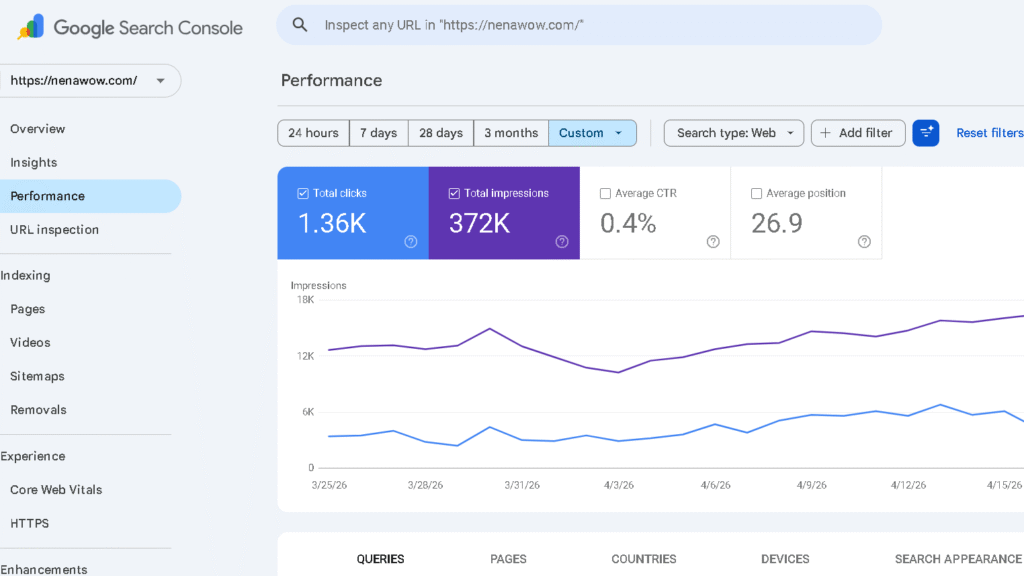
Baseline: approximately 1,000 monthly organic visits verified through Google Search Console. GSC data was the consistent reference throughout. Neither tool’s traffic estimates were used as ground truth — Ahrefs estimated 1,200, which I noted but did not treat as fact.
Test conditions: Both platforms ran at the same time with identical inputs. Thirty keywords tracked, the same three competitor domains analyzed, the same crawl settings. Nothing was adjusted mid-test.
Duration: 30 days, April 2026.
One honest caveat: smaller sites amplify data gaps between tools. At scale — hundreds of thousands of monthly visits and massive backlink profiles — the proportional differences may narrow. Everything here is directional. It is real data from a real site, not a lab.
What Changed in Ahrefs and Semrush in 2026?
Very few comparison articles address this, but it matters. These platforms move fast. What was true in 2024 is not always true now.
Ahrefs Updates in 2026
Ahrefs expanded its AI Overview tracking to cover more generative search surfaces beyond Google. Bing Copilot coverage improved significantly during the first quarter. The backlink index also grew — testing confirmed it at 2,700 links found on nenawow.com, up from earlier reported benchmarks. The core product philosophy has not changed: focused tools, conservative data, no content production layer.
Semrush Updates in 2026
Semrush rolled out ContentShake AI improvements in early 2026, with better SERP-grounded draft generation and tighter integration with the SEO Writing Assistant. Google AI Overview tracking became more reliable across tracked keywords. Reporting automation on the Business plan also added new white-label customization options. Local SEO listing management expanded to more international markets.
What Neither Tool Has Yet
Neither Ahrefs nor Semrush tracks ChatGPT brand mentions as of April 2026. That feature remains specific to Moz Pro. It is also worth knowing that both tools still rely on estimated traffic data that diverges from GSC actuals — neither has solved that gap.
Ahrefs vs Semrush 2026: Pricing
Ahrefs Pricing
| Plan | Monthly | Annual (per month) |
|---|---|---|
| Lite | $129 | $108 |
| Standard | $249 | $208 |
| Advanced | $449 | $374 |
| Enterprise | Custom | Custom |
Free option: Ahrefs Webmaster Tools — permanently free, no credit card required. Real backlink data, site audit results, and organic keyword reports for any domain you verify. One of the genuinely useful free tools in SEO.
Semrush Pricing
| Plan | Monthly | Annual (per month) |
|---|---|---|
| Pro | $139.95 | $117.33 |
| Guru | $249.95 | $208.33 |
| Business | $499.95 | $416.66 |
Free option: A limited account with 10 searches per day. Enough to see the interface. Not enough for any real work.
How the Pricing Compares in Practice
The difference at the entry level is just $10.95 per month, making pricing nearly identical. The real distinction appears once you move beyond the starter plans. Ahrefs Standard unlocks content gap analysis and deeper historical data, while Semrush Guru adds content marketing tools, historical reports, and multi-location rank tracking.
The more meaningful cost difference shows up at the agency level. Semrush Business at $499.95 includes white-label reporting that saves real hours each month when you’re managing client accounts. Ahrefs has no equivalent. For individual operators, entry prices are nearly identical. For agencies, total cost of ownership diverges because of what Semrush includes that Ahrefs does not.
Keyword Research Tool: Ahrefs vs Semrush
Keyword Difficulty: Where Both Tools Are Reliable
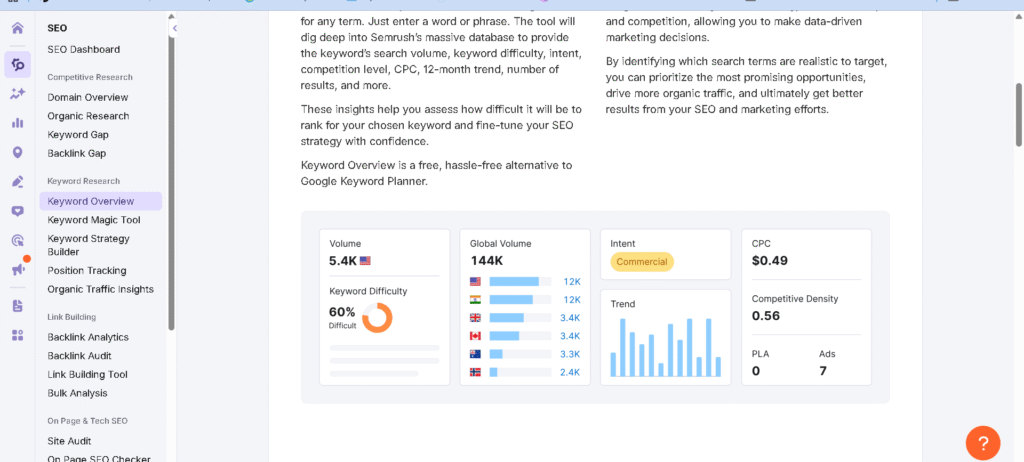
I tested “AI SEO tools” in both platforms at the same time. The results were close.
| Tool | KD Score | Opportunities Returned |
|---|---|---|
| Ahrefs | 58 | 18 |
| Semrush | 57 | 70+ |
A one-point gap in difficulty — functionally the same. Both tools factor the actual backlink profiles of ranking pages into their difficulty scores. That makes them conservative and reliable, unlike platforms that produce optimistic scores you cannot build strategy on.
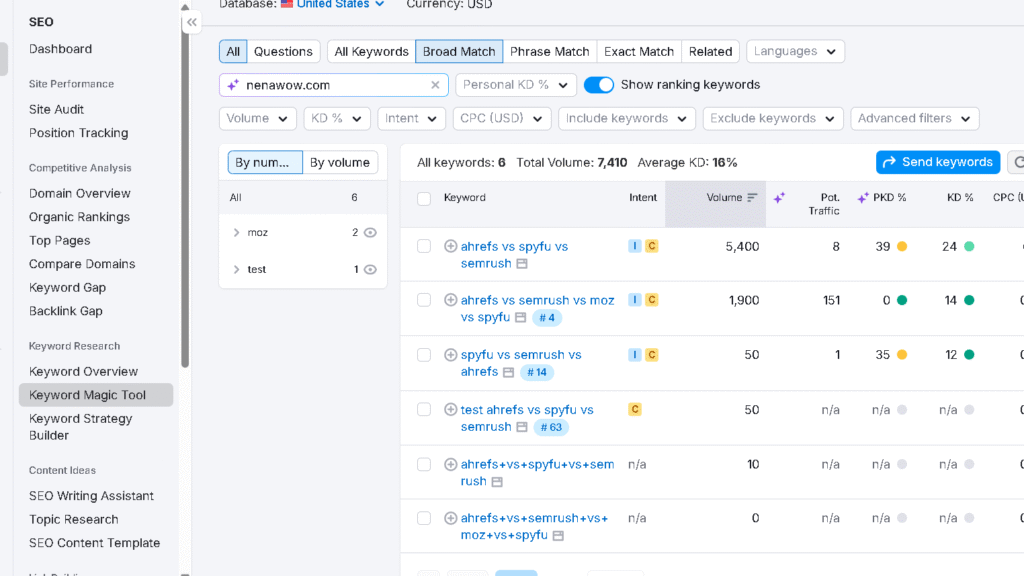
Where they diverge is volume. Semrush returned 70+ keyword variations from the same seed. Ahrefs returned 18. That gap is not Ahrefs being worse. It reflects a different philosophy. Ahrefs is precise. Semrush casts a wider net, which suits content teams who want topic clusters and long-tail variations at volume.
Ahrefs Keywords Explorer
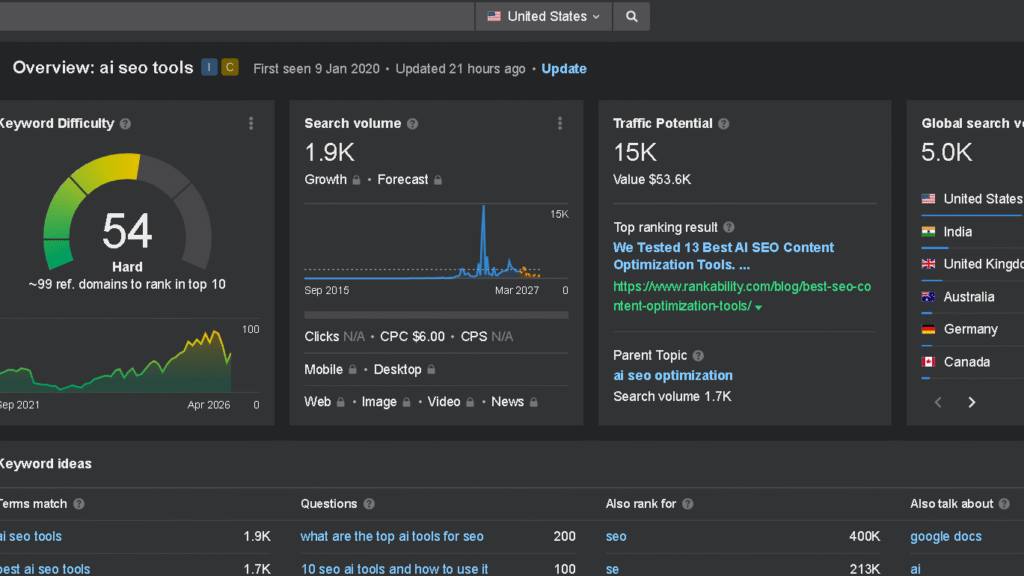
Billions of keywords across 170+ countries. Ahrefs returns click estimates, parent topic traffic potential, SERP history, and a ranking page breakdown for each keyword. The parent topic feature stands out — it finds the broader query driving the most traffic in a topic area. That often redirects you from a narrow long-tail toward something with ten times the potential. Conservative opportunity counts are a feature once you understand the logic. Ahrefs shows you what is winnable at your current domain strength.
Semrush Keyword Magic Tool
Over 25 billion keywords with filters for intent, SERP features, question-format queries, and related terms. The Keyword Gap tool lets you analyze up to five competitors at once, filtered by keywords they rank for that you do not. PPC data sits right alongside organic data — cost per click, ad competition level, paid SERP previews. For teams running both channels, that removes the need for a separate paid research tool.
For pure keyword volume, Semrush wins. For precision and strategic focus at the individual keyword level, Ahrefs is tighter.
Best for Keyword Research
Choose Ahrefs if you want accuracy and precision at the individual keyword level, and if you are building an organic-only content strategy where winnable opportunities matter more than raw volume.
Choose Semrush if you want larger keyword lists, topic cluster research, and integrated PPC data alongside organic keywords.
Backlink Analysis: Ahrefs vs Semrush
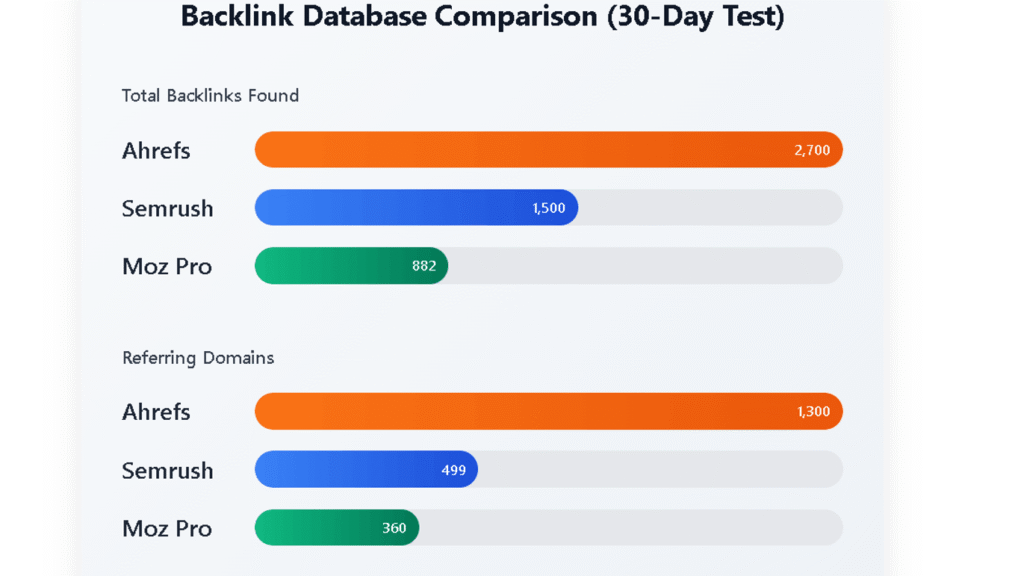
This is the most significant gap between the two tools. The numbers from my 30-day test were not close.
| Tool | Backlinks Found | Referring Domains Found |
|---|---|---|
| Ahrefs | 2,700 | 1,300 |
| Semrush | 1,500 | 499 |
Ahrefs found 2.6 times more referring domains on the same site over the same crawl window. Every link I could independently verify showed up in Ahrefs. Several confirmed domains were completely absent from Semrush.
If backlink intelligence is your priority, you may also want to explore some leading Ahrefs Competitors to see how other platforms compare.
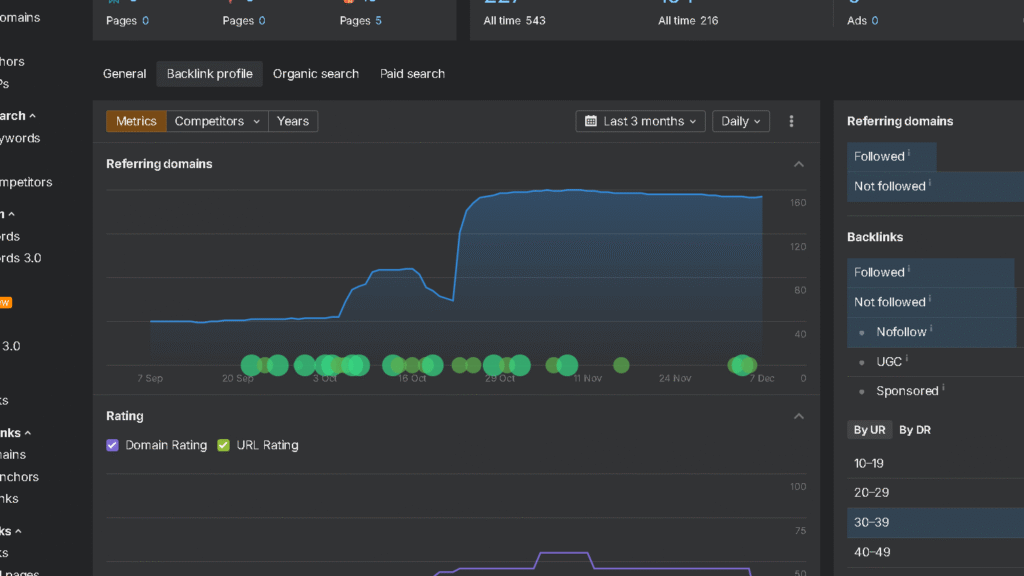
That gap has a direct effect on link building. When you map a competitor’s backlink profile to build an outreach list, working from Semrush’s index means roughly 62 percent of available referring domains are invisible. You will not know those targets exist. That is not a minor variance. It is a structural blind spot in any outreach strategy built on Semrush data alone.
Beyond raw index size, Ahrefs gives you historical link gain and loss charts, anchor text distribution, new versus lost link tracking with exact dates, dofollow/nofollow breakdowns, and link velocity data. The velocity signal — seeing a competitor pick up 40 links in one week — is useful for spotting PR campaigns and content getting wide coverage in your niche.
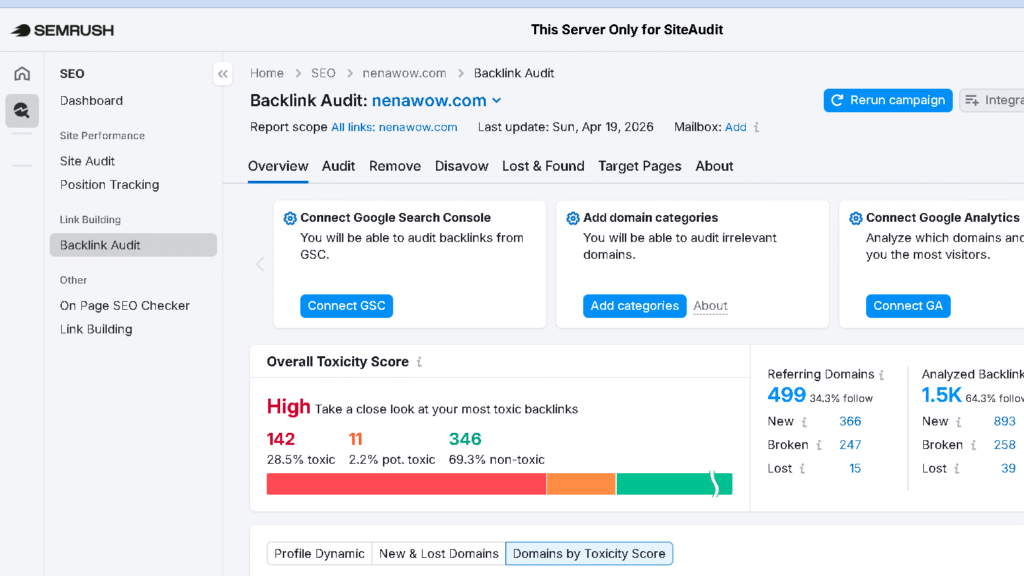
Semrush’s backlink audit includes a toxic score for identifying and disavowing harmful links, plus Google Search Console integration for a combined view of link health and traffic performance. Those are real advantages for specific workflows. The index size gap still matters more for outreach.
Best for Backlink Analysis
Ahrefs wins because of the larger index. At 1,300 referring domains found versus Semrush’s 499, the practical difference for link building is not small. If backlinks are central to your strategy, the index gap decides this.
Technical SEO and Site Audit: Ahrefs vs Semrush
Two tools, two very different philosophies. Both are more useful than Moz, but useful in different ways.
| Tool | Issues Flagged | Orphaned Pages | Core Web Vitals | GA Integration |
|---|---|---|---|---|
| Ahrefs | 173 (grouped) | 45 | No | No |
| Semrush | 3,818 (per instance) | 92 | Yes | Yes |
Ahrefs groups related issues — 34 posts missing meta descriptions appear as one finding with a list, not 34 separate line items. It surfaces the highest-impact problems first. During the 30-day test, five grouped findings drove almost all meaningful action: an accidental noindex tag blocking six posts from Google indexing, keyword cannibalization across four competing posts, three crawl issues, 45 orphaned pages, and an internal link map showing which posts had no authority flowing toward them. The noindex finding alone was the highest-impact discovery of the entire test. Fast to find, fast to fix.
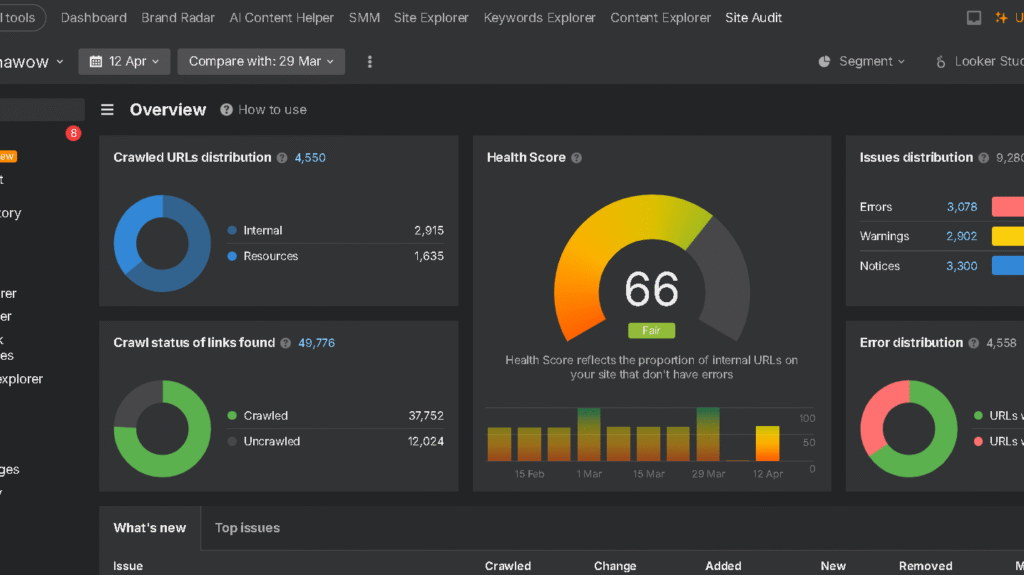
Semrush logs every issue as a separate instance — 1,485 errors and 2,333 warnings. The total looks alarming on first view. What makes it manageable is the Google Analytics and Search Console integration. You can filter the full list to show only pages that receive real traffic or impressions. That context turns 3,818 raw issues into a prioritized action list based on actual impact. Semrush also found 92 orphaned pages versus Ahrefs’ 45, and it is the only tool of the two with Core Web Vitals monitoring built into the audit interface.
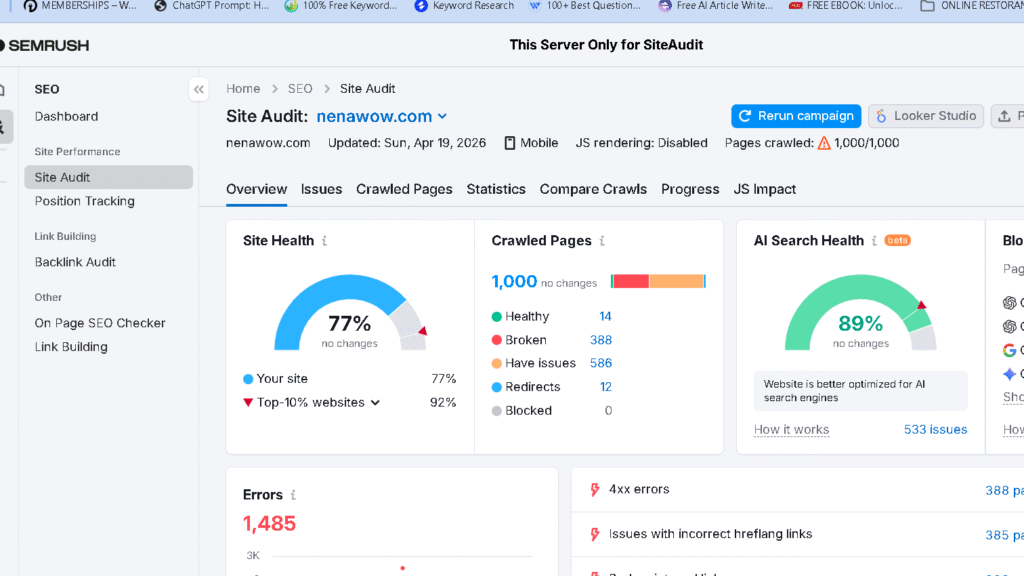
If speed to action matters more than coverage depth, Ahrefs. If you want maximum coverage with traffic-weighted filtering and performance monitoring in one place, Semrush.
Rank Tracking: Ahrefs vs Semrush
Both tools update daily and deliver position accuracy within one to two positions of Google Search Console across the 30 tracked keywords. Accuracy is not where they differ.
| Metric | Ahrefs | Semrush |
|---|---|---|
| Update Frequency | Daily | Daily |
| SERP Feature Tracking | Yes | Yes |
| AI Overview Tracking | Multi-engine | Google only |
| ChatGPT Mention Tracking | No | No |
| Visibility Score | No | Yes |
| Cannibalization Alerts | Yes | Yes |
| Automated Reporting | Basic | Scheduled, white-label |
| GSC Position Accuracy | 1–2 positions | 1–2 positions |
Both tools flag active SERP features per keyword — featured snippets, People Also Ask boxes, video carousels, AI Overviews, local packs — and show whether you own them. That context is critical. During the test, several keywords where nenawow.com ranked positions four to six were generating near-zero clicks because Google AI Overviews consumed the visible SERP. Both tools surfaced that. A position number alone would not have.
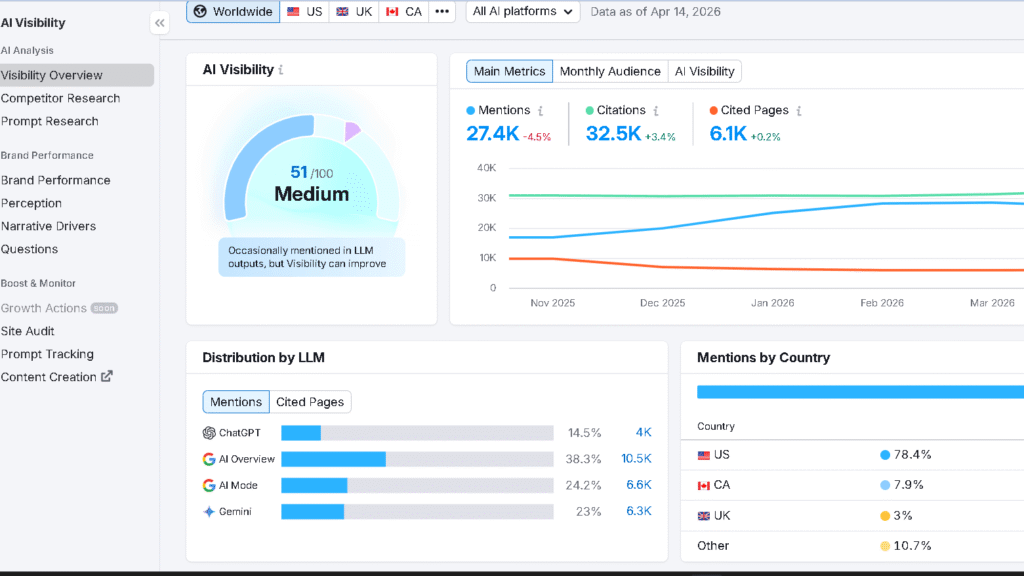
Where Semrush goes further: the Visibility Score aggregates performance across all tracked keywords into a single trend line. Useful for catching directional shifts before individual keyword volatility makes them obvious. Automated weekly reports reduce recurring manual work — a real time saving for agencies managing multiple accounts.
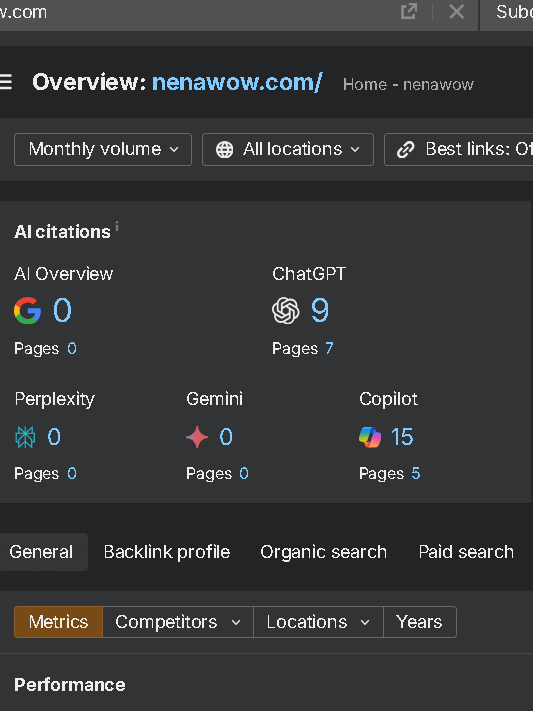
Where Ahrefs goes further on AI: Ahrefs tracks AI Overview appearances across Google, Bing Copilot, and other generative search surfaces. Semrush covers Google AI Overviews only. As AI search spreads across platforms, multi-engine tracking increasingly reflects where organic traffic is actually going.
Neither tool tracks ChatGPT brand mentions. That is Moz Pro’s specific angle.
Competitor Analysis: Ahrefs vs Semrush
This is where the two tools serve genuinely different strategic goals.
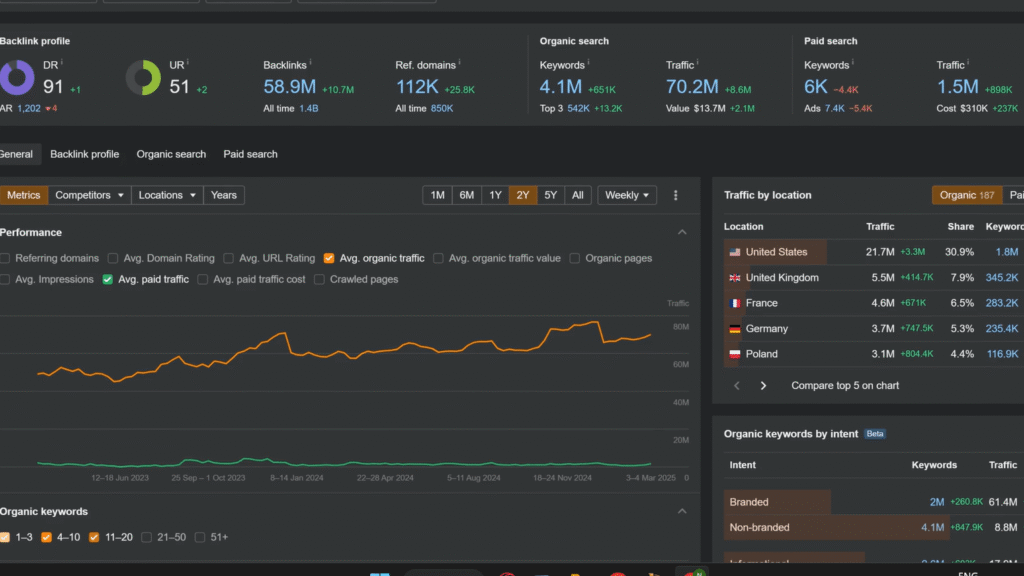
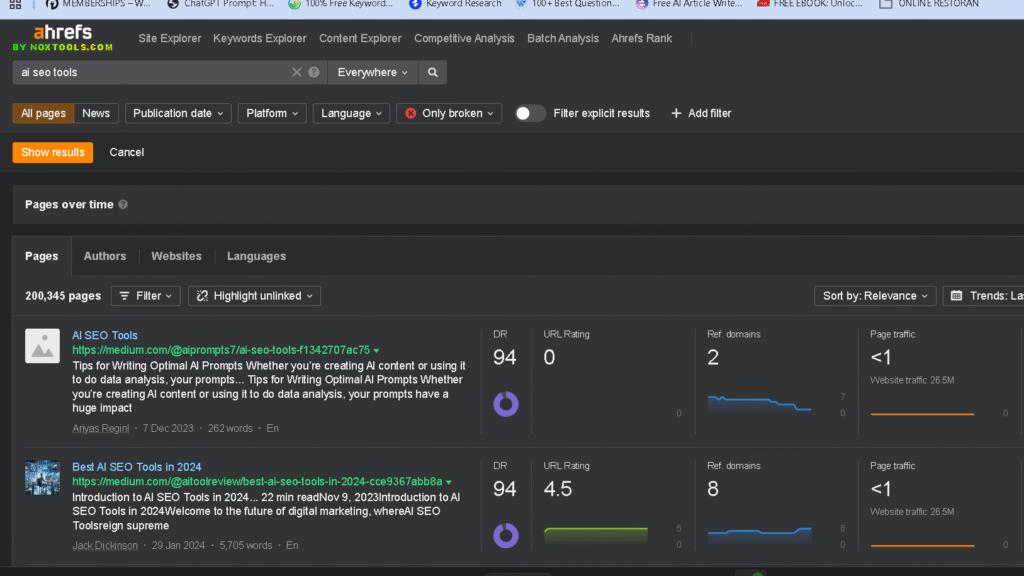
Ahrefs Site Explorer gives you estimated organic traffic, top pages by traffic value, full keyword rankings, and the complete backlink profile for any URL or domain. The Content Gap tool was the single highest-impact feature across the entire 30-day test. Three competitors analyzed at once, 40+ keyword topics identified with zero coverage on nenawow.com. Several became published posts before the test ended. The Backlink Gap tool surfaced 67 unique domains linking to all three competitors but not to my site — a ready-made outreach list with relevance signals already built in.
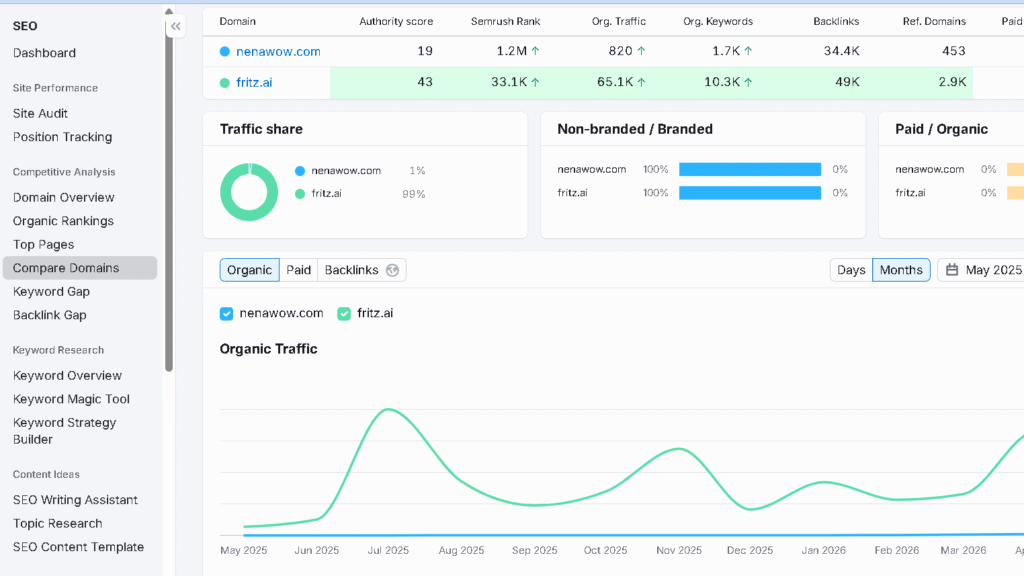
Semrush Traffic Analytics estimates competitor traffic across all channels — organic, paid, direct, referral, and social — using clickstream data rather than rank-based inference. Nothing equivalent exists in Ahrefs. The Keyword Gap tool handles five competitors at once and returned 41 unique referring domain opportunities not linking to nenawow.com.
| Metric | Ahrefs | Semrush |
|---|---|---|
| Competitor Backlink Gaps Found | 67 domains | 41 domains |
| Content Gap Depth | Deep (40+ topics) | Deep + paid data |
| Multi-Channel Traffic Estimates | No | Yes |
| Paid Search Competitor Intelligence | No | Yes |
For a broader comparison beyond these two tools, see my detailed Ahrefs vs Semrush vs Moz comparison.
Ahrefs wins on organic backlink and content gap intelligence. Semrush wins on full-funnel multi-channel competitor analysis.
Content Tools and AI Tracking
This is where the product philosophies diverge most clearly.
AI Overview Tracking
Ahrefs covers Google AI Overviews, Bing Copilot, and additional generative search surfaces. During the test, it found six keywords where nenawow.com appeared in AI Overviews — none of that showed up in Google Search Console. For sites trying to understand their true generative search footprint, multi-engine coverage is the more complete picture. That matters more as AI search spreads across platforms.
Semrush tracks Google AI Overviews specifically. For businesses where Google is the primary traffic source — which is most — this covers the highest-impact surface. Non-Google AI tracking is still developing on the Semrush roadmap.
Neither tool currently tracks ChatGPT brand mentions. That feature is unique to Moz Pro right now.
Content Production and On-Page Tools
This is where Semrush has built a real edge.
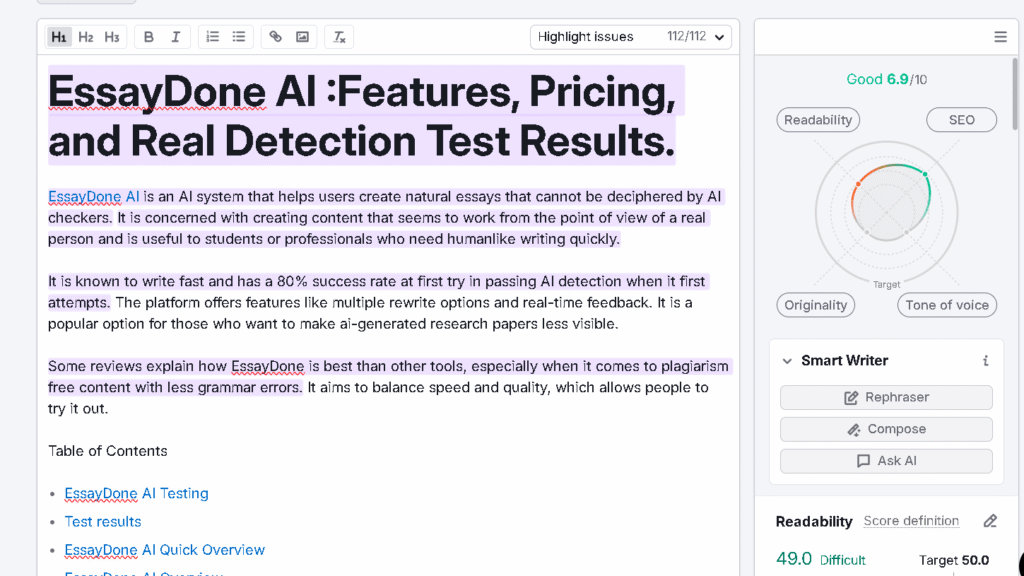
Semrush has a full in-platform content stack: the SEO Writing Assistant grades drafts in real time against top-ranking competitors, flagging missing semantic terms and readability issues as you write. ContentShake AI generates full article drafts with built-in SERP analysis. Topic Research finds trending subtopics and content angles. For content teams producing at volume, having research, drafting, and optimization inside one subscription removes significant tool sprawl.
Ahrefs is a research tool, not a production tool. Content Explorer is powerful — finding content earning backlinks, trending by shares, or gaining organic traction in a niche — but there is no writing help, no draft grading, no in-tool content brief. You pull the insight, then move to a separate tool.
| Feature | Ahrefs | Semrush |
|---|---|---|
| AI Tracking | Multi-engine | Google only |
| ContentShake AI | No | Yes |
| SEO Writing Assistant | No | Yes |
| Page Optimization Scoring | No | Yes |
| Topic Research | No | Yes |
| Content Explorer (research) | Yes | Yes |
Ahrefs wins on multi-engine AI tracking. Semrush wins on content production — and it is not close.
Advanced Features
Core Web Vitals: Semrush monitors LCP, CLS, and FID inside the audit interface, connected to actual performance data. Ahrefs has no Core Web Vitals integration. If page experience monitoring is a regular part of your workflow, this is Semrush only.
Google Analytics Integration: Semrush connects to both GSC and GA, letting you cross-reference audit findings against real traffic and revenue data. Ahrefs integrates with GSC for click and impression data but not GA. The Semrush integration is more complete for agencies needing to show business impact.
Local SEO: Semrush includes full listing management, multi-location rank tracking, and review monitoring inside the core platform. Ahrefs tracks location-based keywords but does not manage citations or reviews. For local SEO agencies, Semrush is the consolidated answer — Ahrefs would need supplementary tools alongside it. If you work in this space, you may also find the SE Ranking vs Ranktracker comparison useful, since both position themselves as local SEO alternatives.
White-Label Reporting: Semrush includes customizable white-label reports on the Business plan. Ahrefs offers basic reporting that requires manual assembly for client-facing delivery. For agencies, this is a significant operational difference every week.
API Access: Both platforms offer API access on higher-tier plans. Semrush has the more mature developer ecosystem. Ahrefs API is strong for backlink and keyword data specifically.
Domain Authority Metrics: Neither tool uses Moz DA — Ahrefs uses Domain Rating, Semrush uses Authority Score. Both correlate well with ranking ability internally. Neither has the external recognition that Moz DA has among non-SEO stakeholders.
Ease of Use: Ahrefs vs Semrush
Both platforms have a real learning curve compared to Moz. The difference is in the nature of that curve.
Ahrefs is dense. Five core tools — Site Explorer, Keywords Explorer, Content Explorer, Site Audit, Rank Tracker — each with significant depth. Getting comfortable across all of them takes most users two to four weeks. Power users consistently rate it the fastest platform for competitive research once the workflow is mapped. The investment pays off. It is a real investment though.
Semrush offers guided onboarding on first login — it walks you through setting up rank tracking, a site audit, and keyword targets before you reach the main dashboard. That structure gets new users to useful data faster than Ahrefs’ open-ended interface. The flip side: 55+ tools across multiple modules creates real navigation overhead. Finding the right tool for a specific task is not always obvious until you have spent time mapping the platform.
| Aspect | Ahrefs | Semrush |
|---|---|---|
| Learning Curve | Steep | Moderate |
| Guided Onboarding | No | Yes |
| Time to First Useful Data | Longer | Faster |
| White-Label Client Reporting | No | Yes |
| Navigation Complexity | Focused (5 core tools) | High (55+ tools) |
Semrush wins for faster onboarding. Ahrefs wins for long-term workflow speed once the initial curve is past.
30-Day Test Results: nenawow.com
April 2026. GSC baseline: approximately 1,000 monthly organic visits. 220 posts. Zero paid traffic.
Head-to-Head Numbers
| Metric | Ahrefs | Semrush |
|---|---|---|
| Referring Domains Found | 1,300 | 499 |
| Backlinks Found | 2,700 | 1,500 |
| Audit Issues Flagged | 173 (grouped) | 3,818 (per instance) |
| Orphaned Pages Detected | 45 | 92 |
| KD for “AI SEO tools” | 58 | 57 |
| Keyword Opportunities (same seed) | 18 | 70+ |
| Competitor Backlink Gaps | 67 domains | 41 domains |
| GSC Position Accuracy | 1–2 positions | 1–2 positions |
| AI Appearances Tracked | 6 keywords, multi-engine | Available (Google) |
Weeks 1–2: What Each Tool Surfaced
Ahrefs found the highest-impact issue of the entire test in week one: an accidental noindex tag blocking six posts from Google indexing. Those posts had been live for months, generating no traffic, with no obvious sign of the problem in the CMS. Ahrefs also identified keyword cannibalization — four posts competing for the same primary query instead of one strong, authoritative page. Both findings needed immediate action.
Semrush confirmed the crawl issues Ahrefs flagged and added context through GA integration: of 92 orphaned pages detected, it showed which ones had Search Console impressions, reducing a large triage task to a focused list of roughly 15 pages worth prioritizing. Core Web Vitals data flagged two posts with LCP issues that Ahrefs could not surface.
Weeks 2–3: Actions Taken
Removed noindex from six blocked posts based on the Ahrefs audit. Merged four cannibalistic posts into consolidated articles with 301 redirects, based on Ahrefs’ cannibalization alert. Added meta descriptions to 34 flagged posts, confirmed by both tools. Fixed three broken internal links using Ahrefs. Rebuilt internal linking toward the consolidated post using the Ahrefs link equity map. Published three new posts targeting Ahrefs Content Gap keyword topics. Prioritized orphaned page fixes using Semrush’s impression-weighted list to avoid wasting time on pages that would not return traffic even if fixed.
Day 30 Results
| Metric | Day 1 | Day 30 | Change |
|---|---|---|---|
| Monthly Organic Visits | ~1,000 | ~1,340 | +34% |
| Keywords in Top 10 | 18 | 27 | +9 |
| Keywords in Top 3 | 4 | 7 | +3 |
| Crawl Errors | 173 | 41 | −132 resolved |
| Referring Domains | 358 | 371 | +13 |
| AI Appearances Tracked | Not tracked | 6 keywords | New data |
The noindex fix drove the largest share of traffic recovery. Six posts returning to Google’s index is a significant event on a 220-post site. The cannibalization fix and internal link rebuild contributed to position improvements in the final week. Semrush’s impression-weighted orphaned page list prevented wasted effort on pages with no traffic potential even if fixed.
SEO attribution is never clean. Every action traced back to a specific finding from one of the two tools. Treat this as directional.
Is Ahrefs Still Worth It in 2026?
Yes — for the right user. The backlink index is still the largest I have tested, and the gap over Semrush has not closed. If you build links, do competitive backlink research, or want multi-engine AI Overview tracking, Ahrefs is the sharper tool. The 2026 updates to its generative search tracking make it more relevant, not less.
The ceiling is real. If you need white-label reporting, in-platform content writing tools, Core Web Vitals monitoring, or PPC data, Ahrefs does not have those. Ahrefs Webmaster Tools remains the best free entry point in SEO for anyone with a verified domain.
So is it worth it? For organic-focused operators, yes. For full-stack teams, it may need a partner tool.
Is Semrush Still Worth It in 2026?
Also yes — but for a different audience. The 2026 ContentShake AI improvements and expanded Google AI Overview tracking make the content stack more capable than it was a year ago. White-label reporting and Google Analytics integration remain the strongest arguments for agencies, and those have only gotten more refined.
The question is not whether Semrush is good. It is whether you use enough of it to justify $139.95 per month at the Pro level. Solo bloggers focused purely on organic often pay for capabilities they never touch. At Guru or Business, the platform earns its price more clearly. At Pro, the value depends heavily on how much of the feature set you actually use each month.
Who Should Skip Each Tool
Skip Ahrefs if you are…
Running paid search campaigns — there is no PPC data at all. An agency sending branded client reports — white-label reporting requires significant manual assembly. A content team that needs in-platform writing tools — research only, no drafting or optimization. Tracking Core Web Vitals regularly — no integration. Managing multi-location local SEO — keyword tracking only, not listing management.
Skip Semrush if you are…
A link builder who needs index completeness — Ahrefs found 1,300 referring domains versus Semrush’s 499, and that gap affects every outreach list you build. Focused purely on organic and do not want to pay for paid search features you will not use. Looking for the most conservative keyword difficulty scores — both are good, but Ahrefs is tighter. Needing the broadest AI Overview tracking across multiple generative platforms — Semrush covers Google; Ahrefs covers more surfaces.
Alternatives Worth Considering
| Tool | Price | Best For | Main Advantage |
|---|---|---|---|
| Moz Pro | $99/month | Beginners | ChatGPT tracking and DA metric |
| SE Ranking | ~$65/month | Small businesses | Good all-around SEO toolkit |
| Mangools | ~$29/month | Bloggers | Easy keyword research |
| Ahrefs Webmaster Tools | Free | Website owners | Free backlink and audit data |
Moz Pro — $99 per month. The only tool that tracks ChatGPT brand mentions, has the widely recognized DA metric, and offers keyword prompt suggestions for content briefs. Lower price, smaller index. Best for beginners and content-focused teams. Read a full Moz Pro review for a detailed breakdown.
SE Ranking — around $65 per month. A solid mid-market alternative with good rank tracking, keyword research, and audit tools. The logical choice if Semrush Pro feels like more platform than you need. See how it compares in the SE Ranking vs Semrush guide.
Mangools — around $29 per month. KWFinder for keyword research, SERPChecker for SERP analysis. No serious link building tools, but keyword difficulty calibration is meaningfully better than most budget tools. Read the full Mangools vs Ahrefs review to understand its ceiling. Good for bloggers with tight budgets.
Ahrefs Webmaster Tools — Free, permanent. Real Ahrefs backlink data and audit reports for your verified domain. If you want Ahrefs quality at zero cost, start here and upgrade when the return is clear.
For a broader look at the category, the AI SEO tools comparison and the AI rank tracking tools roundup cover how these platforms fit into a wider AI-driven workflow.
| Situation | Best Pick |
|---|---|
| Best backlink index | Ahrefs |
| Full marketing platform | Semrush |
| Tracking ChatGPT visibility | Moz Pro |
| Mid-budget, one site | SE Ranking |
| Keyword research on a budget | Mangools |
| Zero budget, own domain | Ahrefs Webmaster Tools |
Still undecided? My full Ahrefs Review, Semrush Review, and Ahrefs vs Semrush vs Ubersuggest comparison go deeper into specific use cases and workflows.
Ahrefs vs Semrush: Final Verdict
Both are professional-grade platforms. The choice depends on what professional SEO means in your context. Those are different things.
Choose Ahrefs if link building and competitive backlink intelligence drive your strategy, accurate keyword difficulty scores are essential to your content decisions, or you need multi-engine AI Overview tracking across Google, Bing, and other generative surfaces. Organic-only teams — especially solo operators and focused content sites — tend to get more value per dollar from Ahrefs because they use everything it offers.
Choose Semrush if you run paid and organic together, client reporting is a significant weekly time cost, your content team needs in-platform writing and optimization tools, or you manage local SEO for multiple locations. Agencies especially: Semrush’s white-label reporting, GA integration, and multi-channel competitor analysis justify the price in ways Ahrefs cannot match for that workflow.
The combination that makes sense at scale: some teams run both. Ahrefs for link prospecting and content gap analysis, Semrush for client reporting, content production, and multi-channel competitor intelligence. Expensive, but the overlap is smaller than you would assume. They are strong in different places.
For a single-tool decision: organic-first goes Ahrefs, full-stack goes Semrush. That combination is harder to find than it looks.
FAQ
Is Ahrefs or Semrush better for SEO?
It depends on your focus. Ahrefs is stronger for pure organic work — larger backlink index (1,300 versus 499 referring domains found in testing), more conservative keyword difficulty scores, and multi-engine AI Overview tracking. Semrush is stronger as a complete platform — paid search data, content writing tools, white-label reporting, Core Web Vitals, and cross-channel competitor analysis. For link building and organic research, Ahrefs. For agencies and multi-channel teams, Semrush.
Which tool has better keyword research, Ahrefs or Semrush?
Both scored the same test keyword at near-identical difficulty — KD 58 versus KD 57 — but Semrush returned 70+ keyword variations from the same seed while Ahrefs returned 18. Ahrefs is more precise and conservative. Semrush returns more volume, which suits content teams building large topic clusters. For individual keyword precision, Ahrefs. For cluster research and PPC keyword data, Semrush.
Which has the better backlink index, Ahrefs or Semrush?
Ahrefs, and it is not close. In 30-day testing on the same site, Ahrefs found 2,700 backlinks and 1,300 referring domains versus Semrush’s 1,500 backlinks and 499 referring domains. Every link I could independently verify appeared in Ahrefs. Several confirmed domains were absent from Semrush entirely. For link building and competitive backlink analysis, the index gap translates directly into strategic blind spots if you rely on Semrush data alone.
Does Ahrefs have content tools like Semrush?
No. Ahrefs is a research tool. Its Content Explorer finds content earning backlinks and organic traction, but there is no in-platform writing help, draft grading, or content optimization scoring. Semrush has ContentShake AI for full draft generation, an SEO Writing Assistant that grades content in real time, and Topic Research for content angle discovery. For teams that want research and production under one subscription, Semrush is the only option of the two.
Is Semrush worth it for a solo blogger?
Probably not at full price. At $139.95 per month for the Pro plan, Semrush is hardest to justify for single-site operators who do not need PPC data, white-label reporting, or multi-channel analytics. Ahrefs Lite at $129 covers backlink analysis, keyword research, and rank tracking better for organic-focused bloggers. Moz Pro at $99 covers the basics at lower cost. SE Ranking at around $65 is the best value for solo operators who want something in between.
Which tool is better for technical SEO?
Both are strong, but differently. Ahrefs groups its 173 audit issues by type, surfacing the highest-impact problems first — the fastest path from audit to action. Semrush logs 3,818 individual issues but adds Google Analytics integration to show which problems affect pages with real traffic, plus Core Web Vitals monitoring. For prioritization speed, Ahrefs. For maximum coverage and performance signal integration, Semrush.
Can I use Ahrefs for free?
Yes. Ahrefs Webmaster Tools is permanently free with no credit card required. Verify ownership of your domain and you get real Ahrefs backlink data, site audit results, and organic keyword reports for that domain. Competitor research and the full Keywords Explorer require a paid plan. For analyzing your own site, it is a genuinely capable free tool.
Does Semrush track AI Overviews?
Semrush tracks Google AI Overviews for keywords you are monitoring. It does not currently cover Bing Copilot or other generative search surfaces — Google only. Ahrefs tracks AI Overview appearances across multiple platforms including Google and Bing Copilot. Neither tool tracks ChatGPT brand mentions. That is specific to Moz Pro.
Which is better for agencies, Ahrefs or Semrush?
Semrush, for most agencies. White-label client reporting, Google Analytics integration, multi-location local SEO management, and multi-channel competitor traffic analysis are all capabilities that Ahrefs does not match. The exception: agencies where link building is the primary service often prefer Ahrefs for its larger backlink index and more complete competitive link intelligence.
Test data from nenawow.com, April 2026. Pricing and features change — verify current details directly with each provider before purchasing.