
This is a hands-on Moz Pro review based on 30 days of real testing.
Here’s the short version: Moz Pro is more capable than its reputation suggests. The backlink index is limited compared to competitors, and keyword difficulty scores run optimistic — but the platform has genuinely evolved. ChatGPT visibility tracking, keyword prompt suggestions, and page optimization tools make it a different product than it was two years ago.
I tested Moz Pro on a real niche site (220 posts, ~1,000 monthly organic visits from Google Search Console) throughout April 2026. Same conditions and same keywords, measured against Ahrefs and Semrush in the same time. No free trials padded with cherry-picked data.
If you want the full breakdown of those tools individually, see my detailed Ahrefs review, Semrush review, and the full Moz vs Semrush vs Ahrefs comparison.
Disclaimer: I may earn a small commission on purchases made through links on this page, at no extra cost to you. This supports honest, independent reviews.
Table of Contents
Moz Pro Review-Quick Verdict
Best for content-focused site owners who prioritize publishing and on-page optimization over aggressive link building.
Backlink database is noticeably weaker than Ahrefs and Semrush, making it less ideal for heavy outreach or competitive link analysis.
Worth $99/month if structured optimization guidance and usability matter more to you than raw backlink depth.
| Feature | Moz Pro | Verdict |
|---|---|---|
| Best For | Beginners, content teams, DA tracking | ✅ Strong fit |
| Backlink Database | 882 backlinks / 360 referring domains (test site) | ⚠️ Limited |
| Keyword Difficulty Accuracy | KD 35 vs. actual 57–58 | ⚠️ Optimistic |
| Site Audit | Functional, less granular | ✅ Usable |
| Rank Tracking | Daily updates, ChatGPT mentions | ✅ Good |
| AI Tracking | ChatGPT only | ✅ Unique angle |
| Content Tools | Page optimization + prompt suggestions | ✅ Genuinely useful |
| Domain Authority | Industry standard metric | ✅ Best in class |
| Starting Price | $99/month | ✅ Most affordable |
| Free Option | 30-day trial + MozBar extension | ✅ Low-risk entry |
Is Moz Pro worth it in 2026?
Yes — more than it was a year ago. ChatGPT tracking, prompt suggestions, and page optimization are substantive additions. At $99/month with a 30-day trial, the evaluation risk is low. The core limitations are backlink index depth and keyword difficulty calibration, both of which matter more as sites grow and enter competitive niches.
What is Moz Pro best for?
Four things stand out in 2026: DA as the SEO industry’s shared authority metric, the most beginner-accessible interface in the category, the lowest entry price point ($99/month), and a combination of ChatGPT visibility tracking plus keyword prompt suggestions that neither Ahrefs nor Semrush replicates.
Moz Pro Pricing Plans 2026
| Plan | Monthly | Annual (per month) |
|---|---|---|
| Starter | $99 | $79 |
| Standard | $179 | $143 |
| Medium | $299 | $239 |
| Large | $599 | $479 |
The Starter plan at $99/month is the most affordable full-featured SEO platform entry point available right now. Ahrefs starts at $129, Semrush at $139.95. That gap is real money, especially for solo bloggers and small businesses.
A few things worth knowing before you upgrade blindly: API access requires Medium tier or above. Daily rank tracking kicks in on Standard. If you need serious crawl volume for a large site, Starter will hit limits fast.
The 30-day free trial is the most generous offer in this category. No credit card tricks, no feature walls — you get the full tool for a month. That alone makes the initial risk calculation easy.
Keyword Research: How Does Moz Stack Up?
Moz Keyword Explorer is clean, fast, and beginner-friendly. Enter a seed term, and you get search volume, keyword difficulty, organic CTR, and a Priority score that rolls those signals into one number. That Priority metric is genuinely useful when you’re newer to SEO and not yet comfortable synthesizing multiple data points manually.
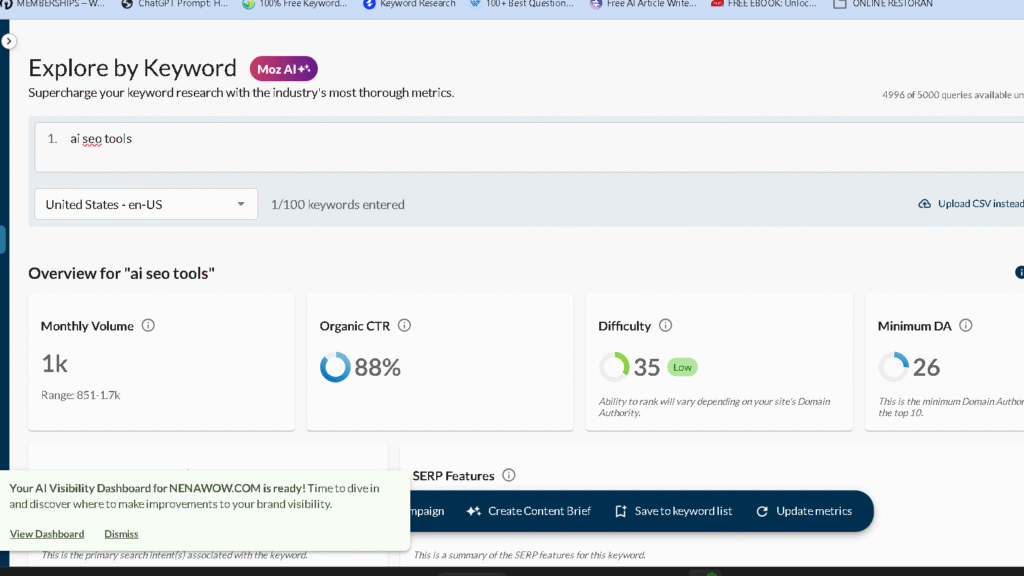
Test result for “AI SEO tools”:
| Tool | KD Score | Accuracy |
|---|---|---|
| Moz Pro | 35 | ⚠️ Optimistic |
| Semrush | 57 | ✅ Accurate |
| Ahrefs | 58 | ✅ Accurate |
That 22-point gap is the thing you really need to understand before relying on Moz’s difficulty scores. A KD of 35 says “this is achievable.” A KD of 57 says “you’ll need serious domain authority and backlinks to compete here.” If you act on Moz’s number without checking the actual SERP yourself, you can easily invest months of content creation chasing rankings that aren’t realistic for your site.
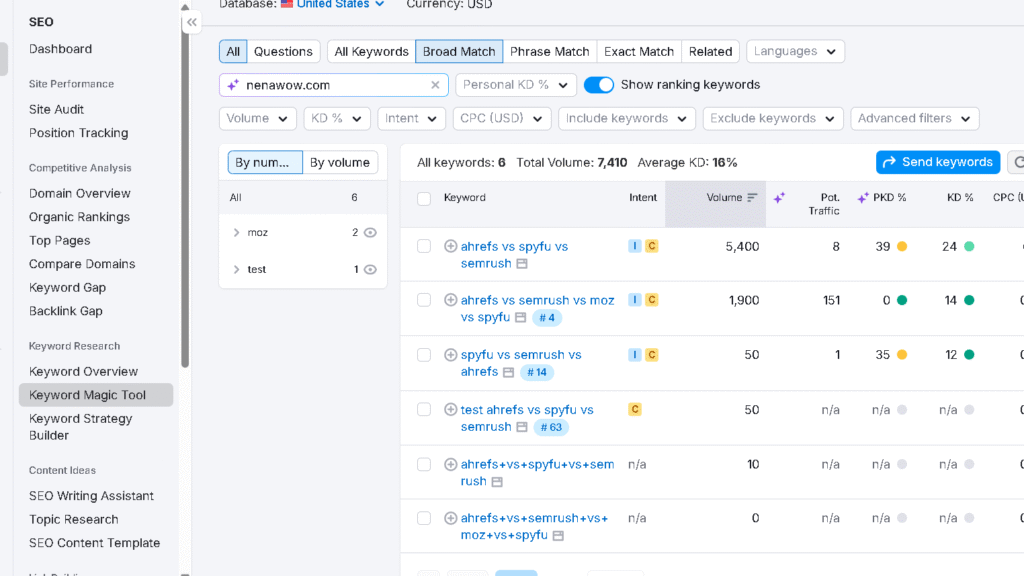
The reason for the gap comes down to methodology. Moz’s KD leans on Page Authority of currently-ranking pages. Ahrefs and Semrush factor in the actual backlink profiles behind those pages — a more complete picture of what it truly takes to crack page one.
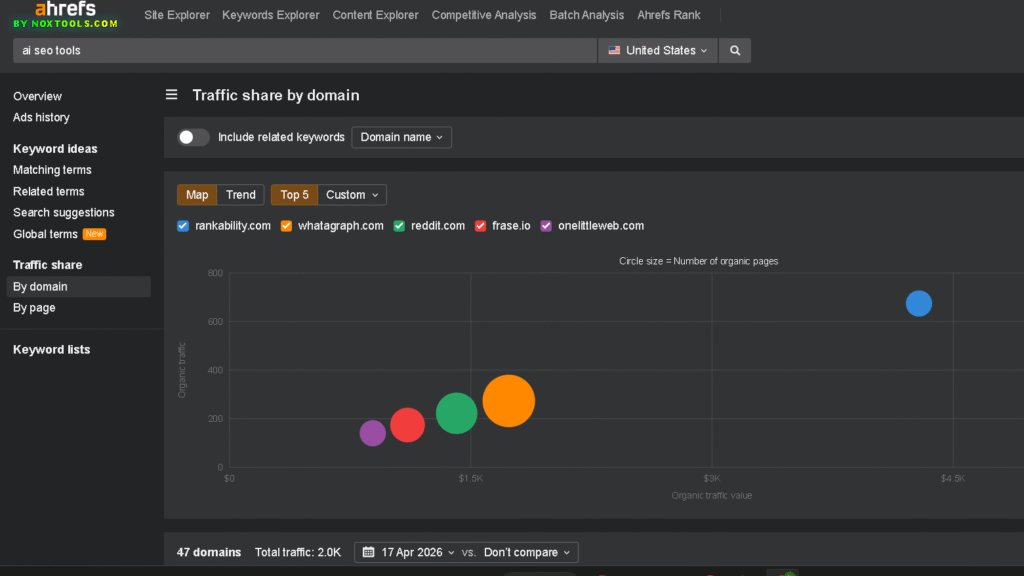
What Moz does explain well: Every metric comes with plain-language descriptions. When you hover over KD or Priority, Moz tells you what it means in real terms. Neither Ahrefs nor Semrush does it consistently. For someone learning SEO, that context matters more than people give it credit for.
Moz found a limited set of keyword opportunities for the “AI SEO tools” seed — noticeably fewer than Semrush’s 70+ suggestions. For volume-intensive keyword discovery, Semrush or Ahrefs pull further ahead. Moz is better suited for focused, single-topic research than broad keyword expansion.
Winner for keyword research: Moz wins on accessibility and explanation quality. Semrush and Ahrefs win on volume, accuracy, and competitive depth.
If you’re looking for a lower-cost alternative with solid keyword tracking, see my SE Ranking review.
Backlink Analysis: The Honest Numbers
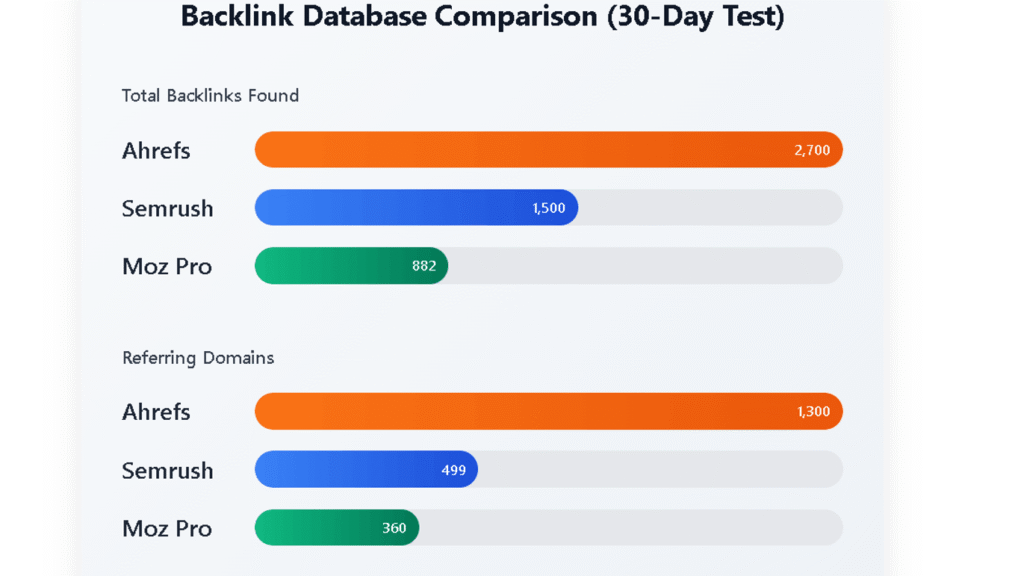
This is where Moz has the most ground to make up. These numbers came from the same site, the same crawl window:
| Tool | Backlinks Found | Referring Domains |
|---|---|---|
| Ahrefs | 2,700 | 1,300 |
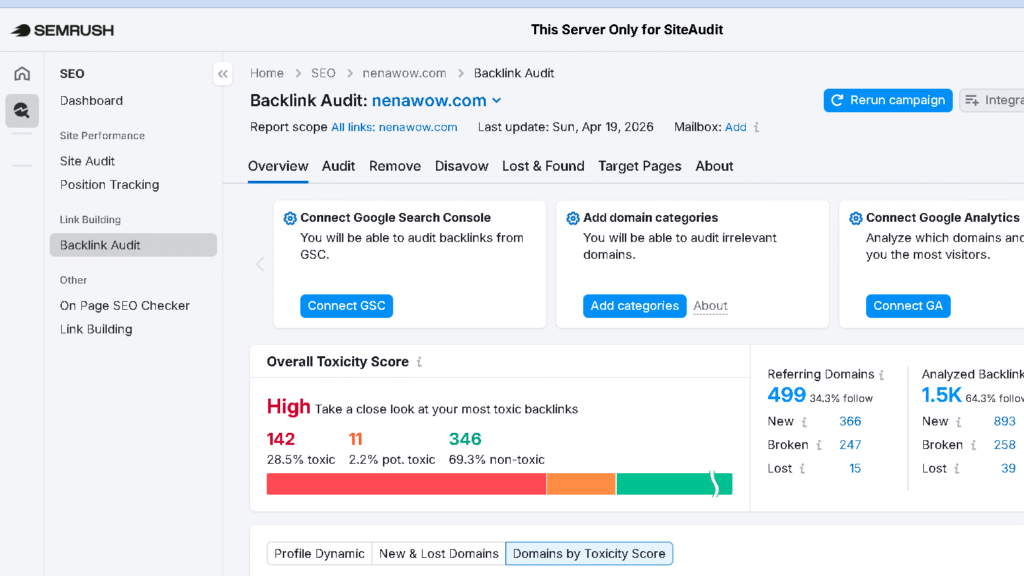
| Semrush | 1,500 | 499 |
| Moz Pro | 882 | 360 |
Moz found roughly 28% of the referring domains Ahrefs discovered. That’s not a rounding error — that’s a structural gap in the index. For link building, this has direct consequences. Any competitor backlink analysis or outreach list built on Moz data will have blind spots you don’t know about.
I explore this backlink database gap in much more detail in my full Ahrefs review, where I test index size, link freshness, and competitor link discovery head-to-head.
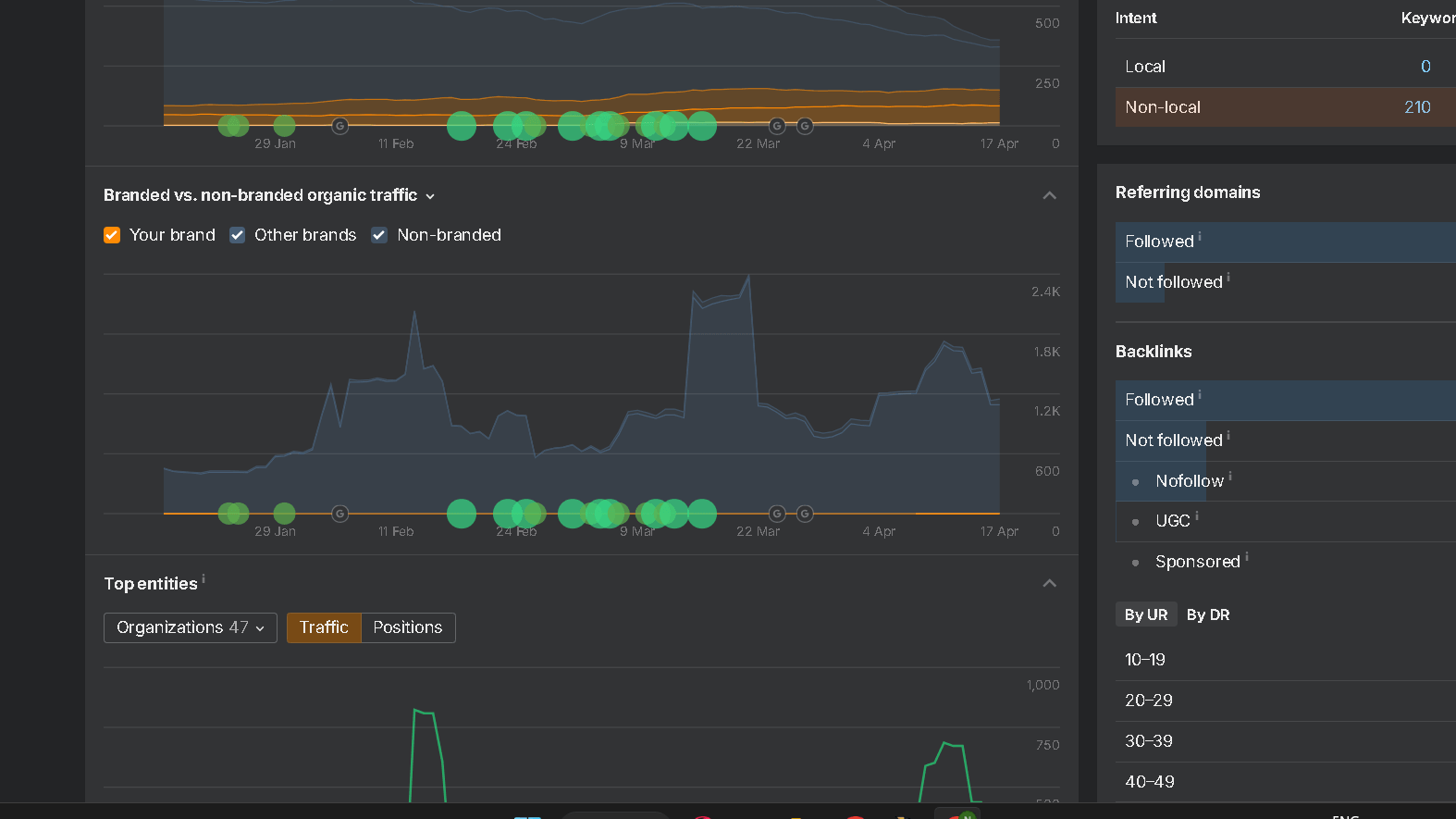
That said, there’s one area where Moz still owns the category entirely: Domain Authority (DA). When a journalist, PR contact, potential advertiser, or link partner asks about your site’s authority, they’re asking for DA. Not Ahrefs’ Domain Rating. Not Semrush’s Authority Score. DA is the shared language of the SEO industry, and Moz invented it. If you regularly communicate authority to clients or external partners, Moz DA remains the clearest shorthand available.
Beyond index size, Moz’s backlink analysis covers link types, anchor text distribution, and basic link tracking. It’s functional. But if link building is a core part of your strategy, you’ll feel the index ceiling quickly.
Site Audit: What Moz Finds (and Misses)
Moz’s site crawl returned 2,853 total issues across the test site — split into crawler issues, metadata problems, and content flags. The headline number sounds alarming. It’s mostly not.
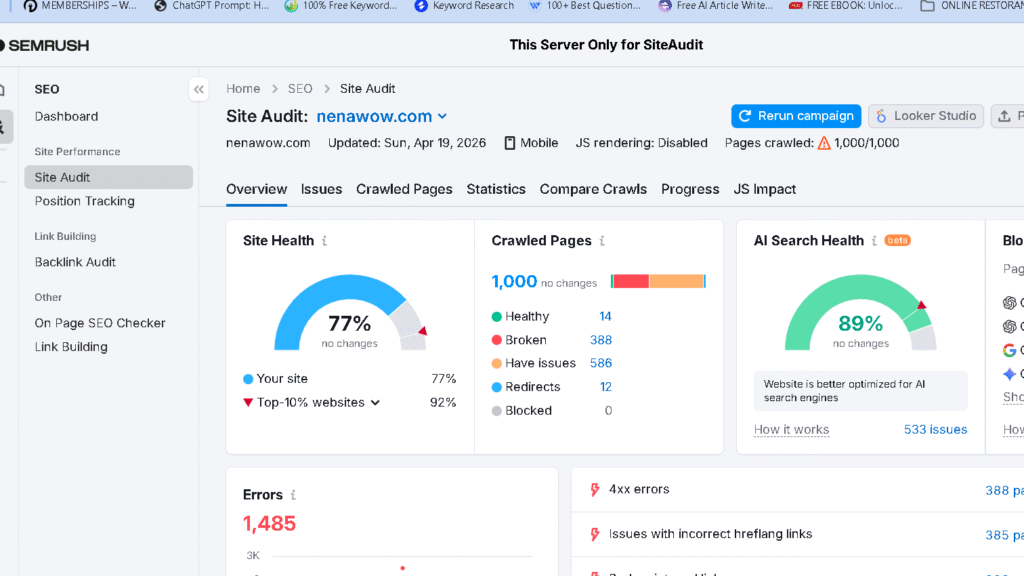
Moz logs each page instance separately rather than grouping related issues together. So if 34 pages share the same meta description, that shows up as 34 separate findings rather than one grouped item. Filtering by severity brings the list down to something workable, but it requires manual triage that Ahrefs doesn’t make you do.
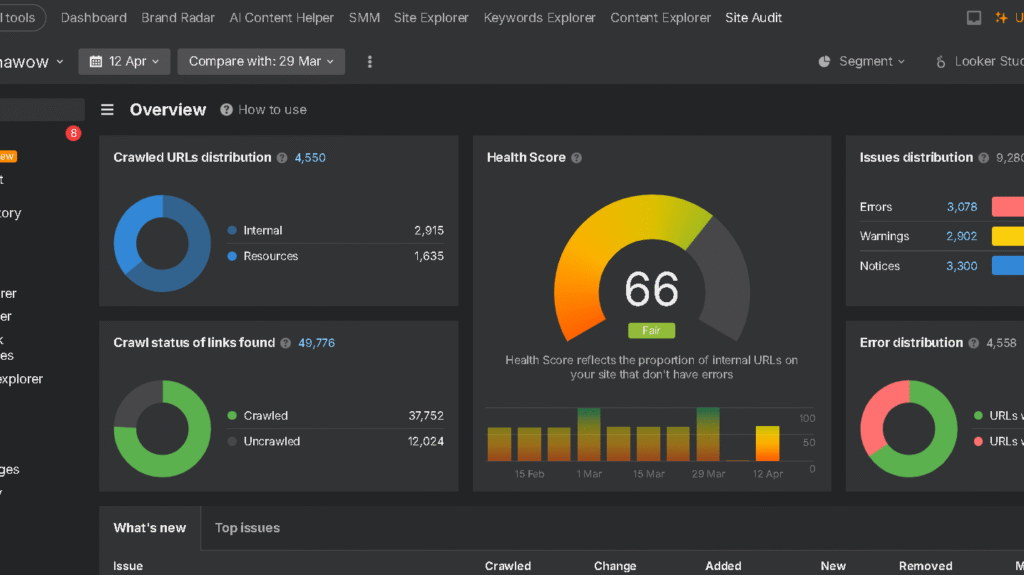
Head-to-head audit comparison:
| Tool | Issues Flagged | Orphaned Pages | Internal Link Map | Core Web Vitals |
|---|---|---|---|---|
| Ahrefs | 173 (grouped) | 45 | ✅ | ❌ |
| Semrush | 3,818 combined | 92 | ✅ | ✅ |
| Moz Pro | 2,853 | ❌ | ❌ | ❌ |
The two notable gaps: Moz doesn’t detect orphaned pages, and it has no internal link equity visualization. Both of those features drove significant fixes during the 30-day test. Ahrefs identified 45 orphaned pages and showed exactly which posts had no internal authority flowing to them. Moz didn’t flag either issue.
For a straightforward site with under 100 pages, Moz’s audit is perfectly adequate.
Rank Tracking
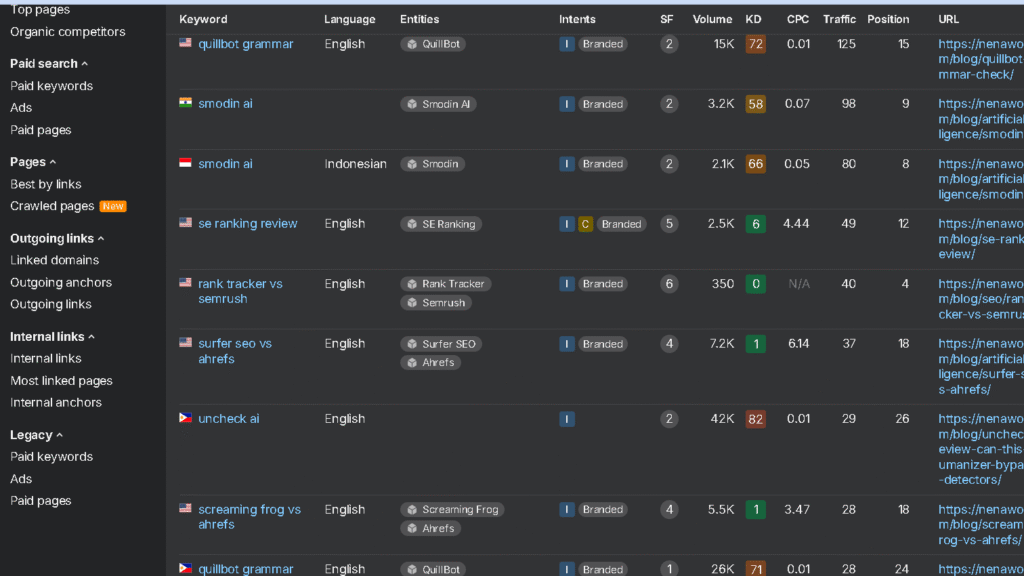
Moz’s rank tracker is solid for daily use. Position accuracy across the 30-keyword test landed within 1–3 positions of Google Search Console data — slightly wider than Ahrefs and Semrush (both within 1–2 positions), but close enough to be reliable for directional decisions.
Daily updates are available on Standard plan and above. The interface is clean, easy to read, and not overwhelming.
Where Moz diverges from the others: ChatGPT AI mention tracking. You can see whether your brand or site appears in ChatGPT responses when users ask questions relevant to your topic. Neither Ahrefs nor Semrush offers this in the same dedicated format. For brands asking “does AI mention us when someone searches our category?” — this is the only tool of the three that answers it directly.
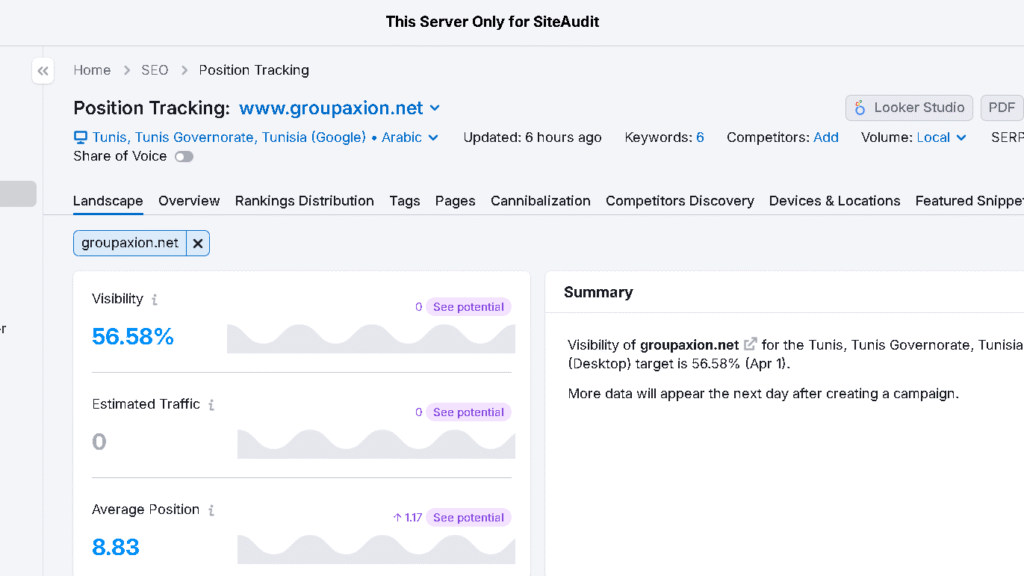
Rank tracking comparison:
| Feature | Moz Pro | Ahrefs | Semrush |
|---|---|---|---|
| Update Frequency | Daily (Standard+) | Daily | Daily |
| SERP Feature Tracking | ⚠️ Basic | ✅ Full | ✅ Full |
| AI Tracking | ✅ ChatGPT | ✅ Multi-engine | ✅ Google only |
| Visibility Score | ❌ | ❌ | ✅ |
| Cannibalization Alerts | ❌ | ✅ | ✅ |
The missing Visibility Score and cannibalization alerts are real gaps. During testing, Ahrefs flagged keyword cannibalization across four posts competing against each other — a high-impact finding that Moz didn’t surface.
Competitor Analysis
Moz covers the basics: Link Intersect for finding sites that link to competitors but not to you, and Keyword Explorer for mapping competitor keyword sets. The interface is approachable, and for a site still building out its competitive intelligence workflow, it’s a reasonable starting point.
The ceiling shows up fast, though. With 360 referring domains in the index versus Ahrefs’ 1,300, any link gap analysis will be materially incomplete. Moz’s Link Intersect feature is useful in concept but constrained by what its crawler has actually found.
For competitor keyword gaps, Moz provides useful directional data. It won’t match Semrush’s Keyword Gap tool (five competitors simultaneously, with PPC data alongside organic) or Ahrefs’ Content Gap (which surfaced 40+ keyword opportunities from three competitors in the test), but it gives you enough to identify blind spots on a focused topic.
Content Tools and AI Features
This is where Moz surprised me most in 2026. Two features stand out.
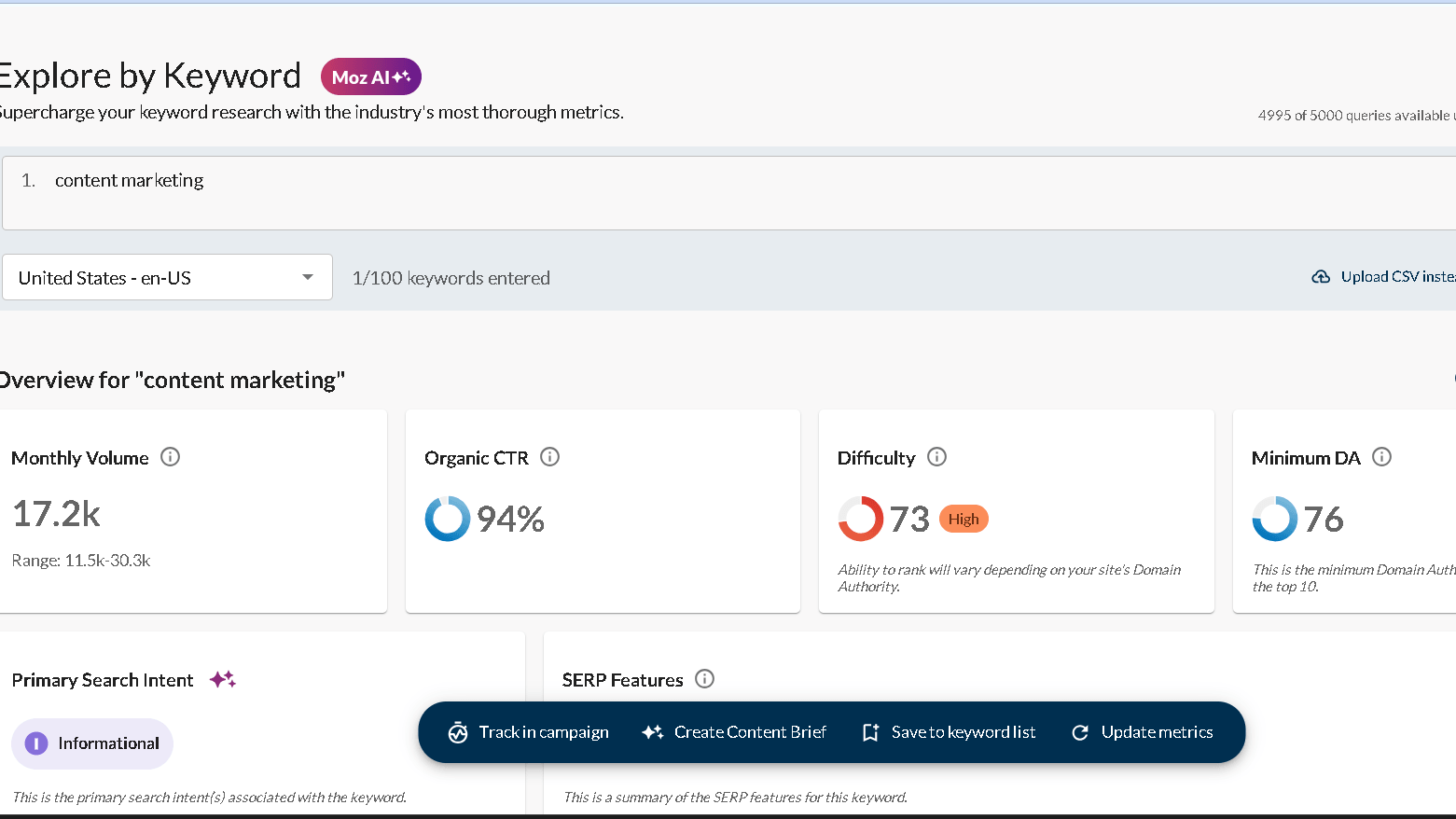
Page Optimization scores your existing or draft content against the top-ranking pages for a target keyword. It flags missing terms, topic gaps, and heading coverage. Not groundbreaking on its own — Semrush’s SEO Writing Assistant does something similar — but Moz’s implementation is clean and gives clear, actionable recommendations without AI-generated fluff.
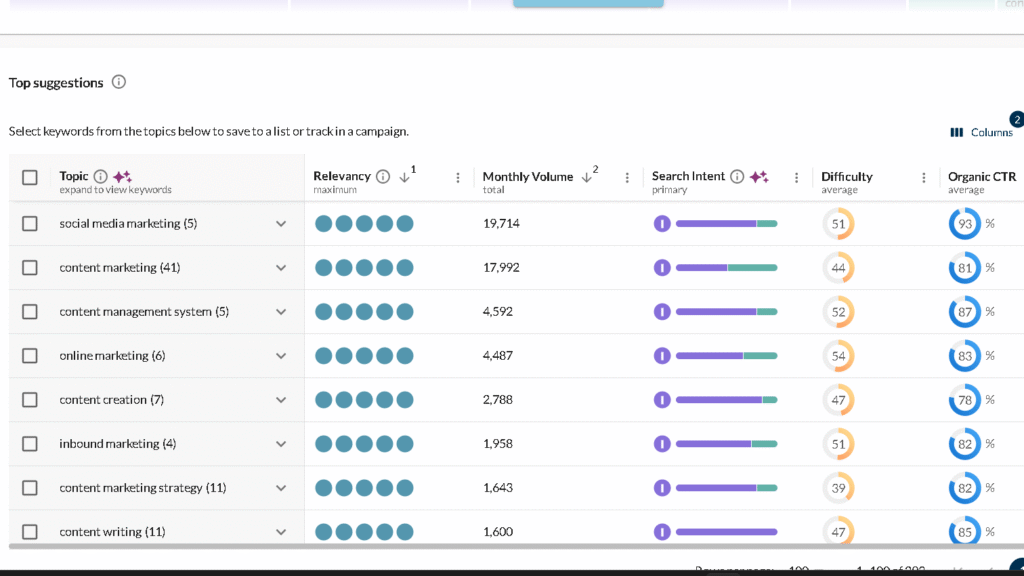
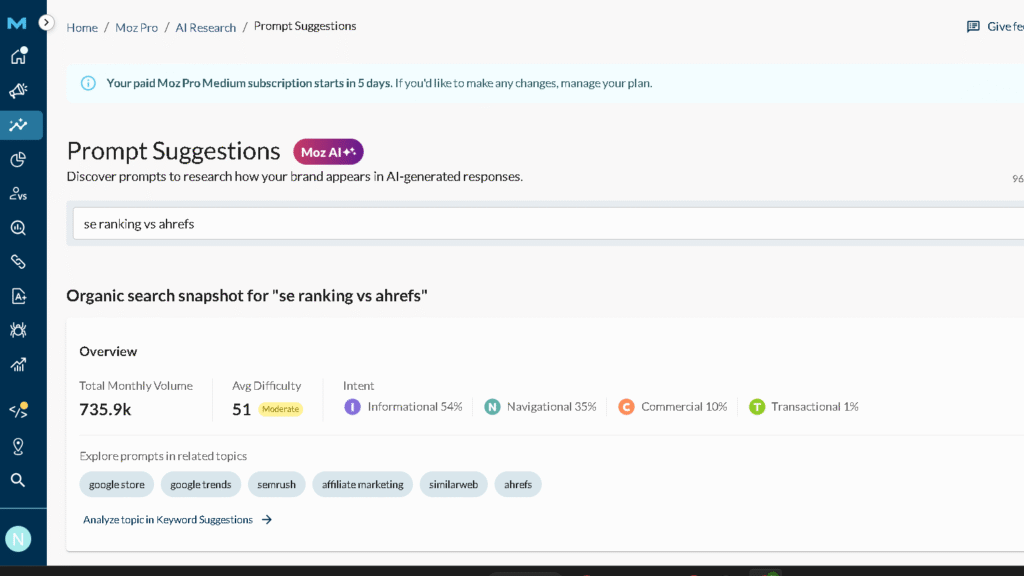
Keyword Prompt Suggestions is the more interesting feature. Enter a keyword, and Moz generates a structured list of specific questions and phrases your content should address, based on SERP data. It’s not AI-written copy. It’s a content brief — the questions real searchers are asking, organized so a writer can address them systematically. For content teams that want structure without automation, this is more practical than it might sound at first. Neither Ahrefs nor Semrush offers feature like this.
Content and AI feature comparison:
| Feature | Moz Pro | Ahrefs | Semrush |
|---|---|---|---|
| AI Tracking | ✅ ChatGPT | ✅ Multi-engine | ✅ Google only |
| Page Optimization | ✅ | ❌ | ✅ |
| Keyword Prompt Suggestions | ✅ | ❌ | ❌ |
| AI Content Generation | ❌ | ❌ | ✅ ContentShake AI |
| Topic Research | ❌ | ❌ | ✅ |
| Content Explorer | ❌ | ✅ | ✅ |
Semrush leads on content production volume — full AI drafts, SEO writing assistant, topic research. Ahrefs leads on multi-engine AI Overview tracking. Moz’s lane is narrower but distinct: ChatGPT visibility monitoring and structured content briefs through prompt suggestions.
Ease of Use
Moz is the most accessible SEO platform in this category. Terminology gets explained in context. The Priority score in Keyword Explorer means a new user doesn’t have to synthesize volume, difficulty, and CTR manually — Moz does it. Most people can run a keyword search and understand the output within their first ten minutes.
Onboarding is guided. The dashboard walks you through setting up rank tracking, running a crawl, and exploring keywords without assuming prior knowledge. Compare this to Ahrefs, where getting comfortable across five separate tools (Site Explorer, Keywords Explorer, Content Explorer, Site Audit, Rank Tracker) typically takes 2–4 weeks of consistent use.
| Aspect | Moz Pro | Ahrefs | Semrush |
|---|---|---|---|
| Learning Curve | Low | Steep | Moderate |
| Guided Onboarding | ✅ | ❌ | ✅ |
| Beginner-Friendly Language | ✅ | ❌ | Partial |
| Time to First Useful Data | Fastest | Longest | Moderate |
| White-Label Reporting | ❌ | ❌ | ✅ |
The one usability gap worth mentioning: client reporting. Moz’s reporting is basic. Agencies that need branded, white-label reports will need to assemble them manually — a time cost that Semrush eliminates.
30-Day Test Results from a Real Site
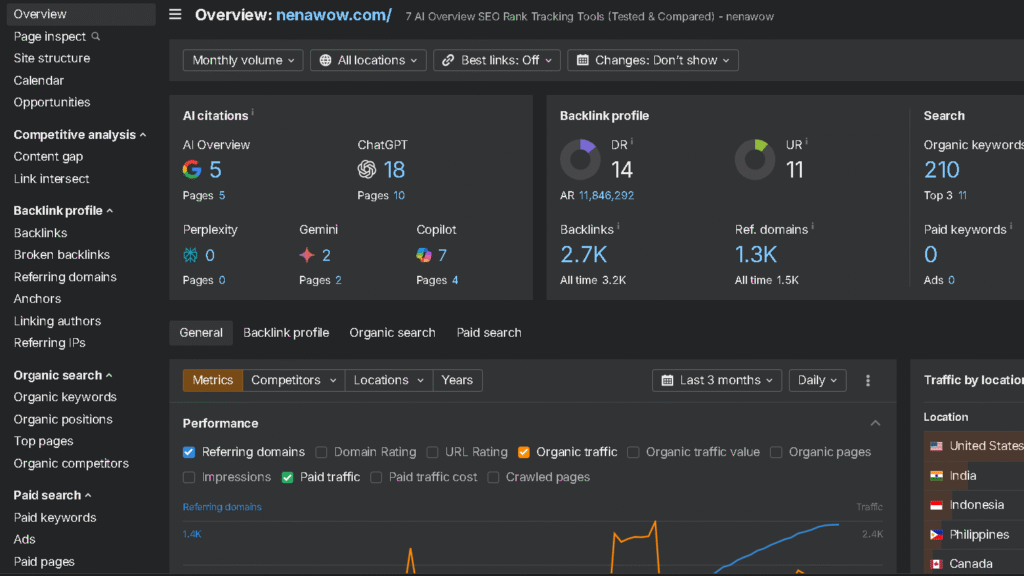
Baseline: nenawow.com — 220 posts, ~1,000 monthly organic visits per GSC, ~1,300 referring domains.
What Moz found in weeks 1–2:
Page Optimization flagged content gaps on several posts I was already planning to refresh — missing topic coverage, heading gaps, thin sections. Prompt suggestions generated structured briefs for two posts with low organic performance. Both were rewritten and republished by week three.
What Moz missed:
The highest-impact finding of the entire test — an accidental noindex tag blocking six posts from Google — came from Ahrefs. Moz didn’t flag it. Keyword cannibalization across four posts also went undetected. Orphaned pages: not found.
Day 30 outcomes (all three tools combined):
| Metric | Day 1 | Day 30 | Change |
|---|---|---|---|
| Monthly Organic Visits | ~1,000 | ~1,340 | +34% |
| Keywords in Top 10 | 18 | 27 | +9 |
| Keywords in Top 3 | 4 | 7 | +3 |
| Crawl Errors | 173 | 41 | −132 fixed |
| Referring Domains | 358 | 371 | +13 |
The noindex fix drove the majority of the traffic recovery. Moz’s content tools contributed to the keyword improvements. SEO causation is never clean — treat this as directional, not a controlled experiment.
Who Should NOT Use Moz Pro
Skip Moz if you’re a serious link builder. Working from a 360-domain index when your competitor has 1,300 means your outreach lists will have structural blind spots you can’t see. That matters.
Skip Moz if keyword difficulty accuracy drives content investment decisions. A 22-point optimism gap on competitive keywords will send resources toward rankings you can’t currently reach.
Skip Moz if you need Google AI Overview tracking. Moz covers ChatGPT mentions. It doesn’t track Google’s AI Overviews or Bing Copilot. For full generative search visibility, Ahrefs or Semrush gives you broader coverage.
Skip Moz if you’re running a content agency with reporting needs. No white-label reporting means more manual work per client.
Moz Pro Alternatives
| Situation | Best Pick |
|---|---|
| Largest backlink index | Ahrefs ($129/mo) |
| Full marketing suite | Semrush ($139.95/mo) |
| Mid-budget with solid rank tracking | SE Ranking (~$65/mo) |
| Blogger, keyword-focused only | Mangools (~$29/mo) |
| Complete beginners on tight budget | Ubersuggest ($12/mo) |
| Zero budget, backlink data on your site | Ahrefs Webmaster Tools (free) |
SE Ranking is the most logical alternative if you’ve outgrown Moz but can’t justify Ahrefs pricing. Solid rank tracking, functional audit, reasonable keyword research — at roughly half the cost of Ahrefs Lite.
Ahrefs Webmaster Tools is worth setting up regardless of which platform you use. Free, permanent, no credit card — it gives you real Ahrefs backlink and audit data for any domain you verify. Running it alongside Moz Pro is an effective combination while you evaluate whether to upgrade.
Can I use Moz Pro and Ahrefs together?
Yes, and it’s a practical combination. Use Moz for DA tracking, keyword research, ChatGPT visibility monitoring, and on-page optimization. Use Ahrefs Webmaster Tools (free) for real backlink data on your own domain. When competitive intelligence becomes a daily priority, upgrading to full Ahrefs becomes a straightforward decision.
Final Verdict
Moz Pro is the right tool for a specific type of user: someone earlier in their SEO journey, building content, tracking a manageable keyword set, and needing an affordable, understandable platform to grow with. The DA metric, beginner-friendly interface, ChatGPT tracking, and prompt suggestions make it a meaningfully different tool than it was in 2024.
It’s not the right tool if link building is core to your strategy, if you’re operating in competitive niches where difficulty calibration drives investment decisions, or if you need the technical depth that Semrush and Ahrefs deliver on larger sites.
The hybrid that makes practical sense: start with Moz Pro for its content and optimization workflow, run Ahrefs Webmaster Tools free on your domain, and upgrade to a full Ahrefs or Semrush subscription when competitive intelligence becomes a daily priority.
The 30-day free trial is genuinely worth taking. Evaluate it with real keywords and a real site — you’ll know quickly whether it fits your workflow.
FAQ
Different calculation methods. Moz’s KD is based primarily on the Page Authority of pages currently ranking. Ahrefs and Semrush incorporate the actual backlink profiles of those pages — which produces more conservative, more accurate scores for competitive queries. Always verify against the live SERP before committing to a target keyword.
Both measure domain authority — but Moz DA is the metric clients, journalists, advertisers, and link prospects actually ask for. It’s the industry standard for communicating site authority to non-SEO audiences. Ahrefs’ Domain Rating (DR) and Semrush’s Authority Score are solid metrics internally, but neither carries the same universal recognition outside of the SEO community.
Yes, but specifically ChatGPT. Moz’s AI Visibility dashboard tracks whether your site appears in ChatGPT responses for relevant queries. It doesn’t cover Google’s AI Overviews or Bing Copilot. If your priority is Google AI Overview tracking, Ahrefs (multi-engine) or Semrush (Google-focused) fills that gap better.
For basic sites, yes. For complex or large sites, it has gaps. Moz doesn’t detect orphaned pages, lacks internal link equity visualization, and doesn’t track Core Web Vitals. Semrush goes deepest on technical coverage; Ahrefs gives you faster signal-to-action. Moz’s audit is functional but will miss things the others catch.
Within 1–3 positions of Google Search Console data across 30 keywords tested over 30 days. Ahrefs and Semrush landed within 1–2 positions. The gap is small enough that Moz’s rank data is reliable for trend monitoring and directional decisions. Where it falls behind is SERP feature context — Moz’s SERP feature tracking is basic compared to the full coverage Ahrefs and Semrush provide.
Test data from nenawow.com, April 2026. Pricing and features change — verify directly with each provider before purchasing.