Short answer: yes, but the numbers get more complicated the closer you look. I spent two weeks testing how to track brand mentions in AI using AthenaHQ to find out what “tracking” actually means once ChatGPT and AI Overviews get involved. What I found was not one number. It was four, and they do not all agree with each other.
Here is the real question buried under the search term. It is not whether these tools exist. It is whether a mention, a citation, and an attribution are the same thing. They are not, and the difference is the whole story.
Table of Contents
Four Words That Do Not Mean the Same Thing
Every AI visibility tool I have tested reports some mix of these four signals, often without explaining how they differ. I want to define them plainly before showing you my own numbers.
A mention means your brand name shows up somewhere in an AI response. A position tells you where in that response the mention lands, first sentence or buried at the end. A citation rate measures how often the model’s answer shows citation behavior tied to your domain in some form. Attribution is the strictest of the four. It means the tool can confirm a specific source URL from your site got pulled directly into the answer.
Four different questions. Four different answers, as I was about to learn.
My Two-Week Test: The Numbers
I ran nenawow.com through AthenaHQ and pulled the dashboard at day seven, then again at day fourteen.
At day seven, AthenaHQ had analyzed 60 responses. Mention rate sat at 42.9 percent, well above the 30.7 percent competitor average. Average position was 2.0. Citation rate came in at 15.0 percent. Attributed citations read 0.0 percent.
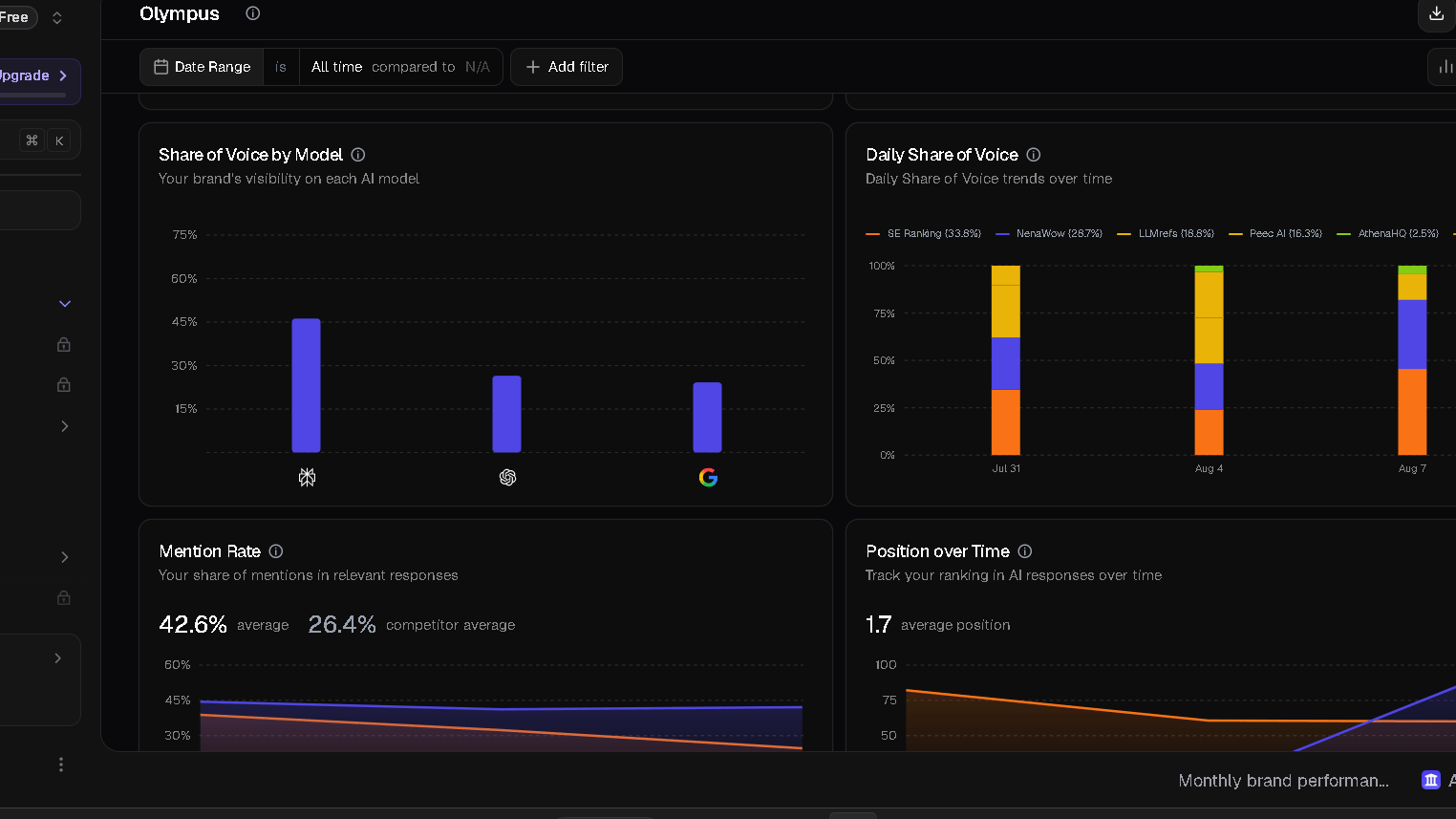
AthenaHQ shows NenaWow maintaining a 42.6% average mention rate versus a 26.4% competitor average, with an average AI response position of 1.7.
By day fourteen, the sample had grown to 90 responses. Mention rate held at 42.6 percent, still well above the 26.4 percent competitor average that week, about 61 percent higher. Position improved to 1.7. Citation rate climbed slightly to 15.6 percent. Attributed citations still read 0.0 percent.
Worth flagging early: the sample size grew between checkpoints, 60 responses to 90. These are not two identical snapshots of the exact same data. They are two readings, seven days apart, on a growing pool of tracked answers. Keep that in mind as you read the rest.
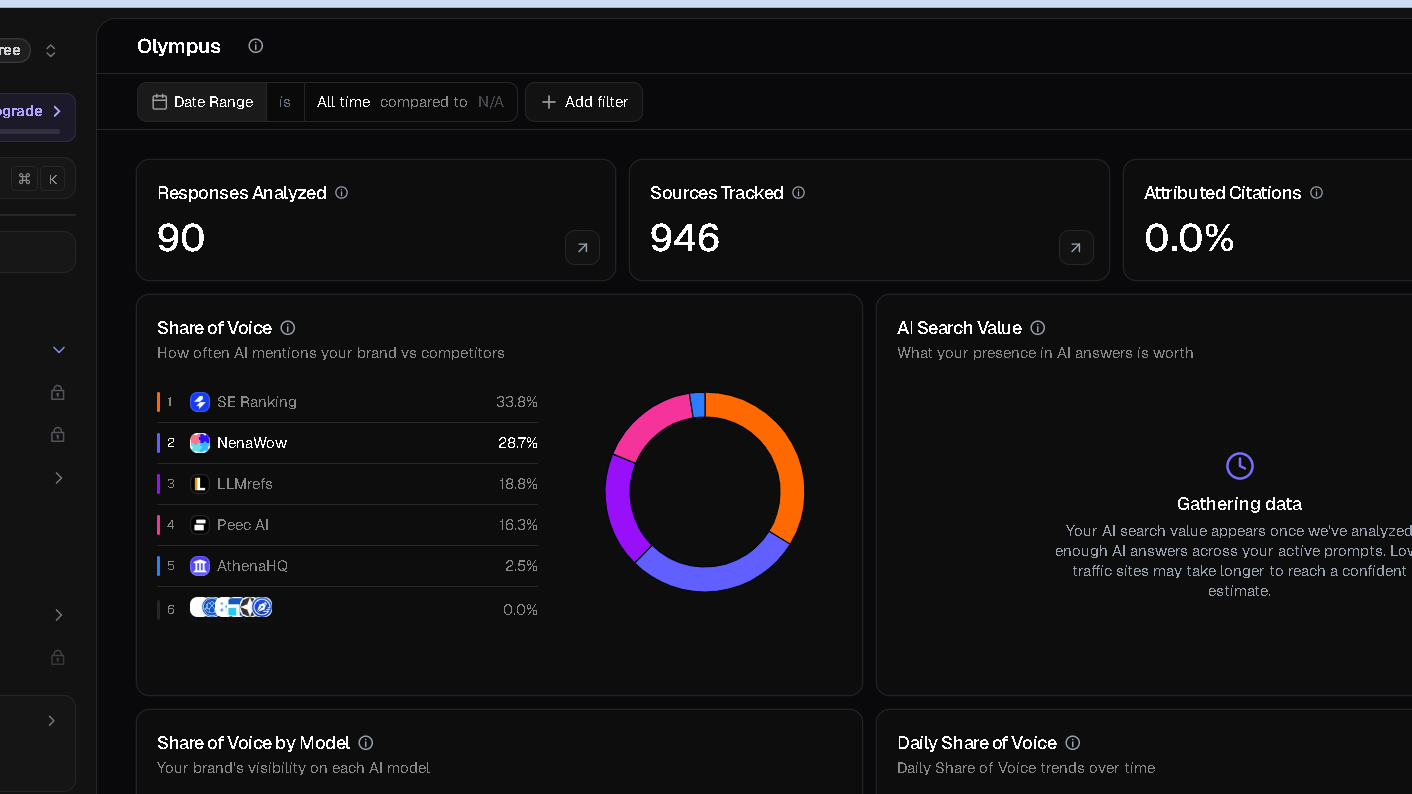
NenaWow ranks second in AthenaHQ’s AI Share of Voice at 28.7%, with a 42.6% mention rate and 1.7 average position in the current 90-response sample.
Sit with the core numbers for a second, though. Citation rate says my content shows citation behavior around 15 percent of the time. Attribution says zero.
The Gap Inside the Gap
This is where the article almost went wrong, and I want to be upfront about that. My first instinct was to write that none of my mentions ever turned into a link back to my site. That is not quite true, and the dashboard itself pushes back on it.
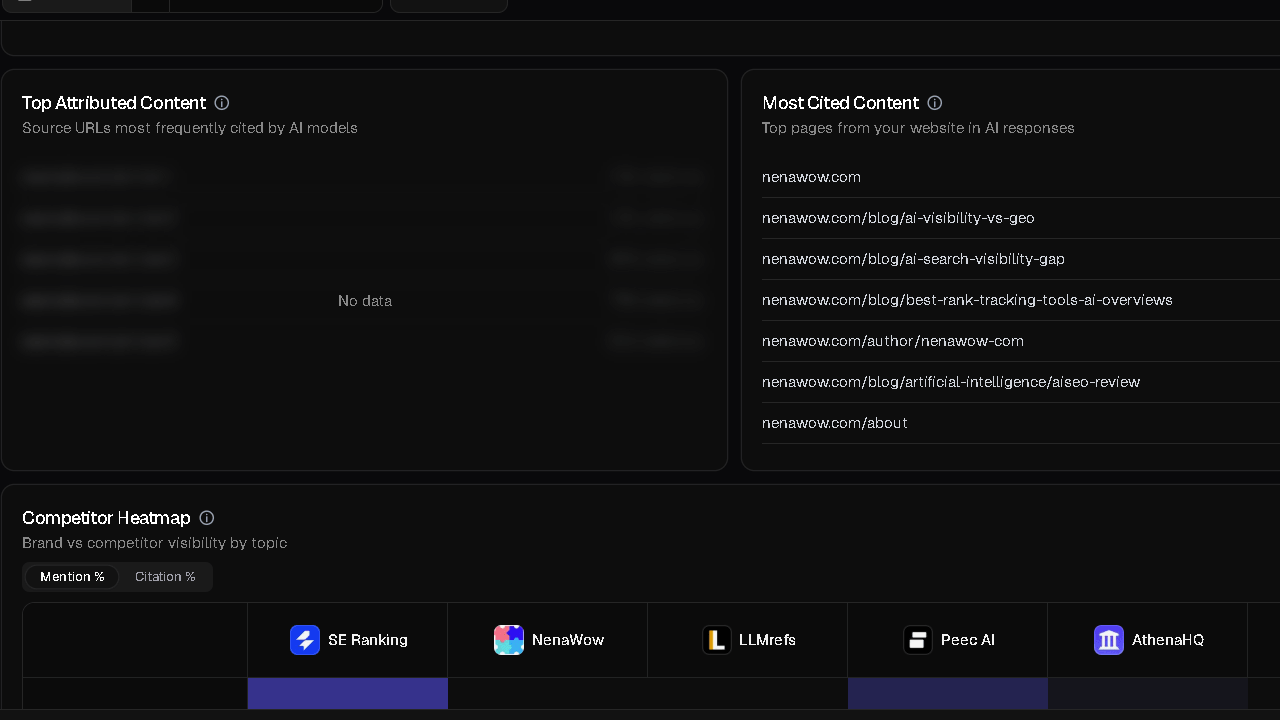
AthenaHQ identifies multiple NenaWow pages among the most cited content in AI responses, including the AI Visibility vs GEO and AI Search Visibility Gap articles.
Under Most Cited Content, AthenaHQ names specific pages pulling weight: my homepage, the AI visibility versus GEO piece, the AI search visibility gap article, the rank tracking roundup, my About page, and two tool reviews. Those are not hypothetical. Those are named URLs the tool lists as showing up as sources.
So AthenaHQ’s citation rate and its attributed-citation metric appear to be measuring different things, and the dashboard does not make that distinction fully clear. One reads roughly 15 percent citation behavior. The other reads zero attribution. I am not calling that a contradiction. I am calling it two metrics that need a clearer definition from the tool itself.
What I Think Is Actually Happening
I do not have a confirmed answer for why these two numbers split. What I have is a working interpretation, and I want to label it as exactly that.
My working interpretation is that citation rate is the broader signal, something closer to influence, while attribution is the stricter proof, a confirmed source-URL match the tool can stand behind with confidence. If that interpretation is correct, influence is easier to measure than proof. That would explain why one number moves and the other sits at zero across two checkpoints.
I am not certain this is right. It is the most reasonable read of two metrics from the same dashboard pointing in different directions, and I will keep testing it.
What Changed Between Day Seven and Day Fourteen
Metric
Day 7
Day 14
Responses analyzed
60
90
Mention rate
42.9%
42.6%
Competitor average
30.7%
26.4%
Average position
2.0
1.7
Citation rate
15.0%
15.6%
Attributed citations
0.0%
0.0%
Not much, and that itself tells you something. Mention rate barely moved, 42.9 percent down to 42.6 percent. Position improved a touch, 2.0 down to 1.7, a good direction since lower means closer to the top of the answer. Citation rate ticked up slightly, 15.0 to 15.6 percent. Attribution stayed flat at zero across both checkpoints, even as the sample grew from 60 to 90 responses.
Visibility stayed strong. Position improved. Citation edged up. Attribution did not move at all. I am not claiming any of these numbers caused another. I am reporting what the dashboard showed, twice, a week apart.
One possible explanation is that AI systems may favor sources with stronger, more established authority signals, and that a site rebuilding its standing needs more than two weeks to earn full attribution credit. I want to flag that as a hypothesis, not a finding. My own site is still working through a content recovery period, so I cannot rule out that timing alone explains part of this.
Visibility Depends on the Topic
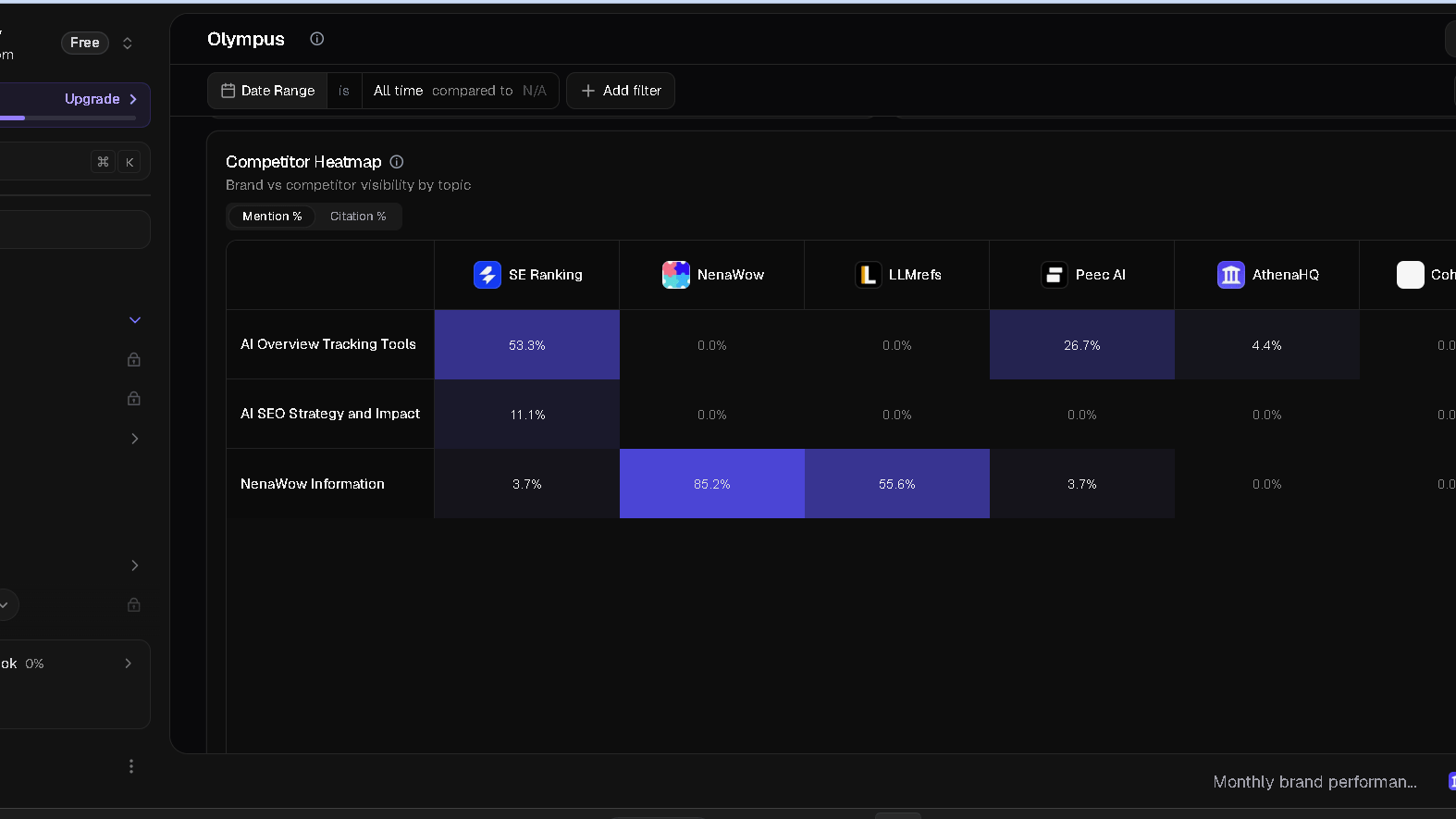
The overall share-of-voice number also hides an important detail: NenaWow’s visibility isn’t evenly distributed across every topic. AthenaHQ’s competitor heatmap shows NenaWow at 85.2% mention share for “NenaWow Information,” while SE Ranking leads the “AI Overview Tracking Tools” category.
AthenaHQ’s competitor heatmap shows NenaWow dominating the “NenaWow Information” topic with an 85.2% mention share, while SE Ranking leads the AI Overview Tracking Tools category.
That distinction matters because an overall AI visibility score can hide where a brand is actually strong. In my case, NenaWow is particularly visible when the prompts are directly about NenaWow, while established competitors remain stronger in broader tool-related queries.
Which Tools Can Actually Show You This
I have only run a full multi-week test on AthenaHQ so far, with ZipTie and SE Visible queued for the same treatment. What I can speak to firsthand is what AthenaHQ’s dashboard shows, since that is the one I have real numbers for.
It reports mention rate, position, citation rate, and attributed citations as four separate lines rather than folding them into one blended score. That separation is exactly what let me catch the split between citation rate and attribution in the first place. A tool that reports one combined “visibility score” would have hidden this completely.
ZipTie splits citations, mentions, and sentiment into three distinct reads rather than one number, at least based on how it is described. I have not run it long enough yet to make a meaningful comparison. That test is next.
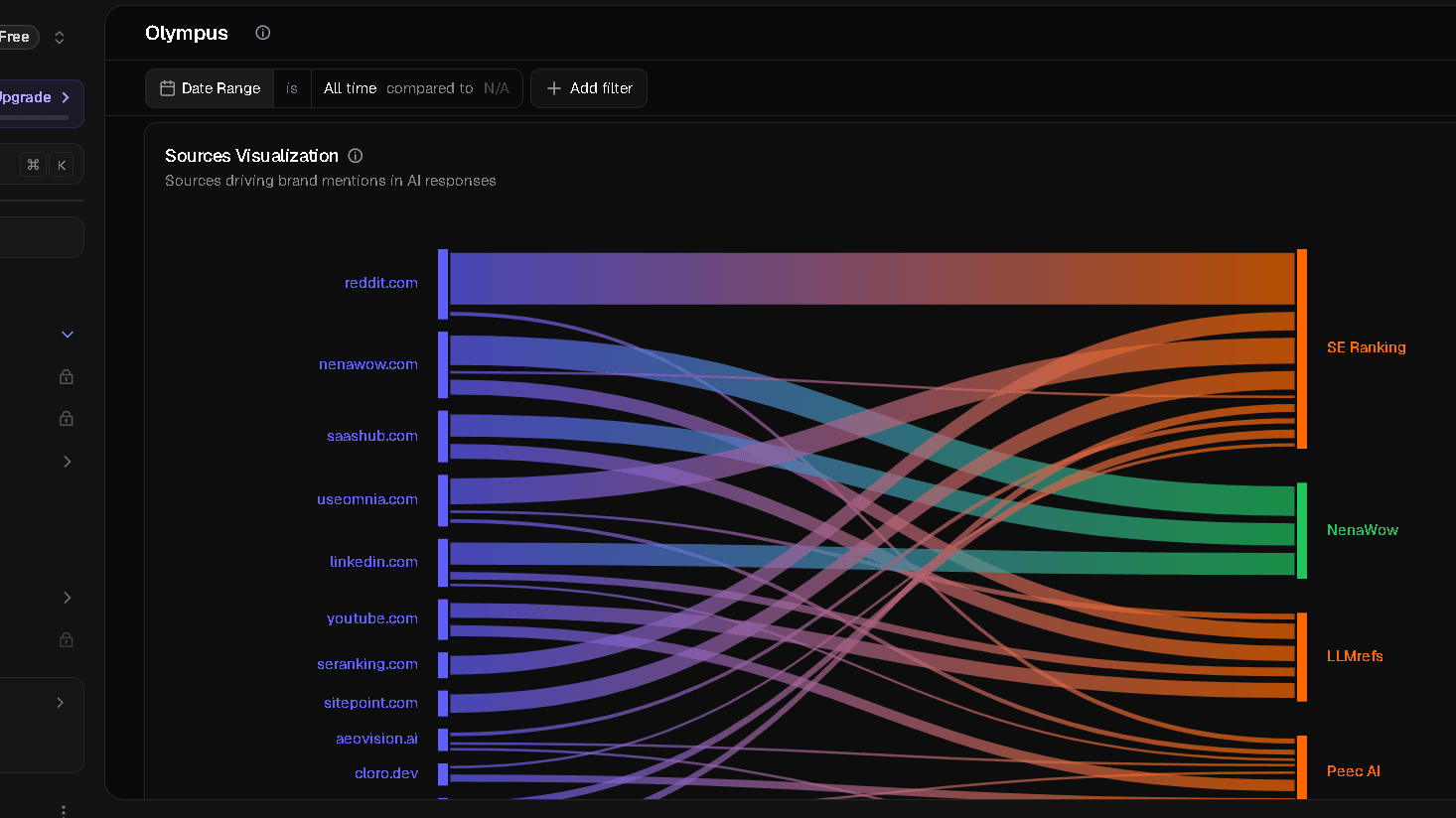
AthenaHQ maps the external sources associated with AI brand mentions, including NenaWow.com, Reddit, SaaSHub, LinkedIn, YouTube and other websites.
What Traffic Actually Depends On
I want to be careful with this part, because it is easy to overstate. A citation with a confirmed attribution creates a direct path to your site, a link someone can actually click. A mention without one does not create that path, but it is not worthless either.
A brand mention can still push someone to search your name manually later, or plant recognition that shows up somewhere else down the line. Indirect brand awareness is real, even without a clickable link attached to it. What I would not do is assume a strong mention rate is quietly driving traffic behind the scenes. I have no data proving that yet, in either direction.
What I Still Do Not Know
I want to be honest about the edges of this test, because a two-week read on one tool is a start, not a conclusion.
I do not know why citation rate and attribution read so differently. I do not know whether that split is specific to AthenaHQ’s measurement method or shows up across other tools too. I do not know whether more time would close the gap, or whether attribution simply requires a stronger link profile than my site has built yet. Those are the exact questions the next checkpoint needs to answer.
What I Am Tracking Next
Day thirty is next. I want to see whether attribution moves off zero at all, or whether it holds flat while citation rate keeps drifting upward. If the split holds through day thirty, that becomes the real finding, not a two-week anomaly but a structural feature of how these tools grade a smaller, recovering site.
Can you track brand mentions in ChatGPT specifically?
Yes. Tools like AthenaHQ, ZipTie, and SE Visible run prompts through ChatGPT alongside other models and report whether your brand appears in the response. Some break results out by model, so you can see whether you show up more in ChatGPT than in Perplexity or Google AI Overviews.
Is a mention in an AI answer the same as a citation?
No, and my own test shows why that distinction matters. Mention rate measures whether your brand name appears at all. Citation rate measures a broader pattern of citation-like behavior. Attribution is the strictest read, a confirmed source-URL match. In my two-week AthenaHQ test, mention rate ran above 42 percent both weeks while attribution stayed at zero, even as citation rate sat near 15 percent. Treat these as separate metrics, not one number wearing different names.
Do AI mentions actually drive traffic?
The honest answer is I do not fully know yet. A citation with confirmed attribution gives readers a direct link to click. A mention without one may still build brand awareness that shows up later as a manual search, though I have no data confirming that path for my own site. Do not assume a high mention rate is quietly converting into clicks without checking your citation and attribution numbers too.
How long should I track before drawing conclusions?
Longer than two weeks, based on what I found. My day-seven and day-fourteen numbers were close enough to call a real pattern rather than noise, but attribution held flat at zero across both checkpoints, even as the tracked sample grew from 60 to 90 responses. I am running this through day thirty before treating the split between citation rate and attribution as settled.