
This is hands-on Ahrefs vs Semrush vs Ubersuggest comparison.
Picking between Ahrefs, Semrush, and Ubersuggest isn’t just a budget decision. Each tool reflects a fundamentally different philosophy about who SEO is for, and what accurate data actually looks like when you’re in the trenches.
Quick Answer: Ahrefs is the best tool for serious SEO and backlink research. Semrush is the best all-in-one marketing platform covering paid and organic search. Ubersuggest is the best budget option for beginners. Based on 30-day simultaneous testing on a real site (April 2026), Ahrefs had the largest backlink index, Semrush the most features, and Ubersuggest the lowest cost.
I ran all three simultaneously on a real niche website, nenawow.com, 220 published posts, roughly 1,000 monthly organic visits, for a full 30 days in April 2026. Same keywords. Compared same competitor domains. Same audit crawls. The goal was simple: cut through the marketing claims and figure out what each tool actually delivers when the stakes are real.
Here’s what I discovered.
Disclaimer : Transparency is something I firmly believe in. I might receive a tiny commission if you use the links on this website to make a purchase without charging you anything extra. This enables me to continue writing frank reviews.
Table of Contents
Ahrefs vs Semrush vs Ubersuggest: Quick Comparison
| Feature | Ahrefs | Semrush | Ubersuggest |
|---|---|---|---|
| Backlink Database | Strongest | Strong | Basic |
| Keyword Research | Precise | Extensive | Simple |
| Site Audit | Technical Focus | Detailed Reporting | Basic |
| PPC Tools | Limited | Excellent | No |
| Ease of Use | Clean | Feature-Heavy | Beginner-Friendly |
| Starting Price | $129 | $139.95 | $12 |
Best for serious SEO: Ahrefs
Best all-in-one marketing tool: Semrush
For beginners best choice: Ubersuggest
How I Tested All Three Tools
nenawow.com is a two-year-old niche site covering AI and SEO topics. 220 posts, no paid traffic, competing in a reasonably crowded content space. Small enough to audit completely. Competitive enough to stress-test each platform’s data.
One important caveat before we get into the numbers. This is a relatively low-authority site with around 1,300 referring domains. That matters. The data gaps between tools, especially between Ahrefs and Semrush, tend to be more pronounced on smaller sites and can narrow meaningfully on high-authority domains with tens of thousands of backlinks.
If you’re managing an enterprise site, treat the proportional differences here as directional, not definitive.
Over 30 days, I:
- Tracked 30 identical target keywords in all three rank trackers simultaneously
- Ran the same seed terms through each keyword research tool
- Put the same three competitor domains through each backlink analyzer
- Ran full site audits on the same crawl settings across all platforms
- Used each tool’s content gap feature against the same competitor set
Nothing was cherry-picked. The data below reflects what each tool actually surfaced.
Ubersuggest vs Semrush vs Ahrefs: Pricing Breakdown
Ahrefs Pricing (2026)
| Plan | Monthly | Annual (per month) |
|---|---|---|
| Lite | $129 | $108 |
| Standard | $249 | $208 |
| Advanced | $449 | $374 |
| Enterprise | Custom | Custom |
Free option: Ahrefs Webmaster Tools. Permanently free, no credit card required, no expiry. You get real Ahrefs data for any verified domain you own.
👉 Verify current Ahrefs pricing before purchasing, as rates may have changed since testing.
Semrush Pricing (2026)
| Plan | Monthly | Annual (per month) |
|---|---|---|
| Pro | $139.95 | $117.33 |
| Guru | $249.95 | $208.33 |
| Business | $499.95 | $416.66 |
Prices shown were accurate during April 2026 testing — verify current pricing via the link , as Semrush has adjusted rates several times in recent years.
Free option: Limited free account with 10 searches per day. Not enough for a real workflow, but enough to evaluate the interface.
👉 Verify current Semrush pricing before purchasing.
Ubersuggest Pricing (2026)
| Plan | Monthly | Lifetime (one-time) |
|---|---|---|
| Individual | $12 | $120 |
| Business | $20 | $200 |
| Enterprise | $40 | $400 |
The lifetime deal is Ubersuggest’s sharpest competitive edge. A single month of Ahrefs Lite costs more than a lifetime Individual plan from Ubersuggest. That gap tells you immediately who each product is designed for.
👉 Verify current Ubersuggest pricing before purchasing.
Ubersuggest vs Ahrefs vs Semrush Feature Comparison
Head-to-Head: Keyword Research
Keyword research is where quality gaps become obvious fastest. Volume estimates and difficulty scores look similar across tools until you start cross-referencing them against real SERPs. That’s where things get interesting.
Ahrefs Keyword Research Tool
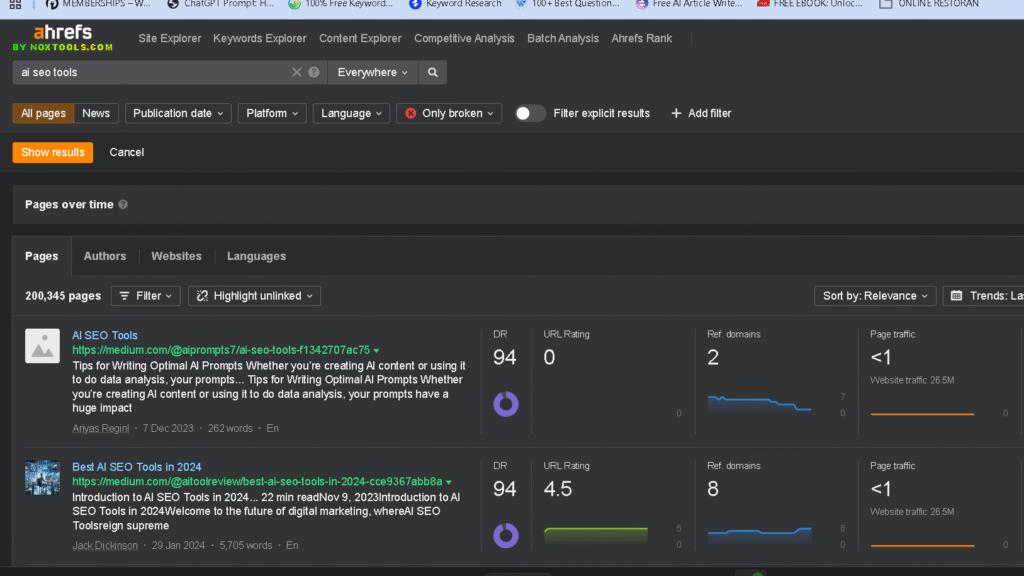
Ahrefs Keywords Explorer pulls from billions of keywords across 170+ countries. For any given seed term, you get search volume with seasonal trends, keyword difficulty calculated from actual backlink data, clicks estimates, traffic potential, SERP history, and a full breakdown of current ranking pages with their estimated traffic. The parent topic feature, which identifies the broader query actually driving the most traffic, frequently changes how I approach content strategy.
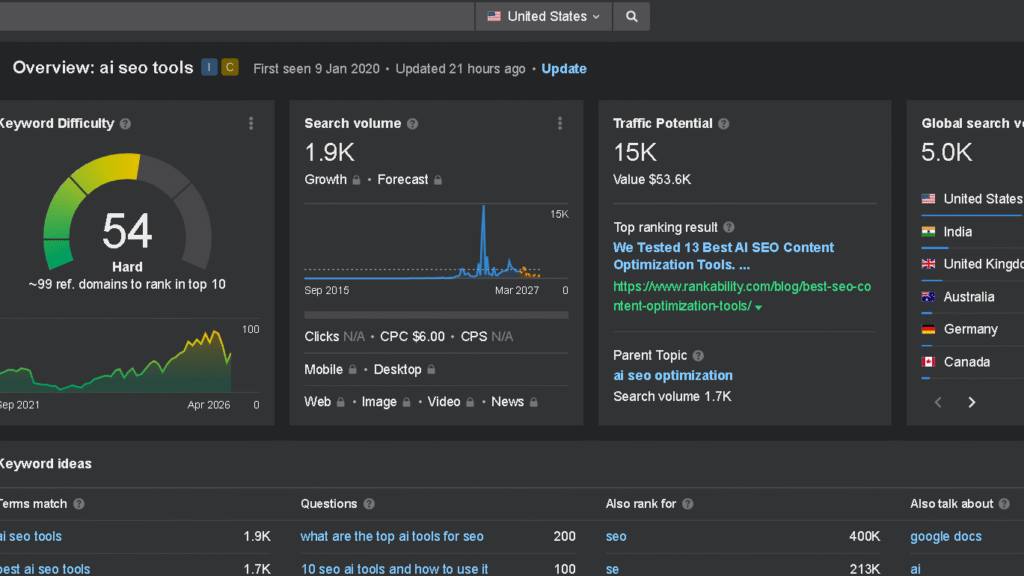
When I searched “AI SEO tools” during testing, Ahrefs returned 18 actionable keyword opportunities with confidence. Difficulty scores held up when I manually verified the SERPs. The related clusters surfaced angles I hadn’t considered, and the SERP overview showed me exactly what domain authority level I’d need to compete for each term.
Semrush Keyword Magic Tool
Semrush Keyword Magic Tool returned 70+ keyword opportunities for the same seed. Volume data was generally accurate and matched GSC trends closely. The Keyword Gap tool, where you drop in competitor domains and surface terms they rank for that you don’t, is genuinely one of the best features across any SEO platform.
Semrush also layers in PPC data natively, so you can see CPC, ad competition, and paid SERP layouts alongside organic data. That dual-channel view is unique at this price point.
Ubersuggest Keyword Research
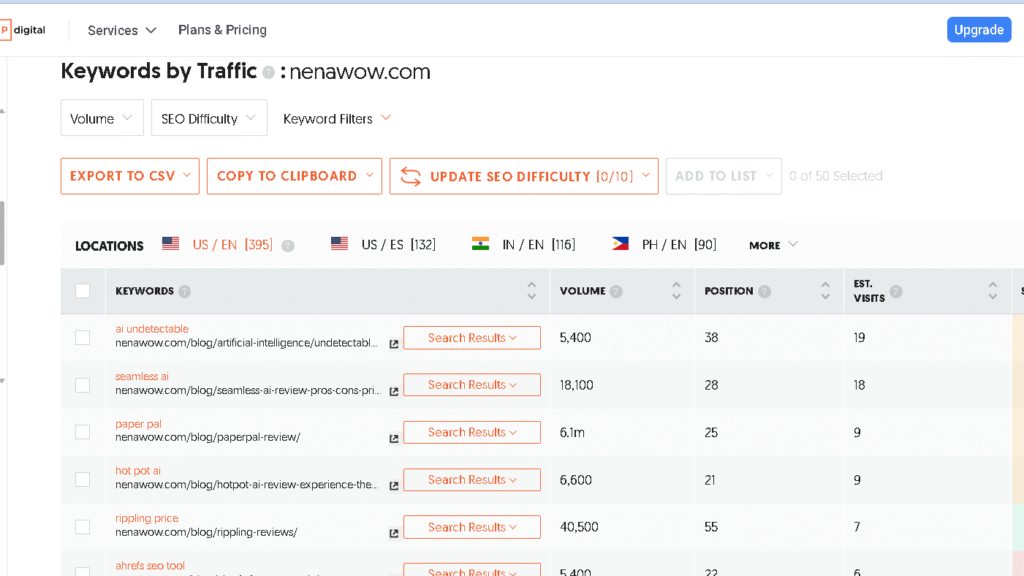
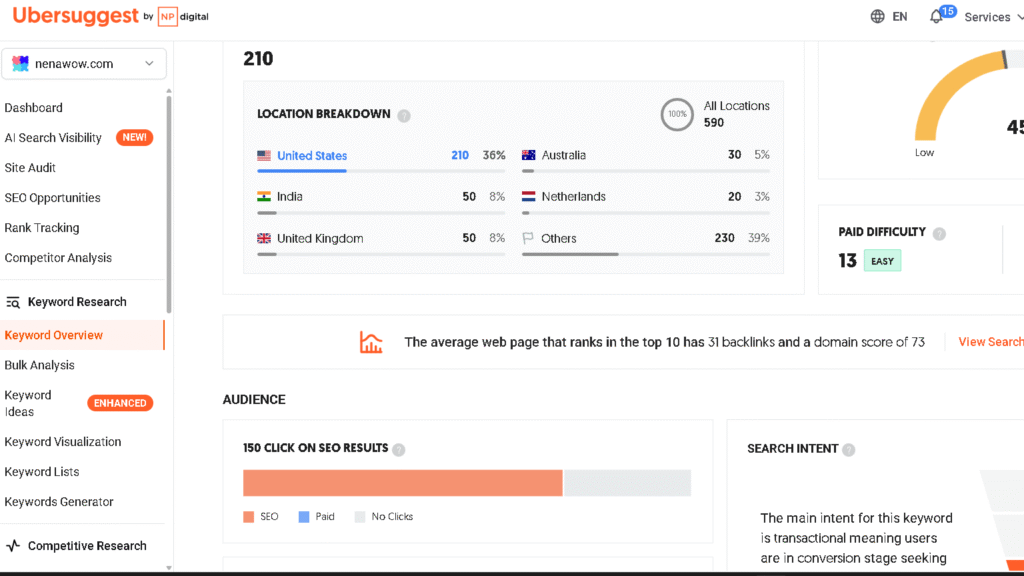
Ubersuggest returned 5 actionable opportunities after manual verification. The interface is clean. Volume, SEO difficulty, CPC, and paid difficulty, all surface clearly.
The problem is calibration. Multiple keywords labeled “medium difficulty” were dominated by high-authority domains when I checked the actual SERPs. For someone making real content investment decisions, trusting those scores without verification could send you chasing keywords you can’t realistically rank for yet.
| Tool | Keyword Opportunities Found (AI SEO tools) | Difficulty Calibration |
|---|---|---|
| Ahrefs | 18 | Accurate vs. real SERP |
| Semrush | 70+ | Accurate vs. real SERP |
| Ubersuggest | 5 | Optimistic vs. real SERP |
Winner: Split between Ahrefs and Semrush. Ahrefs for accuracy. Semrush for volume and paid/organic combined research. Ubersuggest trails on calibration.
Head-to-Head: Backlink Analysis
Backlink data quality is arguably the single most important differentiator between SEO tools. An incomplete index doesn’t just show you fewer links — it distorts your entire competitive picture.
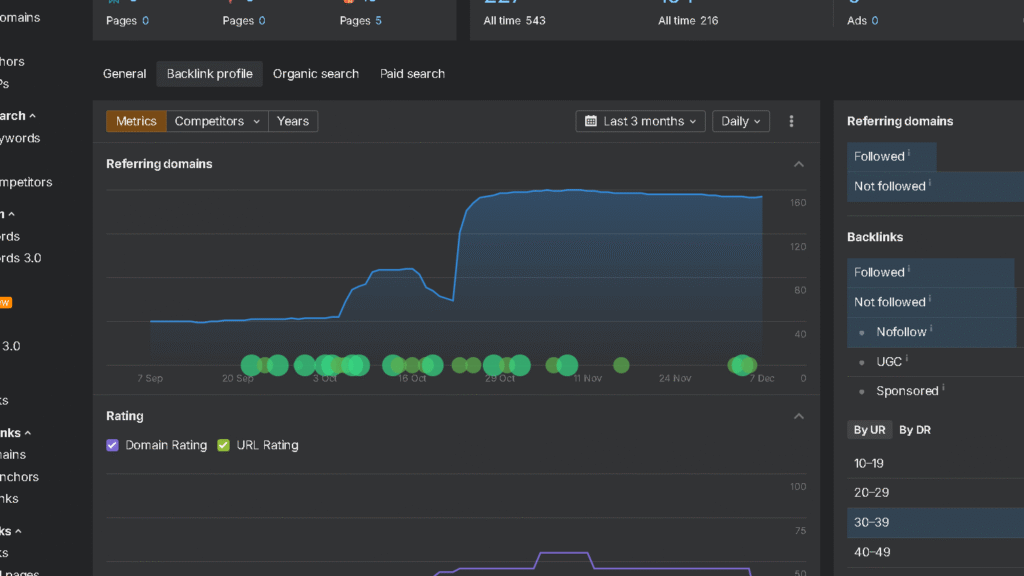
Ahrefs is widely considered the industry benchmark for backlink data. Running nenawow.com through Site Explorer surfaced 2,700 backlinks across 1,300 referring domains. Every link I could independently verify (guest posts, editorial mentions, niche directory placements) was present. The historical view showed exactly when referring domains were gained or lost, making it possible to connect link velocity to ranking movements with real precision.
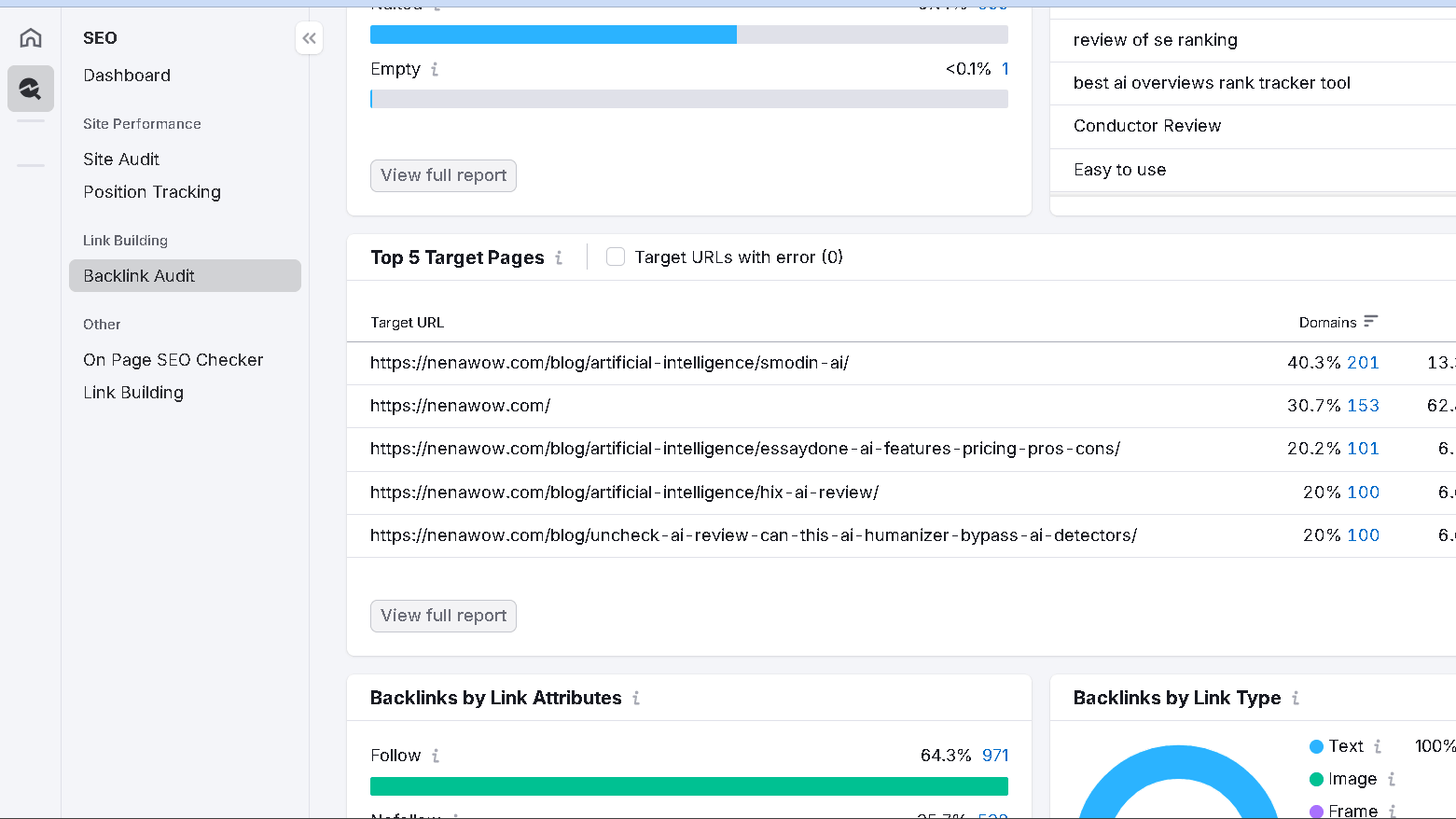
Semrush returned 1,500 backlinks across 499 referring domains for the same domain. That’s meaningful data. The competitive analysis features built on top of it are solid, but the index gap relative to Ahrefs was clear.
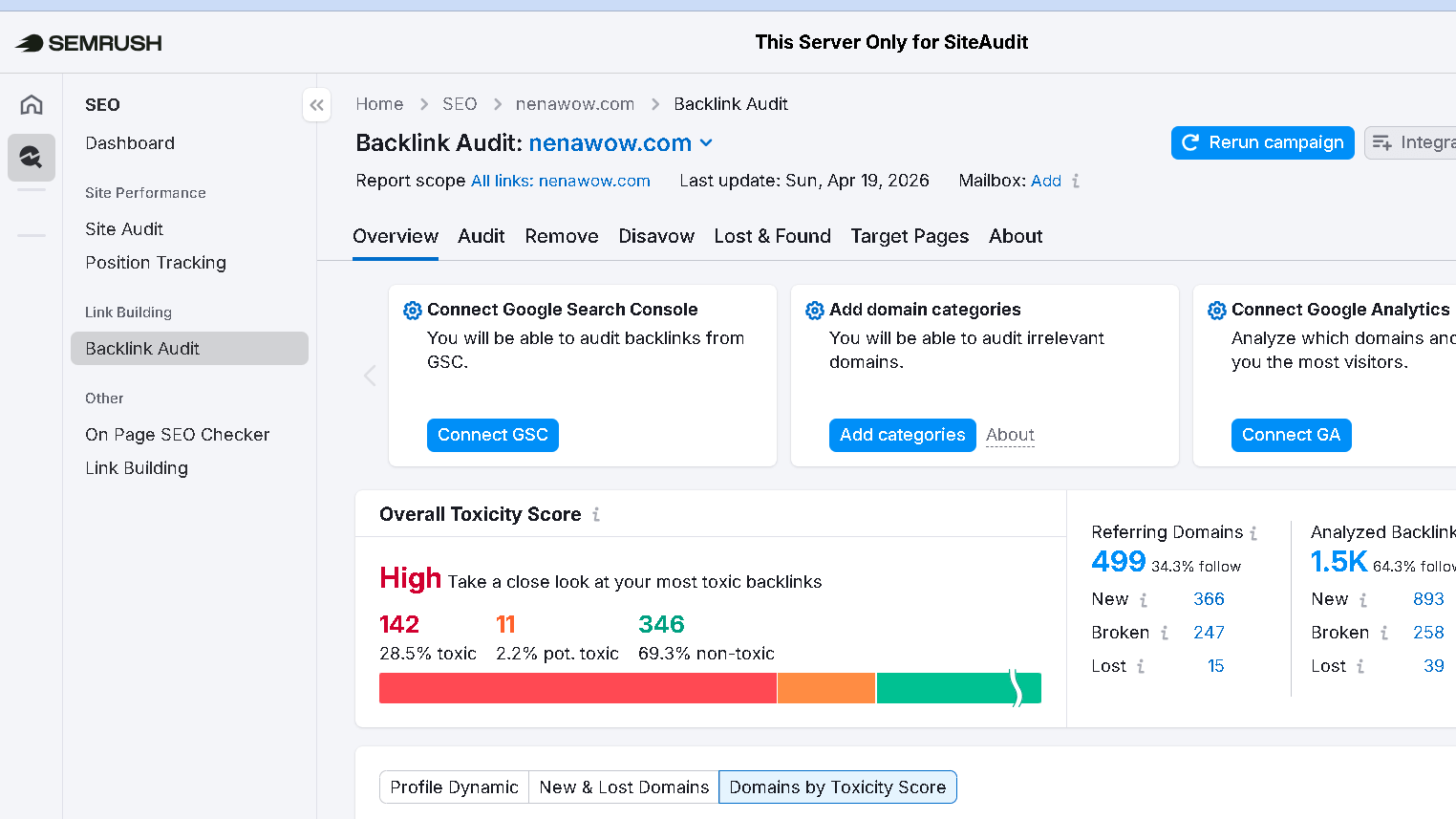
Several referring domains I knew existed simply weren’t appearing. For link building decisions, that matters. If you’re trying to identify competitor link sources to replicate, missing 800 referring domains changes the strategy.
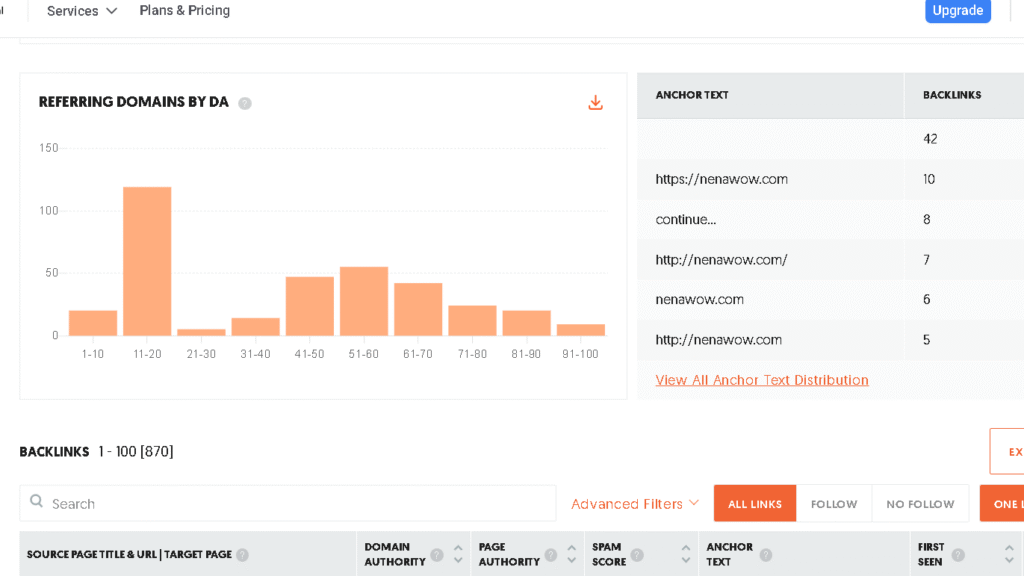
Ubersuggest found 878 backlinks across 358 referring domains. Less than a third of the referring domains Ahrefs identified. For a rough signal on whether a prospective guest post opportunity has any real authority — functional. For serious competitive link analysis, the gap is too large.
One more note: as mentioned earlier, this site has around 1,300 referring domains. On higher-authority sites with tens of thousands of backlinks, the proportional differences between these tools may look different. But the directional ranking held true across all competitor domains I tested.
| Tool | Backlinks Found | Referring Domains Found |
|---|---|---|
| Ahrefs | 2,700 | 1,300 |
| Semrush | 1,500 | 499 |
| Ubersuggest | 878 | 358 |
Winner: Ahrefs. Semrush second. Ubersuggest a distant third.
Head-to-Head: Technical Site Audit
Technical SEO problems are often invisible until something breaks rankings. Good audit tools catch issues before they become expensive.
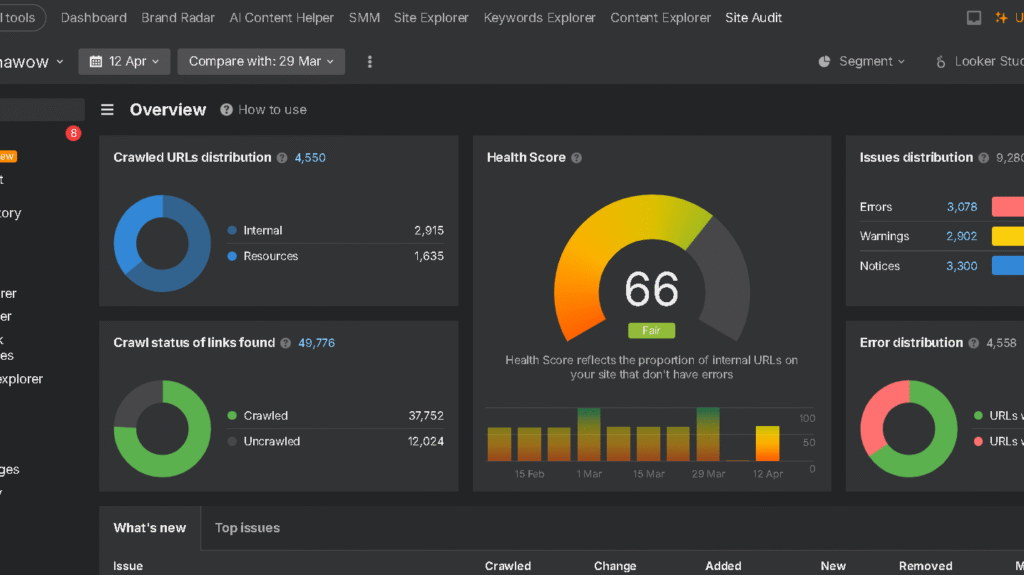
Ahrefs Site Audit crawled nenawow.com and returned 173 issues: 52 errors, 62 warnings, 59 notices. The categorization is precise. Errors that actively affect crawl efficiency are clearly separated from lower-priority warnings.
The internal linking visualization was immediately useful: it showed which pages were accumulating link equity and which sat orphaned with no internal links pointing to them. Ahrefs identified 45 orphaned pages. I hadn’t been aware most of them existed in that state.
Three crawl efficiency issues that Ahrefs flagged were affecting how Googlebot moved through the site. One, an accidental noindex tag, was actively preventing 6 posts from being indexed. That single finding alone justified the audit.
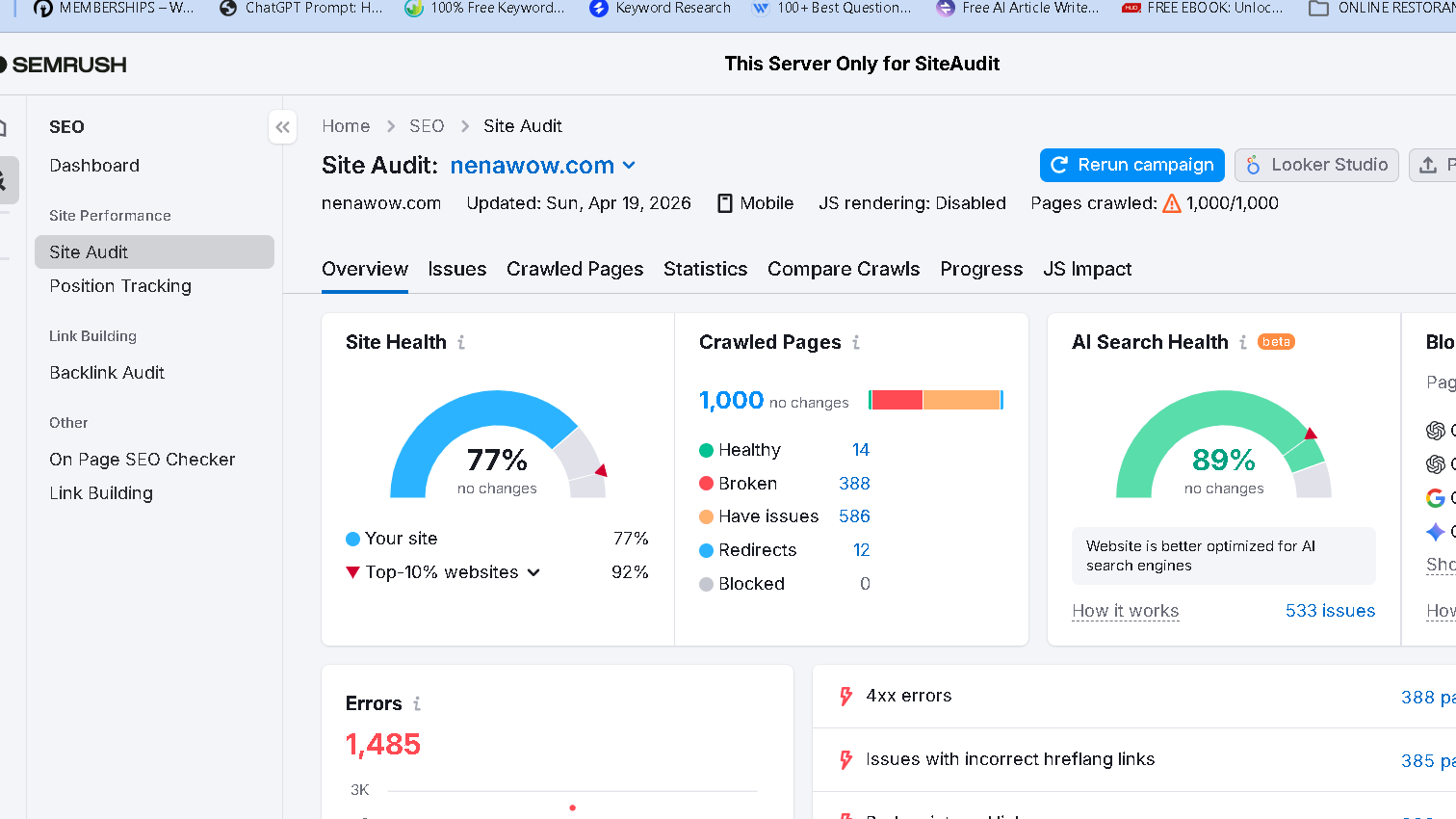
Semrush Site Audit ran deeper in raw issue count: 1,485 errors and 2,333 warnings for the same site. It also identified 92 orphaned pages, more than Ahrefs. This is a meaningful difference that suggests slightly different crawl depth or issue classification logic.
The reporting interface is detailed and offers clear prioritization guidance. Semrush’s audit also integrates with Google Analytics and Search Console data, adding context to technical findings that purely crawl-based tools can’t provide.
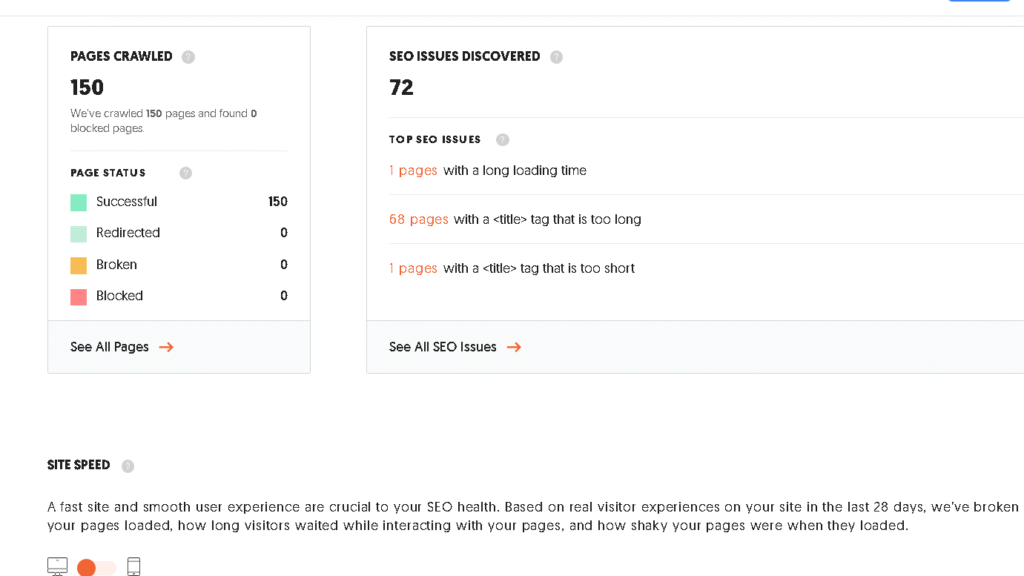
Ubersuggest flagged 72 issues. Every issue it found was also found by Ahrefs. It missed the three crawl efficiency problems, didn’t identify any orphaned pages, and produced no internal linking visualization. For a brand-new site owner checking whether anything is obviously broken, it’s a reasonable starting point. For anyone managing a site above early-stage, the gaps are limiting.
| Tool | Issues Flagged | Errors | Orphaned Pages | Internal Link Map |
|---|---|---|---|---|
| Ahrefs | 173 | 52 | 45 | ✅ |
| Semrush | 3,818 combined | 1,485 | 92 | ✅ |
| Ubersuggest | 72 | — | 0 | ❌ |
Why does Semrush report 3,818 issues while Ahrefs reports 173?
This comes down to methodology, not accuracy. Semrush uses a highly granular auditing system. It flags individual instances of minor issues (slightly long meta descriptions, low text-to-HTML ratios, redirect chains, duplicate tags) separately.
Ahrefs groups related issues together and focuses more heavily on critical structural and indexability problems. If 20 pages have similar metadata problems, Semrush may report 20 separate issues. Ahrefs may categorize them under a single broader warning.
Neither approach is wrong.
They just reflect different auditing philosophies: Semrush is exhaustive, Ahrefs is prioritized. In practice, most of Semrush’s additional flagged items were minor warnings rather than crawl-blocking errors. After filtering by severity, the number of genuinely actionable issues between the two tools was much closer than the raw totals suggest.
Winner: Semrush for raw depth. Ahrefs for actionable prioritization. Ubersuggest for beginners only.
Rank Tracking
I tracked 30 identical keywords across all three tools simultaneously for the full 30-day period.
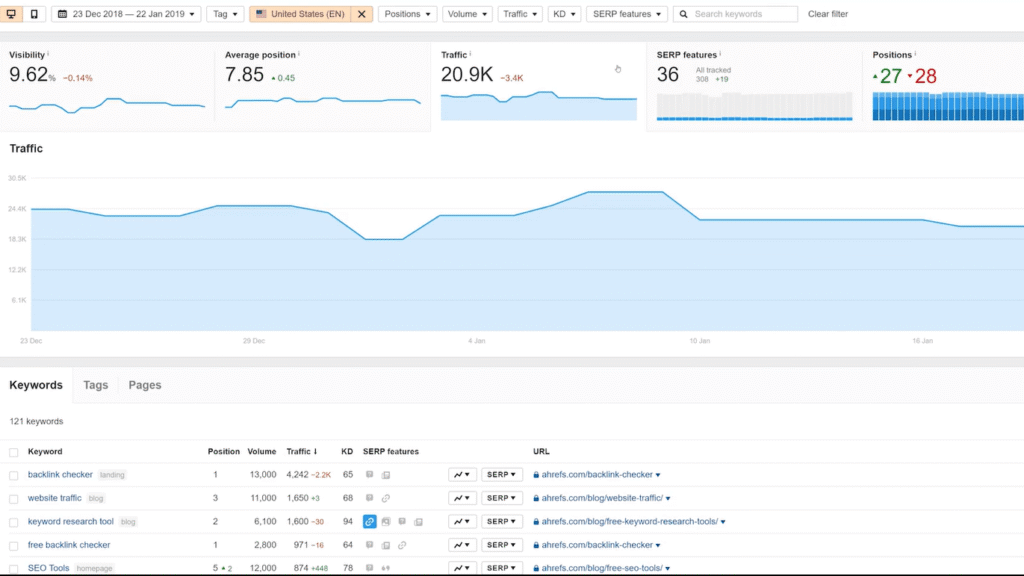
Ahrefs updated daily. Position data matched manual incognito verification within 1–2 spots consistently. More importantly, it tracked SERP features (featured snippets, People Also Ask boxes, video carousels, AI Overviews) for each tracked keyword.
Ranking #3 in a clean SERP is different from ranking #3 behind a featured snippet and two PAA boxes. That distinction has real traffic implications, and Ahrefs surfaced it clearly for every tracked keyword.
Semrush also updated daily at the Pro plan and above. Accuracy was comparable to Ahrefs, within 1–2 positions versus GSC. Position tracking includes SERP feature visibility, keyword cannibalization alerts, and competitor position monitoring.
The Visibility Score metric, which aggregates ranking positions into a single trend line, makes it easy to spot directional changes before digging into individual keyword movements.
Ubersuggest updated every 3–7 days on entry-level plans. Position data was within 1–3 spots of GSC, which is acceptable for broad trend monitoring. But the less frequent update cycle creates friction when you’re trying to correlate position changes with specific site updates or link acquisition events.
| Metric | Ahrefs | Semrush | Ubersuggest |
|---|---|---|---|
| Update frequency | Daily | Daily | Every 3–7 days |
| SERP feature tracking | ✅ Full | ✅ Full | ❌ Limited |
| Accuracy vs. GSC | Within 1–2 positions | Within 1–2 positions | Within 1–3 positions |
Winner: Tie between Ahrefs and Semrush. Ubersuggest functional but slower.
Head-to-Head: Competitor Analysis
Understanding what competitors rank for and why, is the fastest shortcut to a content strategy that actually works.
Ahrefs Competitor Analysis
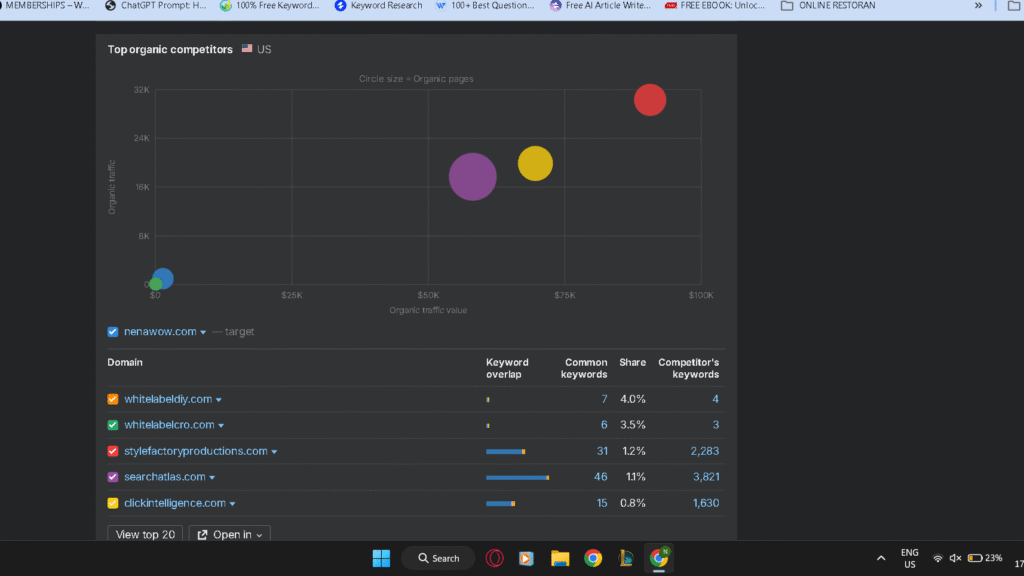
Ahrefs Site Explorer lets you drop any competitor URL and immediately see estimated organic traffic, top pages by traffic, keywords those pages rank for, the full backlink profile, traffic value, and content gaps.
The Content Gap tool was one of the highest-impact features during my 30-day test. Running nenawow.com against three competitors surfaced 40+ keyword opportunities with zero current presence on my site. Several became published posts before the testing window closed.
Ahrefs also identified 67 unique referring domains in competitor backlink profiles that nenawow.com wasn’t getting links from. That’s a concrete link building roadmap built from actual data rather than guesswork.
Semrush Competitor Analysis
Semrush approaches competitor analysis from a broader angle. Traffic Analytics estimates competitor website traffic using clickstream data ,not just organic search. You can see paid search spend, display ad placements, and social engagement alongside organic rankings.
The Traffic Journey feature shows where a competitor’s audience comes from and where it goes after leaving their site. For a marketing team that needs the complete picture, that breadth is genuinely useful.
The Keyword Gap tool is particularly strong. Drop in up to five competitors simultaneously and filter the shared, unique, or missing keyword sets by volume, difficulty, or current ranking position. Semrush found 41 unique competitor referring domains not linking to nenawow.com. This is a solid data, though fewer than the 67 Ahrefs surfaced.
Ubersuggest Competitor Analysis
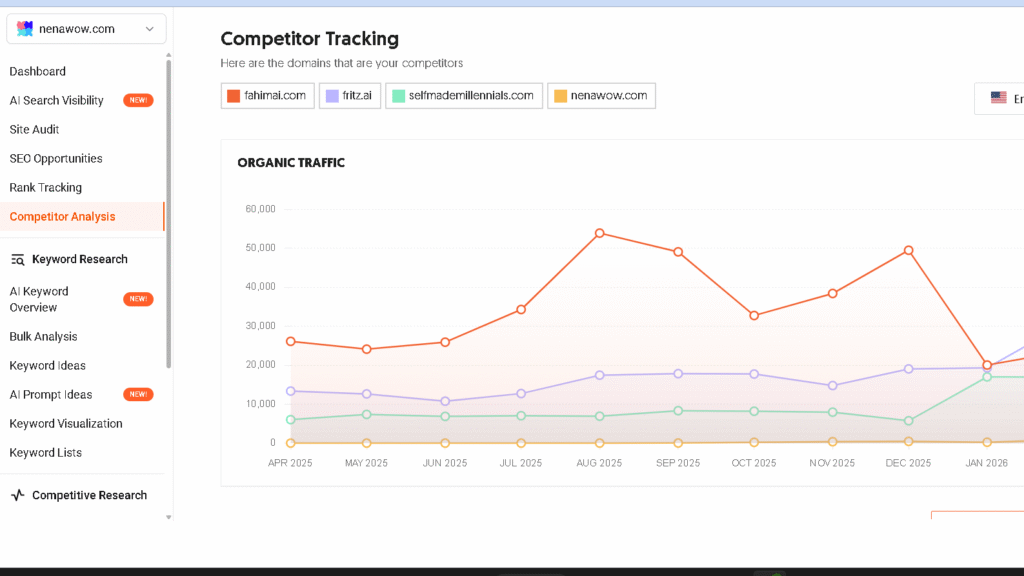
Ubersuggest offers a competitor analysis module showing top pages, estimated traffic, and keyword overlap. For someone building a first content plan, it surfaces useful directional data. But the content gap feature lacks granularity, and competitor backlink gap analysis isn’t available.
| Tool | Competitor Backlink Gaps Found | Content Gap Depth |
|---|---|---|
| Ahrefs | 67 unique domains | Deep |
| Semrush | 41 unique domains | Deep + paid channels |
| Ubersuggest | Not available | Basic |
Winner: Ahrefs for organic SEO. Semrush if you need paid and organic combined.
Content Tools & AI Overviews Tracking
This is where the landscape shifted most noticeably in 2026. AI Overviews in Google Search, and generative answers across Bing Copilot and other AI-powered engines, have fundamentally changed what “ranking” means. Appearing in position 1 is no longer the full picture if an AI-generated answer sits above every organic result.
Ahrefs
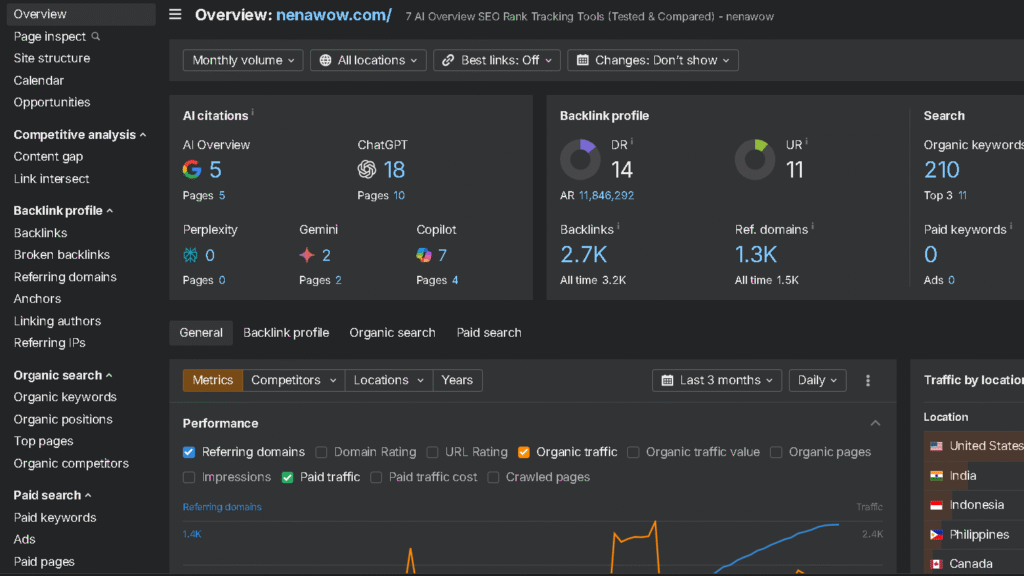
Ahrefs now tracks AI Overview appearances across multiple search engines: Google AI Overviews, Bing Copilot, and emerging generative search surfaces. You can see which tracked keywords trigger AI-generated snippets and whether your content gets cited inside them.
During my 30-day test, Ahrefs identified 6 keywords where nenawow.com was appearing in AI Overviews . This data didn’t exist in my GSC dashboard. For SEO in 2026, this is becoming a critical visibility metric. Ahrefs doesn’t offer native AI writing tools, but its analytical coverage of AI search is the deepest in this comparison.
Semrush
Semrush has developed solid AI Overview tracking focused on Google. It surfaces which keywords trigger AI-generated snippets and provides competitive positioning within those snippets. Coverage of non-Google AI engines is still developing.
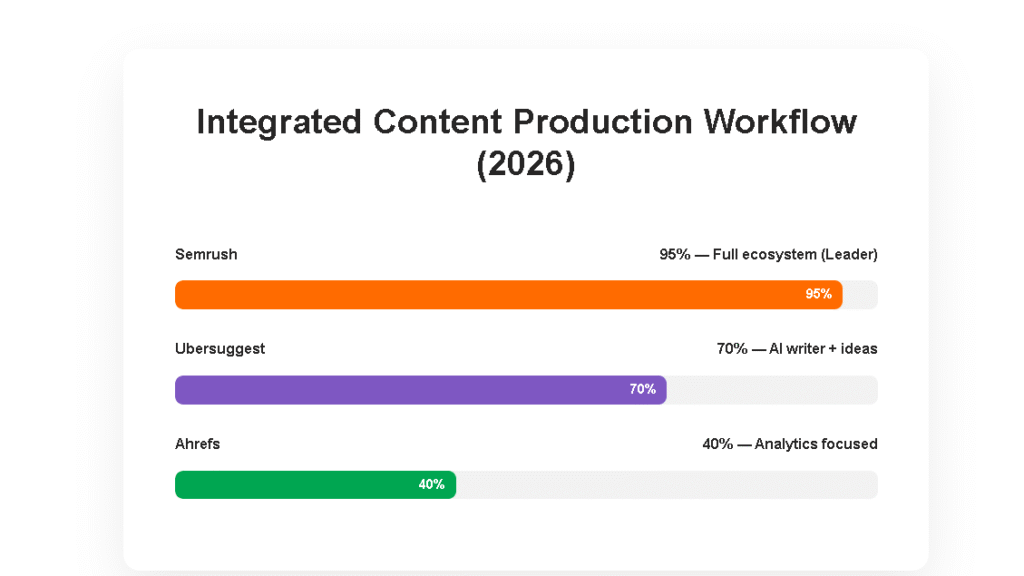
Where Semrush adds distinct value is its content creation ecosystem: the SEO Writing Assistant grades content in real-time against top-ranking pages, Topic Research surfaces trending subtopics and questions, and ContentShake AI generates full drafts with built-in optimization suggestions. For teams producing high content volume, that integrated workflow matters.
Ubersuggest
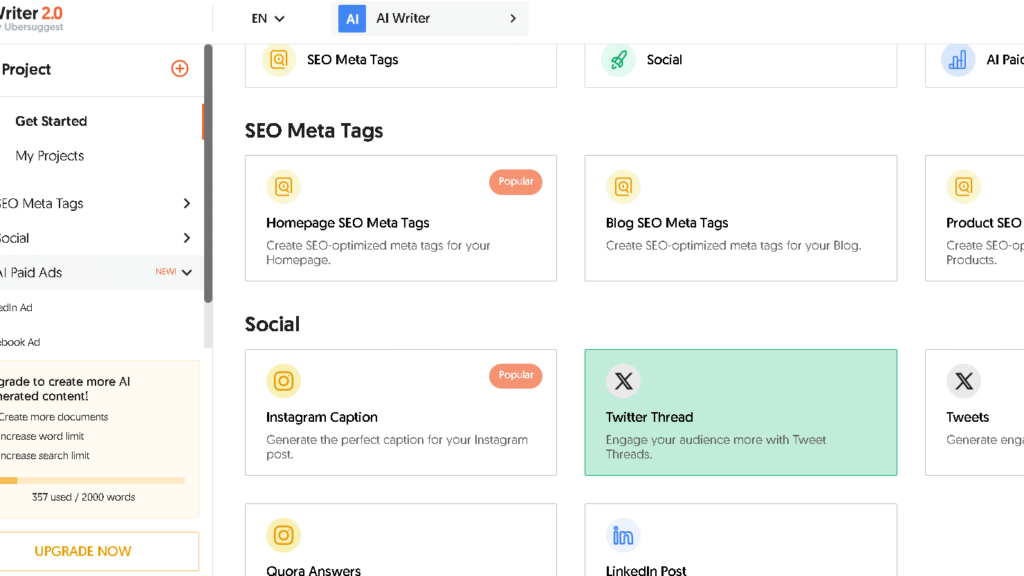
Ubersuggest includes an AI Writer for generating outlines and drafts directly inside the platform, plus a Content Ideas section based on social shares and search performance. AI Overview tracking exists but is basic and limited to Google, minimal depth, no multi-engine coverage. The integrated writing workflow is genuinely convenient for beginners who want research and drafting in one place.
No single winner here — it depends on what you actually need.
Ahrefs leads on multi-engine AI search tracking, which is increasingly important as search behavior fragments across platforms.
Semrush leads on full content production workflow, which matters more if your team is writing at scale.
Ubersuggest serves beginners who want an all-in-one research and drafting tool and don’t need advanced AI search intelligence yet. If you need to pick one dimension as the most forward-looking: Ahrefs’ multi-engine AI tracking is where the industry is heading, and Semrush is catching up quickly.
Head-to-Head: Ease of Use
Ahrefs has a learning curve. Not because it’s poorly designed. It is because the data density requires navigation. Most users spend several weeks before they feel fully comfortable moving between Site Explorer, Keywords Explorer, Content Explorer, and Rank Tracker efficiently. Once past that curve, the workflow becomes fast and intuitive.
Semrush sits in the middle. The interface is more structured than Ahrefs but more complex than Ubersuggest. The breadth of features means there’s always more to discover, which can feel like feature bloat until you understand which modules apply to your specific workflow. Reporting tools are particularly polished. White-label PDF reports for client delivery are a standout.
Ubersuggest is the fastest to start with. Terminology is explained in plain language, the layout is uncluttered, and most tasks complete in 2–3 clicks. You can run a keyword search and understand the results within minutes of signing up.
Winner: Ubersuggest for accessibility. Ahrefs and Semrush for long-term power output once past the initial curve.
Advanced Comparison: What Serious SEOs Actually Care About
Beyond keyword research and backlinks, a few features tend to drive tool decisions for more experienced users. Here’s how the three compare on those dimensions.
Google Search Console Integration
All three tools support some level of GSC integration, but the depth varies significantly.
Ahrefs and Semrush both pull real click and impression data directly from GSC, allowing you to combine keyword research with actual performance metrics. This helps you identify underperforming pages, declining queries, and content refresh opportunities.
Ubersuggest supports basic GSC integration but offers less advanced filtering and segmentation. If you rely heavily on first-party Google data, Ahrefs and Semrush provide significantly more actionable insights.
Core Web Vitals & Technical Performance Monitoring
Semrush includes Core Web Vitals monitoring within its Site Audit tool, allowing you to track LCP, CLS, and other performance signals that affect page experience rankings. Ahrefs focuses more on crawl errors and structural technical SEO rather than performance metrics. Ubersuggest provides basic technical scans but lacks detailed Core Web Vitals tracking.
If technical performance is part of your regular workflow, Semrush has the edge here.
API Access for Agencies and Developers
Ahrefs and Semrush both offer API access on higher-tier plans, allowing you to pull backlink data, keyword metrics, and site analytics into custom dashboards or internal tools. Ubersuggest does not provide a robust public API. If you’re running large-scale reporting systems or automation workflows, this alone may eliminate Ubersuggest as a viable option.
Local SEO Capabilities
Semrush includes dedicated local SEO tools, including listing management and local rank tracking. Ahrefs supports location-based keyword tracking but doesn’t offer full local listing management. Ubersuggest supports location-based keyword research but has limited local optimization features. For local businesses or agencies managing local clients, Semrush currently offers the strongest feature set.
Data Refresh Frequency
Ahrefs updates backlink data continuously and refreshes keyword metrics regularly. Semrush maintains frequent database updates, particularly for high-volume markets. Ubersuggest updates its database less frequently, which can result in outdated keyword difficulty or backlink counts. In competitive niches, data freshness directly impacts strategy accuracy.
Full Test Results from nenawow.com
Data collected April 2026 during a 30-day simultaneous test.
| Finding | Ahrefs | Semrush | Ubersuggest |
|---|---|---|---|
| Referring domains found | 1,300 | 499 | 358 |
| Backlinks found | 2,700 | 1,500 | 878 |
| Technical issues flagged | 173 | 1,485 errors + 2,333 warnings | 72 |
| Orphaned pages identified | 45 | 92 | 0 |
| Keyword opportunities (AI SEO tools) | 18 | 70+ | 5 |
| Competitor backlink gaps found | 67 unique domains | 41 unique domains | Not available |
| Rank tracking accuracy vs. GSC | Within 1–2 positions | Within 1–2 positions | Within 1–3 positions |
| Organic traffic estimate | 1,200 | — | 1,269 |
| AI Overview appearances tracked | 6 keywords | Available | Not surfaced |
What Changed Over 30 Days
Starting baseline: roughly 1,000 monthly organic visits, 220 posts, ranking mostly in positions 8–20 for target keywords, no structured keyword research process in place.
Weeks 1–2 were diagnostic. Ahrefs flagged the accidental noindex tag blocking 6 posts from Google entirely. It surfaced keyword cannibalization — four separate posts targeting slight variations of “AI SEO tools” were splitting authority instead of consolidating it. Semrush’s audit flagged 92 orphaned pages and confirmed the crawl efficiency issues Ahrefs identified. Ubersuggest flagged 72 issues, all of which appeared in the other two audits.
Weeks 2–3 were execution. Fixes implemented: removed the noindex tag from 6 posts, merged the cannibalistic AI SEO tools posts into one consolidated piece with 301 redirects on the old URLs, added meta descriptions to 34 flagged posts, fixed 3 broken internal links, optimized internal linking to push authority toward the consolidated page, published 3 new posts targeting keyword gap opportunities surfaced by Ahrefs Content Gap analysis.
Day 30 results:
| Metric | Day 1 | Day 30 | Change |
|---|---|---|---|
| Monthly organic visits | ~1,000 | ~1,340 | +34% |
| Keywords in top 10 | 18 | 27 | +9 keywords |
| Keywords in top 3 | 4 | 7 | +3 keywords |
| Crawl errors | 173 | 41 | -132 issues resolved |
| Referring domains | 358 | 371 | +13 new |
| AI Overview appearances | Not tracked | 6 keywords | New data point |
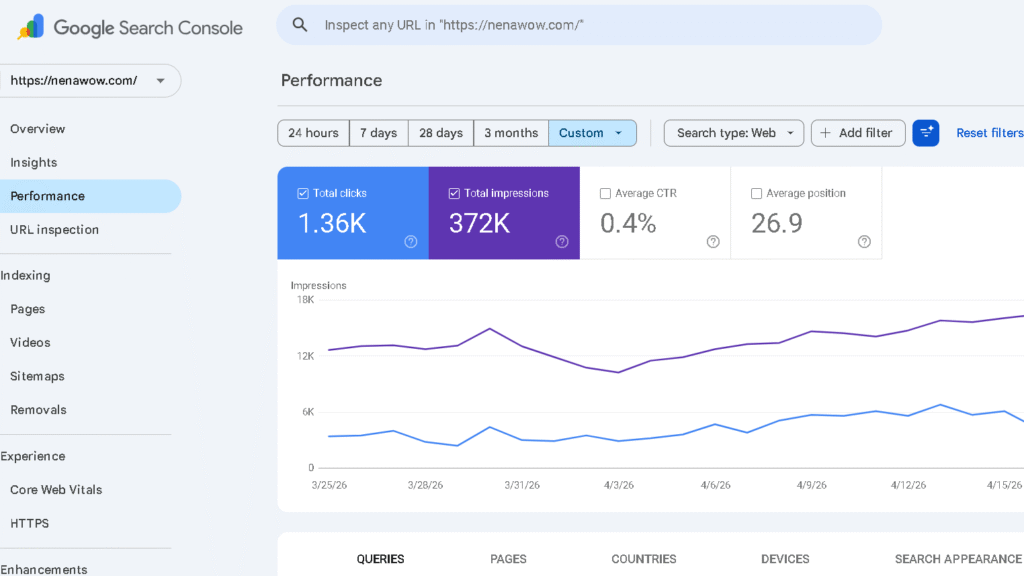
Important context: traffic increased from ~1,000 to ~1,340 monthly visits. Given the short 30-day window, causation can’t be confirmed — but the directional correlation with specific fixes was clear.
Don’t take the “+34%” headline in isolation. What’s more meaningful is that every fix implemented was directly tied to an audit finding, and the movement tracked in the expected direction. 30 days is a short SEO window. The directional takeaway held up, but treat this as a signal, not a proof point.
Who Should NOT Use Each Tool
Who Should NOT Use Ahrefs
Ahrefs is excellent — but it’s not for everyone.
Budget-conscious beginners — $129/month is hard to justify before you’ve seen your first organic click. You’ll pay for depth you won’t use for months.
Pure content marketers — If your workflow is “find keyword → write → publish,” you’re paying for site audits, log file analysis, and SERP tools you’ll never open.
Paid or social media teams — Ahrefs is built for organic search only. No ad intelligence, no social listening, no PPC analysis.
All-in-one platform seekers — No CRM, no content calendar, no social tools. Ahrefs does SEO exceptionally well and stops there.
Agencies relying on client reporting — White-label reporting has improved but still lags behind Semrush. Client-facing PDF workflows can feel clunky.
Bottom line: Ahrefs is built for SEOs and serious bloggers who live inside keyword research and backlink analysis daily. If that’s not you, the price won’t justify itself.
Who Should NOT Use Semrush
Semrush’s breadth is its biggest strength — and its biggest liability.
Solo bloggers and niche site owners — At $139.95/month, the ROI math rarely works for a single site. Cheaper alternatives cover 80% of your needs.
Anyone who values simplicity — 55+ tools is genuinely disorienting if you don’t know exactly what you’re looking for. The learning curve is real.
Pure link builders — Ahrefs’ backlink index is more comprehensive and more frequently updated. Using Semrush primarily for backlinks is overkill.
Small businesses without a dedicated SEO person — Semrush rewards expertise. Without it, you’ll pay for a dashboard you’ll rarely open.
Teams that just need rank tracking — Dedicated trackers like SERPWatcher or Nightwatch do this better, for a fraction of the cost.
Bottom line: Semrush earns its price for agencies and advanced SEOs who will use a significant portion of its feature set. If that’s not you, you’re overpaying.
Who Should NOT Use Ubersuggest
Ubersuggest’s lifetime deal is genuinely attractive — but it has real ceilings.
Serious SEOs and agencies — Smaller backlink index, less granular keyword data, and a site audit that misses issues the other two catch. Professionals need professional-grade data.
Competitive niche operators — In finance, health, SaaS, or legal, Ubersuggest’s wider margin of error on keyword difficulty and traffic estimates can lead to bad decisions.
High-volume rank trackers — Accuracy and consistency drop noticeably at scale. If you’re tracking hundreds of keywords across multiple locations, you’ll hit its limits fast.
Developers needing API access — Ubersuggest’s API is severely limited compared to Ahrefs or Semrush. If API access is a requirement, look elsewhere.
Users who need a tool that evolves quickly — Development pace is slower than its competitors. AI Overview tracking, SGE data, and other forward-looking features lag behind.
Bottom line: Ubersuggest is the right call for beginners and budget-conscious bloggers. Once SEO becomes a serious revenue driver, you’ll outgrow it.
Alternatives Worth Knowing About
Before committing to any of these three, a few alternatives deserve an honest mention.
Moz Pro sits at a similar price point to Ahrefs Lite with a gentler learning curve. Its Domain Authority metric is referenced widely across the industry. Keyword and backlink databases are smaller than both Ahrefs and Semrush, but the interface is genuinely approachable for earlier-stage SEO practitioners.
SE Ranking has been gaining serious traction as a mid-market option. Solid rank tracking, audit functionality, and keyword research at a price that sits comfortably between Ubersuggest and Ahrefs. If your budget doesn’t reach Ahrefs or Semrush but Ubersuggest feels limiting, SE Ranking is the most serious alternative to evaluate.
Mangools bundles five tools — KWFinder, SERPChecker, SERPWatcher, LinkMiner, SiteProfiler — starting around $29/month. KWFinder has a strong reputation for keyword difficulty accuracy, which is specifically where Ubersuggest struggled most in this test. For bloggers whose primary need is keyword research rather than full-stack SEO, Mangools competes well.
Ahrefs Webmaster Tools (free) is worth calling out separately. If you’re not ready to pay for anything, this gives you real Ahrefs data — site audit, backlink monitoring, organic keyword reporting — for your own verified domains at no cost, permanently. It’s not a replacement for a paid subscription, but it’s a legitimate starting point that outperforms most paid tools at the entry level.
Quick Comparison Table
| Situation | Best Pick |
|---|---|
| Most accurate backlink and keyword data | Ahrefs |
| Full marketing suite including paid search | Semrush |
| Tightest budget, just getting started | Ubersuggest |
| Mid-budget freelancer or small agency | SE Ranking |
| Blogger focused on keyword research | Mangools |
| Starting out with zero budget | Ahrefs Webmaster Tools (free) |
Final Verdict and Decision Guide
After 30 days running all three tools simultaneously on a real site, the decision framework is pretty clear.
Choose Ahrefs if organic SEO is a primary growth channel, you’re making serious content investment decisions, and link building is part of your regular workflow. It’s not cheap — but on a site where rankings move revenue, the data quality difference pays for itself. Bad keyword targeting and missed technical issues cost more over time than the subscription.
Choose Semrush if your role spans both paid and organic search, you manage clients who need white-label reporting, or you want competitor intelligence beyond just organic rankings. It’s not strictly better than Ahrefs for pure SEO — it’s broader. The choice between them comes down to whether your scope extends beyond organic.
Choose Ubersuggest if you’re new to SEO, your site is early-stage, or the idea of a lifetime deal appeals more than recurring monthly billing. The interface is approachable, the learning curve is gentle, and it covers the fundamentals well enough to get started.
Read my full Ubersuggest review
The hybrid worth considering: Ubersuggest lifetime deal + Ahrefs Webmaster Tools (free). You get Ubersuggest’s research and content workflow features, plus real Ahrefs data for your own site at essentially no ongoing cost. When your site grows to the point where competitive intelligence and backlink depth start mattering — and they will — you’ll know exactly which full platform to upgrade to.
Frequently Asked Questions
Ahrefs and Semrush are both significantly more accurate than Ubersuggest for keyword research — and they’re broadly comparable with each other for organic strategy. Ahrefs tends to be more conservative: keyword difficulty scores closely matched real SERP competition in my testing. Semrush surfaces higher keyword volume estimates with similar calibration quality.
Ubersuggest is worth buying in 2026 for beginners, especially at the lifetime deal price — but it will become a limiting factor as your site grows. The lifetime deal eliminates the recurring cost barrier that makes Ahrefs and Semrush inaccessible at the start.
Yes — Ahrefs Webmaster Tools is permanently free and requires no credit card. It gives you site audit, backlink monitoring, and organic keyword data for your own verified domains.
Yes — Semrush offers a limited free account with up to 10 searches per day, with occasional 14-day free trials on paid plans during promotional periods.
Ahrefs is the best tool for link building in 2026, with the most comprehensive backlink index available and the fastest data refresh rate for catching new opportunities. The competitor gap analysis surfaces actionable link targets quickly, and index depth means fewer missed referring domains compared to any alternative tested. Semrush is a credible second option. Ubersuggest is not competitive for serious link building work.
The answer depends on your experience level: Ahrefs delivers more actionable audits for most users, while Semrush offers unmatched issue coverage for technical practitioners. In my testing, Semrush flagged the highest raw volume — 1,485 errors and 2,333 warnings — but Ahrefs prioritized issues more cleanly, surfacing the highest-impact crawl problems first.