
I signed up for ZipTie‘s free trial and ran it against nenawow.com for a week. Real onboarding, real prompts, my own site’s actual citation data, not a demo account walking me through someone else’s numbers.
The short version: ZipTie’s Overview page told me I had zero visibility for 26 minutes straight, while its own Competitors tab, one click away, already knew I ranked ninth out of 171 domains. Both were true at different points. That gap is the first thing worth knowing before you sign up.
Table of Contents
ZipTie Review: Nena’s Quick Verdict
At $19.95 a month, ZipTie gives you more depth than anything else I have tested in this space. Five separate competitor views, a prompt-by-prompt breakdown across 24 tracked queries, and an AI Insights panel that found my biggest visibility gap without me asking a single follow-up question. The onboarding runs long, and the first dashboard screen you see is misleading. Past that, this is the tool I would actually pay for.
What I Actually Tested
I ran the full 7-day free trial, no card required, starting from account signup through five days of real tracking data. I built my own prompt list by hand, keeping two prompts identical to ones I had already tested through AthenaHQ, so I could compare results across two tools on the same exact search.
That overlap matters more than it sounds. It gave me a real cross-check, not just one tool’s opinion of itself.
Onboarding Took Longer Than It Promises
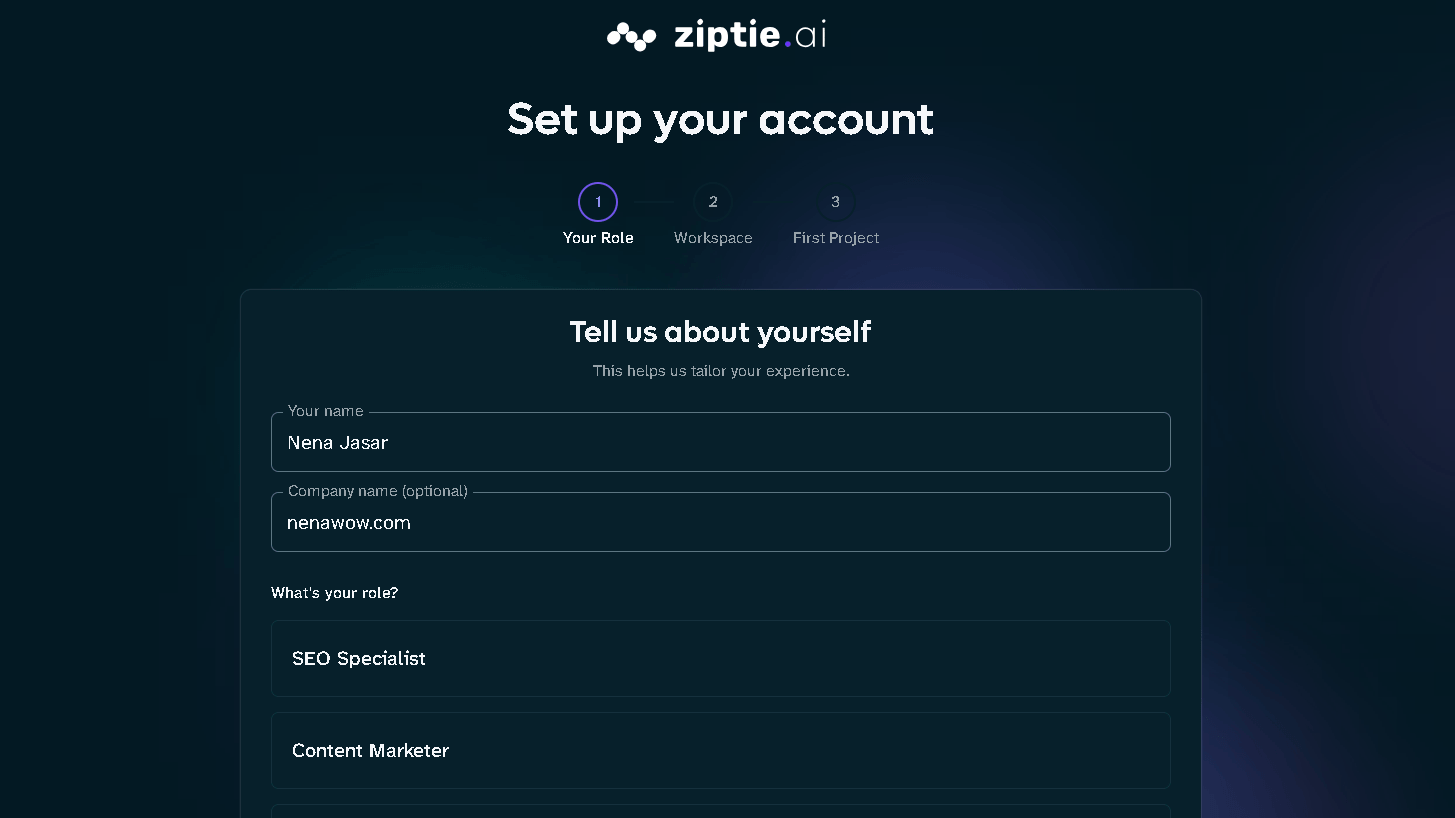
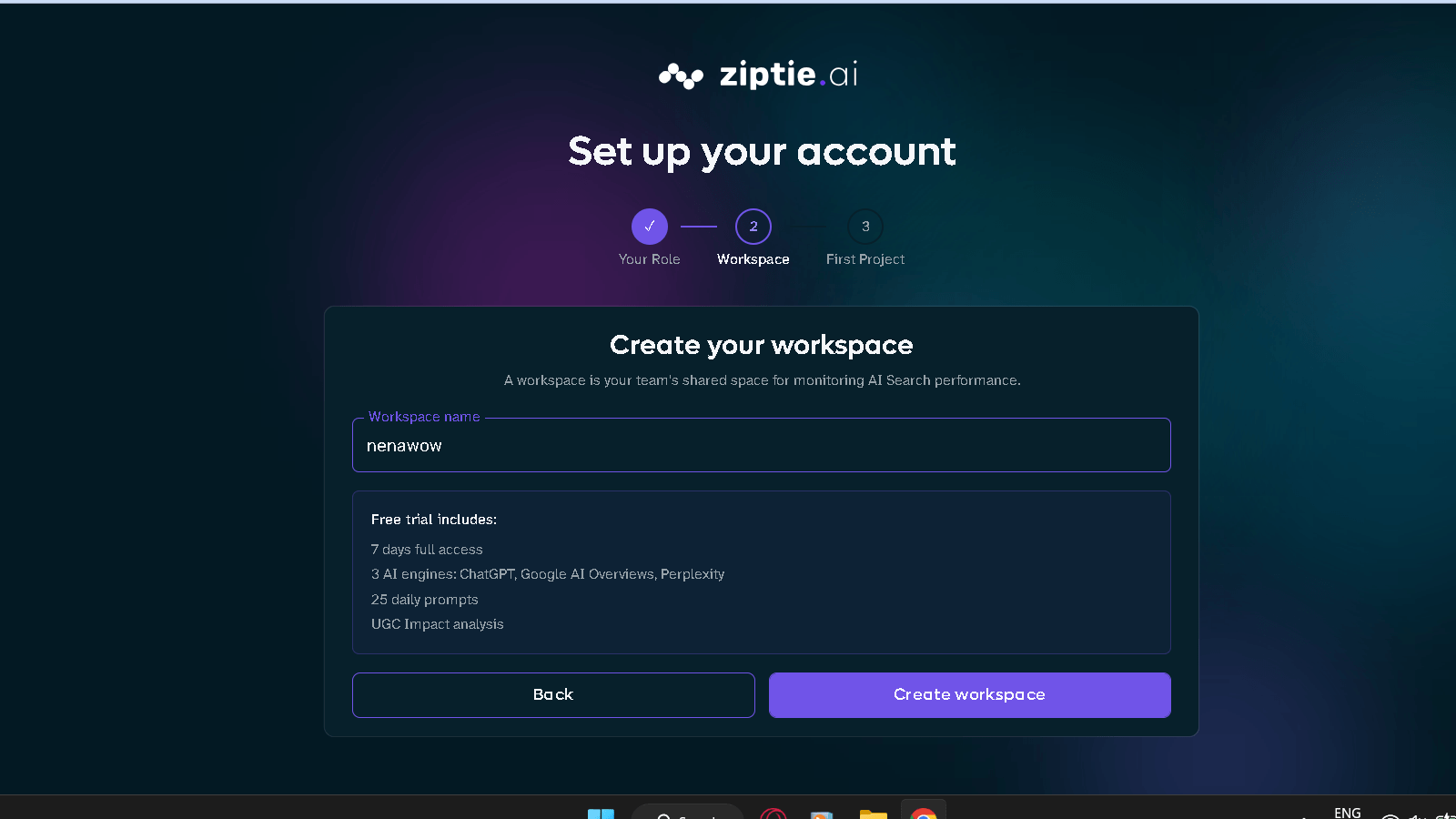
ZipTie’s homepage says you can track your site free, no card, in a matter of minutes. In practice, I went through two separate onboarding flows before I saw a single real number.
The first was account setup: your role, your workspace name, three steps. The second was project setup: project details, an optional Search Console connection, a conversational AI Assistant, a findings review, and a final prompts review. Eight steps total.
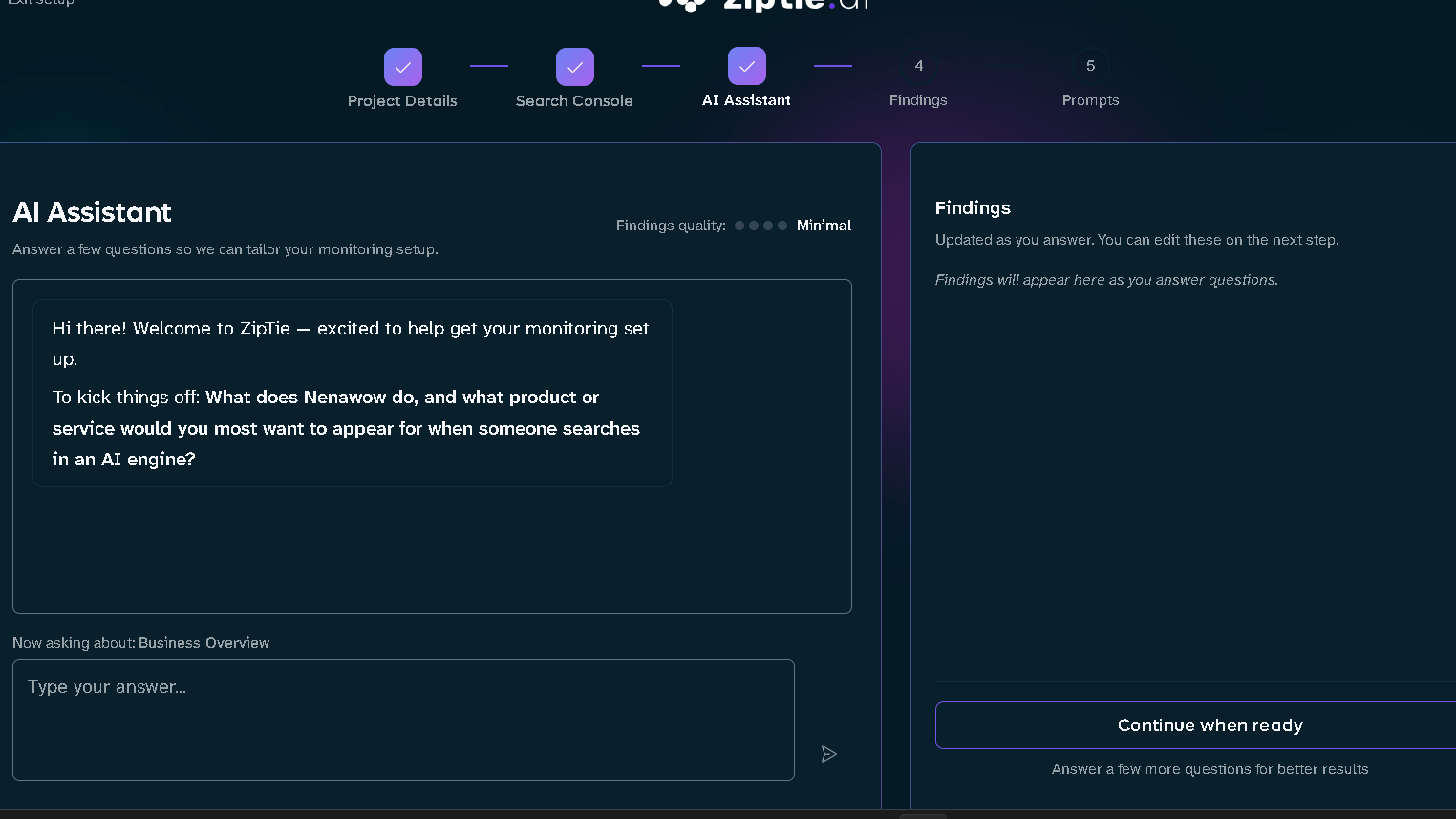
The AI Assistant step was the strongest part of it. It asked me three real questions, what my site does, which comparisons I wanted to rank for, who my actual reader is. From those three answers, it built fourteen findings categories on its own, including a competitor list that named AthenaHQ, SE Visible, and SE Ranking correctly on the first try.
Compare that to AthenaHQ, which auto-suggested Search Engine Land and Neil Patel as my competitors. ZipTie asked, and it listened. That is a real difference, not a small one.
What the Trial Actually Includes
Plans start at $19.95 a month once the trial ends, with no seat fees and no project fees. You pay for prompts monitored, times engines tracked, nothing more.
| Metric | What I Got |
|---|---|
| Trial length | 7 days, no card required |
| Engines included | ChatGPT, Google AI Overviews, Perplexity |
| Daily prompt allowance | 25 |
| Add-on: Public API and MCP | Flat $10 a month |
| Add-on: Content Generation | $20 a month per content slot |
| Add-on: Source Impact Analysis | Multiplies your whole subtotal by 1.8x |
That last add-on is worth pausing on. It is not a flat fee like the others. It multiplies your entire prompts-and-engines bill by 1.8, which makes it the single biggest lever on your invoice if you turn it on. I did not test it directly, but any reader considering it should know that number going in.
By the time I finished building my 24-prompt list, I had zero prompt slots left for the day. The whole daily allowance went into setup, not monitoring. That is a real trade-off worth naming plainly.
The Overview Page Lied to Me for 26 Minutes
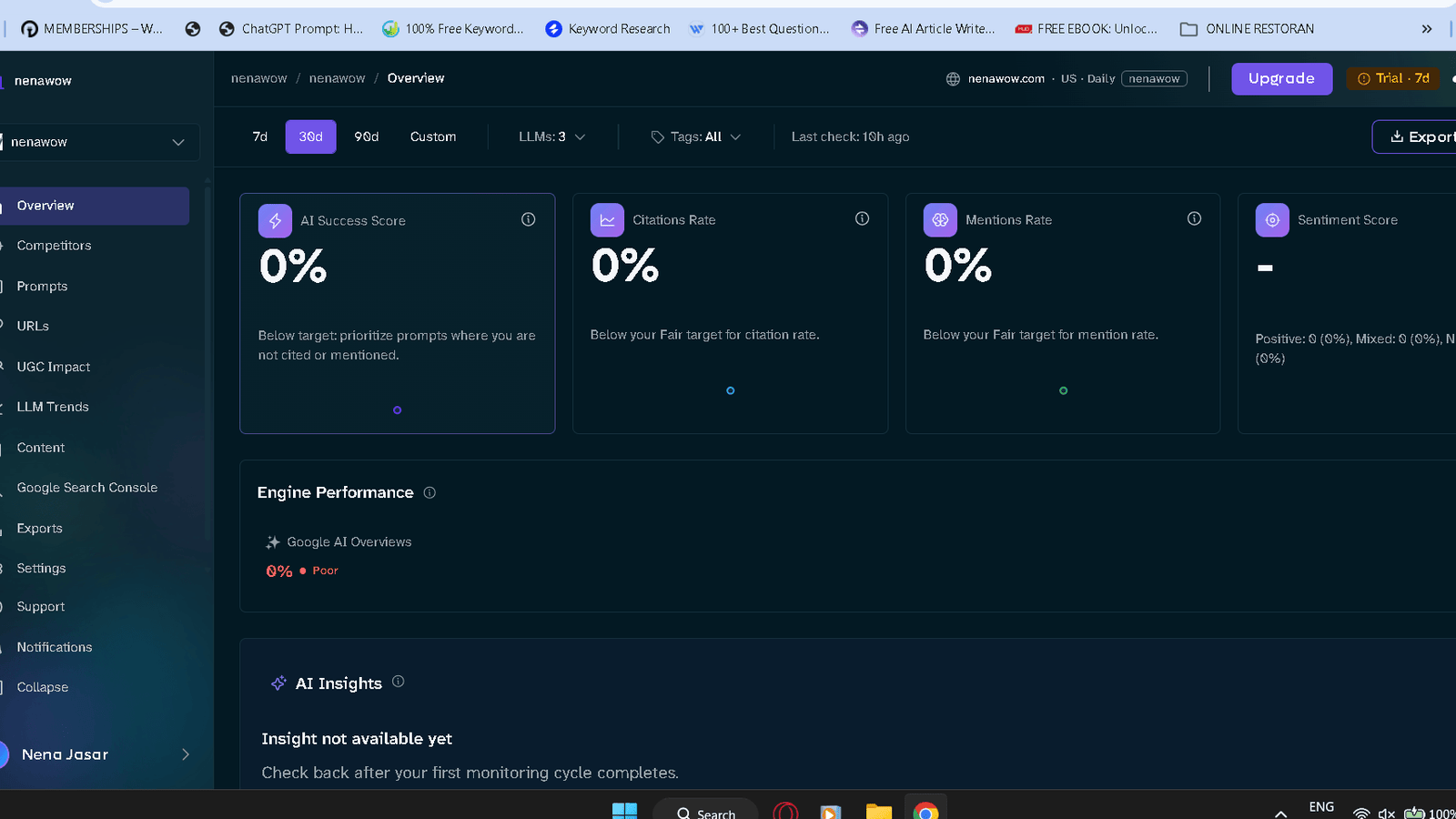
Here is the part that would have scared off a less patient reader. I finished onboarding at 12:55. By 13:01, ZipTie’s main dashboard showed 0% across every headline metric: AI Success Score, Citations Rate, Mentions Rate, even Sentiment Score sat blank.
I nearly wrote the tool off right there. Zero, nothing, is not a small number to sit with when it is your own site staring back at you.
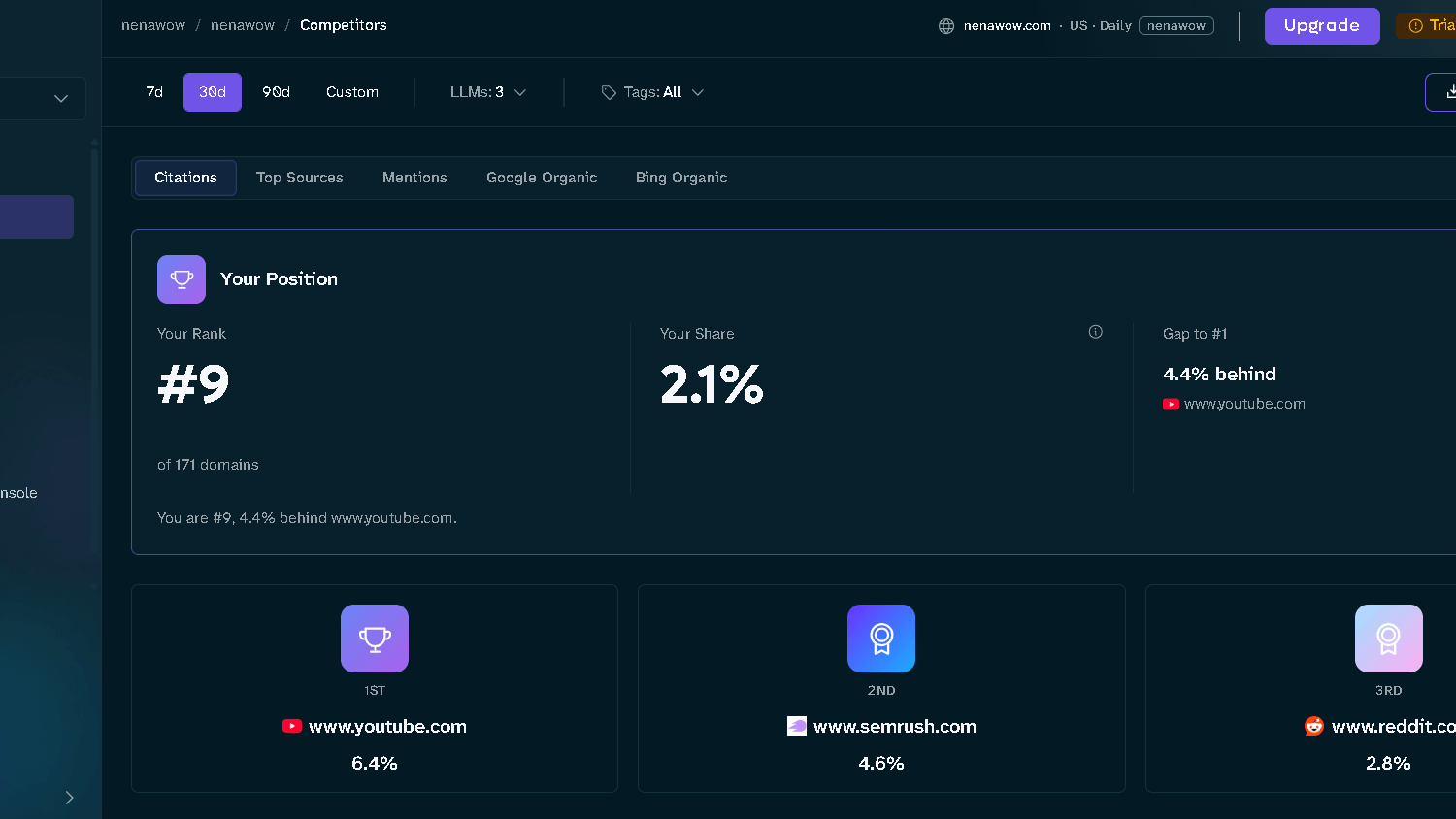
Then I clicked into the Competitors tab. It told a completely different story: I ranked ninth of 171 domains on citations, with a real 2.1 percent share. Not zero. Not close to zero.
By 13:27, the Overview page finally caught up, showing a 9 percent AI Success Score and an 8 percent citation rate. Twenty-six minutes between a flat, alarming zero and the real number that had been sitting one click away the entire time. That is the sharpest usability problem I found in this whole test.
Five Ways ZipTie Ranks You
ZipTie does not give you one visibility score. It gives you five, each measuring something different, and each with its own leaderboard.
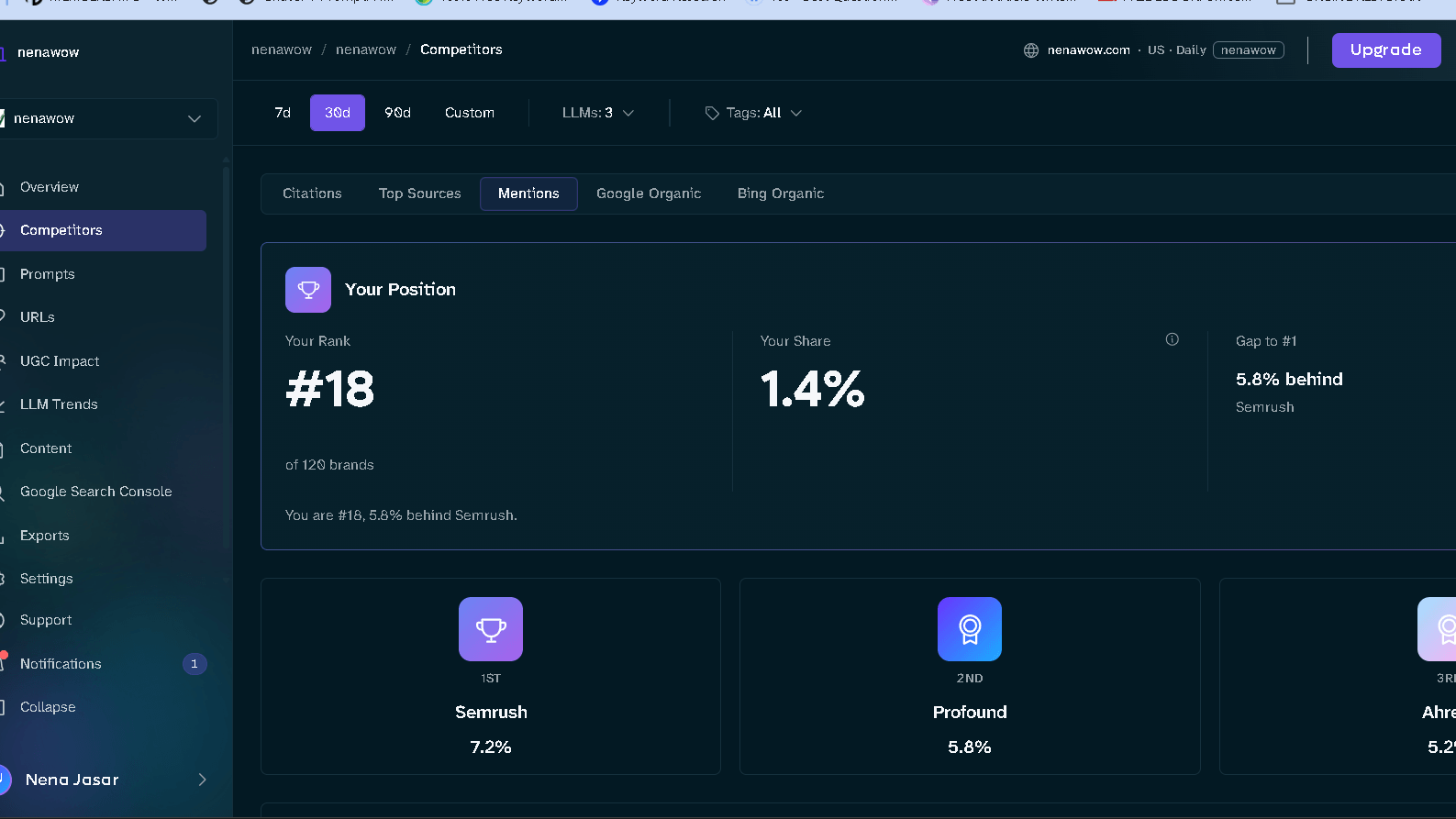
Citations ranked me ninth of 171 domains, 2.1 percent share, 4.4 percent behind YouTube at the top. Top Sources, a page-level view rather than a domain-level one, ranked me twenty-second of 305 individual URLs, with my tag archive page beating my terms and conditions page, which beat my own about page. Mentions, a brand-name view, put me eighteenth of 120 tracked brands, 5.8 percent behind Semrush.
Google Organic ranked me twenty-seventh of 100 domains. Bing Organic was not available at all on the trial, gated behind an upgrade since Bing data ships bundled with Bing AI Overview tracking.
Five numbers, five denominators, one site. If you read only the first one you land on, you get a partial picture. Read all five, and a clearer shape starts to show.
The 24-Prompt Test
This is the test that mattered most. I tracked 24 prompts across three engines for five days. The average AI Success Score across all of them came out to 6 percent.
My best-performing prompt was “nenawow review,” scoring 89 percent, green across every engine. My worst was “AI visibility checker with real screenshots and testing,” a phrase pulled straight from my own editorial standards. It scored zero. Flat zero, on every engine, no citations, no mentions.
Here is the number that stopped me. Twenty-two of my 24 tracked prompts scored exactly 0 percent. Only two prompts, both searches for my own name, scored anything at all.
Two of those zero-scoring prompts were the same two I had pulled directly from my AthenaHQ testing: “best SEO platforms for measuring AI Overview citation frequency” and “rank tracking software that monitors AI generated search summaries.” AthenaHQ had already told me I had zero presence on those exact searches, tracing the gap to a single competing domain with no third-party backing. ZipTie, running a completely separate test on a different day, found the same zero.
Two tools, two testing sessions, the same result. That is not a coincidence. That is confirmation.
The AI Insights That Wrote Themselves
I did not have to ask ZipTie why my numbers looked the way they did. It told me on its own, inside the Overview page, generated automatically from the first completed check.
The insight named the exact pattern: visibility concentrated entirely in branded and brand-awareness prompts, each around 83 percent, with every other category, product recommendation, competitor comparison, use case, problem solving, sitting at zero. It flagged Google AI Overviews as my weakest engine specifically, 6.2 percent, and offered a direct next step: review my unbranded prompt categories first, since that is where the real lift sits.
AthenaHQ got me to this same conclusion, but it took three separate follow-up questions to get there. ZipTie handed it to me unprompted, from one finished check. That is a real point in its favor.
UGC Impact: Content Ideas Built From Real Demand
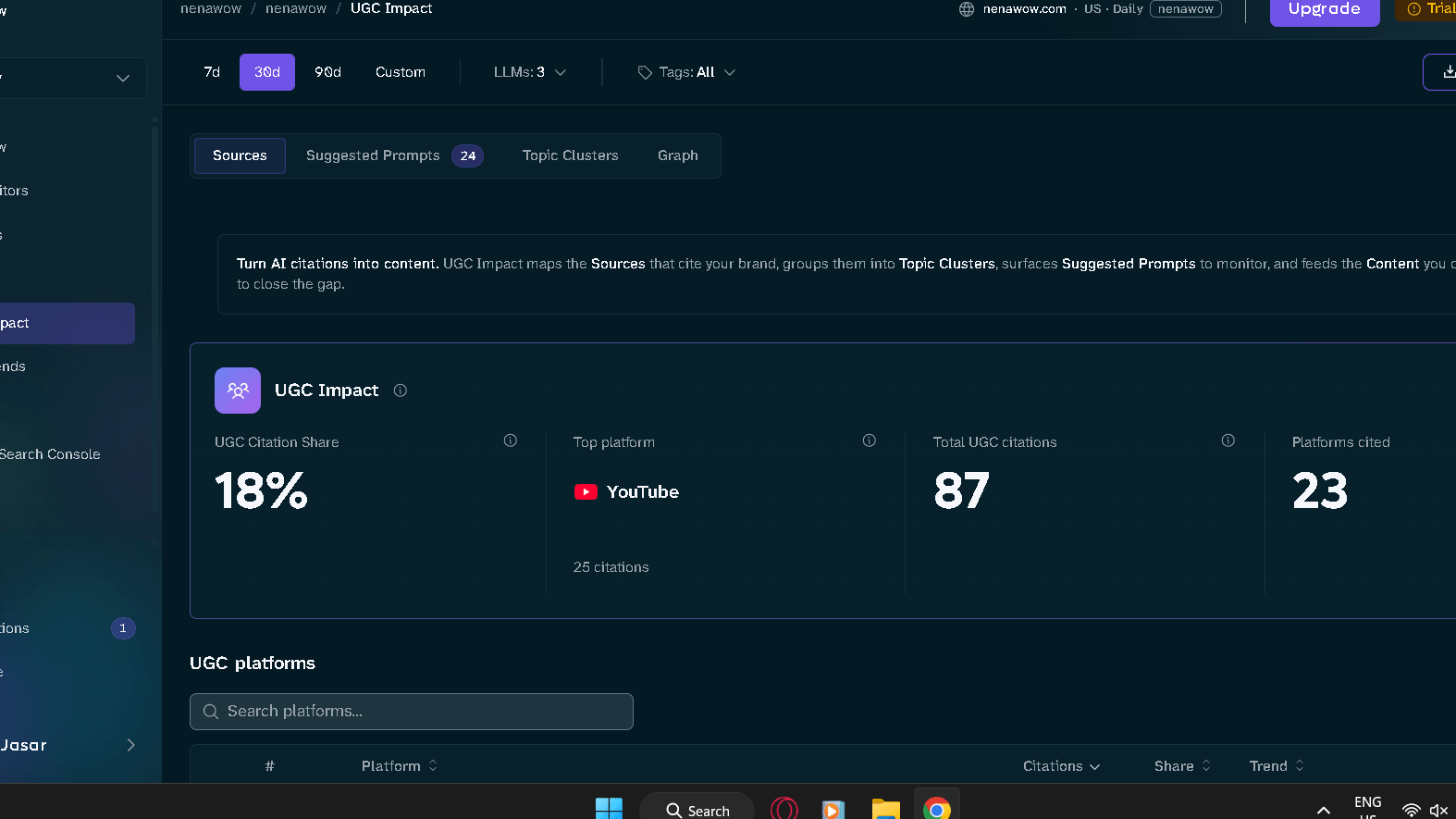
One feature none of the other three tools I have tested this month offer at all. ZipTie’s UGC Impact tab pulls real questions from actual user platforms, YouTube, Reddit, forums, and groups them into demand-ranked clusters you can act on.
My account surfaced 24 suggestions across ten clusters. The top cluster, AI Visibility Tracking, carried four questions at 28 mentions each, real people asking how to track brand visibility when Search Console does not show the full picture. A separate cluster, Measurement Transparency Issues, asked almost the exact question I had just lived through myself: why do different AI visibility tools give different scores.
Each suggestion comes with a one-click “add to monitoring” action. Rather than drafting a finished article for you the way AthenaHQ’s Content Agents feature did, ZipTie hands you a validated topic and lets you write it yourself. Given how much I care about first-party testing over generated drafts, that approach fits my process better than a pre-written piece ever could.
What’s Missing
Bing coverage sits entirely behind an upgrade on the trial, both Bing Organic and Bing AI Overview. That is disclosed clearly at signup, not hidden, so I will not call it a trap. It is still a real gap if Bing matters to your audience.
The two-sequence, eight-step onboarding is longer than the homepage promises. And that Overview page delay, real data sitting hidden behind a misleading zero for over 20 minutes, needs fixing before I would call this tool beginner-proof.
ZipTie Review: Final Verdict
ZipTie gave me more usable, specific, cross-verified data than any other AI visibility tool I have tested this year, at a fifth of the starting price of some competitors. The 24-prompt test confirmed a real gap AthenaHQ had already found independently, and the AI Insights panel found it faster, without me lifting a finger.
The rough edges are real too. A confusing first dashboard screen, a longer setup than advertised, five different rankings that take a minute to understand together. None of that changes my answer. If I were spending my own money on one AI visibility tool right now, this is the one I would buy.
Related Reading
Is It Possible to Track Brand Mentions in AI Answers?
Google AI Mode Product Recommendations: 50-Test Study
Claude Product Recommendations 2026: I Tested 50 Prompts
How Does ChatGPT Decide What Products to Recommend?
Do News Websites Block AI Crawlers? I Tested 13 Major Publishers
How I Found My Own AI Search Visibility Gap
FAQ
Is ZipTie’s free trial actually free?
Yes. Seven days, no card required, no auto-billing. You get 25 daily prompts across ChatGPT, Google AI Overviews, and Perplexity, with UGC Impact analysis included.
Why did ZipTie show 0% on my dashboard at first?
The Overview page had not caught up to my first completed check yet. In my test, it took 26 minutes for the headline numbers to update, even though the Competitors tab already showed real data the whole time. Check the Competitors tab if your Overview page looks empty.
How much does ZipTie cost after the trial?
Plans start at $19.95 a month, with no seat or project fees. Pricing scales by how many prompts you monitor and how many engines you track them on. Add-ons like Content Generation and Source Impact Analysis are priced separately.
Does ZipTie track Bing?
Not on the trial. Bing Organic and Bing AI Overview both sit behind an upgraded subscription, since ZipTie bundles the two together into a single check.
What makes ZipTie different from a tool like AthenaHQ?
The depth. ZipTie gave me five distinct competitive rankings, a prompt-by-prompt breakdown across every tracked query, and a demand-ranked content idea list pulled from real user platforms. AthenaHQ’s strength was its conversational follow-up questions. ZipTie’s strength is showing you everything at once, once you know where to look.