
This is hands-on Moz vs Semrush vs Ahrefs comparison.
Ahrefs wins on pure organic SEO — biggest backlink index, most accurate keyword difficulty, best multi-engine AI Overview tracking.
Semrush is the most complete marketing platform — paid search, content production, local SEO, white-label reporting, all under one roof.
Moz Pro is more capable than people assume. Most accessible entry point, now tracks ChatGPT visibility, and has a prompt suggestion feature and page optimization that neither competitor offers in the same way.
I ran all three simultaneously on nenawow.com — a real niche site, 220 posts, ~1,000 monthly organic visits — for 30 days in April 2026. The same keywords, and competitors, same crawl settings throughout.
Disclaimer: I may earn a small commission on purchases made through links on this page, at no extra cost to you. This supports honest, independent reviews.
Table of Contents
Quick Comparison Table
| Feature | Ahrefs | Semrush | Moz Pro |
|---|---|---|---|
| Best For | Pure organic SEO | Full marketing stack | Beginners + mid-market |
| Backlink Database | ✅ Strongest | Strong | Basic |
| Keyword Research | Conservative, precise | Extensive + PPC data | Simple, beginner-friendly |
| Keyword Difficulty Accuracy | Highest (KD 58) | High (KD 57) | Optimistic (KD 35) |
| Site Audit | Prioritized, actionable | Exhaustive | Functional, less granular |
| Rank Tracking | Daily + full SERP features | Daily + Visibility Score | Daily |
| AI Tracking | ✅ Multi-engine | Google only | ✅ ChatGPT only |
| PPC Tools | ❌ | ✅ | ❌ |
| Content Tools | ❌ Analysis only | ✅ ContentShake AI | ✅ Page Optimization + Prompt Suggestions |
| Client Reporting | Basic | ✅ White-label | Basic |
| Local SEO | Location tracking only | ✅ Full listing management | Basic |
| Domain Authority | Domain Rating (DR) | Authority Score | ✅ DA (industry standard) |
| Starting Price | $129/mo | $139.95/mo | $99/mo |
| Free Option | ✅ Webmaster Tools (permanent) | 10 searches/day | 7-day trial |
Moz vs Semrush vs Ahrefs 2026: Decision Guide
| Your Situation | Best Tool |
|---|---|
| Link building, need largest index | Ahrefs |
| Running paid + organic campaigns | Semrush |
| New to SEO, learning the basics | Moz Pro |
| Content team producing at scale | Semrush |
| Local SEO agency | Semrush |
| Solo blogger, organic focus | Ahrefs or Moz Pro |
| Technical SEO on complex sites | Semrush |
| Need precise keyword difficulty | Ahrefs |
| Communicating DA to clients | Moz Pro |
| Tracking ChatGPT visibility | Moz Pro |
| Need on-page prompt guidance | Moz Pro |
| Zero budget | Ahrefs Webmaster Tools (free) |
How I Tested
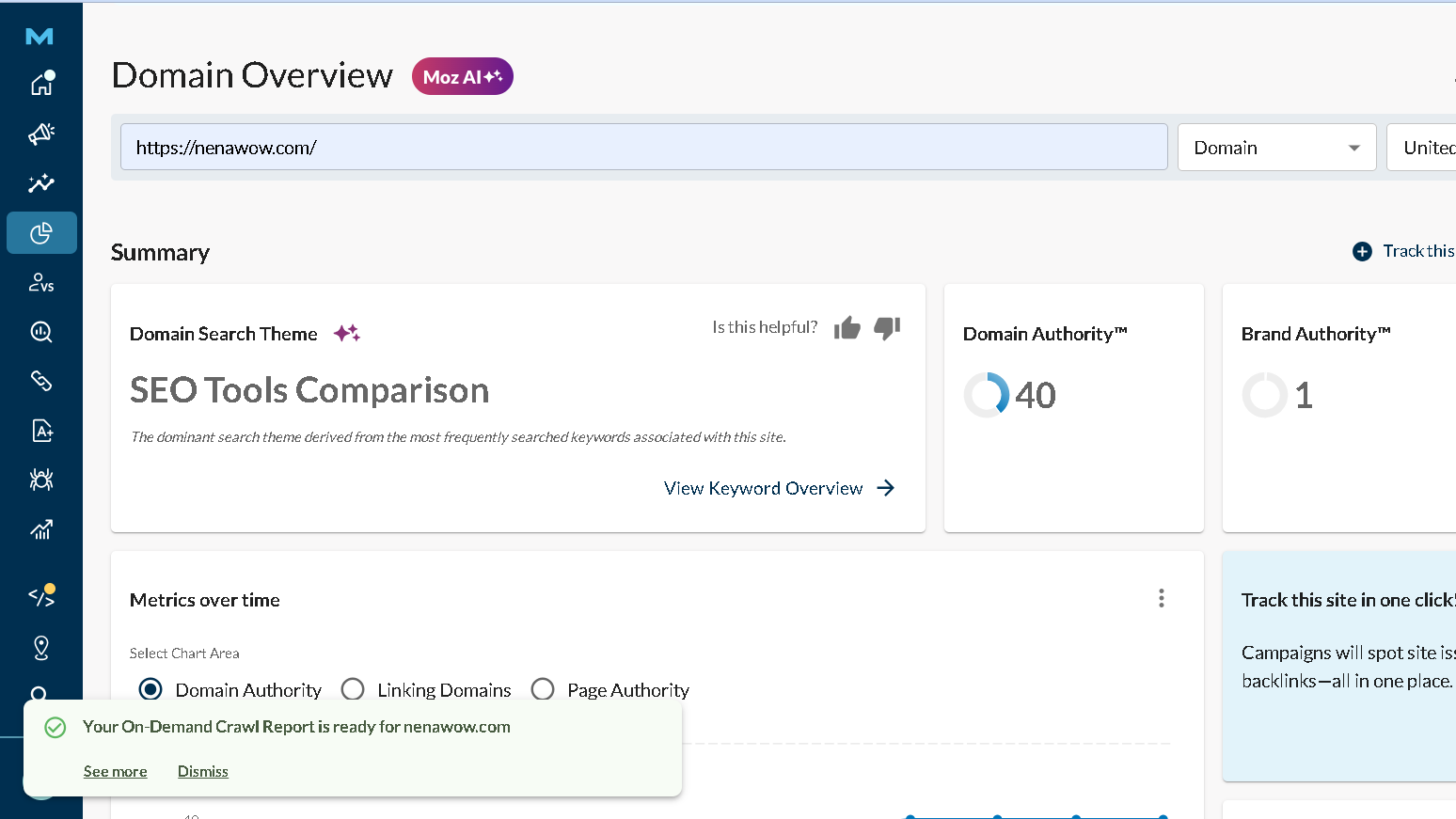
Site: nenawow.com — two-year-old niche site covering AI and SEO. 220 posts, no paid traffic, ~1,300 referring domains.
Baseline: ~1,000 monthly organic visits per Google Search Console. Ahrefs estimated 1,200. GSC is the consistent reference point throughout.
Conditions were identical across all three tools: 30 keywords tracked simultaneously, same seed terms, same three competitor domains, same crawl settings. Nothing was adjusted after the fact.
One caveat worth stating upfront: data gaps are more pronounced on smaller sites. At enterprise scale, proportional differences may narrow. Treat everything here as directional.
Moz vs Semrush vs Ahrefs 2026: Pricing
Ahrefs
| Plan | Monthly | Annual/mo |
|---|---|---|
| Lite | $129 | $108 |
| Standard | $249 | $208 |
| Advanced | $449 | $374 |
| Enterprise | Custom | Custom |
Free: Ahrefs provides Ahrefs Webmaster Tools — permanent, no credit card. Real Ahrefs data (audit, backlinks, organic keywords) for any verified domain.
If you want to learn more about Ahrefs, there is an Ahrefs review with testing results on real website.
Semrush
| Plan | Monthly | Annual/mo |
|---|---|---|
| Pro | $139.95 | $117.33 |
| Guru | $249.95 | $208.33 |
| Business | $499.95 | $416.66 |
Free: Limited account, 10 searches/day. Fine for exploring the UI, not for real work.
Here is my Semrush review with data after the test.
Moz Pro
| Plan | Monthly | Annual/mo |
|---|---|---|
| Starter | $99 | $79 |
| Standard | $179 | $143 |
| Medium | $299 | $239 |
| Large | $599 | $479 |
Free: 30-day trial. MozBar browser extension gives free DA and link data while browsing.
The price reality
Moz Starter at $99 is the cheapest real entry point. Ahrefs Lite ($129) and Semrush Pro ($139.95) are practically neck and neck. All three push you to upgrade — entry plans restrict keywords tracked, projects, and crawl volume. The Moz price gap is real, but so is the capability gap on backlinks and difficulty calibration. That said, Moz’s new SEO content and AI features change the value equation more than the price does.
Semrush vs Moz vs Ahrefs: Best for Keyword Research?
The number that matters most: Keyword Difficulty
For “AI SEO tools,” tested simultaneously:
| Tool | KD Score | Accuracy vs. Real SERP | Opportunities Found |
|---|---|---|---|
| Ahrefs | 58 | ✅ Accurate | 18 |
| Semrush | 57 | ✅ Accurate | 70+ |
| Moz Pro | 35 | ⚠️ Optimistic | Limited |
That 23-point gap between Moz and the others isn’t academic. A KD of 35 says “go for it.” A KD of 58 says “you’ll need serious backlinks to compete.” Act on Moz’s number without verifying the SERP yourself and you could waste months chasing rankings you can’t reach yet.
Ahrefs Keywords Explorer Tool
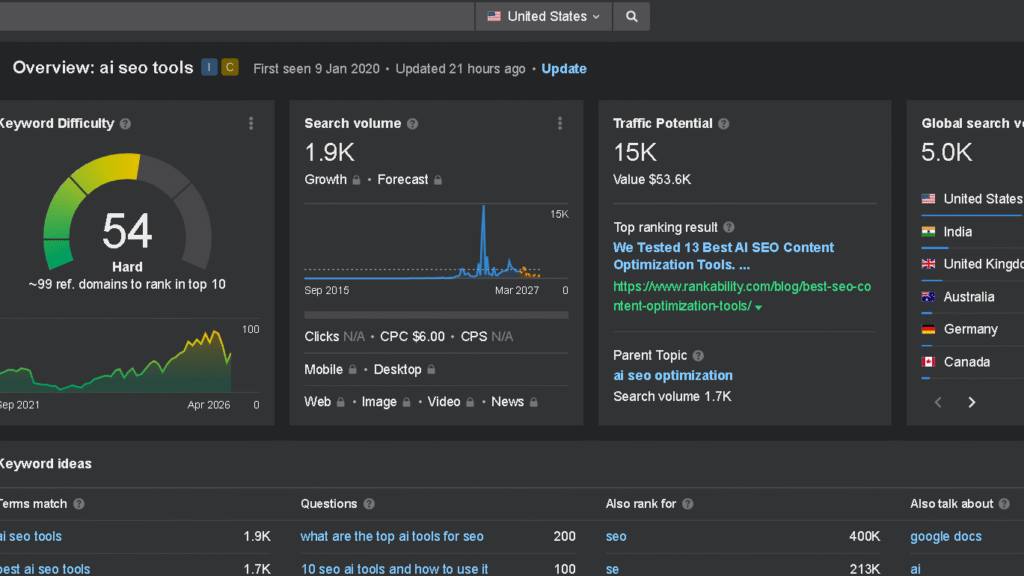
Billions of keywords across 170+ countries. Returns clicks estimates, traffic potential for the parent topic, SERP history, and ranking page breakdown. The parent topic feature alone is worth the subscription for many users — it redirects your strategy toward higher-value queries that surface-level tools miss.
18 opportunities for the “AI SEO tools” seed. Conservative count.
Semrush Keyword Magic Tool
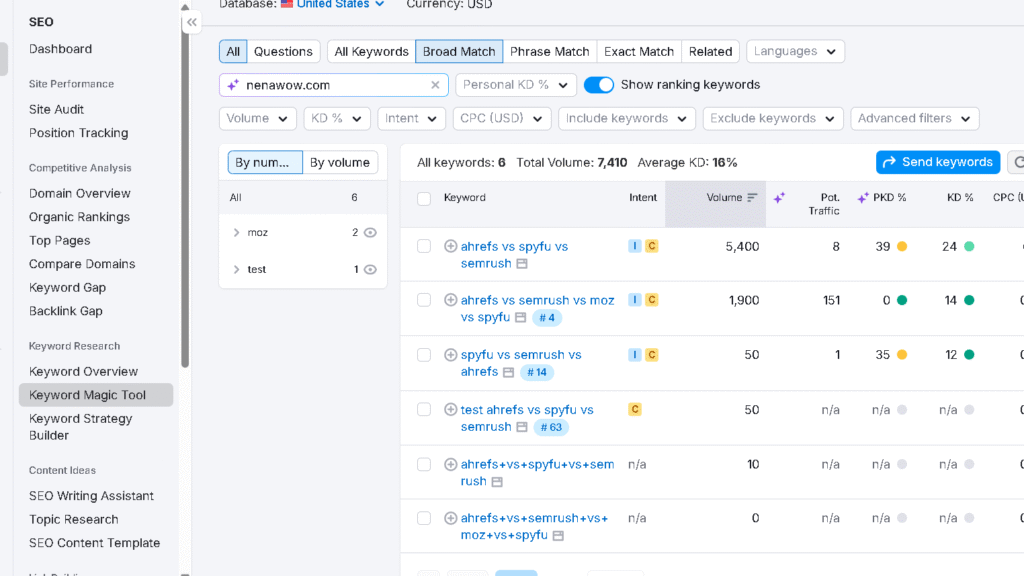
70+ opportunities for the same seed. The Keyword Gap tool is exceptional — five competitors at once, filtered by shared, unique, and missing keyword sets. PPC data lives right next to organic data: CPC, ad competition, paid SERP previews.
Moz Keyword Explorer
This keyword overview tool is clean and accessible. The Priority score combines volume, difficulty, and CTR into one number. This is very useful when you don’t yet want to manually synthesize multiple signals. Moz also explains what its metrics mean in plain language, which neither Ahrefs nor Semrush does consistently.
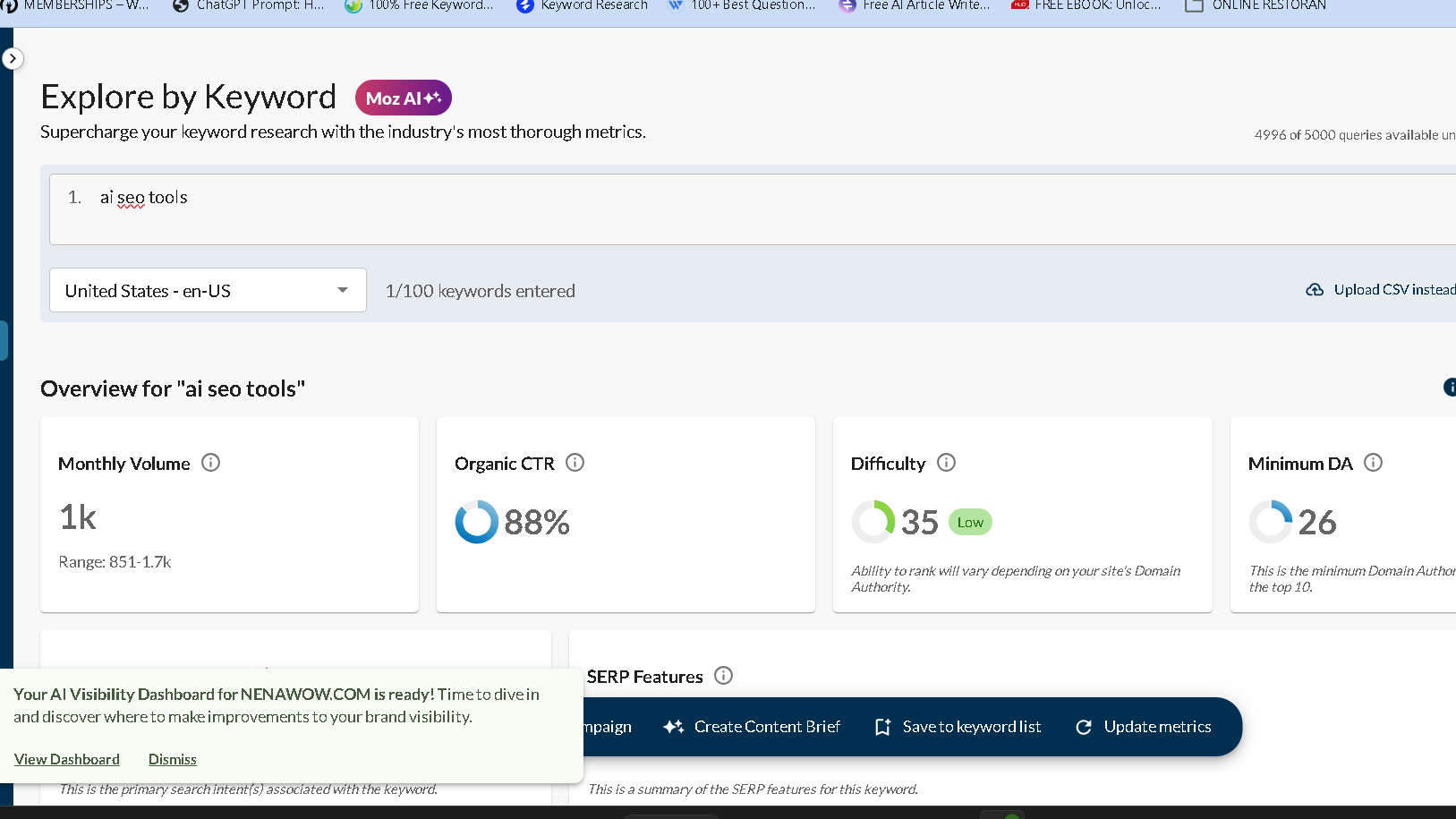
The calibration gap remains the issue for anyone making real investment decisions. Always verify against the SERP results before committing.
Winner: Ahrefs and Semrush tie for professional use. Moz wins on accessibility.
Moz vs Ahrefs vs Semrush: Backlink Analysis
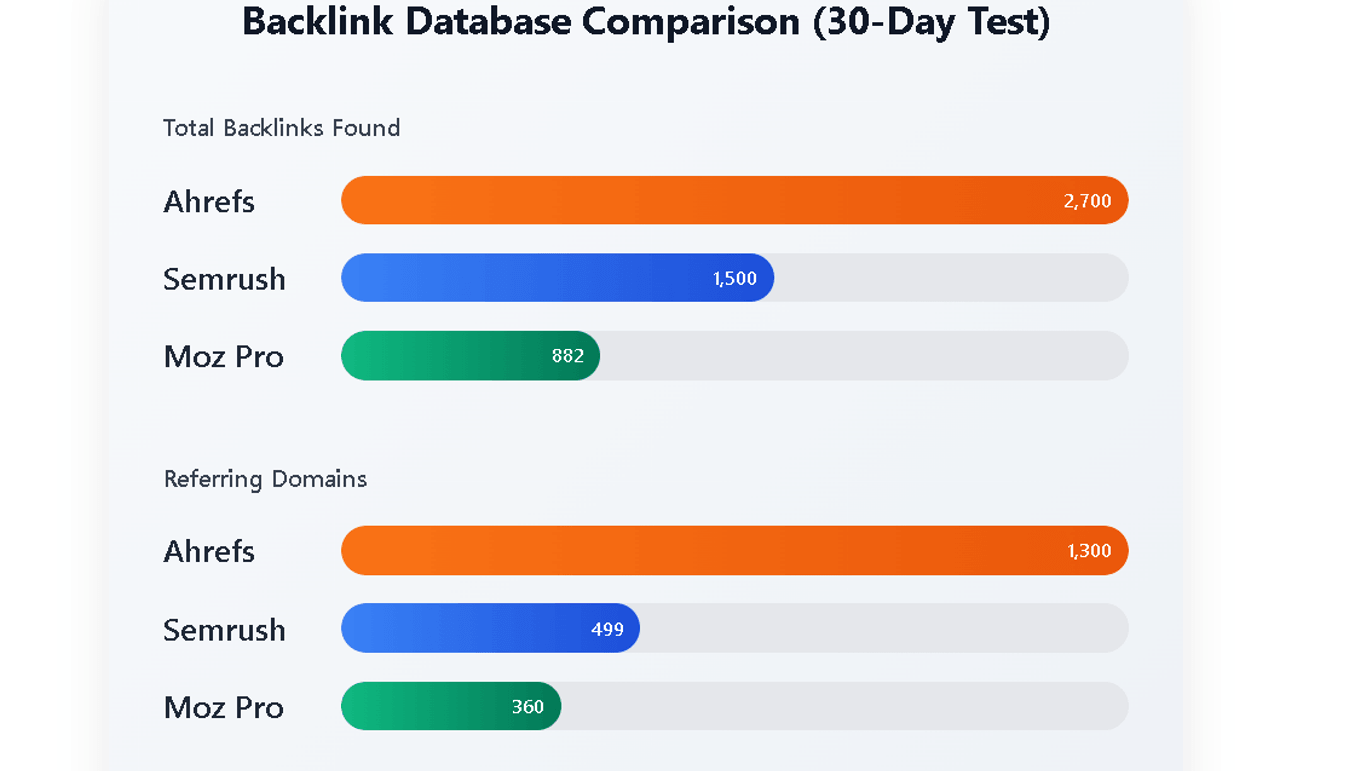
Same site and crawl window. Here’s what came back:
| Tool | Backlinks Found | Referring Domains |
|---|---|---|
| Ahrefs | 2,700 | 1,300 |
| Semrush | 1,500 | 499 |
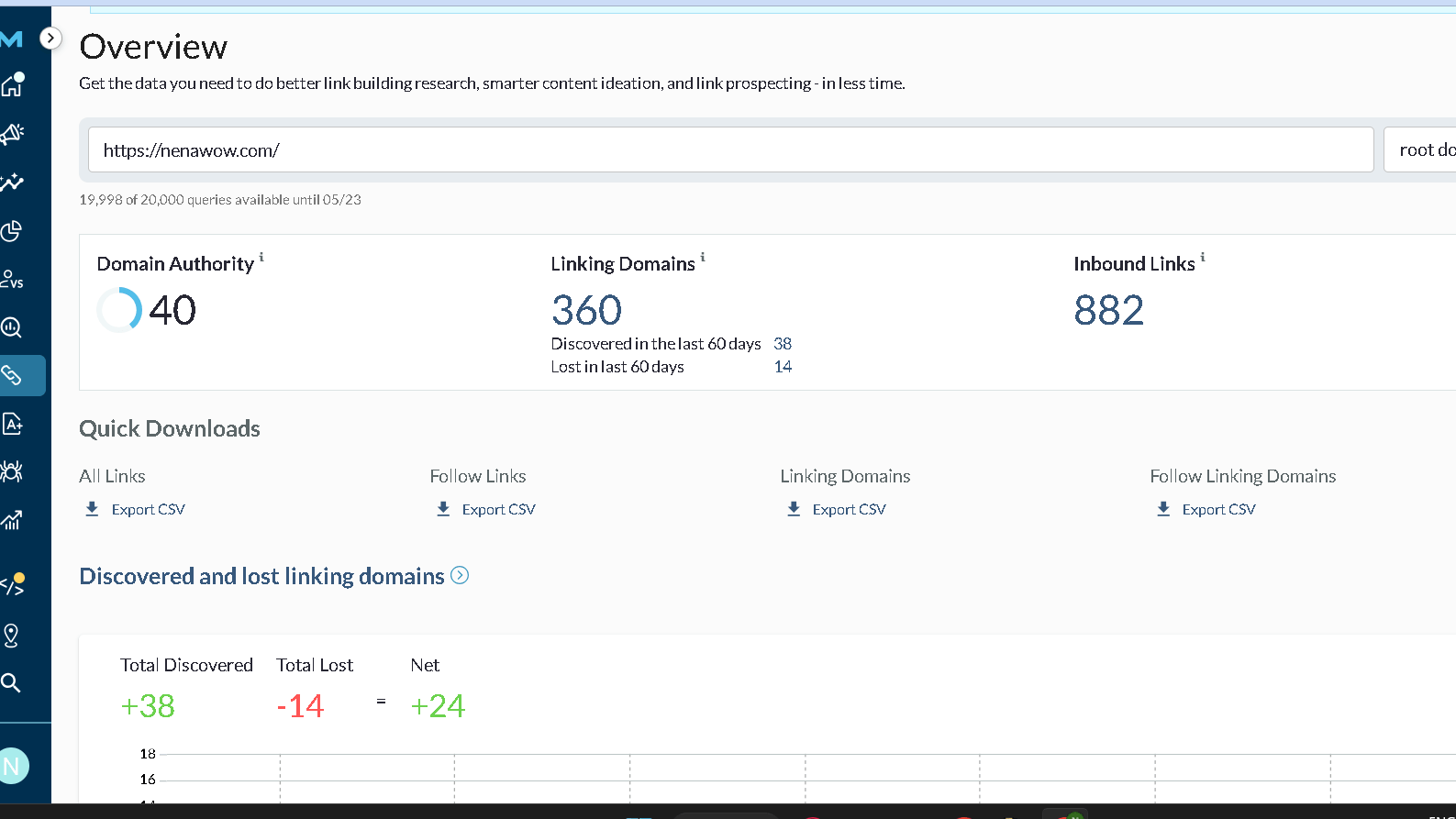
| Moz Pro | 882 | 360 |
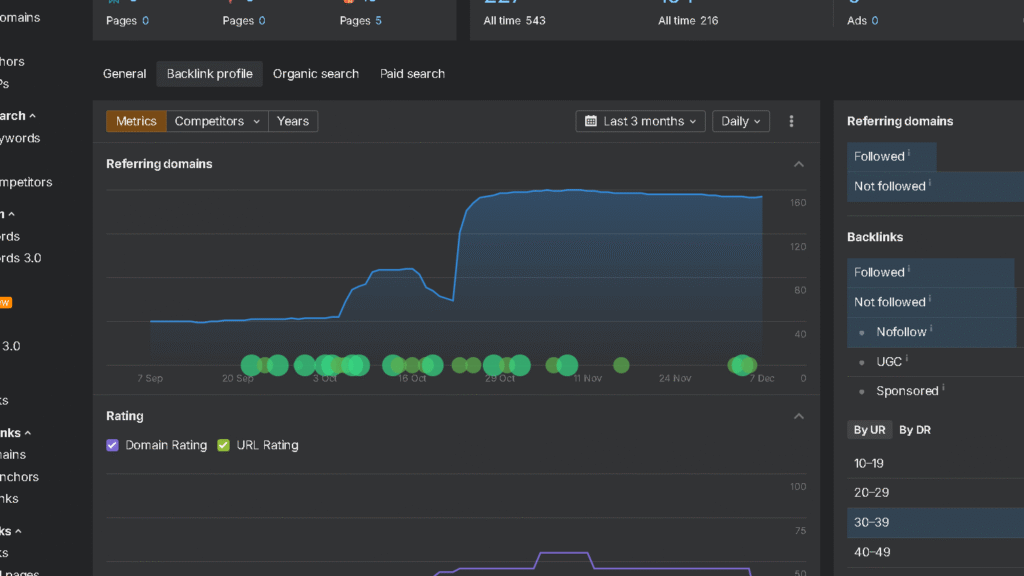
Ahrefs found 3x more referring domains than Moz. Every link I could independently verify showed up in Ahrefs. Several confirmed domains were absent from Semrush entirely. Moz returned less than a third of Ahrefs’ referring domain count.
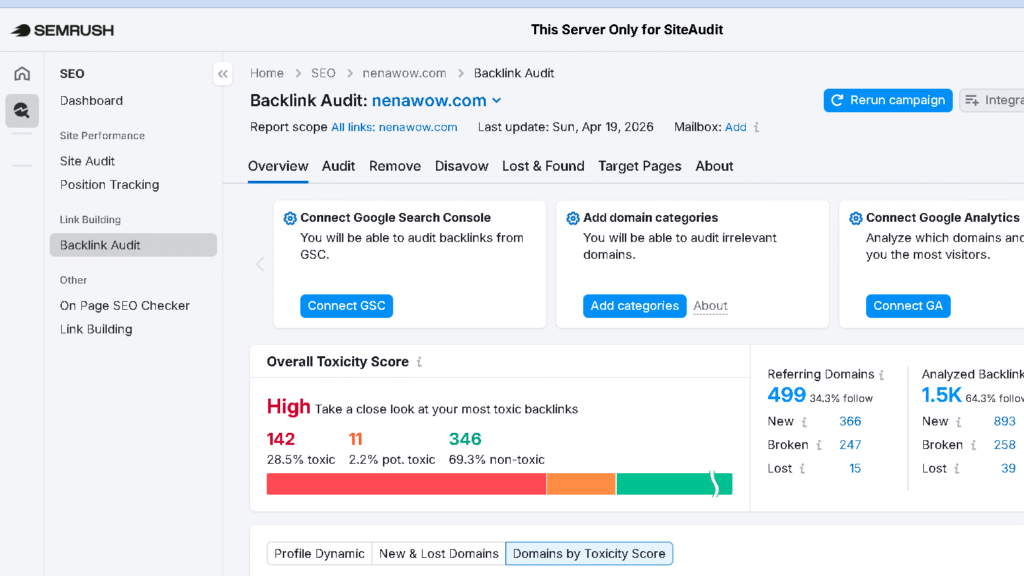
For link building, this isn’t cosmetic. If you’re mapping competitor backlinks to build your outreach list, working from Moz’s index means your list has structural holes you don’t know about.
Beyond index size, Ahrefs gives you historical gain/loss charts, anchor text distribution, new vs. lost link tracking, and dofollow/nofollow breakdowns.
One genuine Moz advantage: Domain Authority. When a journalist, publisher, or advertiser asks “what’s your DA?” — they mean Moz DA. They do not want Ahrefs’ Domain Rating. They do not want Semrush’s Authority Score. DA is the industry’s common language, and Moz owns it.
Winner: Ahrefs is the best on index depth. Moz on DA as a communication metric.
Technical Site Audit
Three different philosophies, three very different outputs.
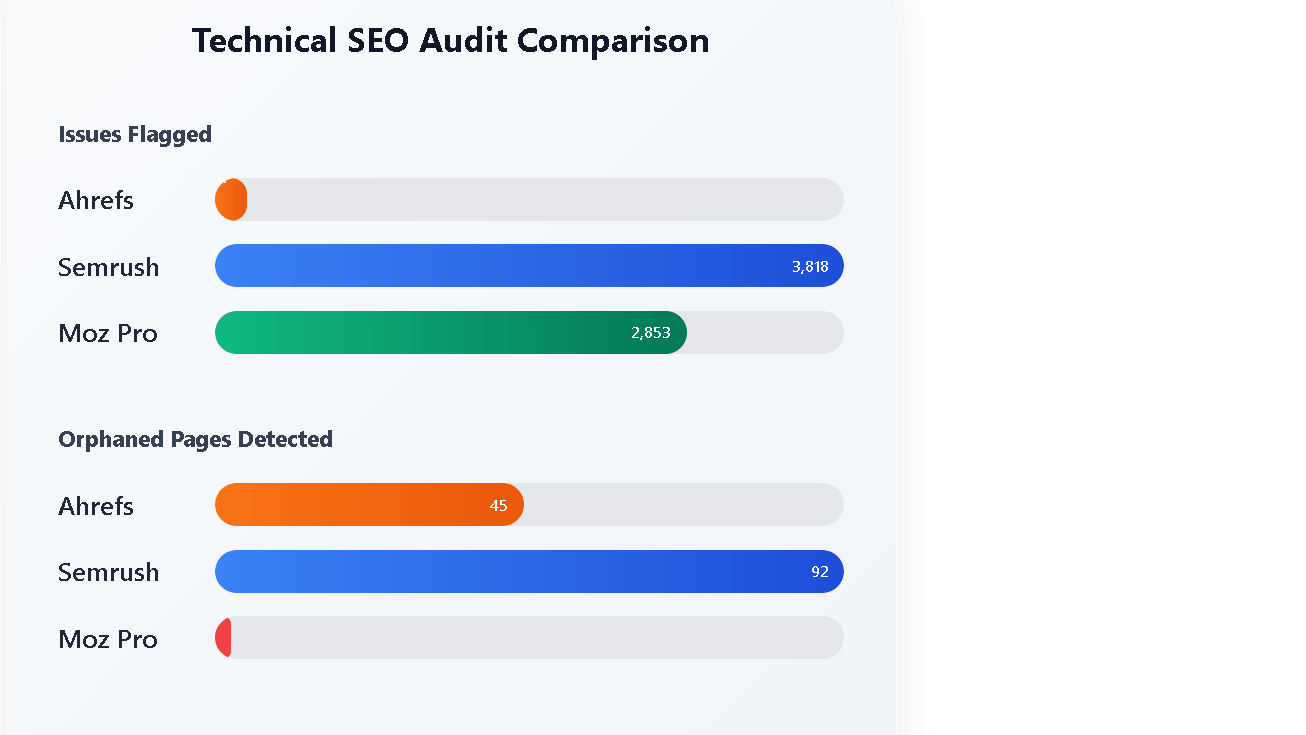
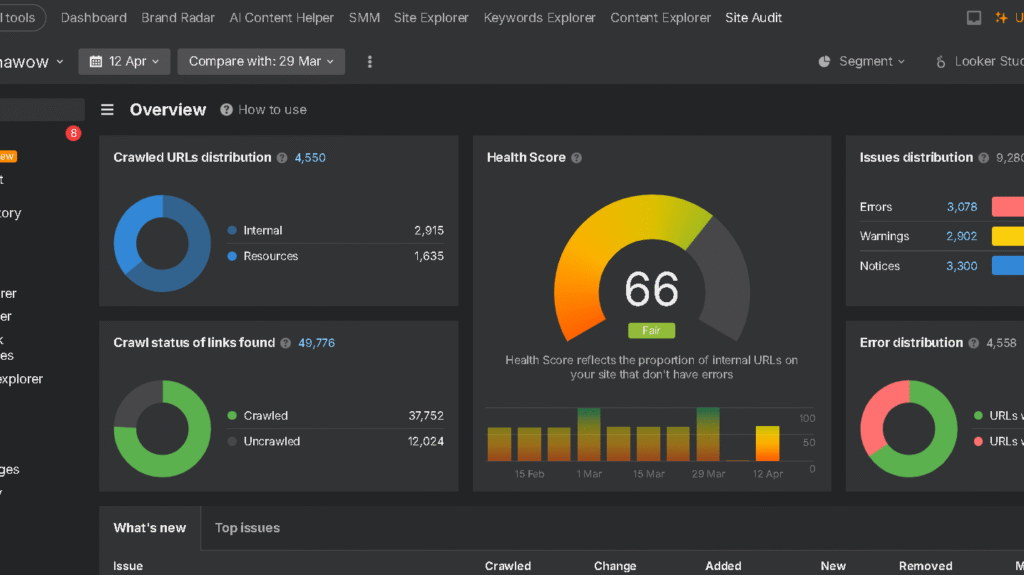
Ahrefs site explorer tool: 173 issues — 52 errors, 62 warnings, 59 notices. Groups related problems: 34 posts with the same meta description issue show as one finding. Highest-impact problems surface first. Five findings drove almost all the action during the test: an accidental noindex tag (blocking 6 posts), keyword cannibalization across four posts, three crawl efficiency issues, 45 orphaned pages, and an internal link equity map showing which posts had no authority flowing to them.
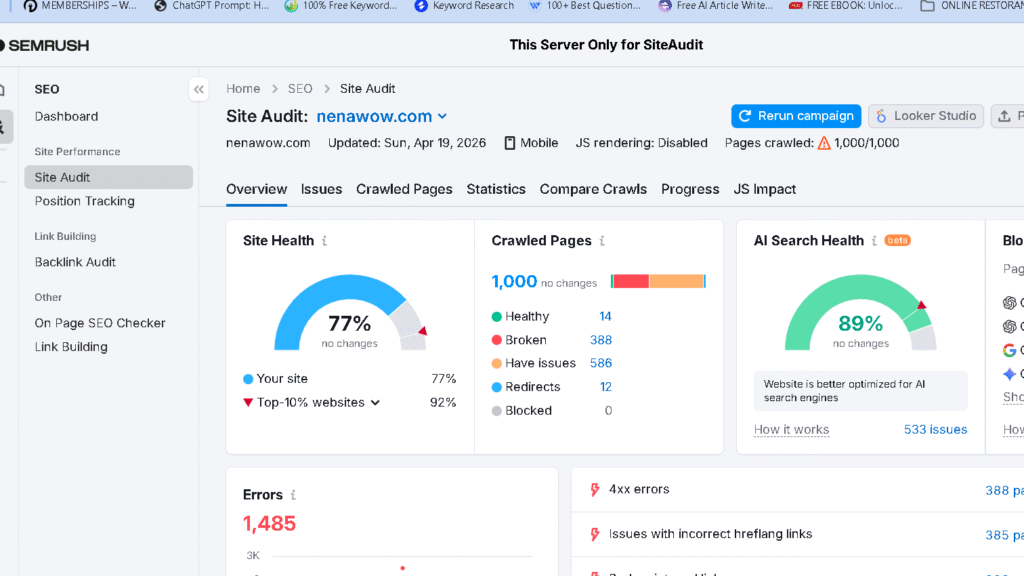
Semrush: 1,485 errors, 2,333 warnings — every instance logged separately. Found 92 orphaned pages. GA and Search Console integration shows which crawl errors affect pages that actually get traffic. Core Web Vitals monitoring is built in. If you want maximum coverage and performance signal integration, Semrush goes deepest.
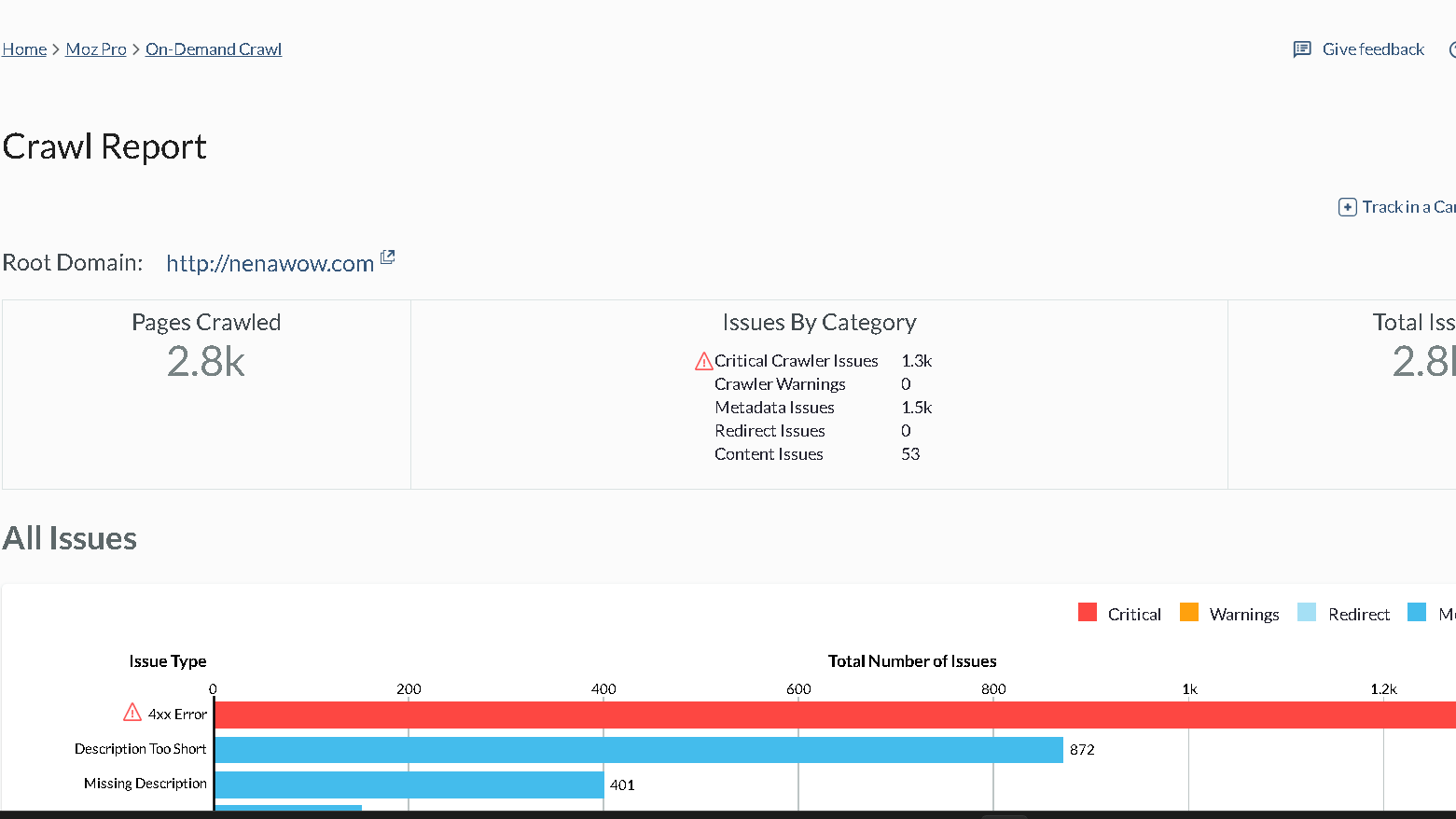
Moz: 2,853 total issues — 1,300 crawler, 1,500 metadata, 53 content. The metadata count is inflated because Moz flags each page separately rather than grouping. Filtering by severity brings it down to something workable, but it takes manual triage. Moz doesn’t detect orphaned pages and has no internal link equity visualization.
| Tool | Issues Flagged | Orphaned Pages | Internal Link Map | Core Web Vitals |
|---|---|---|---|---|
| Ahrefs | 173 (grouped) | 45 | ✅ | ❌ |
| Semrush | 3,818 combined | 92 | ✅ | ✅ |
| Moz Pro | 2,853 | ❌ | ❌ | ❌ |
Winner: Semrush for depth. Ahrefs for speed to action. Moz functional but limited.
Ahrefs vs Moz vs Semrush: Rank Tracking
30 keywords tracked across all three tools for the full 30 days.
Position accuracy is roughly equivalent — Ahrefs and Semrush land within 1–2 positions of GSC, Moz within 1–3. Daily updates across the board (Standard+ for Moz). That’s not where they differ.
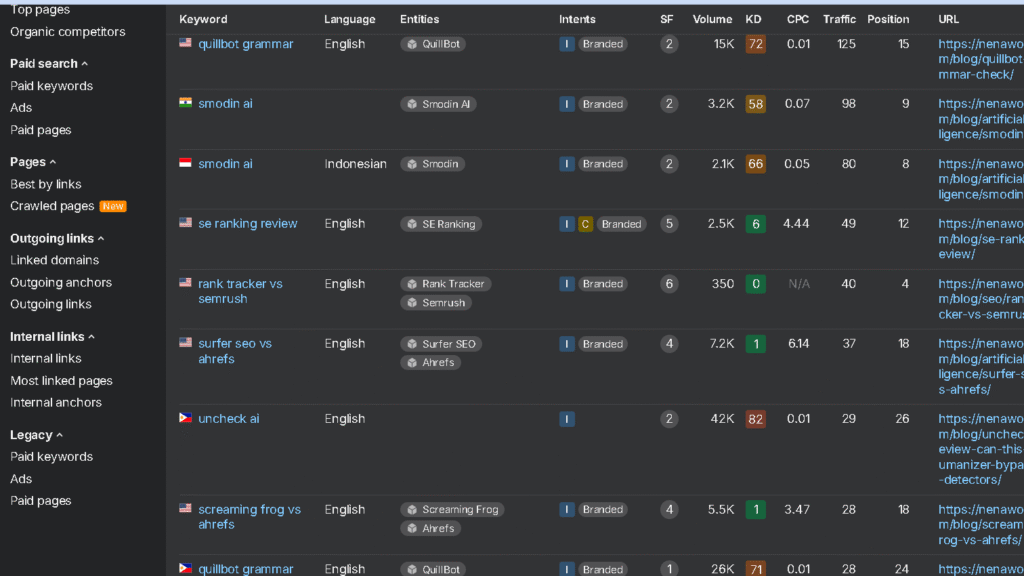
The real difference is SERP context.
Ahrefs flags every SERP feature per keyword: featured snippets, PAA boxes, video carousels, AI Overviews, local packs — and tells you whether you own them or not. During the test, several keywords where nenawow.com ranked positions 4–6 were generating near-zero clicks because AI Overviews took up the entire visible page. Ahrefs made that visible immediately. Without that context, those rankings look fine on paper.
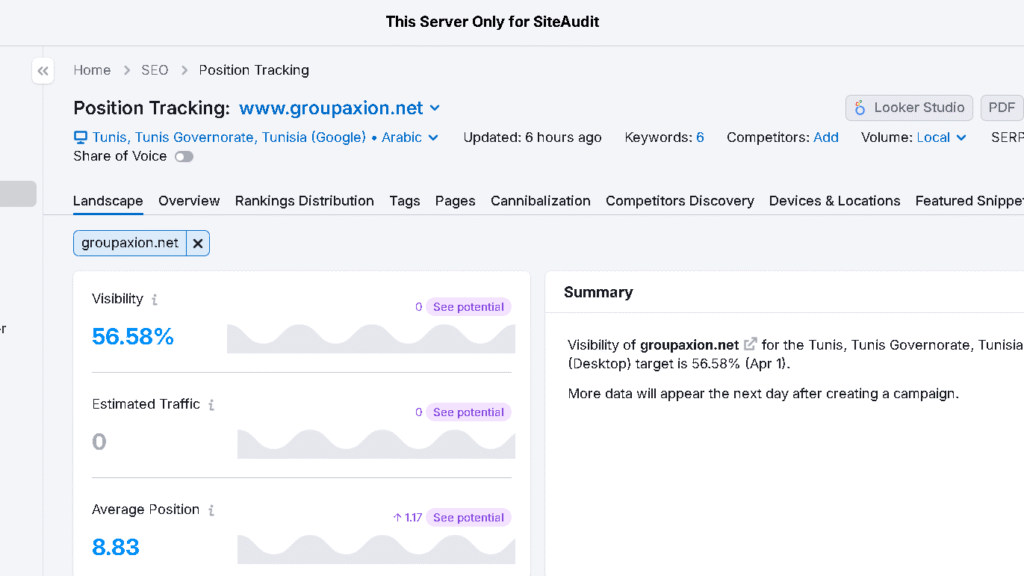
Semrush matches Ahrefs on SERP feature tracking and adds a Visibility Score — one aggregated trend line across all tracked keywords. Useful for catching directional shifts before individual keyword data shows them. Automated weekly reports reduce recurring manual work.
Moz tracks basic SERP feature presence and now offers ChatGPT AI mention tracking — something neither Ahrefs nor Semrush provides in the same dedicated format. That’s genuinely useful for brands asking whether they appear in conversational AI results. But Moz still lacks the Google AI Overview depth and Visibility Score that make Ahrefs and Semrush more actionable for daily decisions.
| Metric | Ahrefs | Semrush | Moz Pro |
|---|---|---|---|
| Update frequency | Daily | Daily | Daily (Standard+) |
| SERP feature tracking | ✅ Full | ✅ Full | ⚠️ Basic |
| AI tracking | ✅ Multi-engine | ✅ Google only | ✅ ChatGPT only |
| Visibility Score | ❌ | ✅ | ❌ |
| GSC accuracy | 1–2 positions | 1–2 positions | 1–3 positions |
| Cannibalization alerts | ✅ | ✅ | ❌ |
Winner: Ahrefs and Semrush tie. Moz’s ChatGPT tracking is a genuine differentiator, but it trails on overall SERP intelligence.
Moz vs Ahrefs vs Semrush: Competitor Analysis Research Tool
Ahrefs: Site Explorer gives you estimated organic traffic, top pages, full keyword rankings, backlink profile, and traffic value for any URL. The Content Gap tool was the highest-impact feature of the entire test — three competitors analyzed, 40+ keyword topics identified with zero current coverage on my site. Several became published posts before the test ended. Backlink gap analysis surfaced 67 unique domains linking to competitors but not to nenawow.com.
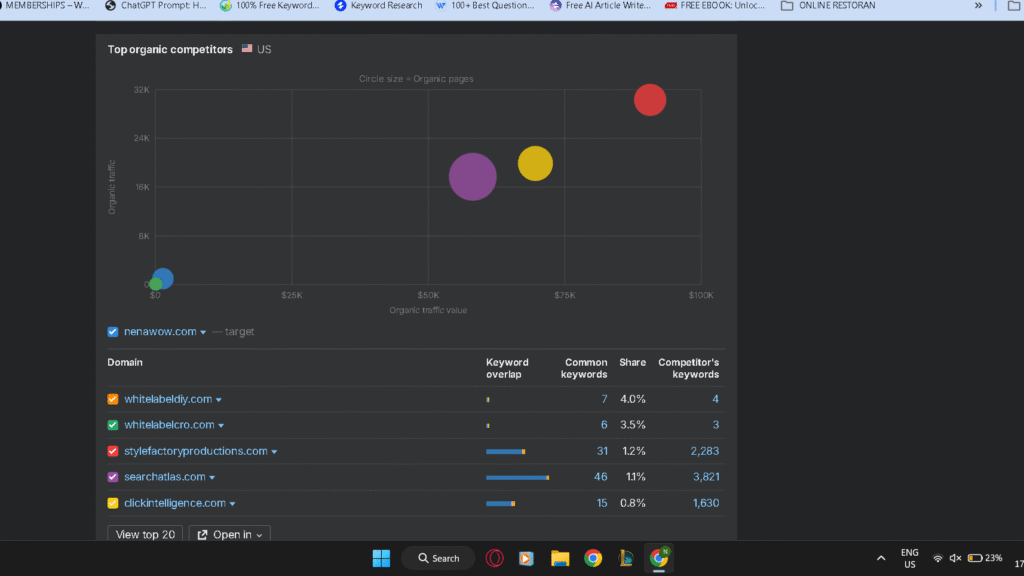
Semrush: Traffic Analytics estimates competitor traffic across all channels — organic, paid, direct, referral, social — using clickstream data, not just rankings. No equivalent exists in Ahrefs or Moz. The Keyword Gap tool handles five competitors simultaneously. Found 41 unique referring domains not linking to my site. This feature was really handy for new content ides.
Moz: Link Intersect and Keyword Explorer cover the basics. Accessible interface. But with 360 referring domains found vs. Ahrefs’ 1,300, the structural ceiling on link gap analysis shows up fast.
| Tool | Backlink Gaps Found | Content Gap Depth | Cross-Channel Traffic |
|---|---|---|---|
| Ahrefs | 67 unique domains | Deep, organic | ❌ |
| Semrush | 41 unique domains | Deep + paid | ✅ |
| Moz Pro | Limited by index | Basic | ❌ |
Winner: Ahrefs for organic intelligence. Semrush for full-funnel view.
Content Marketing Tools & AI Overviews
This is where Moz surprised me most.
AI tracking
Ahrefs covers Google, Bing Copilot, and other generative surfaces. Found 6 keywords where nenawow.com appeared in AI Overviews — none of it visible in Google Search Console. Multi-engine matters as AI search fragments across platforms.
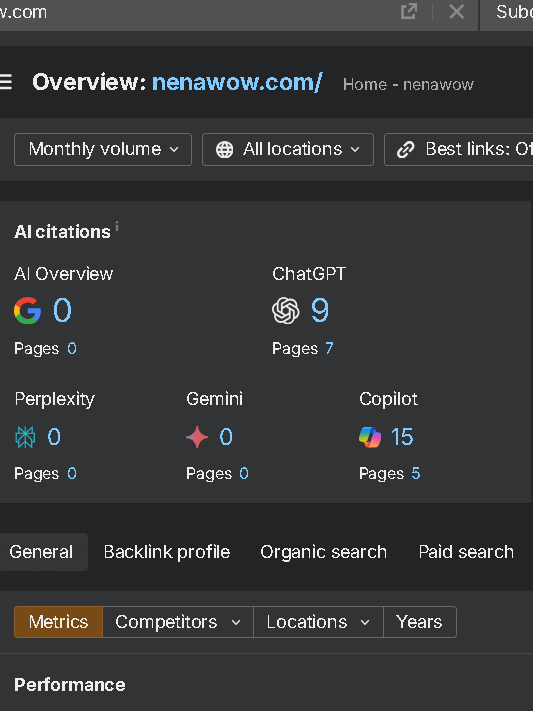
Semrush covers Google AI Overviews. Non-Google coverage is still developing. For Google-first audiences, this is usually sufficient.
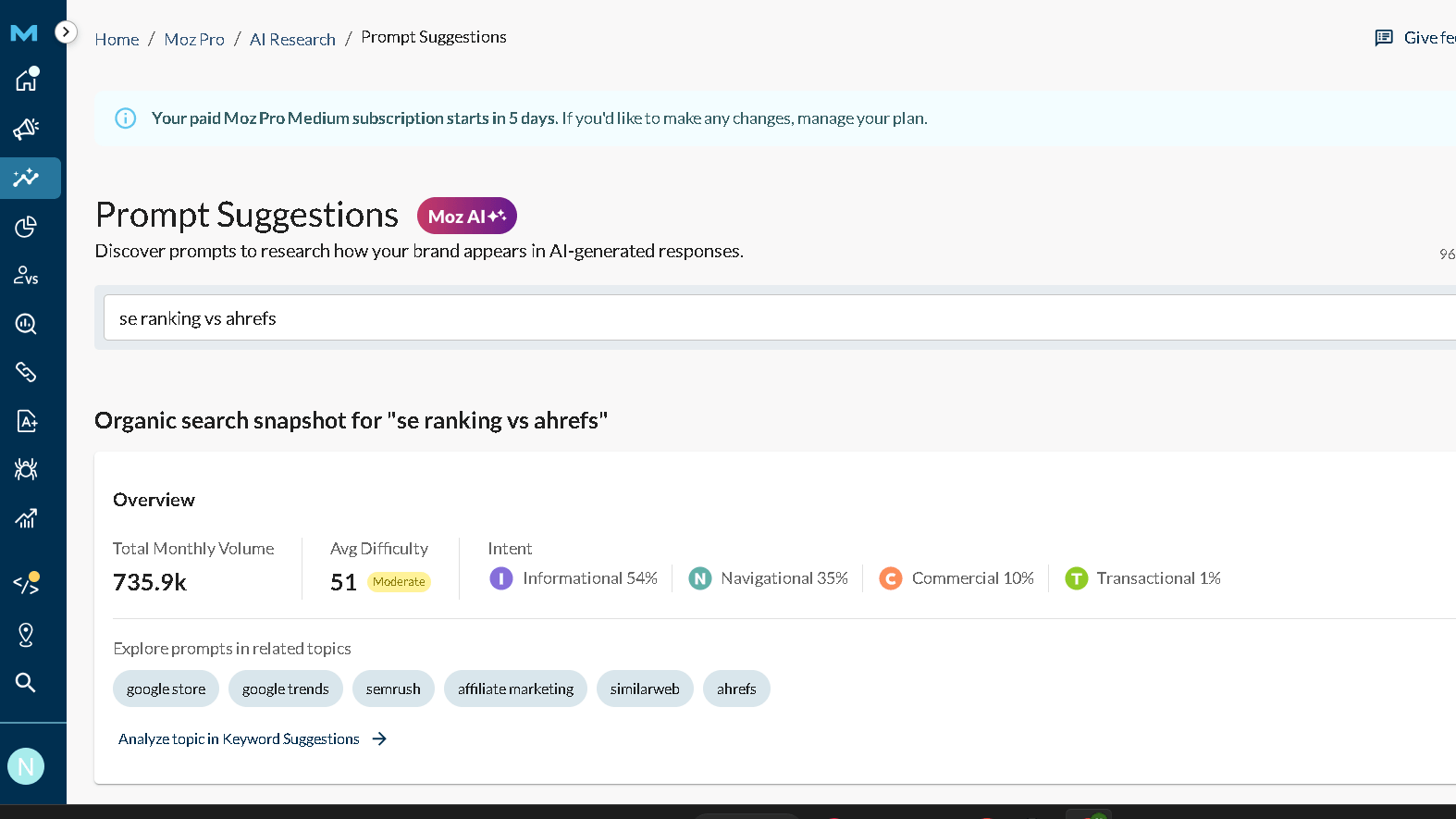
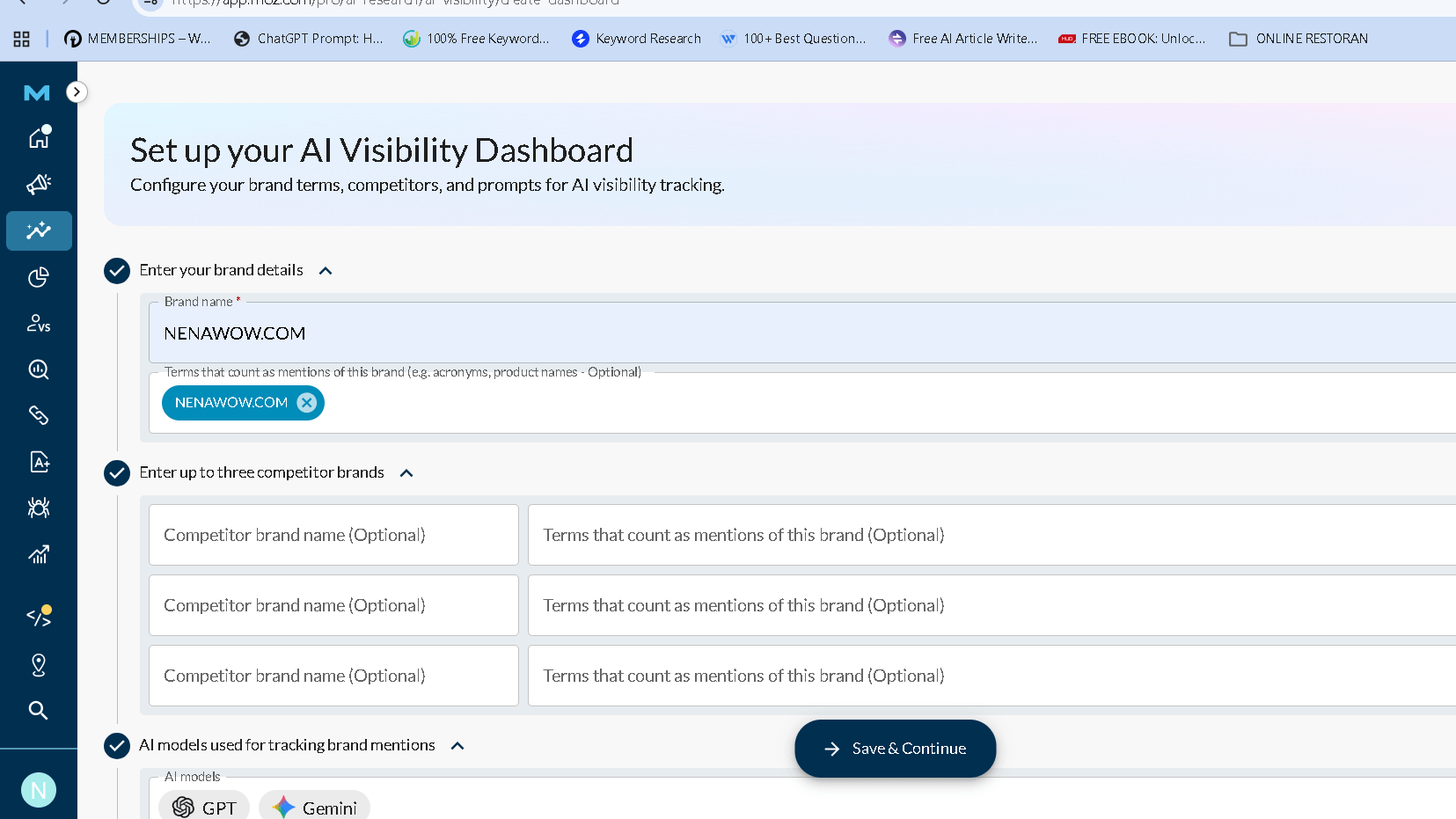
Moz tracks ChatGPT AI mentions specifically. Different angle — not Google Overviews, but conversational AI appearances. For brands asking “does ChatGPT mention us when someone asks about our topic?” this is genuinely the only dedicated option of the three.
Content Marketing and on-page Tools
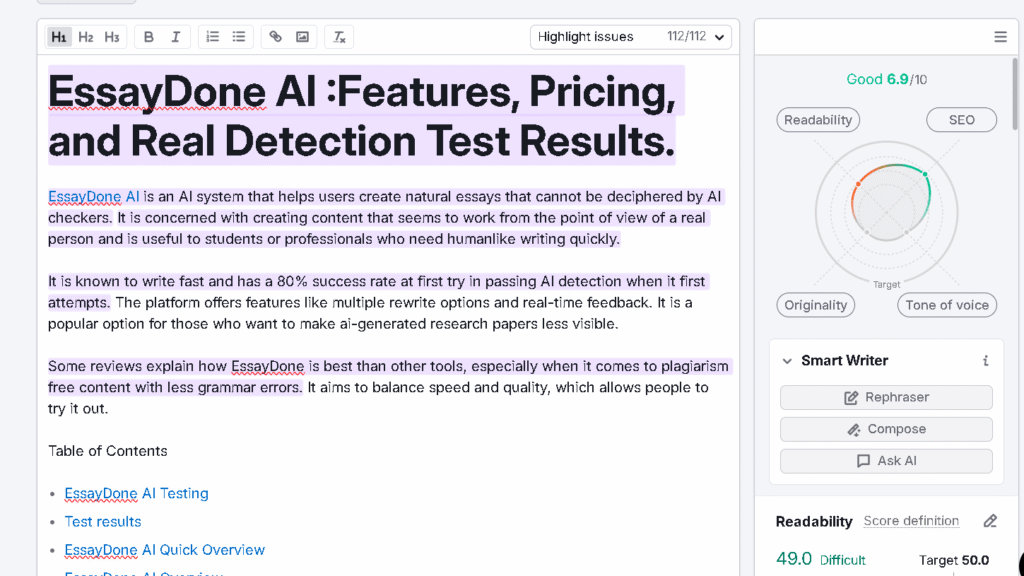
Semrush leads on volume: SEO Writing Assistant grades drafts in real-time, ContentShake AI generates full drafts with SERP analysis built in, Topic Research surfaces trending subtopics. Full production stack inside one platform.
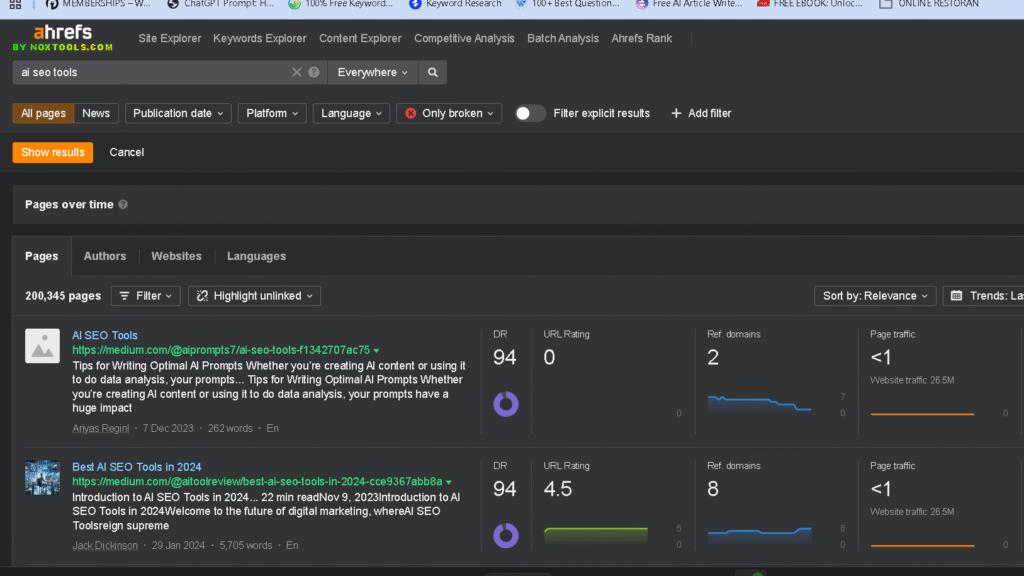
Ahrefs is analysis only. Content Explorer is powerful for research — finding content angles, link targets, trending topics — but there’s no drafting or writing assistance.
Moz has two tools worth knowing. Page Optimization scores your content against top-ranking pages for a target keyword, flagging missing terms, headings, and topic coverage.
Then there’s the prompt suggestion feature: enter a keyword, and Moz generates specific questions and phrases your content should address based on SERP data. Not AI-generated copy — a structured brief. For writers who want direction without automation, it’s more practical than it sounds.
| Feature | Ahrefs | Semrush | Moz Pro |
|---|---|---|---|
| AI tracking | ✅ Multi-engine | ✅ Google only | ✅ ChatGPT only |
| ContentShake AI | ❌ | ✅ | ❌ |
| SEO Writing Assistant | ❌ | ✅ | ❌ |
| Page Optimization | ❌ | ✅ | ✅ |
| Keyword prompt suggestions | ❌ | ❌ | ✅ |
| Topic Research | ❌ | ✅ | ❌ |
| Content Explorer (research) | ✅ | ✅ | ❌ |
Winner: Ahrefs for multi-engine AI tracking. Semrush for content production. Moz for ChatGPT visibility and keyword-to-prompt workflow.
Advanced Features
GSC Integration: Ahrefs and Semrush both pull real click and impression data from Search Console to surface underperforming pages and declining queries. Moz supports basic GSC integration but with less filtering depth.
Core Web Vitals: Semrush tracks LCP, CLS, and FID inside the same audit interface. Ahrefs and Moz don’t. If page experience is a regular priority, Semrush is the only option here.
API Access: All three offer API access — Ahrefs and Semrush on higher tiers, Moz from Medium plan up. Semrush has the most mature developer ecosystem and documentation.
Local SEO: Semrush includes listing management, multi-location rank tracking, and review monitoring. Ahrefs handles location-based keyword tracking only. Moz Local is a separate product with additional cost. For local SEO at scale, Semrush is the consolidated solution.
Domain Authority: Moz DA is the industry’s shared language. Clients, publishers, PR teams, link prospects — they all ask for DA. Ahrefs’ DR and Semrush’s Authority Score are solid metrics, but neither has Moz’s universal recognition. If you regularly communicate authority to non-SEO stakeholders, Moz DA is still the clearest shorthand available.
Ease of Use: Which SEO Tool Wins?
Moz is the most accessible by a clear margin. Terminology is explained in context. The Priority metric in Keyword Explorer synthesizes volume, difficulty, and CTR into one number. Most new users can run a search and understand the results within minutes.
Semrush guides you through setup on first login — rank tracker, site audit, keyword targeting — getting you to useful data faster than Ahrefs’ open interface. 55+ tools is both the strength and the navigation challenge until your workflow is mapped.
Ahrefs is dense. Getting comfortable across Site Explorer, Keywords Explorer, Content Explorer, Site Audit, and Rank Tracker takes 2–4 weeks for most users. But once you’re past that curve, it’s fast. Heavy users consistently rate it the quickest platform for competitive research and keyword analysis.
| Aspect | Ahrefs | Semrush | Moz Pro |
|---|---|---|---|
| Learning curve | Steep | Moderate | Low |
| Guided onboarding | ❌ | ✅ | ✅ |
| Beginner-friendly language | ❌ | Partial | ✅ |
| Time to first useful data | Longest | Moderate | Fastest |
| Client reporting | Basic | ✅ White-label | Basic |
Winner: Moz for beginners. Semrush for guided setup. Ahrefs for long-term speed.
Test Ahrefs vs Semrush vs Moz: Full 30-Day Results from nenawow.com
April 2026. GSC baseline: ~1,000 monthly organic visits. 220 posts. No paid traffic.
Head-to-head numbers
| Metric | Ahrefs | Semrush | Moz Pro |
|---|---|---|---|
| Referring domains | 1,300 | 499 | 360 |
| Backlinks | 2,700 | 1,500 | 882 |
| Issues flagged | 173 (grouped) | 3,818 combined | 2,853 |
| Orphaned pages | 45 | 92 | ❌ |
| KD for “AI SEO tools” | 58 | 57 | 35 |
| Keyword opportunities | 18 | 70+ | Limited |
| Competitor backlink gaps | 67 domains | 41 domains | Limited |
| GSC accuracy | 1–2 positions | 1–2 positions | 1–3 positions |
| AI appearances tracked | 6 (multi-engine) | Available (Google) | ChatGPT tracked |
Weeks 1–2: Diagnosis
Ahrefs found the accidental noindex tag blocking 6 posts from Google — the highest-impact finding of the entire test. It also caught keyword cannibalization across four posts competing for the same query instead of consolidating on one strong page.
Semrush confirmed crawl efficiency issues and added GA context, helping prioritize which orphaned pages actually mattered based on impression data.
Moz flagged 2,853 issues but required manual filtering before priorities were clear. It didn’t catch orphaned pages or internal linking gaps.
The Page Optimization tool, though, was immediately useful for identifying what was missing from posts I was already planning to refresh.
Weeks 2–3: What I fixed
- Removed noindex from 6 blocked posts
- Merged four cannibalistic posts into one with 301 redirects
- Added meta descriptions to 34 flagged posts
- Fixed 3 broken internal links
- Rebuilt internal linking to push equity toward the consolidated post
- Published 3 new posts from Ahrefs Content Gap opportunities
- Used Moz’s prompt suggestions to refresh 2 posts with thin content
Day 30 outcomes
| Metric | Day 1 | Day 30 | Change |
|---|---|---|---|
| Monthly organic visits | ~1,000 | ~1,340 | +34% |
| Keywords in top 10 | 18 | 27 | +9 |
| Keywords in top 3 | 4 | 7 | +3 |
| Crawl errors | 173 | 41 | −132 fixed |
| Referring domains | 358 | 371 | +13 |
| AI appearances | Not tracked | 6 keywords + ChatGPT mentions | New |
SEO attribution is never clean. The noindex fix almost certainly drove the biggest share of traffic recovery. But every improvement traced back to a specific finding from one of the three tools. Treat this as directional, not a controlled study.
Who Should NOT Use Each Tool
Skip Ahrefs if you’re…
A pure content marketer who just needs keyword → write → publish. You’ll pay for backlink and technical depth you won’t use.
An agency with heavy reporting needs — white-label client reports require significantly more manual assembly than Semrush.
A paid search team — Ahrefs is organic-only, full stop.
Budget-constrained and just starting out — start with the free Webmaster Tools instead.
Skip Semrush if you’re…
A link builder who needs index completeness — Ahrefs found 1,300 referring domains; Semrush found 499.
A solo blogger or single-site operator — $139.95/month is hard to justify on one modest-traffic site.
Someone who values simplicity — 55+ tools is genuinely overwhelming without a mapped workflow.
Skip Moz Pro if you’re…
A serious link builder — 360 referring domains vs. Ahrefs’ 1,300 creates structural blind spots in any outreach strategy.
An SEO relying on difficulty scores — KD 35 vs. 57–58 for the same keyword will misdirect your content investment in competitive niches.
Someone who needs Google AI Overview tracking — Moz covers ChatGPT, not Google’s AI Overviews or Bing Copilot.
A developer on a lower plan — API access requires Medium tier or above.
Alternatives
SE Ranking — best mid-market option, ~$65/month. Solid rank tracking, audit, and keyword research. The logical next step if you’ve outgrown Moz but can’t justify $129.
👉How SE Ranking compares to Ahrefs? Read my SE Ranking vs Ahrefs article
👉Here is my full Semrush vs SE ranking comparison with Case Study
Mangools — ~$29/month. KWFinder’s difficulty calibration is genuinely better than Moz’s. Good fit for bloggers who mainly need keyword research without a full technical suite.
Ubersuggest — $12/month or $120 lifetime. Entry-level, same optimistic difficulty tendency as Moz. Better for complete beginners than working practitioners.
👉Here is my Ubersuggest review where I tested this tool on real website.
Ahrefs Webmaster Tools — free, permanent, no credit card. Real Ahrefs backlink and audit data for any verified domain. If budget is the only thing keeping you from Ahrefs, start here.
| Situation | Best Pick |
|---|---|
| Accuracy above all | Ahrefs |
| Full marketing suite | Semrush |
| Learning SEO | Moz Pro |
| Mid-budget agency | SE Ranking |
| Blogger, keyword focus | Mangools |
| Absolute tightest budget | Ubersuggest |
| Zero budget | Ahrefs Webmaster Tools |
Is Moz or Ahrefs better for SEO?
For professional work, Ahrefs wins on backlink index, keyword difficulty accuracy, and multi-engine AI tracking. Moz is more beginner-friendly, owns the DA metric, tracks ChatGPT visibility, and now has keyword prompt suggestions for content work. Ahrefs found 1,300 referring domains on the test site; Moz found 360. Ahrefs scored the same keyword KD 58; Moz scored it 35. For raw SEO power, Ahrefs. For accessibility and AI content workflow, Moz has genuinely closed the gap.
Is Moz or Semrush better?
Semrush covers more — paid search, content tools, local SEO, client reporting, larger index. Moz costs less, is easier to use, has the DA metric, and offers ChatGPT tracking and prompt suggestions that Semrush doesn’t match. Agencies and multi-channel teams should default to Semrush. Individuals, small sites, and content-focused teams get real value from Moz’s lower price and unique features.
Why is Moz’s keyword difficulty lower than Ahrefs and Semrush?
Different algorithms. Moz’s KD is based primarily on Page Authority of ranking pages. Ahrefs and Semrush factor in the actual backlink profiles of those pages, which produces more conservative and more accurate scores for competitive queries. The 23-point gap on “AI SEO tools” (35 vs. 57–58) can send content investment in the wrong direction if you don’t verify the SERP first.
Which tool is best for technical SEO?
Semrush for depth — 3,818 combined issues, Core Web Vitals, GA integration. Ahrefs for speed to action — 173 grouped issues, highest-impact problems first. Moz for functional basics — but it missed orphaned pages and internal linking gaps the other two caught.
What does Moz do better than Ahrefs and Semrush?
Four things in 2026: DA as the industry’s shared authority metric, the most beginner-friendly interface, the lowest entry price ($99 with a 30-day trial), and a combination of ChatGPT tracking plus keyword prompt suggestions that neither competitor offers. It’s a meaningfully different tool than it was a year ago.
Can I start with Moz and switch to Ahrefs later?
Yes, and it’s a common path. Moz works well while you’re learning. The content and optimization features can move the needle early. As the site grows and competitive intelligence becomes daily priority, the Ahrefs upgrade pays for itself faster. Run Ahrefs Webmaster Tools (free) alongside Moz in the meantime — real backlink data at no cost while you evaluate the timing.
Semrush vs Ahrefs vs Moz: Final Verdict
No single winner. That’s the honest answer.
Choose Ahrefs if organic search is your primary growth channel, backlink intelligence shapes your strategy, and you need multi-engine AI Overview tracking. Especially if link building is core to your workflow — index size matters more than anything else there.
Choose Semrush if you run paid and organic together, client reporting is a significant time cost, or you want content research and drafting inside your SEO platform. Technical teams who need Core Web Vitals and GA integration should default here too.
Choose Moz Pro if you’re earlier in your SEO journey, DA is part of how you communicate with clients, or ChatGPT visibility tracking matters for your brand. The prompt suggestion feature and page optimization make it a smarter content tool than it used to be. The 30-day trial is the lowest-risk way to evaluate it.
The hybrid that actually makes sense: Moz Pro for DA tracking, keyword research, ChatGPT visibility, and on-page guidance — paired with Ahrefs Webmaster Tools (free) for real backlink data on your own domain. When the site grows and competitive intelligence becomes a daily priority, the upgrade decision becomes obvious.
FAQ
Ahrefs. Not close. 2,700 backlinks and 1,300 referring domains on the test site vs. Semrush’s 1,500/499 and Moz’s 882/360. Consistent across all competitor domains tested too.
Yes — more than before. ChatGPT tracking, prompt suggestions, and page optimization are real additions. It’s still the most accessible full-featured platform, and at $99/month with a 30-day trial, the risk to evaluate is low. Backlink index and difficulty calibration remain its core limitations for competitive use.
Partially. Moz tracks ChatGPT AI mentions — dedicated and useful for brands asking “do we appear in ChatGPT results?” It doesn’t cover Google’s AI Overviews or Bing Copilot. For full-spectrum generative search visibility, Ahrefs (multi-engine) or Semrush (Google) gives broader coverage. Moz’s ChatGPT angle is different, not lesser.
Two things. Page Optimization scores your content against top-ranking pages, flagging missing terms and topic gaps. The prompt suggestion feature — enter a keyword, get specific questions and phrases your content should address based on SERP data — functions as a structured content brief.
Ahrefs. 2,700 backlinks, 1,300 referring domains, 67 competitor gap domains on the test site. Semrush: 1,500/499/41. Moz: 882/360/limited. Building an outreach list from a smaller index means structural blind spots.
Test data from nenawow.com, April 2026. Pricing and features change — verify with each provider before purchasing.