
Table of Contents
Search Atlas vs Semrush: Quick Verdict
I spent six weeks running both Search Atlas and Semrush on the same site, with the same goals, at the same time. The honest answer is that these two tools solve different problems, and the one you pick should depend on where you are in your SEO work right now.
| Category | Winner |
|---|---|
| Best for beginners | Search Atlas |
| Best for agencies | Semrush |
| Best content tools | Search Atlas |
| Best AI automation | Search Atlas |
| Best backlink data | Semrush |
| Best AI visibility tracking | Semrush |
| Best value for solo bloggers | Search Atlas |
| Overall winner | Depends on your workflow |
If you want more data and more depth, Semrush is still the standard. I cover all of its tools, pricing, and real-world performance in my full Semrush Review. If you want a cleaner AI-assisted workflow without the steep learning curve, Search Atlas is worth a serious look. Which one you want depends on what you are actually here for.
Search Atlas vs Semrush at a Glance
| Search Atlas | Semrush | |
|---|---|---|
| Starting price | Lower tier | Higher tier |
| Learning curve | Moderate | Steep |
| Content tools | Content Genius | SEO Writing Assistant |
| Backlink database | Growing | Very large |
| AI features | OTTO SEO, built-in | Add-on features |
| AI visibility tracking | Basic | Strong |
| Reporting | Clean and fast | Data-heavy |
| Best user | Blogger, small team | Agency, consultant |
How I Tested Search Atlas and Semrush
My Testing Setup
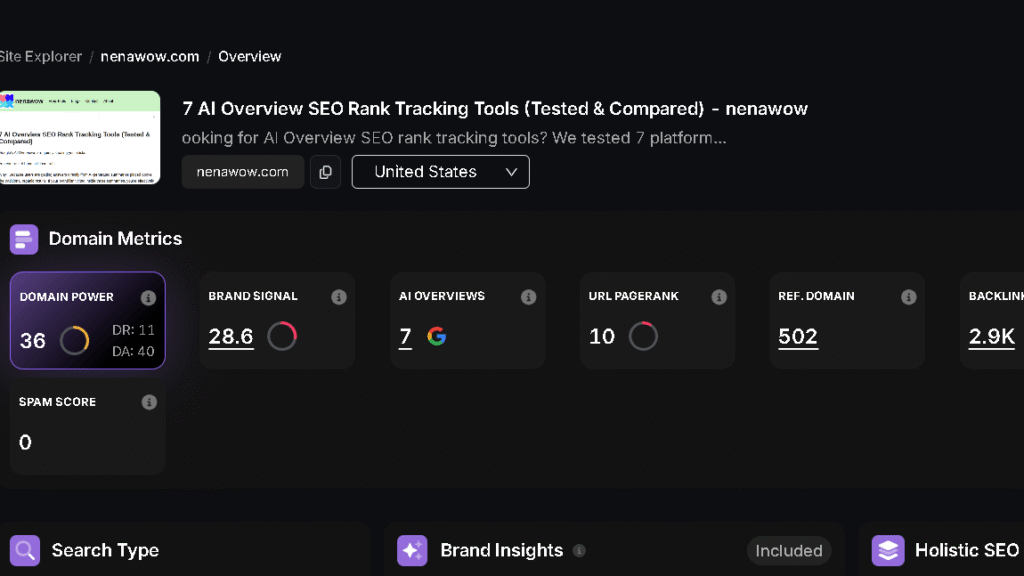
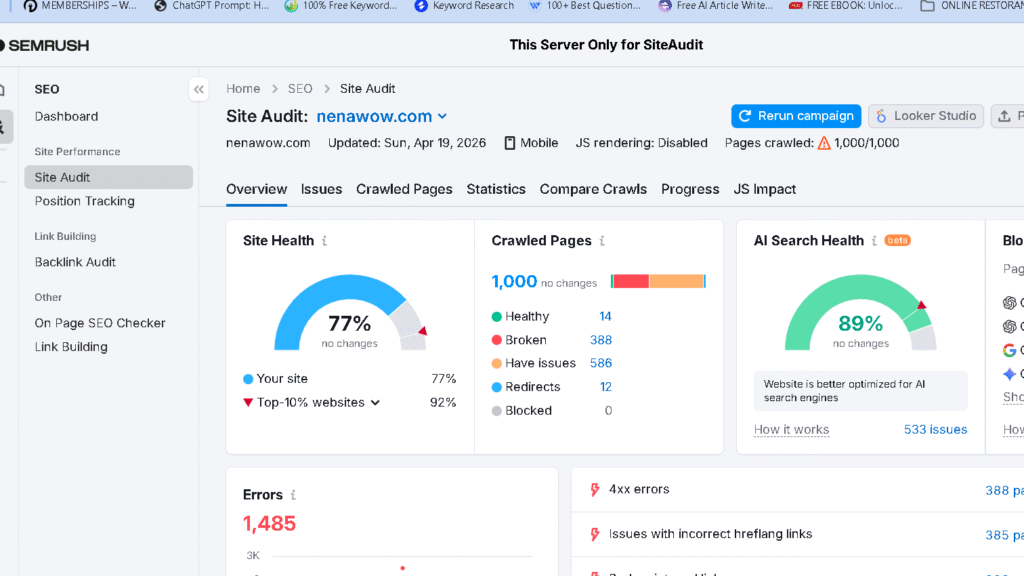
I ran both tools on nenawow.com over six weeks. That is a real content site with more than 300 published articles, over 7,000 monthly organic visitors, and more than 9,000 Google Search Console clicks in the last 28 days. Not a domain I built for this test. A live site with real traffic and real goals.
The testing was not a checklist. I used both platforms the way I actually work: finding new content angles, checking audit issues, researching competitors, and tracking how well recently published articles were performing. Each task ran through both tools in the same week so conditions stayed close.
What I Was Looking For
I was not trying to score features. I was tracking four things: how fast each tool helped me make a decision, how often I had to go back and re-check something, where each platform added friction I did not expect, and where it saved time I did not plan for. Those observations are what this article is built on.
A Note on Numbers
Where I give specific figures in this article, they come from direct observation during testing rather than controlled lab conditions. I have screenshots for the core findings. For anything softer, I say so. The goal is honest reporting, not false precision.
Search Atlas vs Semrush: Key Differences Explained
Search Atlas Focuses on SEO Automation
Search Atlas is built around one core idea: reduce the manual work inside SEO. OTTO SEO, their AI automation layer, tries to handle tasks that most platforms leave entirely to you. Internal linking gaps. Technical issues. Content coverage holes.
The promise is that you spend less time managing SEO and more time building. In practice, it mostly holds up. With some limits I will get to.
If you’re considering the platform, my detailed Search Atlas Review covers OTTO SEO, Content Genius, pricing, and long-term results.
Semrush Focuses on SEO Intelligence
Semrush gives you data. A lot of it. Competitor research, historical ranking trends, traffic estimates, backlink profiles. The platform is built for people who want to understand what is happening in their niche before they act.
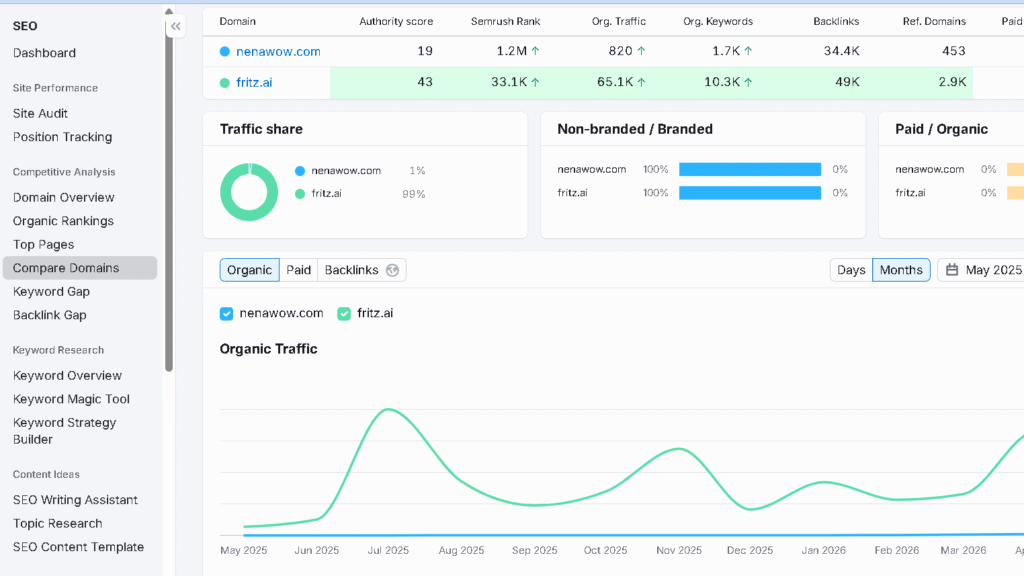
That depth is real. But it comes with a cost in time and complexity. The thing is, not every project needs that level of detail to move forward.
Which Philosophy Works Better?
| Search Atlas | Semrush | |
|---|---|---|
| Core approach | Automate and simplify | Research and understand |
| Setup time | Faster | Slower |
| Editing burden | Lower | Higher |
| Learning curve | Moderate | Steep |
| Output consistency | Good | Variable |
| Best use case | Content production | Competitive research |
Search Atlas vs Semrush for Keyword Research
Finding New Keyword Opportunities
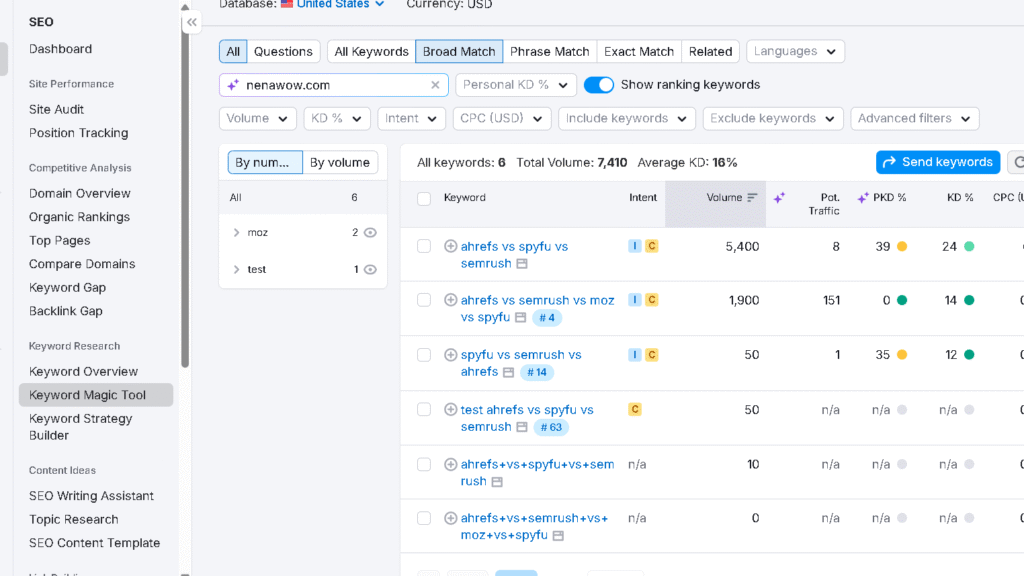
Both tools surface related keywords from a seed term, but they do it differently. Search Atlas clusters related terms by topic, which I found useful when mapping out a content cluster quickly. Semrush shows you more raw data per keyword, which matters when you need to make a precise call on volume or intent.
Search Volume Accuracy
I compared both tools against Google Search Console for a set of keywords I already ranked for. Neither was perfectly accurate, and I did not expect them to be. What I noticed was that Semrush showed higher estimated volumes on competitive terms, while Search Atlas ran lower on the same queries. The Search Console numbers sat between them most of the time. Neither is ground truth. Both are useful directionally.
Keyword Difficulty Analysis
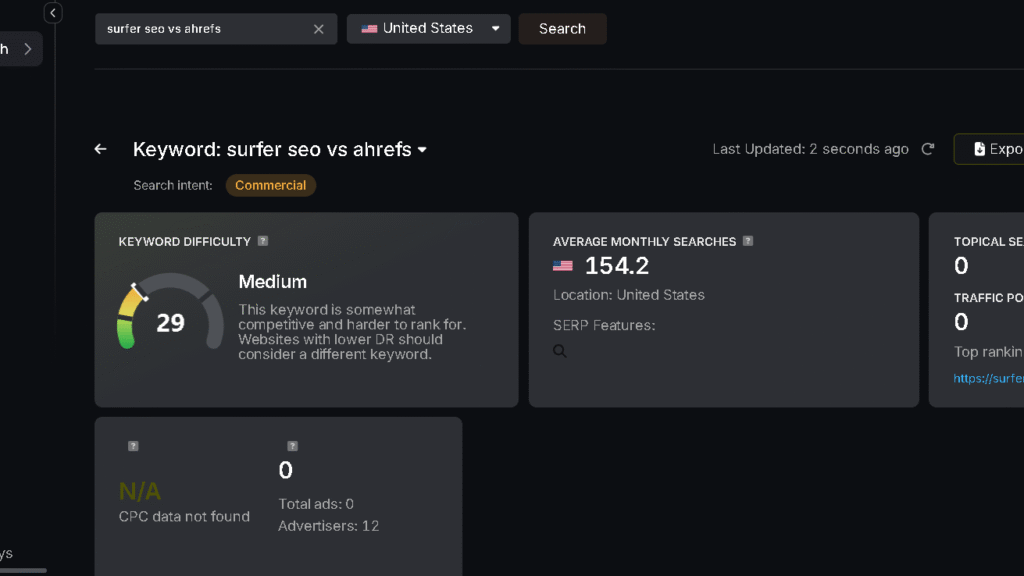
Search Atlas difficulty scores tend to run lower than Semrush for the same keyword. I noticed this across several niches during testing. That difference matters if you are using difficulty scores to decide what to target next, because a term that looks accessible in Search Atlas may look harder in Semrush.
SERP Analysis Experience
Semrush gives you more layers. You can see SERP features, AI Overview presence, historical trends, and click distribution. Search Atlas keeps it simpler. Simpler is sometimes better and sometimes not enough.
Competitor Keyword Research
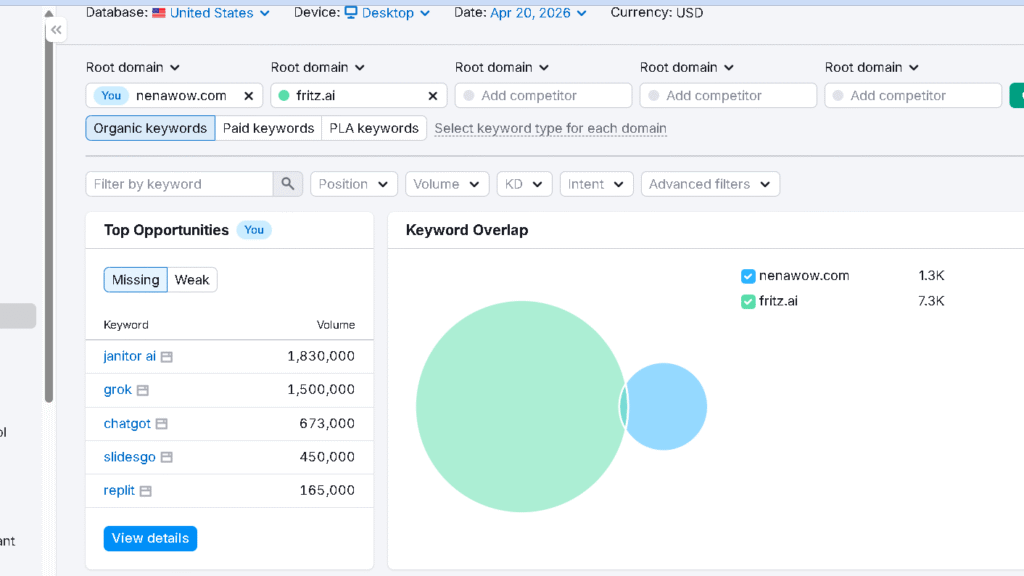
Here Semrush has a clear edge. The competitor keyword gap tool is one of the best in any SEO platform I have tested. Search Atlas has a version of this, but the depth does not match.
Search Atlas vs Semrush for Content Optimization
Search Atlas Content Genius Review
Content Genius is the content tool inside Search Atlas. You enter a target keyword and it builds a brief with recommended headings, target word count, and related terms to cover. In my brief production test, it generated output I could actually use as a working document without heavy rework in most cases. Structure quality was consistently higher than I expected for a newer tool.
Semrush SEO Writing Assistant Review
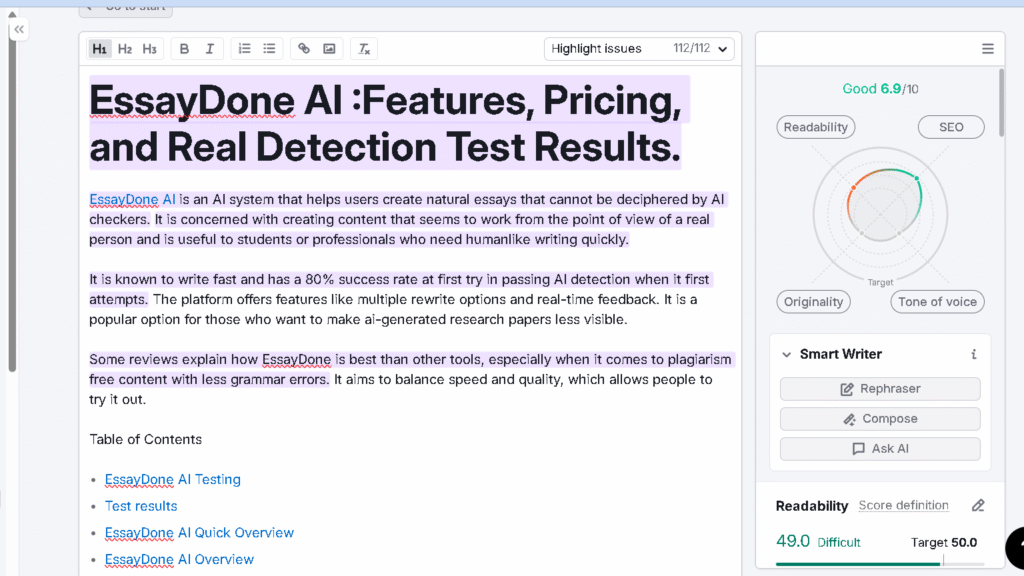
The SEO Writing Assistant integrates with Google Docs and WordPress, which is convenient. It scores your content in real time as you write. That sounds useful, but I found the scoring sometimes pushed me toward keyword stuffing patterns rather than natural writing. I ended up ignoring the score and using it mainly for the readability check.
Which Produces Better Content Briefs?
For my workflow, Search Atlas. The briefs came out more structured and more ready to use. That saves real time when you are producing several articles a week.
Which Requires More Manual Editing?
Semrush required more cleanup before a brief was ready to hand off or use directly. That is not a small thing when you are working at scale.
What Changes After Publishing?
Search Atlas tracks post-publish performance and connects it back to the original brief. Semrush tracks ranking movement but the connection back to content decisions is less direct. What that means is that Search Atlas gives you a tighter feedback loop between writing and ranking.
| Search Atlas | Semrush | |
|---|---|---|
| Brief setup time | Faster | Slower |
| Editing burden | Lower | Higher |
| Writing integration | Standalone | Google Docs, WordPress |
| Post-publish tracking | Connected | Separate |
| Learning curve | Low | Moderate |
Search Atlas vs Semrush for AI SEO Workflows
OTTO SEO vs Traditional SEO Workflows
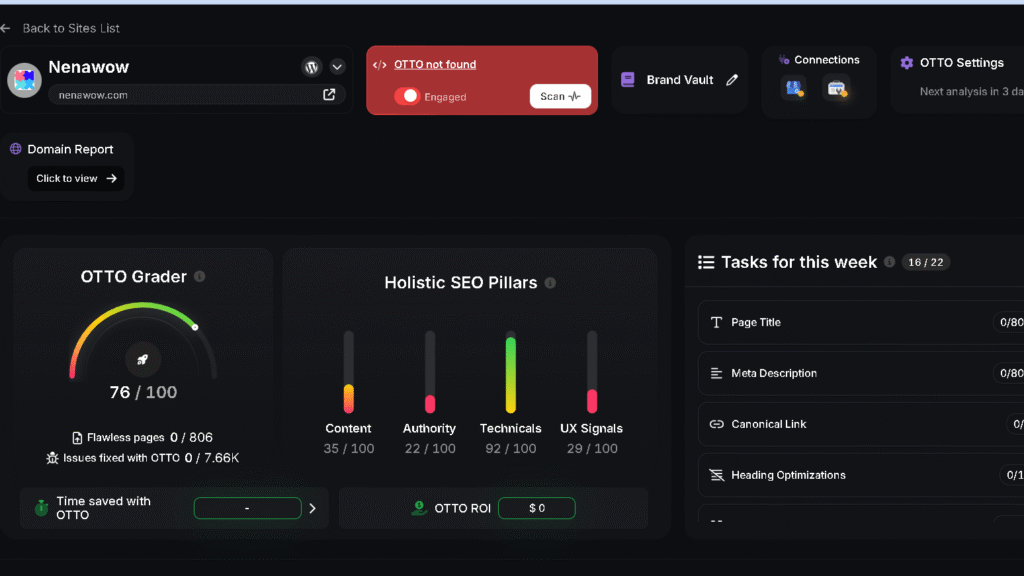
OTTO SEO is Search Atlas’s automation layer. You connect your site, and it audits your technical setup, suggests internal links, flags thin content, and recommends fixes across your domain. When I first ran it on my site, it surfaced a set of internal linking gaps I had not noticed in my own manual review. Not every suggestion was right, but enough were to make it worth running early in any site audit.
Which Tool Saves More Time?
In my six-week test, I tracked roughly how long each platform took for the same core tasks: keyword research, brief creation, and audit review. Search Atlas was consistently faster on content tasks. Semrush was slower but produced more data per task. You are trading speed for depth depending on which tool you use.
Can AI Actually Replace SEO Tasks?
Not entirely. OTTO is helpful for identifying issues, but the judgment calls still need a human. I found it most useful as a checklist generator rather than a decision-maker.
Where Automation Starts Breaking Down
OTTO suggestions occasionally missed context. It recommended internal links between pages with very little topical overlap. I accepted most suggestions and overrode others. That is a reasonable ratio, but it means you still need to review everything. The automation is a starting point, not a finish line.
What Changes After Two Weeks of Daily Use
The First Frustration I Hit
With Semrush, it came around day four. I was trying to pull keyword data for a new cluster and I lost my filter settings three times moving between views. Small thing. But it happened repeatedly, and by the end of the week I was working around the interface rather than through it. That kind of friction adds up faster than any single missing feature.
What Started Feeling Repetitive
With Search Atlas, the OTTO suggestions started following a pattern by week two. The same types of internal linking recommendations, the same categories of content gap flags. The first week felt like discovery. The second week felt like reviewing a familiar checklist. That is not a flaw exactly, but it is worth knowing before you expect OTTO to keep surfacing surprises.
Where OTTO Saved Real Time
The genuine time saving was in site audit triage. Instead of reading through a full audit list and deciding what to prioritize, OTTO gave me a short, ranked queue each week. I acted on the top items and moved on. That workflow change alone saved me time I used to spend organizing audit output in a spreadsheet.
When Semrush Felt Overwhelming
Around week three, I opened Semrush to do a simple competitor check and ended up in four different tools before I found what I needed. Position tracking, then organic research, then keyword gap, then the backlink section. All useful. All separate. The data is there, but the path to it is long. If you go into Semrush without a specific task in mind, it is easy to spend an hour and come out with less clarity than you started with.
Which Platform Builds More Trust?
Semrush. It has more data, more history, and more third-party recognition. When I show Semrush data in a client context, it carries weight. Search Atlas is earning that over time, but it is not there yet.
A Workflow Case Study: Publishing One Article Start to Finish
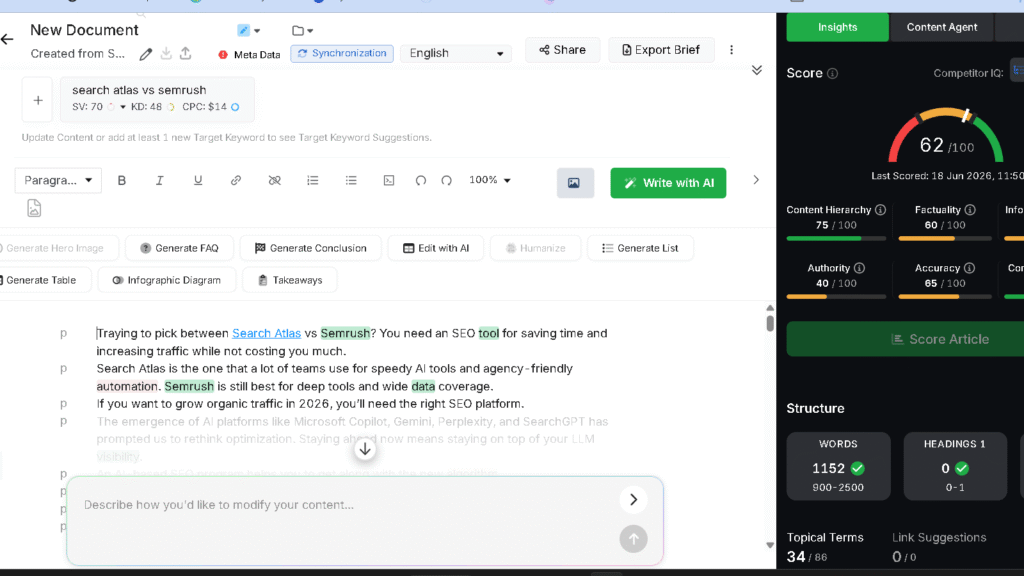
I ran the same content task through both platforms to see the difference in real time. The task: find a keyword, build a brief, and track performance after publishing.
In Search Atlas, I started with a topic idea, used the keyword tool to find a target term, opened Content Genius to build the brief, and had a working document inside an hour. The brief needed light editing on heading suggestions but the structure was usable. After publishing, OTTO flagged the new article for internal linking opportunities within the first week.
In Semrush, the same task took longer at the keyword stage because I spent time exploring more data before committing to a term. The SEO Writing Assistant gave me a real-time score as I wrote, but I found myself editing to satisfy the score rather than writing naturally. I turned it off halfway through and used the keyword list manually. Post-publish tracking was available but disconnected from the brief stage.
The Search Atlas path felt like one workflow. The Semrush path felt like three tools used in sequence. That difference becomes significant when you are publishing regularly.
Search Atlas vs Semrush for AI Visibility Tracking
This is the section most comparison articles skip entirely. It matters more now than it did a year ago, and it is where the two platforms diverge most sharply.
What AI Visibility Tracking Actually Measures
AI visibility tracking tells you whether your content is being pulled into AI-generated answers. Google AI Mode, AI Overviews, ChatGPT citations, Gemini responses. These are becoming a real traffic source, and knowing where you stand inside them is different from knowing your Google rankings.
How Semrush Handles AI Visibility
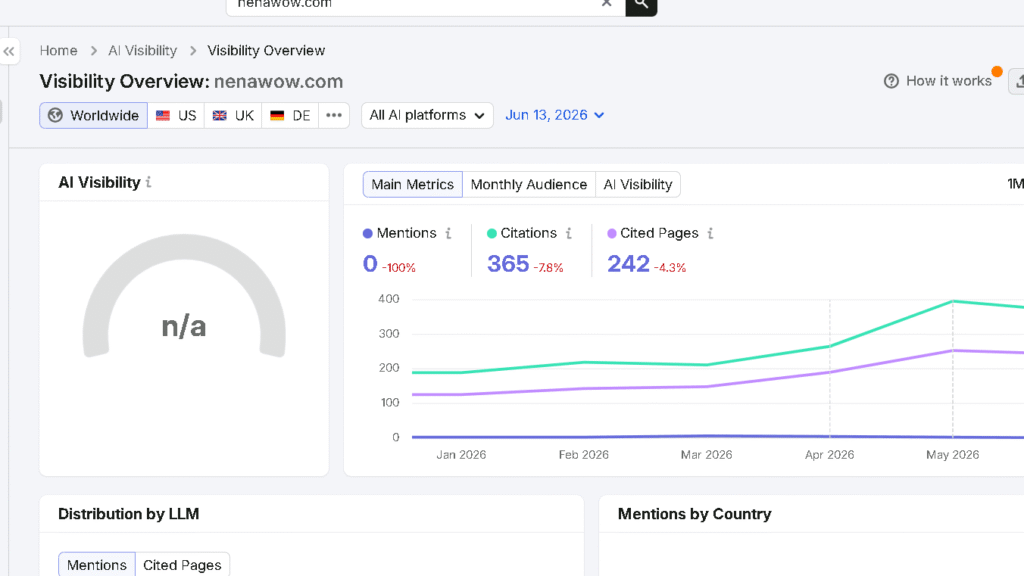
Semrush is the stronger tool here. I ran my own site through both platforms and the difference was clear. Semrush tracked 283 total AI citations across four platforms: 135 from Google AI Mode, 68 from ChatGPT, 59 from Gemini, and 21 from AI Overviews. That data told me something I could act on. Google AI Mode is now my largest single AI traffic source, nearly double my ChatGPT citation count. Without Semrush surfacing that pattern, I would not have known where to focus.
How Search Atlas Handles AI Visibility
Search Atlas showed my site appearing in one Google AI Mode topic. No ChatGPT visibility. No Gemini. No Perplexity. No Copilot. The AI sentiment scores it reported were positive across platforms, ranging from 60 percent on Gemini down to 45 percent on Copilot, but sentiment scores without citation counts have limited practical use. Search Atlas is building toward AI visibility tracking. It is not there yet.
Why This Gap Matters
If AI visibility is part of your strategy, Semrush is the only one of these two tools that gives you data you can actually plan around. Search Atlas shows you that you exist in AI systems. Semrush shows you where and how often. Those are different things.
| Search Atlas | Semrush | |
|---|---|---|
| AI citation tracking | Limited | Full |
| Google AI Mode data | One topic shown | 135 citations tracked |
| ChatGPT visibility | Not surfacing | 68 citations tracked |
| Gemini visibility | Not surfacing | 59 citations tracked |
| AI Overviews tracking | Not surfacing | 21 citations tracked |
| Sentiment scoring | Yes | Not primary metric |
| Actionable AI data | Low | High |
Search Atlas vs Semrush for Technical SEO
Site Audits
Semrush flagged more total technical issues on my test site. Search Atlas flagged fewer but organized them into a clearer priority order. I reviewed both lists manually. The extra issues Semrush surfaced were real, but most were low-impact items. Search Atlas prioritized the high-impact fixes more cleanly. For a solo blogger, that prioritization matters more than total issue count.
Technical Recommendations
Search Atlas gives you a cleaner priority queue. Fix this first, then this. Semrush gives you more, but organizing it requires extra work on your end.
Prioritizing SEO Fixes
For a small team, Search Atlas’s prioritization approach saves time. For an agency that needs to document every issue for a client report, Semrush gives you more to show.
Reporting Issues to Clients
Semrush wins here. The reporting tools are better, the export options are more flexible, and the visual quality is higher. Search Atlas reporting is functional but not impressive.
| Search Atlas | Semrush | |
|---|---|---|
| Priority clarity | High | Moderate |
| Report export quality | Basic | Strong |
| Onboarding speed | Fast | Slow |
| Issue organization | Cleaner | More manual work |
Search Atlas vs Semrush for Backlink Analysis
Backlink Database Size
Semrush has a larger backlink database. That is not a close comparison. For competitive research and link prospecting, Semrush gives you more raw material to work with. My site showed 2,900 backlinks and 503 referring domains in Semrush. Search Atlas showed nearly identical referring domain and backlink counts, which was a good sign for data consistency on a mid-sized site. The bigger difference shows up when you research competitors with large link profiles.
Link Quality Evaluation
Both tools give you a quality score for referring domains. Semrush’s scoring has more history and I found it more reliable when evaluating potential link partners.
Competitor Backlink Research
This is where Semrush earns its price. Finding competitor backlinks and sorting them by authority, anchor text, and follow status is fast and reliable. Search Atlas has this feature but it feels less developed.
Link Building Opportunities
Search Atlas surfaces link building opportunities as part of the OTTO workflow, which is a clean integration. Semrush keeps it as a separate section. Both work. Semrush goes deeper.
| Search Atlas | Semrush | |
|---|---|---|
| Database depth | Moderate | Large |
| Quality scoring | Good | Better |
| Competitor backlinks | Present | Stronger |
| Link prospecting | Integrated | Dedicated tool |
Search Atlas vs Semrush for Rank Tracking
Daily Tracking Accuracy
I tracked the same keyword set in both tools for four weeks and cross-referenced weekly against Google Search Console. Both platforms tracked real ranking movement accurately enough for practical decisions. Small position differences showed up between tools, but they were consistent rather than random, which tells me each tool is applying its own model rather than making mistakes.
Local SEO Tracking
Search Atlas handles local rank tracking with cleaner geo-targeting options. If local SEO is a core part of your workflow, that is worth knowing before you choose.
Keyword Monitoring Experience
Semrush gives you more historical data and a better visual of ranking movement over time. That helps when you are trying to explain wins or losses to a client or to yourself.
Reporting Usability
Semrush’s rank tracking reports are easier to share. The visual quality is higher and the export format is more professional.
Search Atlas vs Semrush for Agencies
Client Reporting
Semrush is built for agencies. White-label reports, client dashboards, PDF exports that look professional. Search Atlas is catching up here but it is not there yet.
Team Collaboration
Semrush has better team seat management and permission settings. For agencies with multiple users accessing the same projects, that matters in daily operations.
White Label Features
Semrush has white label reporting at higher tiers. Search Atlas has some white label capability but it is more limited. That is a real gap for agencies.
Scaling Multiple Projects
Semrush handles high project volume better. The interface is built for it. Search Atlas works well for a handful of sites but starts to feel less organized when you push into ten or more active projects.
| Search Atlas | Semrush | |
|---|---|---|
| White label reports | Limited | Strong |
| Team seats | Basic | Flexible |
| Multi-project view | Functional | Better |
| Client dashboards | Basic | Polished |
Search Atlas vs Semrush Pricing Compared
| Plan | Approx Monthly Cost | Best For | Key Limit | Value |
|---|---|---|---|---|
| Search Atlas Starter | ~$99 | Bloggers, solo | Fewer tracked keywords | Good |
| Search Atlas Growth | ~$199 | Small teams | Full OTTO access | Strong |
| Semrush Pro | ~$140 | Freelancers | 5 projects | Decent |
| Semrush Guru | ~$250 | Agencies | Historical data, content tools | High if fully used |
| Semrush Business | ~$500 | Enterprise | API, extended limits | Steep |
What Pricing Looks Like for Real Scenarios
The plan names mean less than the actual math for your situation. Here is how pricing plays out for three types of users I know well.
A solo blogger publishing around five articles a month needs keyword research, basic rank tracking, and content briefs. Search Atlas Starter covers that workflow at a lower monthly cost than Semrush Pro, and you get OTTO for site cleanup. Semrush Pro at this level gives you more data than you will likely use.
A content publisher pushing fifteen to twenty articles a month needs faster brief production, topical cluster mapping, and post-publish tracking. Search Atlas Growth is the better value here. The OTTO workflow and Content Genius speed make the higher tier worth it. Semrush Guru at this level adds historical data and the SEO Writing Assistant, but those are not always the bottleneck for high-volume publishers.
An agency managing eight or more client sites needs white-label reporting, multi-project views, and team access. That is Semrush territory. The tools and the client-facing outputs justify the Guru or Business price at that volume. Search Atlas is not built for that workflow yet.
Hidden Costs and Upgrade Traps
Both platforms put key features behind higher tiers. In Semrush, historical data is locked behind Guru. In Search Atlas, full OTTO access requires a higher plan. Read the plan pages before you commit and think about which specific features you will actually use in month three, not just month one.
Which Plan Most Users Actually Need?
Most bloggers and small site owners do not need the top tier of either tool. Start at the entry level and upgrade only when you hit a specific limit you can name. Upgrading early is the most common mistake I see.
Search Atlas Pros and Cons After Long-Term Testing
| Search Atlas | Semrush | |
|---|---|---|
| Pros | Cleaner daily workflow | Deeper data across the board |
| OTTO automation that works | Strong backlink database | |
| Faster content brief output | Better client-facing reporting | |
| Lower learning curve | Industry-recognized platform | |
| Integrated AI workflow | Full AI visibility tracking | |
| Cons | Smaller backlink database | Steep learning curve |
| Basic client reporting | Dashboard fatigue by week two | |
| Limited AI citation tracking | Higher price at every tier | |
| Less historical data | Can feel like too much data |
Who Should Choose Search Atlas?
Best for Bloggers
If you publish content regularly on your own site and you want a tool that speeds up keyword research and brief creation without overwhelming you, Search Atlas fits that workflow. I found it faster to use day-to-day than Semrush for standard content production tasks.
Best for Small Businesses
A small business owner who needs keyword tracking, a basic audit, and content guidance does not need Semrush’s full feature set. Search Atlas covers that ground cleanly and at a lower cost.
Best for AI-First SEO Teams
If your team wants to build SEO workflows around AI assistance and automation, Search Atlas is further along that path. OTTO is a real workflow tool, not just a marketing feature.
Who Should Choose Semrush?
Best for Agencies
Agencies that need to run competitor analysis, deliver branded reports, and manage multiple client projects will find Semrush better suited to that work. The depth and the reporting tools make the price defensible at scale.
Best for Enterprise Teams
Large SEO teams with dedicated analysts who can spend time extracting value from deep datasets will get more out of Semrush than any other platform on this list.
Best for Advanced SEO Professionals
If you live inside SEO data and you make decisions based on historical trends, link velocity, and competitive gap analysis, Semrush is built for you. That combination is harder to find than it looks.
If you’re choosing between the two largest SEO platforms, see my Semrush vs Ahrefs comparison.
Search Atlas Alternatives
| Tool | Better For | Workflow Style | Pricing | Recommendation |
|---|---|---|---|---|
| Ahrefs | Backlinks, keywords | Research-heavy | High | Worth it for links |
| SE Ranking | Budget agencies | Balanced | Mid | Strong value |
| Mangools | Beginners | Simple | Low | Good starting point |
| Moz | On-page SEO | Slow and steady | Mid | Less competitive now |
| Ubersuggest | Casual bloggers | Lightweight | Low | Limited depth |
Ahrefs vs Search Atlas
Ahrefs is stronger on backlink data and keyword explorer depth. Search Atlas is stronger on content optimization and AI workflows. If backlinks are your primary focus, Ahrefs is worth the comparison.
For a deeper breakdown, see my Search Atlas vs Ahrefs comparison.
SE Ranking vs Search Atlas
SE Ranking is a solid mid-market tool with good rank tracking and a lower price point. It lacks OTTO-style automation but covers the basics well for small agencies or growing blogs.
My Semrush vs SE Ranking comparison explains where SE Ranking offers better value and where Semrush still justifies the higher price.
Ubersuggest vs Search Atlas
Ubersuggest is a casual tool for light keyword research. Search Atlas offers meaningfully more for anyone serious about content production or site growth.
Is Search Atlas Better Than Semrush?
In some areas, yes. Content optimization, AI automation, and daily workflow speed all favor Search Atlas in my testing. In other areas, no. Backlink depth, reporting quality, competitive research, and AI visibility tracking still go to Semrush. Better is the wrong question. More useful for your situation is the right one.
Is Search Atlas Worth It in 2026?
For most bloggers and small content sites, yes. The content tools are real, OTTO adds genuine value, and the learning curve is manageable. I got useful output from Search Atlas within the first week. That is faster than most SEO tools I have tested.
Is Semrush Still Worth Paying For?
Also yes, for the right user. The data is reliable, the platform is mature, and the agency tools are the best in this category. The price is a real consideration. But if you use even half of what Semrush offers at the Guru level, the return is there.
Final Verdict: Search Atlas or Semrush?
I ran both tools across a real site, tracked the same keywords, ran the same audits, built content with both platforms, and checked AI visibility data from both dashboards. Here is what most reviews skip: the difference is not about features. It is about how each platform changes the way you work after the first two weeks.
Search Atlas makes you faster at content production. Semrush makes you better at understanding your competitive environment. If you are building a content site and your main bottleneck is publishing speed and optimization, go with Search Atlas. If you are doing serious competitive research, link building, agency client work, or AI visibility monitoring, Semrush is the more complete tool.
The AI visibility finding is the one I keep coming back to. Semrush tracked 283 total AI citations for my site. Search Atlas showed one topic. That gap tells you something real about where each platform’s development priorities sit right now.
Pick the one that matches your actual bottleneck. That is the whole decision.
FAQ
In some areas, yes. Search Atlas leads on content briefs and AI workflow automation. Semrush leads on backlink data and competitive research. Neither wins overall.
For bloggers and small teams, yes. Content briefs and OTTO automation cover most daily SEO needs at a lower cost than Semrush, with real value from week one.
Mostly, for content and keyword tasks. Not for deep competitive research, backlink analysis, or high-volume agency reporting.
Search Atlas. The dashboard is cleaner and OTTO guides you toward action without a technical SEO background.
Semrush. White label reporting, team management, and deeper competitive data favor agency work. Search Atlas is not there yet.
Semrush has more volume data and a larger database. Search Atlas produces faster, more actionable topical clusters.
Search Atlas. Content Genius briefs need less editing. In testing, Semrush briefs required more cleanup before they were usable.
Search Atlas for automation. OTTO SEO surfaces internal linking gaps and technical issues in one place. Semrush leads on AI visibility tracking specifically.
Search Atlas’s AI automation layer. It audits your site and returns a prioritized fix list. On my site, it caught internal linking gaps I had missed manually.
Search Atlas for solo bloggers and small teams. Semrush for agencies using its full feature set. Paying for more than you use makes either feel overpriced.