
I did not set out to write about AI visibility. I checked a report one morning, almost by accident, and the number on the screen did not match what I expected. That is how this whole thing started.
This article is not theory. It is what I found when I looked at my own data, what I checked against a few competitors, and what I still do not fully understand. If you are wondering how to improve brand visibility in AI search engines, here is what I can actually back up from my own experience and testing.
Disclaimer: I may earn a small commission on purchases made through links on this page, at no extra cost to you. This supports honest, independent reviews.
Table of Contents
Quick Answer: How to Improve Brand Visibility in AI Search Engines?
The short version is this. If you want to know how to improve brand visibility in AI search engines, AI search tools tend to cite sites that build topic clusters, link those clusters together, show original testing, and answer questions in plain language.
Generic content rarely gets picked up. Specific content does, and that is true whether you are trying to improve AI visibility for a single page or for a whole site.
There is a second part to the short version, and it surprised me more. Domain strength does not appear to be the deciding factor in AI search visibility. I found a site with a strong SEO profile and almost no AI Overview presence at all. More on that shortly.
Here is the quick verdict, before I get into how I got there.
| Factor | Does It Help AI Visibility? | Effort Required |
|---|---|---|
| Topic clusters | Yes, strongly | High |
| Internal linking | Yes, strongly | Medium |
| Original screenshots and testing | Yes | Medium |
| FAQ sections | Yes | Low |
| Brand recognition signals | Yes, more than expected | Medium to High |
| Domain strength alone | Weak, on its own | Low |
| Generic rewritten content | No | Low |
That table is the whole article in one box. The rest is just me showing how I got those rows.
What Is AI Visibility and Why Does It Matter?
AI visibility means how often tools like ChatGPT, Gemini, Claude, Perplexity, and Grok mention or cite your site when someone asks a question in your topic area. It is not the same as ranking on page one of Google. Those are different things.
You can rank well and still get skipped by AI answers. You can also show up in an AI answer for a query where you do not rank at all. The overlap is real, but it is not total, and that gap is exactly why AI search visibility deserves its own attention.
What Counts as an AI Citation?
A citation is any time an AI tool names your site, links to a page of yours, or pulls a fact, quote, or recommendation that traces back to your content. Some tools show this clearly with a source list. Others fold it into the answer without naming you directly, which makes tracking harder.
Tools like Semrush AI Visibility and Search Atlas try to estimate this by checking how often your domain shows up across a large set of prompts. It is not perfect. But it gave me a number to start from, and that number is what kicked this whole investigation off.
If you’re evaluating software for tracking AI citations, I recently compared several platforms in my guide to AI Overview SEO rank tracking tools, including the strengths and limitations of AI visibility data.
How AI Visibility Differs From Traditional SEO
Traditional SEO is mostly about ranking for keywords. AI visibility is about being the source an AI model trusts enough to pull from. The inputs overlap, but the outputs do not always match.
In practice, I have pages that rank fine on Google but never show up in AI answers. I also have pages with so-so rankings that get cited often. The gap is real. That gap is the reason I started digging into how to increase AI visibility in the first place.
How I Discovered My Site Was Being Cited by AI Search Engines
I run Semrush checks on my site every so often, mostly out of habit. One month, the AI Visibility section showed something new. It reported 365 AI citations across 242 cited pages.
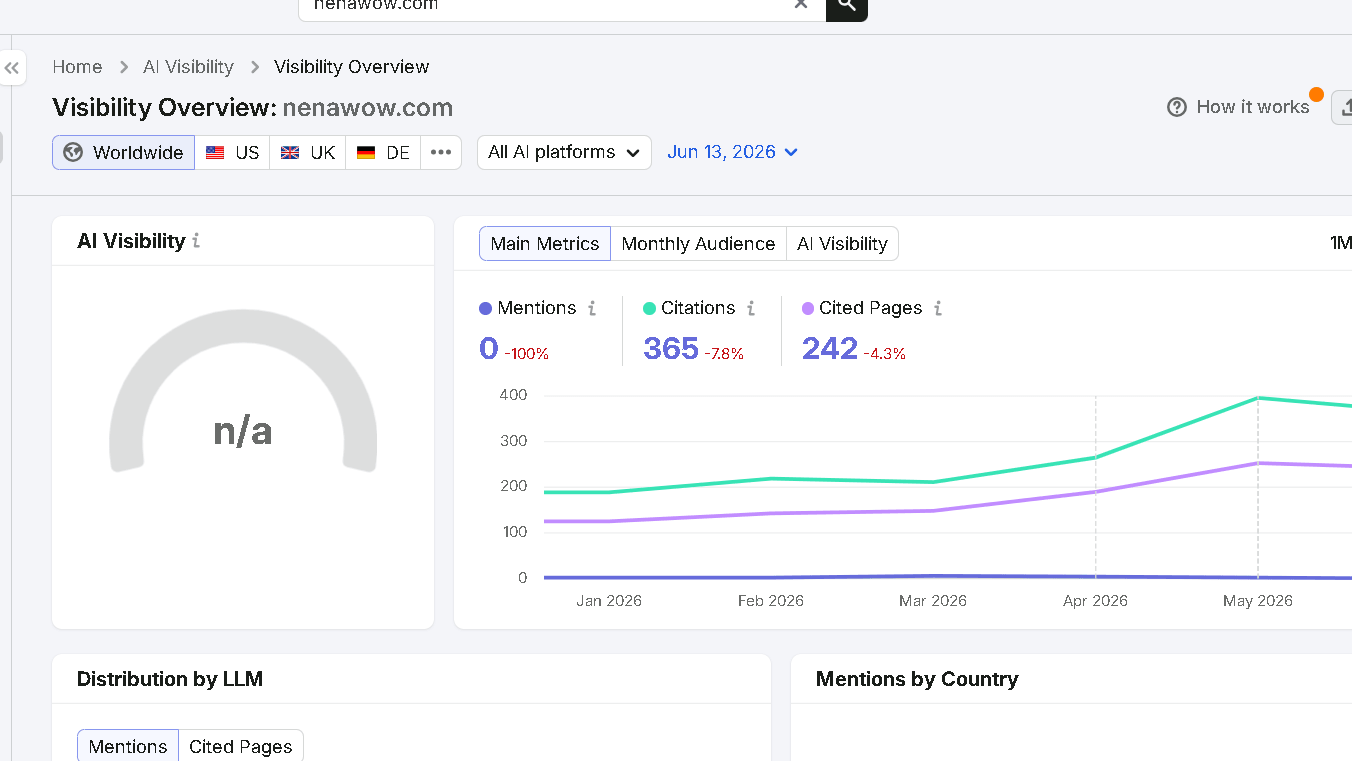
Three months earlier, that number was close to zero. So is it worth paying attention to a jump like that? I think so. Something changed in my AI citation visibility, and I wanted to know what.
Additional Context: How Small This Site Actually Is
Before I go further, here is the part that makes this number mean something. According to Ahrefs, my site gets roughly 4.8K monthly organic traffic, ranks for 214 keywords, and has a Domain Rating of 11, with around 2K referring domains. By most SEO standards, that is small.
Small site, growing citations. Not a big authority site that already had AI tools paying attention. Keep that in mind for the rest of this article, because it changes what the numbers actually mean.
What the Data Did and Did Not Tell Me
The report told me how many citations existed and roughly how many pages were involved. It did not tell me which prompts triggered them, or which AI tool was doing the citing most often. So I went looking myself.
One challenge with AI visibility data is that different platforms measure citations differently. That is why I also tested several dedicated AI tracking platforms in my comparison of AI Overview SEO rank tracking tools.
I checked which pages were involved, and the pattern was clear. It was almost never the homepage. It was almost always a review, a comparison, or a how-to page with a clear structure. That pattern matters, and it shows up again later in this article.
What High AI Visibility Actually Looks Like
Once I had my own number, I wanted to know what it looked like next to other sites in the same space. So I pulled the same metrics for a few AI tool directories that show up constantly in this niche. The result was not what I expected.
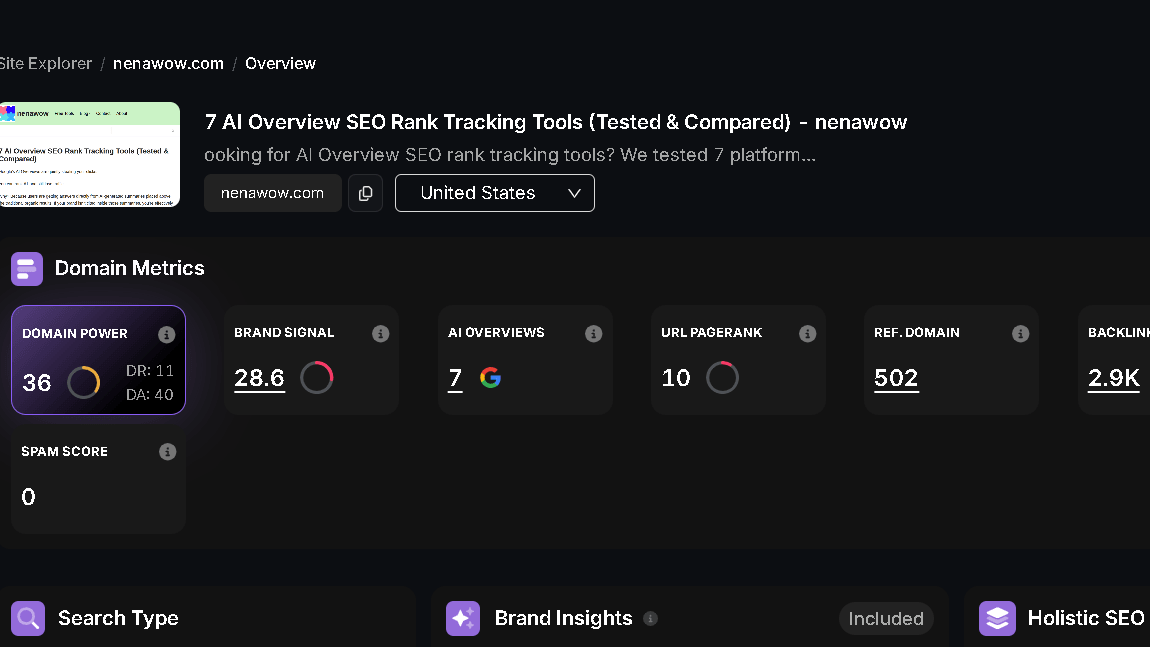
| Website | Domain Power | Brand Signal | AI Overviews |
|---|---|---|---|
| NenaWow | 36 | 28.6 | 7 |
| Futurepedia | 49 | 48.9 | 179 |
| There’s An AI For That | 62 | 77.1 | 247 |
| Toolify | 48 | 75.6 | 1 |
A few things jump out from this table. Futurepedia and There’s An AI For That both sit well ahead of my site on every column, which makes sense. They are bigger, older, and better known in the AI tools space.
Futurepedia
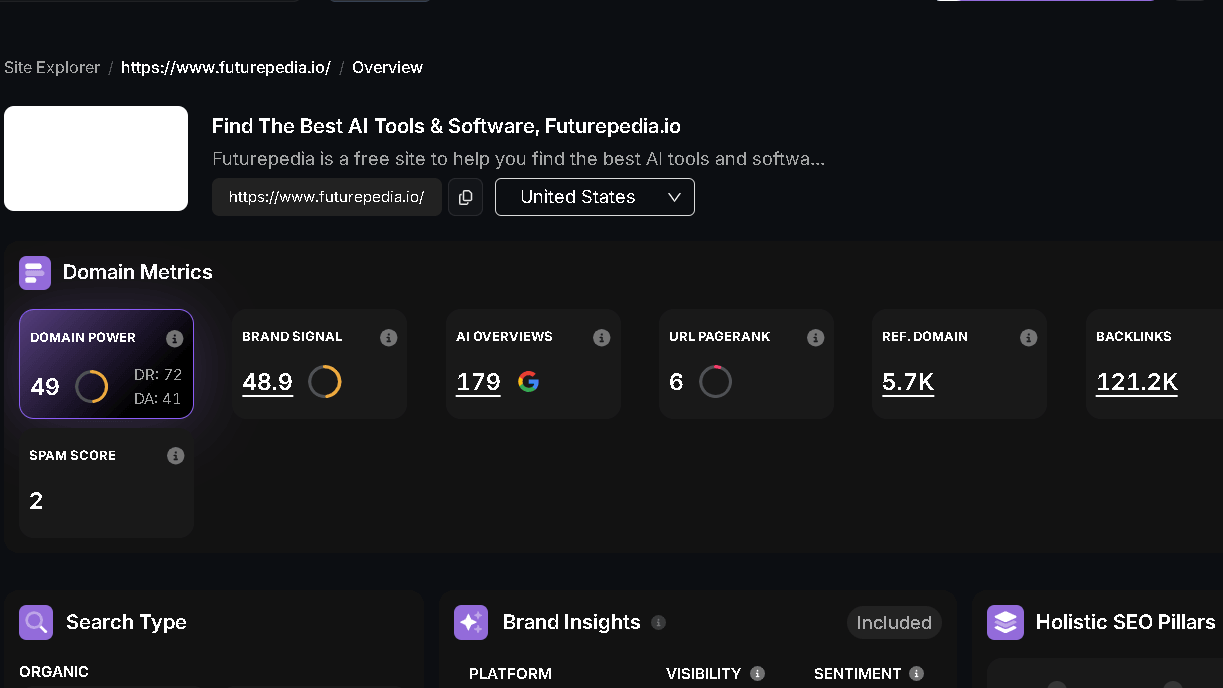
Futurepedia sits in the middle on Domain Power, but its AI Overviews number is the second highest in the table. Its Brand Signal score is also solid. The combination looks consistent across the board, not lopsided in one direction.
There’s An AI For That
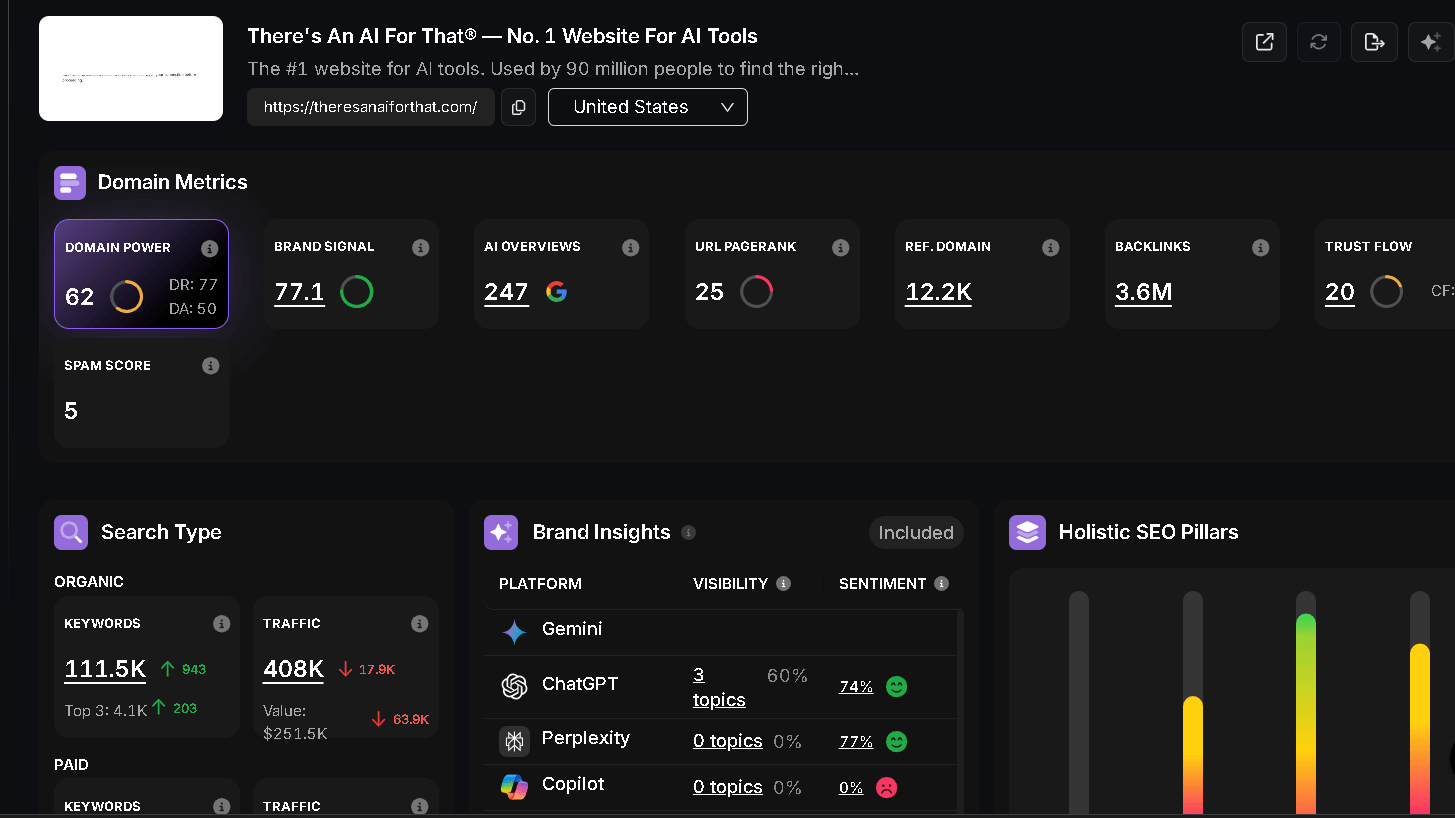
TAAFT leads on every metric here. Highest Domain Power, highest Brand Signal, highest AI Overviews. If you wanted a single example of what a site at full strength looks like across all three numbers, this is it.
Toolify
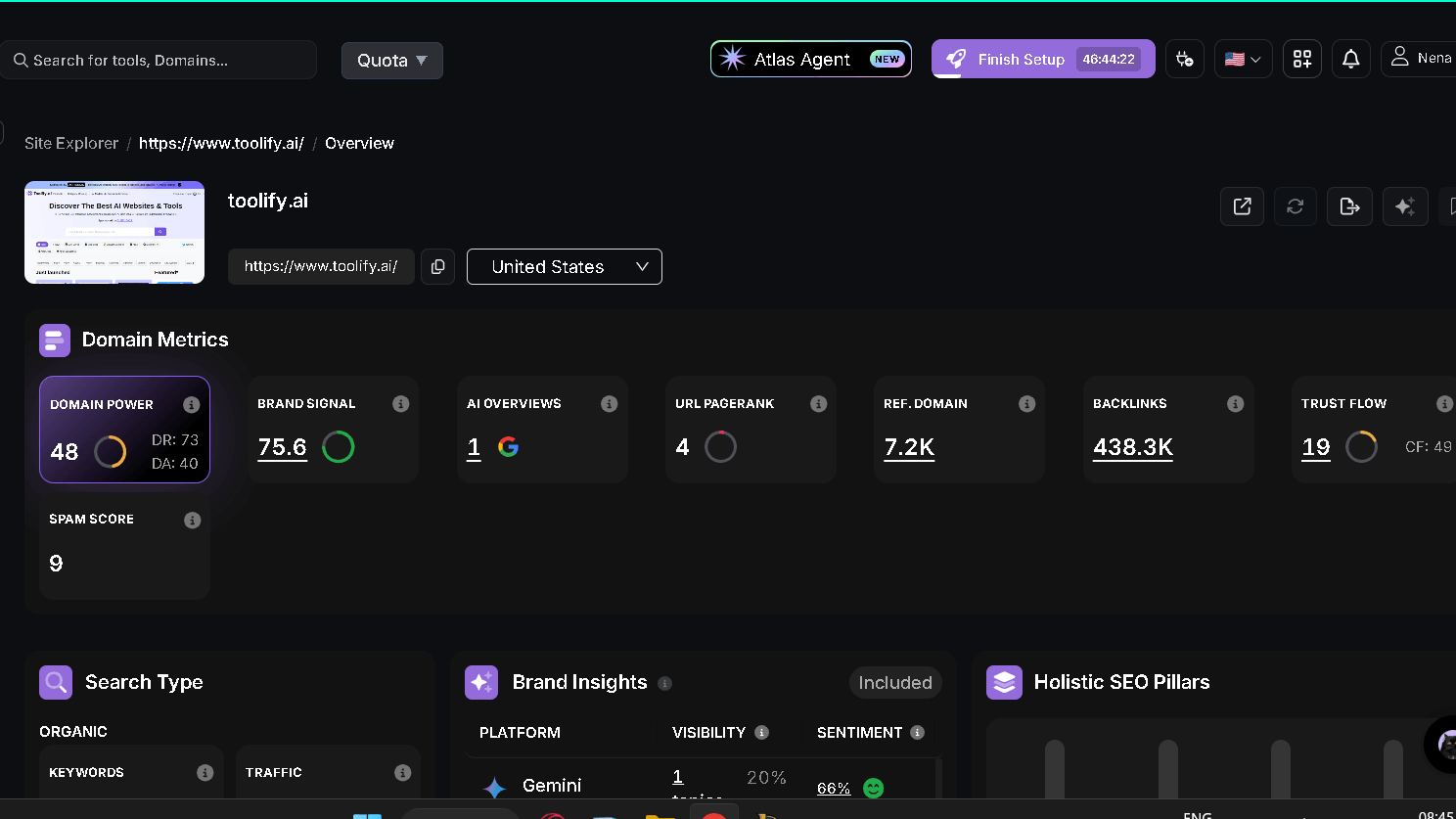
Toolify is the one that stopped me. Its Domain Power is close to Futurepedia’s. Its Brand Signal score is nearly as high as TAAFT’s. And its AI Overviews count is 1.
One. Out of the four sites in this table, Toolify has the strongest SEO numbers paired with the weakest AI Overview presence by a wide margin. That gap is the most interesting thing I found while putting this article together.
Brand Signals Matter More Than I Expected
Until I ran this comparison, I had not paid much attention to Brand Signal as its own metric. I assumed it tracked closely with Domain Power, the way a lot of SEO metrics tend to move together. It does not, at least not here.
| Website | Brand Signal |
|---|---|
| Nena | 28.6 |
| Futurepedia | 48.9 |
| Toolify | 75.6 |
| There’s An AI For That | 77.1 |
Look at where Toolify sits on this list. It is near the top, close to TAAFT, and well ahead of Futurepedia. Yet its AI Overview count is 1, against 247 for TAAFT and 179 for Futurepedia.
So Brand Signal alone is not the deciding factor either. The thing is, it does seem to matter more than raw domain strength does when it comes to AI search visibility. Brand recognition plays a role, and so does how consistent that brand looks across the places where it shows up.
For my own site, the Brand Signal score of 28.6 is the lowest in this group. That tracks. I am the smallest site here by a wide margin, and I have not run any kind of brand awareness push. Even so, my AI Overviews number is not zero. It is 7, which for a site this size, is a real value.
Why Toolify Changed How I Think About AI Visibility
This is the one observation from this whole exercise that I keep coming back to. Toolify has 117K ranking keywords. Its Domain Rating is 73. Its Brand Signal score is 75.6, the second highest in the table.
And its AI Overview count is 1.
If AI visibility were simply a function of SEO strength, Toolify would dominate every visibility metric here. It does not. The fact that it does not suggests AI systems may weigh content structure, brand recognition, editorial depth, or citation behavior differently than traditional search engines do.
I want to be careful here. I do not know exactly why Toolify’s number looks like this. It could be how the content is structured, how it is written, how often it is cited as a source versus just indexed. But the gap itself is real, and it is large enough that it cannot be explained by domain strength alone.
What that means for a small site like mine is something close to hopeful. If AI Overviews were purely about Domain Power, a site with my numbers would have no real shot at increasing AI visibility at all. The data says otherwise.
What Content AI Search Engines Actually Cite
Once I had a sense of which pages were getting picked up on my own site, I started checking what those pages had in common. A few patterns showed up again and again, and they line up with what I would expect from how these tools pull information.
Review Articles
Reviews with named specifics did better than reviews with vague praise. Things like a specific test result, a specific feature name, or a specific number seemed to give the AI something concrete to quote or summarize.
Comparison Articles
Pages that compared two tools directly, like one product against another, came up often in prompts that asked for comparisons. That makes sense. If someone asks an AI to compare two things, the AI tends to look for pages that already do that comparison.
Alternative Articles
Pages built around alternatives to a popular tool showed up for prompts asking what else is out there. These pages tend to be underused by bigger sites, which may be part of why smaller sites can compete here.
Workflow Tutorials and Original Research
Pages that walked through a process step by step, or that included a test I had run myself, performed better than pages that just summarized other sources. In practice, this was the clearest signal I found on my own site.
Here is how I would rank these factors based on what I saw.
| Content Type | Impact on AI Citations | Difficulty to Produce | Time to See Results |
|---|---|---|---|
| Original testing and research | High | High | 2 to 3 months |
| Comparison articles | High | Medium | 1 to 2 months |
| Review articles with named specifics | Medium to High | Medium | 1 to 2 months |
| Alternative articles | Medium | Low to Medium | 1 to 2 months |
| Generic informational pages | Low | Low | Unclear |
What that means is the harder content to produce is also the content most likely to get cited. There is no shortcut here. That is the trade-off.
Build Topic Clusters Instead of Publishing Random Articles
My site is organized around clusters. There is an AI assistant cluster with reviews, comparisons, and alternatives for tools like ChatGPT, Claude, Gemini, Perplexity, Grok, and DeepSeek. There is also an SEO cluster, and a smaller companion content cluster.
I did not build these clusters to improve visibility in AI search. I built them because they made sense for readers. But looking back, the cluster structure seems to line up closely with where the citations came from.
Why AI Systems Seem to Prefer Topical Authority
When a topic has many connected pages on one site, that site starts to look like a real source on the subject, not just a one-off mention. I cannot prove this is exactly how the models weigh things. But the pattern in my data points that way, and the Toolify comparison backs it up. A directory with huge keyword coverage but thin editorial depth on each page still ended up with an AI Overview count of 1.
Why Internal Linking Matters More Than It Used To
Pages in my AI assistant cluster link to each other constantly. A Claude review links to Claude alternatives, which links to a Claude versus ChatGPT comparison, which links to an AI SEO workflow page. The reader can move through the whole topic without leaving the site.
That structure seems to help AI tools understand what the site covers, not just what one page says. Here is the issue. A single great article rarely builds that kind of context on its own. A cluster does.
Publish Original Testing Instead of Rewriting Existing Content
This is the part that takes the most time, and it is also the part I think matters most. Original testing means running the tool yourself, recording what happens, and writing down the actual result, not a guess.
I am now tracking my AI Visibility numbers monthly, alongside the competitor comparison I ran for this article. The starting point is 365 citations across 242 pages, with a Brand Signal score of 28.6 and an AI Overview count of 7. That is the baseline. Whether it moves, and by how much, is something I plan to check again and report honestly, including if it does not move at all.
Why Screenshots Create Trust
A screenshot of a dashboard, a chat response, or a test result gives the reader something to check. It also gives an AI model something concrete to point at when it summarizes your page. Claims without evidence tend to blend into everything else online.
Why AI Systems Seem to Need Original Sources
If every article on a topic says the same thing in the same order, there is nothing to pick out. A page with a number nobody else has, or a screenshot nobody else has, stands out. That is the gap most content never closes.
Create Content That Answers Questions Directly
AI tools tend to extract short, direct answers from longer pages. If your content buries the answer under three paragraphs of setup, it is harder to pull out cleanly.
How to Structure Sections for AI Extraction
Put the direct answer near the top of a section, then explain it after. A short sentence first. Then the detail. This also happens to make pages easier for human readers to skim, which is a nice side effect.
The Role of FAQ Sections
FAQ sections give AI tools a ready-made question and answer pair. I added FAQ sections to most of my cluster pages over the last few months. I cannot say for certain how much this contributed to the citation growth, but the timing lines up.
Build Brand Authority Beyond Your Website
AI visibility is not only about your own pages. It also depends on what other sites say about you, and whether your name shows up consistently across the web. The Brand Signal numbers from earlier suggest this matters more than I used to think.
Author Profiles and Expertise
Having a real author name, a consistent bio, and a clear area of focus seems to help. I write under my own name across every review and comparison, and I keep the bio the same everywhere it appears.
Third-Party Mentions and Brand Recognition
Mentions on other sites, even small ones, add up. I have not run a large campaign for this. But the mentions that exist seem to reinforce the same topic areas my clusters already cover, which keeps the signal consistent. Consistency keeps showing up as a theme here, on the brand side and on the content side.
How to Measure Brand Visibility in AI Search Engines
You need a way to check this regularly, or you are just guessing. Here is what I used, and how each one held up.
| Tool | What It Shows | Ease of Use | Cost |
|---|---|---|---|
| Semrush AI Visibility | Citation count and cited pages by domain | Easy | Paid |
| Search Atlas | Domain Power, Brand Signal, and AI Overview counts | Medium | Paid |
| Ahrefs | Traditional organic traffic and keyword data | Easy | Paid, free tier available |
| Manual prompt testing | Real citations in real answers | Medium, time-heavy | Free |
Ahrefs is not an AI visibility tool, but it gave me context. My site shows roughly 4.8K monthly organic traffic, 214 ranking keywords, and 2K referring domains, with a Domain Rating around 11. That is a small site by most standards. The AI citation visibility numbers grew anyway.
Manual Prompt Testing
Out of all four methods, manual testing was the slowest but the most direct. Running the same prompts across a few AI tools and watching what comes back is the only way to see, in real time, whether a page actually gets used. The apps are solid, but the manual check is what I trust most.
I also use Claude extensively during content reviews and validation. If you rely on Claude workflows, my guide to the best Claude SEO checking software covers tools that help evaluate content quality before publishing.
Common AI Visibility Mistakes
I made some of these myself before I started paying attention. A few of them are easy to fall into without noticing.
| Mistake | Why It Hurts AI Visibility | Easy Fix |
|---|---|---|
| Publishing generic, rewritten content | Nothing original to cite | Add a real test or number |
| Treating articles as one-offs | No cluster context for the topic | Group related pages and link them |
| Focusing only on Google rankings | Misses AI-specific patterns | Check Domain Power against AI Overviews, not just rankings |
| Skipping FAQ sections | Fewer extractable answer pairs | Add 3 to 6 direct Q&A pairs per page |
| Assuming domain strength is enough | Toolify shows this is not true | Pair SEO work with brand and editorial depth |
| Never updating older content | Pages go stale, citations drop off | Refresh data and screenshots every few months |
That said, none of these mistakes are fatal on their own. They just slow things down. Fix them one at a time and the gap starts to close.
AI Visibility vs Traditional SEO: What Has Changed?
The question is not whether SEO still matters. It does. The question is what else now matters alongside it.
| Area | Traditional SEO Focus | AI Visibility Focus |
|---|---|---|
| Keywords | Exact match and search volume | Topic coverage and intent |
| Content depth | Long, comprehensive pages | Clear, extractable answers |
| Links | Backlinks for authority | Internal clusters plus external mentions |
| Brand | Secondary to links | Brand Signal appears closely tied to AI Overviews |
| Evidence | Optional | Increasingly important |
| Updates | Helpful but not urgent | More directly tied to citation freshness |
What still works is solid on-page basics, clear structure, and real keyword research. What matters less than before is keyword density for its own sake, and apparently, raw domain strength on its own. What matters more is brand recognition and whether your content gives a model something specific to pull from.
In practice, SEO and AI search visibility are not competing goals. They overlap more than they conflict. But Toolify is proof that they can pull apart sharply, and that overlap is not guaranteed just because the SEO numbers look good.
How to Improve AI Visibility in AI Search
At this point it helps to pull everything together into one place. If your main goal is to improve AI visibility, or to increase AI visibility on a site that is not showing up in AI answers yet, here is the short version of everything above.
Topic clusters come first. Build groups of connected pages around one subject, not isolated articles. This is the single biggest factor I found, and it shows up in both my own numbers and the competitor comparison.
Original testing comes next. A number nobody else has, a screenshot from your own dashboard, a test you ran yourself. This is what gives AI tools something specific to point at, and it is the difference between a citable page and a forgettable one.
Internal linking ties the cluster together. Pages need to point at each other in ways that make sense for a reader moving through the topic. Without this, even good pages tend to sit alone.
Brand consistency matters more than I expected going in. The same author name, the same bio, the same areas of focus, repeated across the web. Brand Signal tracked with AI Overviews more closely than Domain Power did, and that was the biggest surprise in this whole project.
Citations are the result, not the goal. Track them with Semrush AI Visibility or Search Atlas, watch how they move month to month, and use that to tell you whether the other four pieces are working. My own AI citation visibility went from near zero to 365 citations across 242 pages in about three months. That is the proof, such as it is.
If you want a deeper comparison of AI citation monitoring platforms, see my guide to the Best Tools to Track Mentions in ChatGPT.
How Long Does It Take to Improve Brand Visibility in AI Search?
I do not have a clean answer here, and I do not want to pretend I do. What I can say is what I saw on my own site, and what the competitor comparison suggests about the ceiling and the floor.
Early Signals
The first signs showed up within a few weeks of adding FAQ sections and screenshots to existing cluster pages. These were small changes, not new articles. Citations did not jump overnight, but they did not stay flat either.
What I Noticed After Publishing Clusters
The bigger jump, from near zero to 365 citations, lined up with roughly three months of steady cluster-building. New comparison and alternative pages, all linked into existing reviews, seemed to be the main driver. I cannot prove cause and effect from a single site. But the timing is hard to ignore.
Why Consistency Matters More Than Speed
One big push, then nothing, did not seem to be the pattern that helped my site. The Toolify comparison points the same way from the other direction. A lot of pages built fast, without much editorial depth, did not translate into AI Overview presence. Consistency matters. Consistency, not volume, seems to be the thread running through all of this.
My AI Visibility Checklist
Here is the short list I now run through for every new piece of content.
Content checklist: include a real test, a real number, and at least one screenshot. Add an FAQ section with direct answers. Link to at least two related pages in the same cluster.
Authority checklist: use a consistent author name and bio. Make sure the page fits clearly into an existing topic cluster, not a standalone subject. Keep brand mentions consistent across the sites where your name appears.
Technical checklist: keep page structure clean, with the direct answer near the top of each section. Avoid burying the point under long intros.
Measurement checklist: check AI visibility reports monthly. Track Domain Power, Brand Signal, and AI Overview counts side by side, not just one of them. Compare your numbers against a couple of sites in your space, the way I did here.
Final Verdict: What Actually Improves Brand Visibility in AI Search Engines?
Based on what I found on my own site, and on the competitor numbers I pulled for this article, a few things stand out. Build topic clusters instead of isolated pages. Link those pages to each other in a way that makes sense for readers. Publish original testing with real numbers, not summaries of someone else’s work. Add FAQ sections with direct answers. Pay attention to Brand Signal, not just Domain Power. Update older content instead of letting it sit.
None of this is a guaranteed formula. My sample size is small, and the AI tools themselves keep changing how they choose sources. Even so, the pattern across these four sites is consistent enough to be worth acting on if your goal is to improve AI visibility on your own site.
For a small site, going from near zero to 365 citations, with an AI Overview count of 7, is a real value. Toolify has 117K keywords, a Domain Rating of 73, and an AI Overview count of 1. Those two facts sitting next to each other are the whole argument. That is the honest answer.
FAQ
AI visibility is how often AI tools like ChatGPT, Gemini, Claude, Perplexity, and Grok mention or cite your site when answering questions related to your topic. It is tracked separately from traditional search rankings, and includes metrics like Domain Power, Brand Signal, and AI Overview counts.
Based on what I saw, pages with original testing, specific numbers, comparisons, and clear FAQ sections were the ones that showed up most often. Generic, rewritten content rarely appeared in citations, even on sites with strong domain metrics.
No. Toolify has 117K ranking keywords, a Domain Rating of 73, and a Brand Signal score of 75.6, but only 1 AI Overview. Domain strength on its own does not appear to be enough to improve AI visibility.
Brand Signal is a metric reported by tools like Search Atlas that appears to track brand recognition separately from links and rankings. In the sites I compared, it lined up with AI Overview counts more closely than Domain Power did.
This varies by tool and is not fully public. From what I found, pages that belong to a clear topic cluster, link to related pages, include original evidence, and come from a site with consistent brand signals seemed to be favored over standalone or generic pages.
On my site, early signals showed up within weeks of small changes like FAQ sections. The larger jump, from near zero to 365 citations, took around three months of steady cluster-building.