
Most AI writing tools save time during drafting and then give that time back during fact-checking. That tradeoff is the starting point for this Katteb AI review, since Katteb was built around solving that specific problem.
I used Katteb every day for 30 days across four workflows. SEO blog posts, affiliate product articles, factual explainers, and multilingual content for a client running sites in three languages.
In a 60-article verification test, roughly two-thirds of the articles required no factual corrections before publishing. The remaining third needed at least one manual fix. That ratio is the whole review.
Disclaimer: I may earn a small commission on purchases made through links on this page, at no extra cost to you. This supports honest, independent reviews.
Table of Contents
Testing Methodology
Tested for 30 days. Generated 60 articles across four content types. Covered SEO content, affiliate reviews, and factual explainers. Compared output against ChatGPT and Jasper on matching prompts. Verified every citation by hand against its source.
Katteb AI Quick Verdict
| Category | Verdict |
|---|---|
| Best for | SEO bloggers, affiliate publishers, multilingual content teams |
| Worst for | Investigative writers, opinion writers, anyone expecting full automation |
| Biggest strength | Citation-backed output cuts hallucination anxiety while drafting |
| Biggest weakness | Source quality is inconsistent and citations sometimes mislead |
| Pricing | Free, then $17/month (Pro) up to $99/month (Agency) |
| Overall verdict | Reduces editing anxiety more than it reduces editing time |
That last line is the most honest thing I can say about Katteb. It is worth reading twice before you sign up.
If your biggest frustration with AI writers is hallucinated facts, Katteb is one of the few tools that genuinely attempts to solve that problem. Whether it solves it enough is the rest of this review.
What Katteb Feels Like During the First Week
The first thing you notice is the citation panel. Katteb pulls sources as it writes and attaches them to the claims in the draft. After years of watching ChatGPT invent numbers with total confidence, a source link next to a claim feels reassuring. That feeling is the product. That feeling is also worth questioning.
Setup is fast. You enter a topic, pick an article type, set a length, and Katteb builds a structured draft with headings and sourced claims in around 30 to 45 seconds. First generation ran 38 seconds on average in my testing. That is fast enough to feel like a real tool, not a toy.
Week one output was better than I expected. On straightforward topics, how-to guides, product overviews, factual summaries, Katteb gave me usable first drafts more often than not. I ran 18 articles that week. Fourteen needed light editing. Four needed real work. That early ratio built the kind of trust I have learned to watch closely.
The multilingual output was the early standout. I ran the same article in English, French, and Turkish. English was strongest. French was workable. Turkish needed more cleanup but gave me a usable base. For publishers writing outside English, that range is a real edge.
A Real Workflow Test
One test stuck with me more than the others. I used Katteb to update an affiliate review that already ranked on page two of Google. Katteb produced a cleaner structure than my original draft and surfaced a few sources I had not come across on my own. The piece still needed editing before it went live. Even so, it saved enough research time that I finished the update faster than I expected to.
That is the version of Katteb worth paying for. Not a replacement for the writing. A head start on the parts that usually eat the most time.
What Changes After Weeks of Daily Use
The trust drift starts quietly. By day twelve, I noticed I was clicking fewer source links. The citation panel had trained me to feel the output was checked without me actually checking it. That is a real effect, and it shapes how you should read the rest of this review.
The editing time did not drop the way I expected. Week one, I spent an average of 22 minutes editing each article before publishing. Week four, the average was 19 minutes. That is a three-minute gain across 30 days of daily use. For a tool built around cutting verification work, three minutes is not the workflow shift the marketing implies.
Structural repetition was the other thing I tracked. By week three, Katteb articles followed a pattern I could spot from the outline alone. Intro with a stat. Three or four heading sections of similar length. A closing paragraph that restates the intro in different words. Not wrong exactly. Just not what a careful editor would choose every time, and it starts to read as AI to anyone paying attention.
The Mistake That Stuck With Me
During one test, Katteb cited a source that discussed a related statistic but not the exact figure it presented in the draft. The number looked believable at first glance. It sat next to a working link, in a sentence that read like every other sentence around it. Nothing about it looked wrong.
That is exactly why source verification still matters, even with a citation panel sitting right there. A confident wrong number is harder to catch than an unsourced one, because you have less reason to go looking.
Katteb Features That Actually Matter in Daily Writing
The citation engine is the core feature, and the one that genuinely sets Katteb apart from a standard AI writer. It pulls from real sources, attaches them to specific claims, and gives you a starting point instead of a blank page. That is a real value. The idea behind the citation engine is stronger than the execution, but the idea alone puts Katteb ahead of tools that just invent facts and move on.
SEO mode is the second feature I used daily. Feed it a keyword and it builds an outline based on search intent, then writes a full article targeted to it. The keyword structure was better calibrated than what I got from Jasper on the same prompts. The topical depth was thinner. Those are different problems, and different tools solve them better.
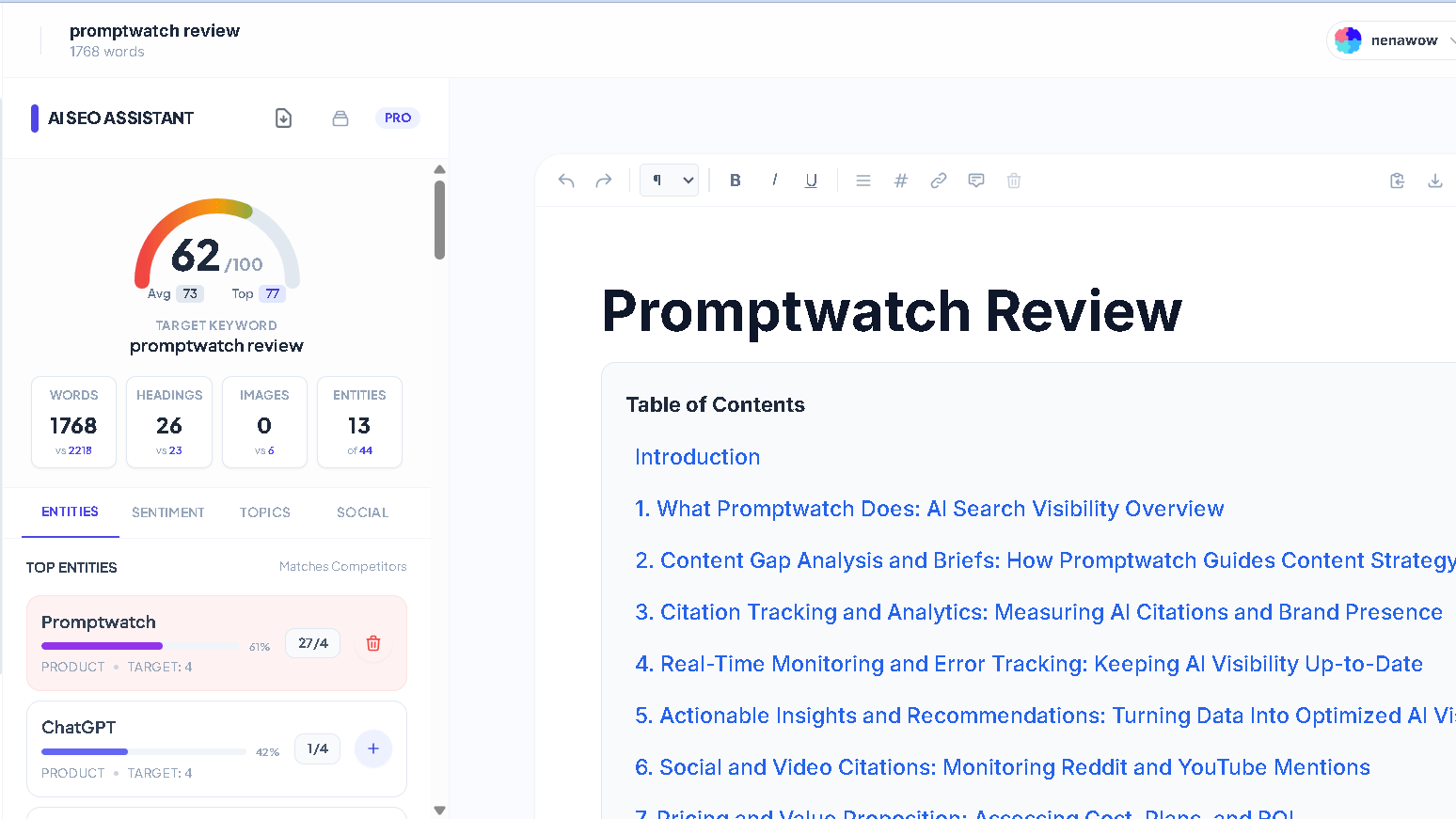
Most of my testing happened inside Katteb’s AI SEO Assistant, where article generation, keyword optimization, and content analysis are combined into a single editor.
The multilingual engine earns its keep for anyone running non-English sites. I tested five languages over 30 days. English came out strongest. Spanish and French were workable with light editing. Arabic and Turkish needed more hands-on work but gave me a real structural base. Named output. Real variation. Actual language switching, not translated English wearing a costume.
The rewriter is the feature I used least. It rephrases existing content but does not add depth or fix what is wrong with it. Thin source content stays thin after the rewrite. It is fine for freshening an old article that already works. It will not create new value on its own.
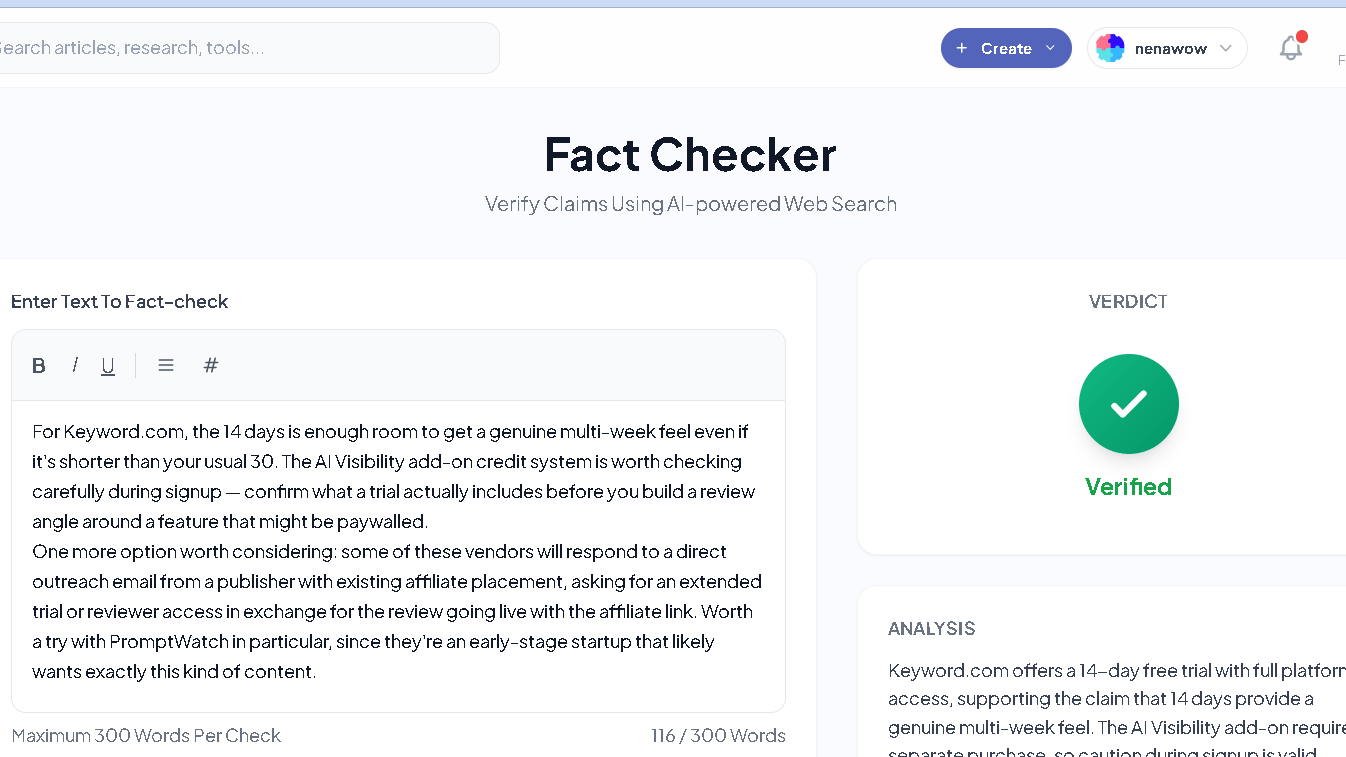
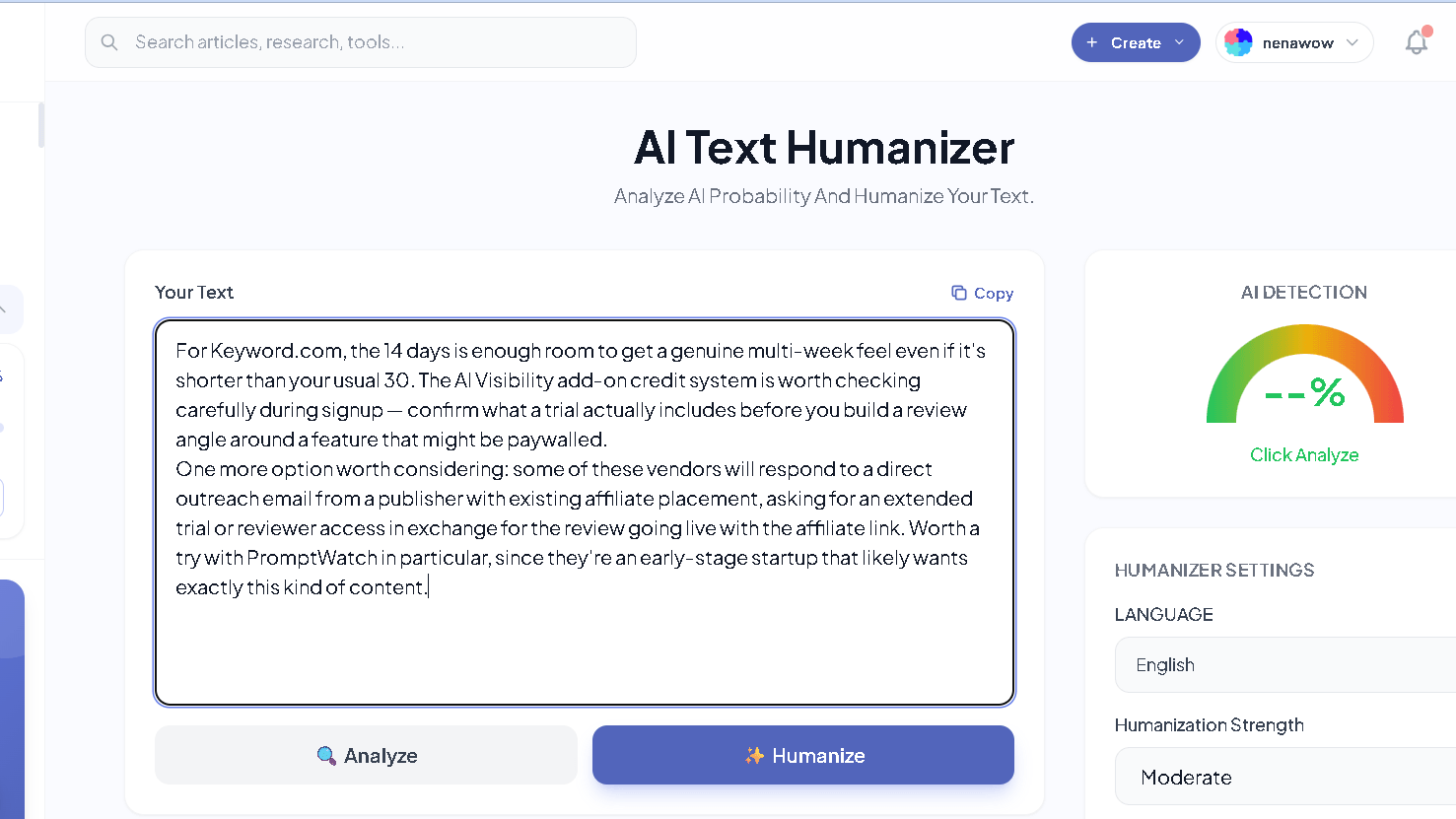
Katteb also includes an AI Humanizer designed to rewrite text in a more natural style and reduce obvious AI patterns. In my testing, it improved readability in some cases, but it did not solve deeper issues like weak arguments, missing insights, or factual inaccuracies.
Where Katteb Starts Becoming Frustrating
Citation quality is the first real frustration. I encountered multiple cases where cited sources did not fully support the attached claim. In several examples, the source suggested something different from what Katteb wrote, and I even ran into a couple of broken links along the way.
Here is the issue with that. A citation next to a wrong claim is more dangerous than no citation at all. It looks checked. It is not. Anyone who trusts the panel without clicking through will publish errors that look sourced. That is a specific failure mode Katteb’s marketing does not mention.
The overconfident tone is the second frustration. Katteb writes with the same certainty whether it is standing on solid ground or guessing. It does not hedge on shaky claims the way a careful writer would. You have to add the hedging yourself, which means already knowing enough about the topic to spot where the uncertainty lives. That is not less work. That is the same work in a different shape.
The formatting repetition I mentioned earlier gets more visible over time. By week four I was manually restructuring most outlines before I even started editing the prose. The tool had trained me to expect its default shape, then work around it. That overhead never shows up in the free trial.
Katteb Pricing: Is It Worth Paying For?
Katteb runs three tiers, with a 20 percent discount if you pay yearly instead of monthly.
| Plan | Price | What You Get | Real Limitation |
|---|---|---|---|
| Free | $0/month | Basic tools, AI Image Designer, Content Library | Limited features, fine for testing only |
| Pro | $17/month | 30,000 AI Credits/mo, Article Writer, SEO Editor, AI SEO Fixes, 1 Brand, AI Humanizer and Rewriter, Fact Checker, Content Planner, 2 Team Seats | Credits run out fast at daily publishing pace |
| Agency | $99/month | 150,000 AI Credits/mo, everything in Pro, White Label Platform, Custom Domain, User Management, Branded Emails | Real ROI depends on output volume and verification discipline |
The Free plan is fine for kicking the tires. It will not carry a real publishing schedule, and it should not be the plan you judge the product by.
The Pro plan at $17 a month is where the real value question lives. That is a low entry price compared to where Katteb sat a year ago, and it puts the tool well under ChatGPT Plus for anyone who only needs one brand and two seats. The 30,000 monthly credits sound generous until you account for regenerations and multiple drafts of the same piece. A publisher running five articles a week will feel the ceiling inside two to three weeks.
What that means is the real ROI argument for Katteb is not time saved. It is anxiety reduced. If the citation panel gives you enough confidence to publish faster, even on days you skip clicking every source, that psychological value may be worth $17 on its own. That is a real thing to buy. It is worth being clear that is what you are buying.
The Agency plan at $99 makes sense once you need White Label, a custom domain, or more than two seats. Below that scale, it is paying for headroom you are not using yet.
Katteb vs ChatGPT for SEO Content
| Category | Katteb | ChatGPT |
|---|---|---|
| Citation-backed output | Yes, with quality inconsistency | No, requires manual sourcing |
| Hallucination rate | Lower in my testing | Higher without strong prompting |
| Editing burden | Medium and fairly stable | High but improvable with prompting |
| SEO keyword targeting | Built in | Requires manual prompt setup |
| Structural variety | Low, repetitive by week three | Higher with varied prompts |
| Pricing | Free to $99/month | Free to $20/month |
| Best use case | Fact-sensitive SEO content at volume | Flexible, high-control writing and research |
ChatGPT hallucinates more in raw output. In my ChatGPT Review, I found it produces more flexible and creative content, but it requires much stronger prompting and manual verification for factual topics. Katteb hallucinates less but sometimes attaches citations to claims that do not check out. Those are different failure modes. ChatGPT’s failure is more visible. Katteb’s failure is more dangerous because it looks like evidence.
For a publisher who fact-checks everything regardless, ChatGPT with a solid system prompt can produce comparable output at a lower price. For a publisher who leans on the citation layer to catch errors, Katteb cuts down on the obvious hallucinations. So is it worth the switch? That depends on how much you actually trust either tool to do your sourcing for you.
Katteb vs Jasper
Jasper is built for marketing copy and brand voice. My Jasper Review goes deeper into how it performs for marketing teams that prioritize brand consistency over factual content generation. Katteb is built for factual article writing. They overlap in SEO content, which is where most of the comparison searches come from, but they are tuned for different jobs.
| Category | Katteb | Jasper |
|---|---|---|
| Factual reliability | Higher with citation layer | Lower, more hallucination-prone |
| Marketing copy quality | Weak | Strong |
| SEO article structure | Adequate | Strong |
| Editing burden for factual content | Medium | High |
| Brand voice integration | Minimal on Pro, stronger on Agency | Strong |
| Entry price | $17/month | Around $39/month |
In my side-by-side test on the same ten SEO prompts, Katteb produced more factually stable first drafts on seven of ten. Jasper produced more polished, readable prose on eight of ten. Those are different things and they matter differently depending on what your workflow actually prioritizes.
For teams where factual accuracy comes first and prose polish is secondary, Katteb is the better tool. For teams where brand voice and persuasive copy matter more than citation depth, Jasper wins easily.
Who Should Actually Use Katteb
Affiliate publishers running product review and comparison sites will get real use out of Katteb. The citation layer gives you a starting point for the factual claims affiliate content needs, and SEO mode is tuned well for commercial keyword intent. At $17 a month, the entry cost is low enough that the editing burden is easy to absorb.
SEO content teams publishing multiple articles a week on factual topics will find the workflow useful too. Katteb produces structurally sound first drafts faster than most alternatives, and the citation panel, inconsistencies and all, gives editors a faster path to verification than starting cold.
Multilingual publishers who need a scalable base for non-English content are a strong fit. The multilingual engine is one of the more honest parts of the tool. It does not pretend to be perfect. It gives you something to work from, which matters when you are managing content in four or five languages with a small team.
Who Should Avoid Katteb
Investigative writers and journalists should avoid Katteb. Citation quality is not good enough for work where sourcing integrity is the entire point. A wrong source attached to a confident claim is a liability in that context, not a time saver.
Opinion writers and essayists are also a poor fit. The tool writes in a neutral, informational register. It does not take positions or build an argument. Those are different skills from what Katteb produces.
Writers expecting full automation should reset that expectation before subscribing. Katteb cuts certain steps. It does not remove editing. Roughly a third of the articles in my testing needed a factual fix before they were safe to publish. That is not a small caveat. That is the whole risk model.
The Real Reason People Stay With Katteb
It is not the output quality. By week three, most users have already noticed the structural repetition and the citation gaps. They stay because the citation panel makes publishing feel safer, even on days they skip checking every source.
That psychological effect is the real product. Reduced anxiety is worth paying for if you publish factual content at volume and the alternative is either unchecked AI output or two hours of manual fact-checking per article. Katteb sits between those two and makes the middle ground feel more comfortable than it technically is.
The honest question is not whether Katteb makes your content better. It is whether it makes publishing AI content feel less risky. For a lot of publishers right now, that second thing is the more valuable one.
Best Alternatives to Katteb
| Tool | Best For | Factual Trust | Workflow Complexity |
|---|---|---|---|
| ChatGPT | Flexible research and writing | Lower raw, higher with strong prompting | Medium to high |
| Claude | Long-form accuracy and reasoning | Higher than most | Medium |
| Jasper | Marketing copy and brand voice | Lower, not built for factual content | Low to medium |
| Writesonic | SEO content at volume | Comparable to Katteb | Low |
| Copy.ai | Short-form and workflow automation | Not built for factual content | Low |
Claude is the alternative I would point factual writers toward most seriously. In my Claude Review, I found it handles nuanced explanations and long-form reasoning better than most AI writers, although it lacks Katteb’s citation system.
It does not give you citations, so you still have to source your own claims. But it reasons through complex topics with more depth than Katteb gives you, and it hedges on uncertain claims in a way that makes editing feel more honest. The workflow is less automated. The output needs less correction.
Another affordable alternative worth considering is Rytr. My Rytr Review found it useful for simple blog drafts and short-form content, although it lacks Katteb’s citation capabilities.
Pros and Cons After Long-Term Use
| Pros | Cons |
|---|---|
| Citation layer cuts obvious hallucinations | Citation quality is inconsistent, sometimes misleading |
| Fast first drafts across SEO topics | Structural repetition shows up by week three |
| Multilingual engine is genuinely usable | Editing time saved is smaller than the marketing implies |
| Low entry price at $17/month | Overconfident tone on uncertain claims |
| SEO keyword targeting built in | Credits run out fast at real publishing volume |
| Reduces publishing anxiety even when imperfect | Psychological safety and actual accuracy are different things |
Final Verdict
Katteb is a useful tool for a specific kind of publisher running a specific kind of workflow. If you are running SEO content at volume, need a structured first draft fast, and have an editing process that catches factual errors before they go live, Katteb gets you to a faster starting point than most alternatives, and it does it at a lower price than it used to.
The ceiling is citation quality. Roughly a third of the articles in my verification test needed at least one factual fix. That rate is lower than raw ChatGPT output. It is not low enough to remove verification from the workflow. Anyone who subscribes expecting to skip fact-checking will publish errors.
What Katteb actually sells is the feeling of safer publishing. That feeling has real value in a market where AI hallucinations are a daily headache. The gap between that feeling and actual accuracy is where the risk lives. Know that gap before you build a workflow around the tool.
After 30 days, I would trust Katteb to speed up drafting. I would not trust it to replace verification.
If you’re still comparing options, my guide to the Best AI for Writing covers Perplexity, ChatGPT, Claude, and other leading platforms side by side.
FAQ
In my 60-article test, about two-thirds needed no factual fix before publishing. The rest needed at least one correction. The citation layer cuts down on obvious hallucinations but does not remove errors, and some sources do not actually back the claims attached to them.
Yes, compared to a standard AI writer. It grounds claims in real sources more than tools like ChatGPT without strong prompting. The catch: citations sometimes attach to the wrong claim, or point to dead links. It cuts hallucinations. It does not erase them.
Katteb has a Free plan, a Pro plan at $17 a month with 30,000 AI credits and two team seats, and an Agency plan at $99 a month with 150,000 credits and White Label access. Yearly billing saves 20 percent on either paid tier.
For fact-sensitive SEO content, yes. Katteb gives more stable first drafts on straightforward topics. ChatGPT gives more varied, often more readable output with strong prompting. The editing gap between them is smaller than it looks.
Yes, for standard SEO content. Keyword targeting is well calibrated for commercial intent, and output stays consistent at volume. Topical depth runs thinner than a specialist writer would produce, which matters more on competitive terms.
No. It speeds up first drafts and basic sourcing. It does not replace subject knowledge, editorial judgment, or fact-checking discipline.
Often, not always. Several test articles had a citation that did not clearly support its claim, and a few links were broken. Treat citations as a starting point, not proof.
Yes, for high-volume publishers who fact-check anyway and want a fast starting point. No, for anyone expecting full automation.