
I run a content site with more than 300 published articles. For years, I tracked exactly one number that mattered: where I ranked on Google. That metric told me whether my content was gaining visibility, attracting traffic, and growing my audience. Today, there is a second metric I pay close attention to: AI visibility.
As more people get answers from ChatGPT, Gemini, Copilot, and Google AI Overviews, being cited inside AI-generated responses has become a new way for content to be discovered.
Somewhere in the last year, a second scoreboard showed up next to the first one. ChatGPT cites pages. Google AI Overviews cite pages. Perplexity, Gemini, Copilot, Google’s AI Mode, all of them now pull content into an answer and tell the reader where it came from, or sometimes do not tell them at all. Ranking on page one and getting cited inside an AI answer are two different games, and I learned that the hard way by running my own site through three separate AI visibility tools and getting three different stories back.
This guide is what I wish existed before I started. What AI visibility actually means. How it gets measured. Why the tools that measure it do not agree with each other. And what I would actually do about it, based on watching my own numbers move.
Key Takeaway: AI visibility is a second scoreboard beside traditional SEO. Rankings and citations overlap, but they are not the same thing.
Disclaimer: I may earn a small commission on purchases made through links on this page, at no extra cost to you. This supports honest, independent reviews.
Table of Contents
What AI Visibility Actually Means
AI visibility is whether your content shows up inside an AI-generated answer, and whether you get credited for it. That is the whole definition. Everything else is detail.
It is a different question from “do I rank.” A page can rank on page one of Google and never once get pulled into an AI Overview. A page can sit on page four and still get cited by ChatGPT, because ChatGPT is not reading Google’s rankings. It is reading the actual content and deciding, on its own terms, what answers a question well.
That gap is the reason this topic exists at all. If AI visibility tracked perfectly with search rankings, nobody would need a separate term for it. It does not track perfectly. Sometimes it does not track at all.
GEO vs AI Visibility: They Are Not the Same Thing
People use these two terms like they mean the same thing. They do not, and mixing them up is the fastest way to misread your own data.
GEO is the process. It is the work you actually do. Writing clearer answers, structuring content so an AI model can extract a claim from it, publishing original tests, updating pages so they stay current. GEO is something you control directly, the same way on-page SEO is something you control directly.
AI visibility is the result. It is the number that comes back when a tool checks whether that work paid off. You cannot directly control your AI visibility score any more than you can directly control your Google ranking. You can only control the inputs and watch what comes out the other end.
Think of it this way. GEO is SEO for AI search engines. AI visibility is the outcome you measure after doing that work, not the work itself. Keep those two ideas separate and the rest of this guide will make a lot more sense.
Why This Suddenly Matters
Google AI Overviews now show up on a meaningful share of searches. ChatGPT alone has hundreds of millions of weekly users, and a growing number of them are using it the way people used to use a search engine. Ask a question, get an answer, move on. No click required. I get into how that shift actually plays out day to day in my ChatGPT review.
That last part is the uncomfortable bit. A citation inside an AI answer does not always send you a visitor. Sometimes it does. Sometimes the reader gets their answer and never opens your page at all. You still got cited. You still did not get the click.
So why bother. Because being cited inside the answer is the modern version of being mentioned by a trusted source. It builds the kind of authority that compounds, even on the visits that never happen. And on the visits that do happen, AI-referred traffic tends to convert well, because the reader already trusts the source enough to click through.
The thing is, most publishers are still optimizing entirely for the first scoreboard. Rankings. Traffic. The second scoreboard is sitting right next to it, mostly unwatched.
The Confusing Part Nobody Tells You: Every Tool Measures This Differently
I want to walk you through something that changed how I think about this whole category, because I do not think you will find it explained honestly anywhere else.
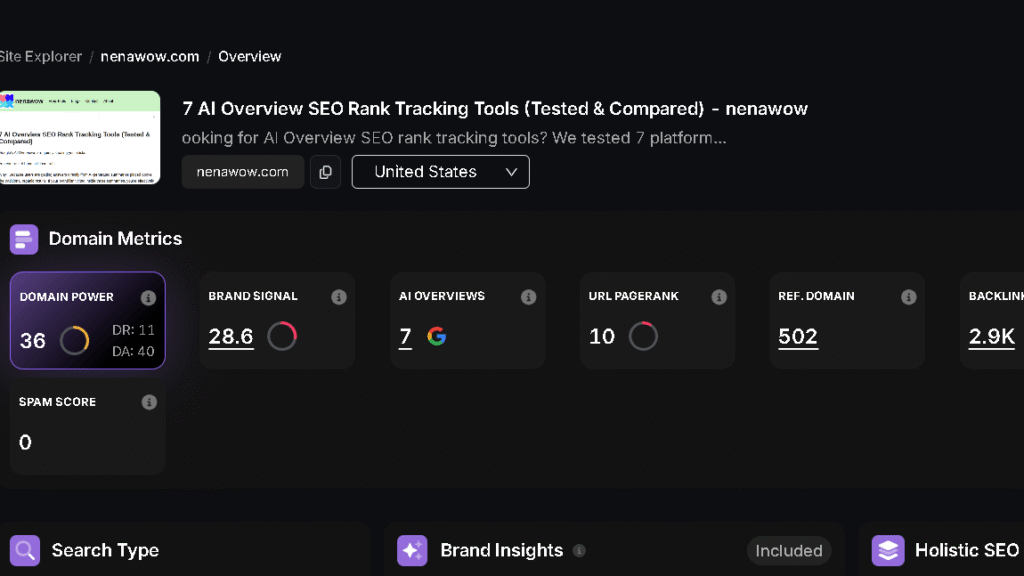
I ran nenawow.com through three different AI visibility tools. Search Atlas. Semrush. Ahrefs’ free AI visibility checker. Same site. Same week, more or less. Three different numbers came back, and they were not close.
Search Atlas reported my site’s AI Overview count at 7. Semrush, in one part of its dashboard, reported 365 total AI citations across 242 cited pages. Elsewhere in Semrush, a more detailed breakdown showed 283 citations split across four platforms: 135 from Google AI Mode, 68 from ChatGPT, 59 from Gemini, and 21 from AI Overviews specifically. Ahrefs’ free checker showed 58 total mentions, broken into 30 from AI Mode, 18 from “AI Mode (new),” 6 from AI Overviews, and 4 from Copilot.
Here is that side by side, because seeing it laid out is the point.
AI Visibility Results for NenaWow Across Three Tracking Tools
| Tool | What It Reported for nenawow.com |
|---|---|
| Search Atlas | AI Overviews: 7 (plus Domain Power 36, Brand Signal 28.6) |
| Semrush | 365 total citations / 242 cited pages (one view); 283 citations across 4 platforms in another view |
| Ahrefs (free checker) | 58 total mentions across AI Mode, AI Overviews, and Copilot |
None of these numbers are wrong, exactly. They are measuring different things, on different schedules, with different definitions of what counts as a citation versus a mention versus an appearance. Search Atlas tracks AI Overview presence as one part of a broader Domain Power and Brand Signal score. Semrush casts a wider net across platforms and seems to count differently depending on which report inside its own dashboard you are looking at. Ahrefs splits Google’s AI Mode and AI Overviews into separate buckets entirely, which neither of the other two tools does in the same way.
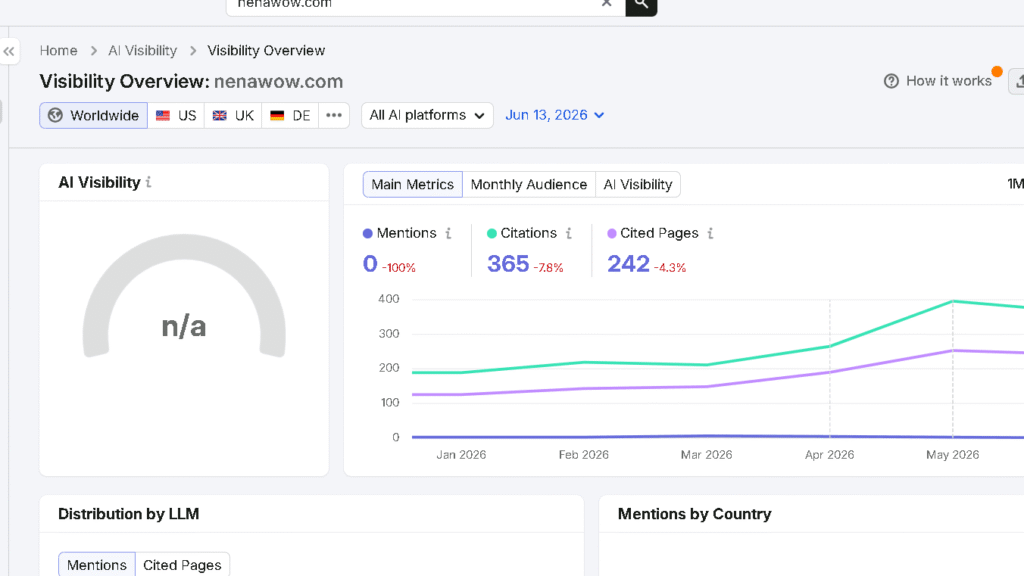
What that means for you: if you are about to pick one AI visibility tool and treat its number as the truth, stop. Treat it as a sample, not a census. The trend matters more than the exact figure. Whether your number is going up or down over time tells you more than whether it says 7 or 58 in any single week.
The Metrics You Will Actually See, Explained
Different platforms use different names for similar ideas. Here is what each one is actually measuring, stripped of the marketing language.
AI Citations or Mentions
A count of how many times an AI model referenced your domain or pulled content from one of your pages while generating an answer. This is the core number every tool is trying to report, even when they disagree on how to count it.
Cited Pages
How many distinct URLs on your site have been pulled into at least one AI answer. A high citation count spread across a handful of pages tells a different story than the same count spread across two hundred pages.
Domain Power
Search Atlas’s overall domain strength score, similar in spirit to Domain Rating or Authority Score from other platforms. It is a general strength signal, not an AI-specific one.
Brand Signal
A Search Atlas metric that tracks brand recognition somewhat separately from links and rankings. In my own testing, this number lined up with AI Overview presence more closely than Domain Power did, which made it one of the more genuinely useful numbers I found anywhere in this research.
AI Overviews versus AI Mode
Google runs more than one AI-powered surface now, and these are not the same thing. AI Overviews are the summary boxes that appear above traditional results on a regular search. AI Mode is a separate, more conversational search experience. Ahrefs tracks them as distinct categories. Other tools sometimes blend them into a single number, which is part of why totals do not match across platforms.
Sentiment Score
Some tools, Search Atlas among them, report how positively or negatively an AI model talks about your brand when it does mention you. A high citation count paired with negative sentiment is not actually a win. Worth checking if your tool reports it.
Claude increasingly cites detailed, structured content over generic overviews, and that pattern shows up consistently enough in my testing that I wrote a full Claude review on what it actually rewards.
What I Found When I Compared My Site Against Competitors
The single most useful thing any of these tools showed me did not come from my own numbers. It came from comparing my site against three competitors in the AI tool directory space, using Search Atlas’s side-by-side view.
| Site | Domain Power | Brand Signal | AI Overviews |
|---|---|---|---|
| nenawow.com | 36 | 28.6 | 7 |
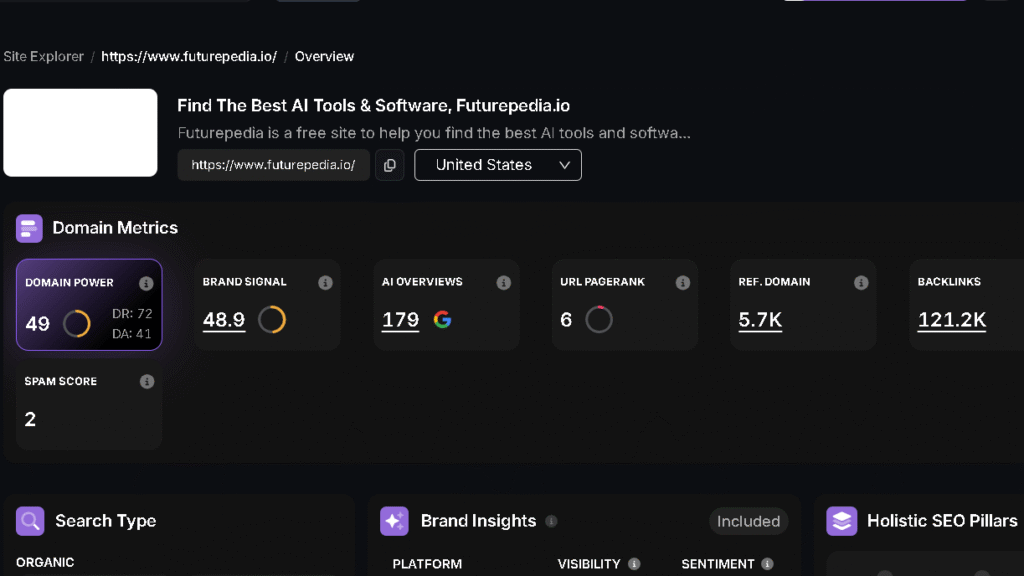
| Futurepedia | 49 | 48.9 | 179 |
| There’s An AI For That | 62 | 77.1 | 247 |
| Toolify | 48 | 75.6 | 1 |
Look at Toolify for a second. Its Domain Power sits close to Futurepedia’s. Its Brand Signal score, at 75.6, is nearly as high as the strongest site in the table. By every traditional SEO measure, Toolify should be doing well in AI Overviews too.
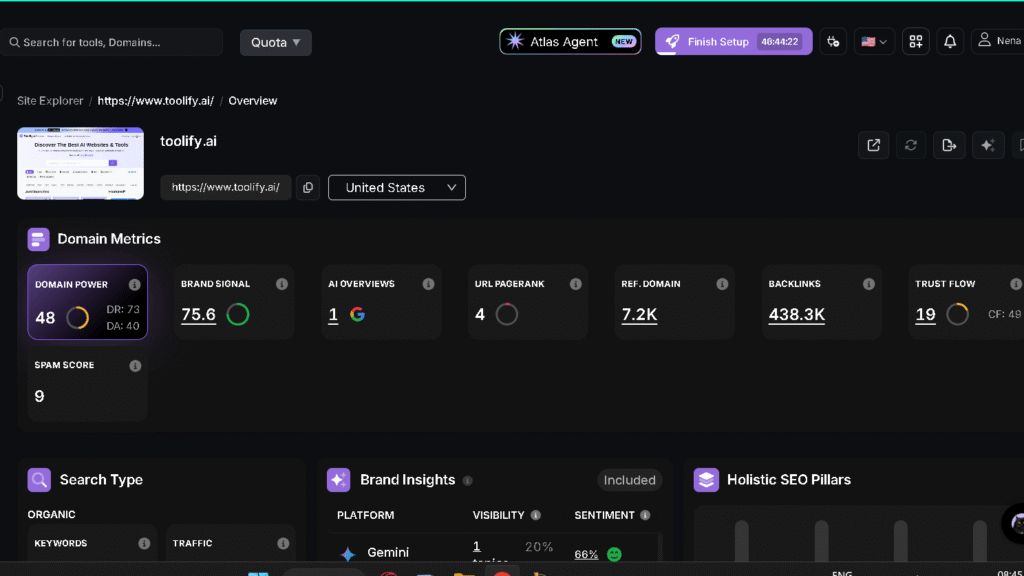
Its AI Overview count came back as 1.
That is the finding that reframed this entire topic for me. If AI visibility were just a downstream effect of SEO strength, Toolify would not be the outlier here. It is. Strong backlinks and a high authority score did not translate into AI citations for that particular site, and I do not fully know why, but the pattern is real and it is worth sitting with.
What this tells you: do not assume that ranking well means you are getting cited. Check separately. They are correlated, loosely, but the correlation breaks more often than you would expect.
Where My Own AI Citations Are Actually Coming From
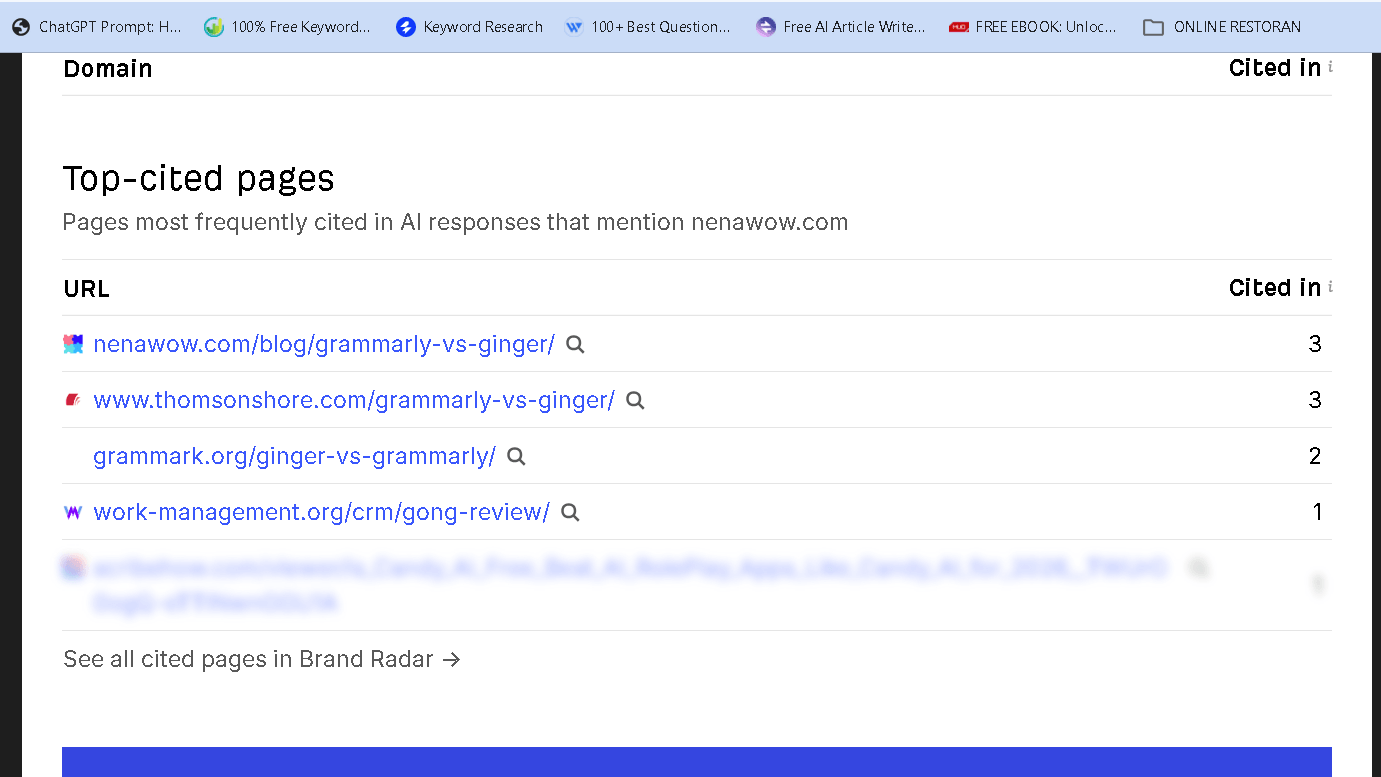
The Ahrefs checker gave me something the other two tools did not: a breakdown of which specific page on my site is doing the work.
My top cited page, by a clear margin, is a Grammarly vs Ginger comparison article. It has been cited 5 times in AI responses that mention my domain, including 3 citations to my own URL directly. The top topic AI models associate with my site right now is “candy ai,” which tells me something honest about where my actual AI footprint sits versus where I might assume it sits.
The biggest surprise was not how many citations I had. It was finding out that the page I assumed would lead my AI visibility was not the one actually doing it. I would have bet on a different article entirely. I was wrong, and the data said so plainly.
That is a useful gut check. The page you would guess is your strongest AI-cited content is probably not the page that actually is. You will not know until you check.
How My AI Visibility Changed
I started tracking this a few months ago. A Semrush number caught my eye that did not match anything I expected, and I followed it. The starting point was close to zero.
Semrush puts my AI citation count at 365 total citations across 242 pages now. Near zero to that, in roughly three months.
The growth was not even. A handful of pages did most of the work. The rest of the site barely registered. That pattern held steady the whole time I have been watching it.
New articles took weeks to show up in any tool’s count at all. Older comparison pieces moved faster. The ones with a clear verdict and a named test picked up citations sooner than anything else I published in the same window.
One page stayed on top across every tool I checked. The Grammarly vs Ginger comparison. It led in Ahrefs. It led in the page-level view too. That is the one piece I keep coming back to when I try to work out what actually works here.
That consistency is the real finding. Not the total, which moves depending on which tool you ask. The same page winning across different tools and different methods. Data like that does not show up in a single week of checking.
How to Start Tracking Your Own AI Visibility
You do not need to buy anything to get a first read. Ahrefs offers a free AI visibility checker that returns a real number in seconds, no signup required. That is the fastest way to see where you currently stand before deciding whether a paid tool is worth it.
From there, a few principles, based on what actually moved the needle in my own testing.
Check more than one tool if the decision matters to you. I would not have caught the Search Atlas versus Semrush versus Ahrefs gap with only one data point. The gap itself was the finding.
Track the trend, not the snapshot. A single number tells you almost nothing. Three months of the same number, moving up or down, tells you whether what you are doing is working.
Look at which pages are getting cited, not just whether your domain is. My Grammarly vs Ginger article is doing more AI-citation work than almost anything else on my site, and I would not have known that without checking page-level data specifically.
Watch sentiment if your tool reports it. Getting mentioned is not automatically good. Getting mentioned accurately and favorably is the actual goal.
Do not assume your SEO tool already covers this. Several major platforms added AI visibility features recently, and coverage is uneven. Some report Google’s AI surfaces well and miss ChatGPT and Perplexity almost entirely. Check what is actually included before assuming your existing subscription has you covered. My breakdown of AI Overview SEO tools goes deeper into which platforms actually cover which AI engines.
What Actually Seems to Drive AI Citations
I want to be honest about the limits of what I know here. This is a young enough category that nobody, including the tools selling visibility tracking, has a fully reliable playbook yet. But a few patterns showed up consistently enough in my own data and in what I observed across competitor sites that they are worth naming.
Specific, well-structured answers to specific questions get cited more than broad, general content. My highest-performing AI-cited page is a head-to-head comparison with a clear verdict, not a broad overview piece.
Content that already ranks well is not a guarantee, as the Toolify example shows, but it does not hurt. Most of my own AI citations are coming from pages that also perform reasonably in traditional search.
Freshness appears to matter, though I cannot quantify exactly how much. AI models tend to favor recently updated information when the topic is one where recency is relevant.
Clear sourcing and original data seem to help. Pages with a specific number, a named test, or a real screenshot are easier for an AI model to extract a confident, citable claim from than pages that hedge everything in vague language. Fact-checked, citation-backed writing tools have an edge here for that exact reason. I tested that angle directly in my Katteb review, and the sourcing discipline it forces is the kind of thing AI models seem to reward.
None of this is a guarantee. It is a directional read based on real data from a real site, which is more than most of what gets written about this topic right now. If content quality is the bottleneck for you specifically, my best AI for writing comparison covers which tools actually hold up for this kind of structured, source-backed content.
My AI Visibility Checklist
A short list, based on what actually moved my own numbers, not a theory of what should work.
Publish original tests. A named test with a real number beats a general overview every time I have checked.
Update content regularly. Freshness seems to matter, even if I cannot put an exact figure on how much.
Use comparison articles. My single highest-cited page is a head-to-head with a clear winner, not a broad guide.
Add screenshots. Real, verifiable proof reads differently to both readers and, it seems, to AI models extracting claims.
Include first-party data. Numbers nobody else has are numbers nobody else can cite instead of you.
Track citations monthly. A snapshot tells you nothing. A trend tells you everything.
Build topical clusters. Pages that sit inside a connected cluster seem to perform more consistently than orphaned one-off posts.
Monitor multiple tools. One tool gives you a number. Three tools give you a range, and the range is more honest. My full list of AI visibility tools breaks down which ones are worth the trial.
Where AI Visibility Is Going Next
I do not know exactly where this category lands in two years. Anyone who tells you they do is guessing with more confidence than the data supports. A few things seem likely from where it stands right now.
More search traffic is going to route through AI answers, not less. That shift is already underway.
Citation tracking is going to get more accurate. Three tools give you three different numbers for the same site right now. That gap is too wide to last.
Attribution tools are going to get better too. Not just whether you were cited, but what that citation actually did. Traffic, trust, brand recall. Most tools stop at the count today.
GEO becoming a standard part of SEO work, the way technical SEO did before it. That is not really a prediction. It is already happening, just slowly.
What This Means If You Are Just Getting Started
If you take one thing from this guide, take this. AI visibility is now a second, separate scoreboard sitting next to your traditional rankings, and it does not move the same way. You cannot infer one from the other. You have to check.
Start with a free check to see where you currently stand. Watch the number over a few months instead of reacting to a single snapshot. Pay attention to which specific pages are doing the work, because it is probably not the pages you would guess. And if you use more than one tool, expect the numbers to disagree, because they measure different things in different ways, and that disagreement is not a bug in the category. It is the category, this early on.
The sites that figure this out now, while the tools are still young and the playbook is still being written, have a real head start. The rest of this site is going to be me documenting exactly what that looks like in practice, tool by tool, test by test, as I run my own site through this the same way I have run everything else.
FAQ
AI visibility is whether your content gets pulled into AI-generated answers from tools like ChatGPT, Google AI Overviews, Gemini, Perplexity, and Copilot, and whether you get credited as the source.
No. Traditional SEO is about ranking in search results. AI visibility is about being cited inside an AI-generated answer. The two are related but not interchangeable, and a site can perform well in one without performing well in the other.
No, and this is the mix-up I see most often. GEO is the process, the actual work of writing and structuring content for AI search engines. AI visibility is the result, the number you get back when you measure whether that work is paying off.
Ahrefs offers a free AI visibility checker that returns a mention count across major AI platforms in seconds, with no signup required. It is the fastest way to get a baseline.
Each tool tracks different AI platforms, counts citations using different definitions, and updates on different schedules. In testing my own site, Search Atlas, Semrush, and Ahrefs each returned a different total, and none of them was simply wrong.
No. In a competitor comparison I ran, one site with strong Domain Power and Brand Signal scores had an AI Overview count of just 1, while a site with lower authority metrics had nearly 250.
AI Overviews are the AI-generated summary boxes that appear above standard results on a regular Google search. AI Mode is a separate, more conversational Google search experience.