
I had no idea how AI search engines described nenawow.com until I ran a free tool and looked at the actual numbers. What I found was not what I expected. ChatGPT barely knew the site existed. Perplexity had it filed alongside Surfer SEO and Semrush. Gemini was somewhere in between but not sure about any of it.
Those are not vague impressions. Those are scored data points from a real report I ran on June 23, 2026. I will walk you through exactly what I found and how you can run the same check on your own site in about ten minutes.
Table of Contents
What AI Visibility Actually Means for a Small Site
Most bloggers think about Google rankings. That is the thing they track, the thing they optimise for, the thing they check on Monday mornings. But there is a second layer now that most small sites are not measuring at all.
When someone asks ChatGPT, Perplexity, or Gemini for a recommendation in your niche, your site either shows up or it does not. It either gets cited as a source or it gets skipped. That is AI visibility. And unlike Google rankings, you cannot see it just by searching your own keywords.
The thing is, these two things are not the same. Ranking on Google page one does not guarantee you show up in AI answers. And getting cited in Perplexity does not mean ChatGPT knows you exist. They pull from different sources, use different training data, and reach different conclusions about the same site.
Here’s a simple way to think about the difference:
| Google SEO | AI Visibility |
|---|---|
| Rankings | Mentions |
| Keywords | Entities |
| Backlinks | Brand recognition |
| Click-through rate (CTR) | Citations |
I explored this disconnect in much more detail in my guide on AI Search Visibility Gap, where I explain why websites can rank well in Google but remain almost invisible to AI assistants.
That gap is what this article is about.
The Tool I Used and Why It Is Free
I used the HubSpot AEO Grader. You enter your URL, your industry, your location, and the type of service your site covers. The tool runs your brand through three AI systems — ChatGPT, Perplexity, and Gemini — and returns a scored report across five dimensions.
It takes about two minutes. No credit card. No sales call. No account required.
The report covers brand recognition, market competition, presence quality, brand sentiment, and share of voice. Each dimension gets a score, a breakdown, and a short diagnosis. You can download the full PDF when it is done.
One thing to know before you run it: the ChatGPT and Gemini scores use fixed training data. GPT-5.4 mini cuts off at August 2025. Gemini 3 Flash Preview cuts off at January 2025. Perplexity searches the live web so its score reflects what is out there right now. The three scores are not measuring the same moment in time. Keep that in mind when you read your results.
My Real Scores Across Three AI Systems
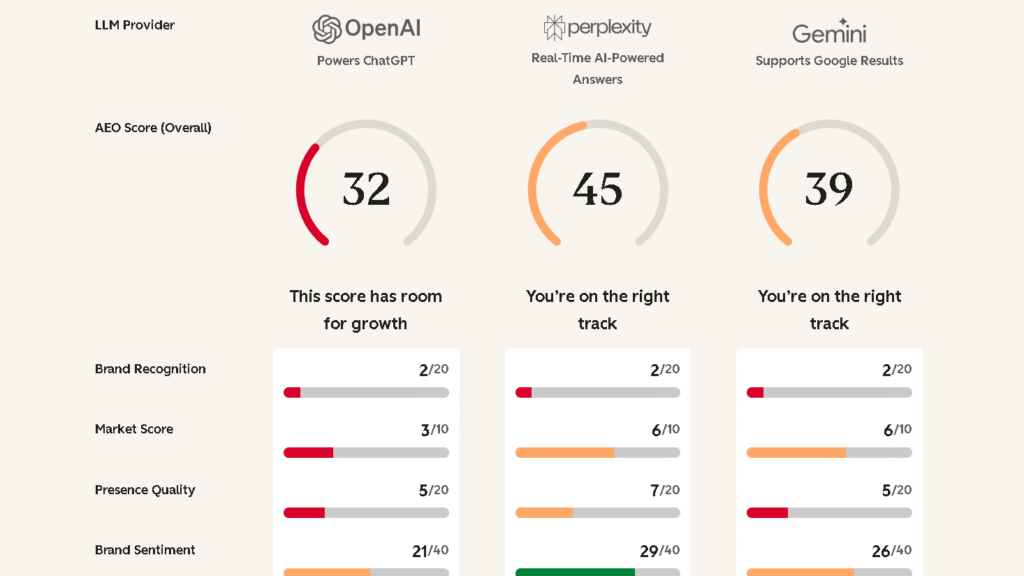
Here is what the grader returned for nenawow.com:
| Dimension | ChatGPT | Perplexity | Gemini |
|---|---|---|---|
| Overall AEO Score | 32/100 | 45/100 | 39/100 |
| Brand Recognition | 12/100 | 12/100 | 12/100 |
| Market Score | 3/10 | 6/10 | 6/10 |
| Presence Quality | 5/20 | 7/20 | 5/20 |
| Brand Sentiment | 21/40 | 29/40 | 26/40 |
| Share of Voice | 1/10 | 1/10 | 0/10 |
The Perplexity score is the strongest at 45. The ChatGPT score is the floor at 32. Gemini sits at 39 but with a confidence level of only 35 percent — meaning Gemini is the least sure about what it knows about my site.
That confidence number matters more than the score. A 39 with 35 percent confidence is shakier data than a 32 with 72 percent confidence. Perplexity runs at 85 percent confidence, which tells me it has the most to work with.
What Each Score Is Actually Telling You
Let me walk through what these numbers mean in plain terms, because the report does not always explain them in ways that are easy to act on.
Brand Recognition: 12/100
This one is flat across all three platforms. Twelve out of 100. Market position is “Niche” on all three.
To be fair, that is accurate. nenawow.com is a single-author review site with a Domain Rating around 11 and about three years of publishing. A 12 is not a disaster. It is an honest read of where a small independent site sits in the broader information landscape that AI systems have absorbed.
What the breakdown showed me is more useful than the headline number. Mention depth, source quality, and data richness all came in at 2 to 4 out of 10. Those are the specific things I can work on. More third-party references, better external coverage, richer entity signals on the site itself.
Market Score: 3/10 on ChatGPT vs 6/10 on Perplexity
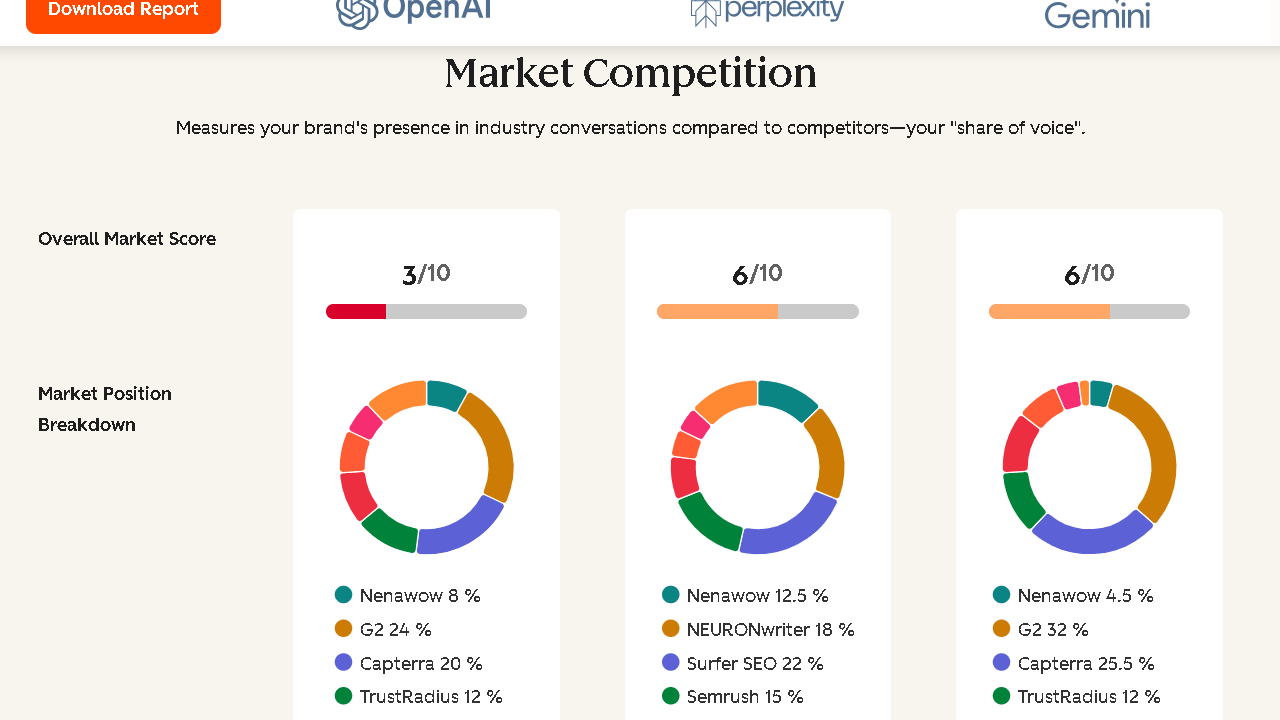
This is where the real difference between the platforms shows up. Under ChatGPT, my site had 42 total mentions and 18 comparison mentions. Under Perplexity, those numbers were 1,420 mentions and 3,850 comparison mentions.
That gap — 42 versus 1,420 — is not noise. It is a structural difference in how the two systems work.
Perplexity searches the live web, so it finds my content where it exists right now. ChatGPT is working from training data that ends in August 2025, and in that snapshot my site did not have much external coverage yet. The result is that ChatGPT files me alongside G2, Capterra, and TrustRadius — review directories — while Perplexity puts me in a competitive set that includes Surfer SEO, NEURONwriter, and Semrush. Those are different categories entirely.
Brand Sentiment: 52/100 on ChatGPT vs 72/100 on Perplexity
Sentiment measures how AI systems describe your brand when they do mention it. A 72 on Perplexity is genuinely solid for a niche site at this stage. A 52 on ChatGPT is lower, but the source analysis explains why.
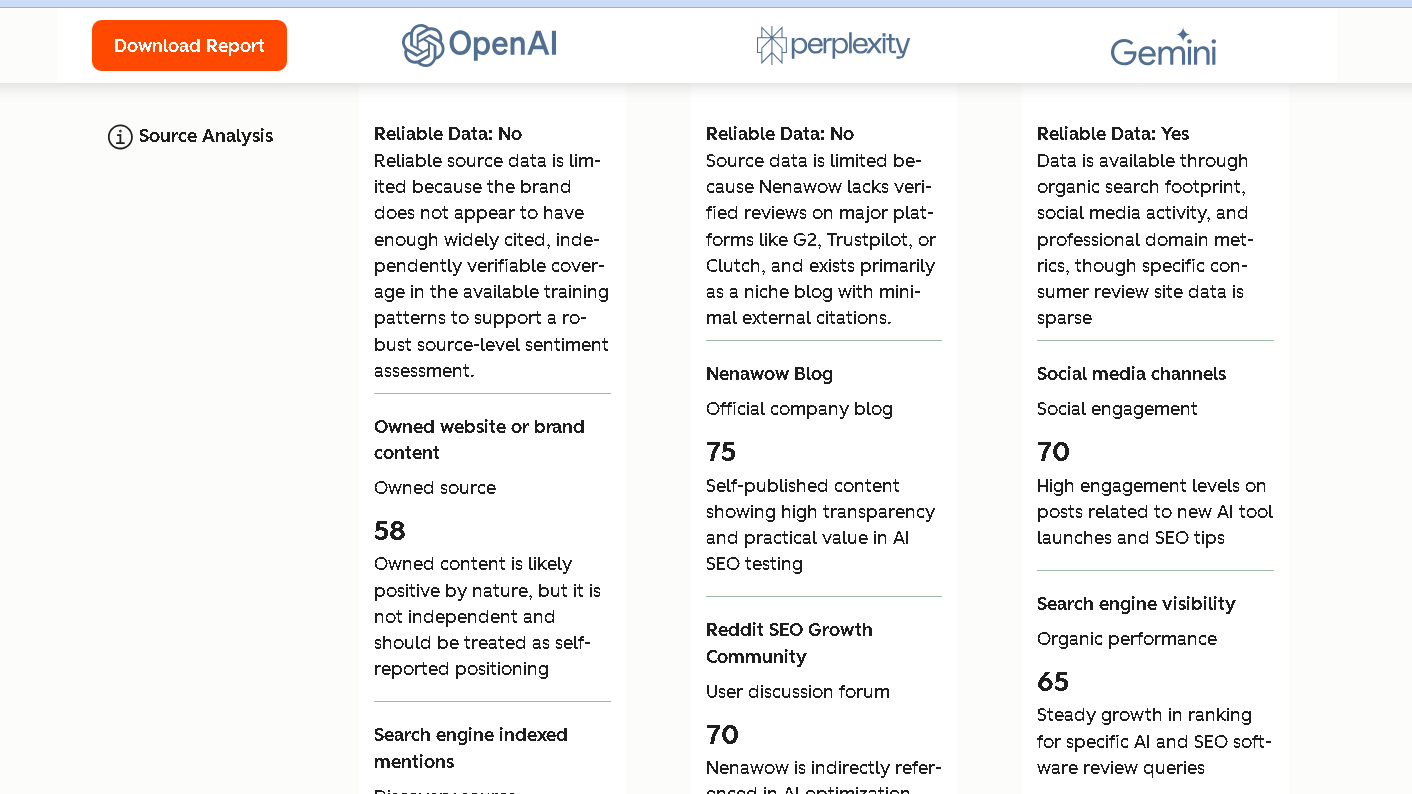
The ChatGPT source analysis flagged “Reliable Data: No” and scored third-party review platforms at 45 out of 100. That is the issue in one line. ChatGPT cannot find nenawow.com on platforms it trusts — G2, Product Hunt, Clutch. Until that changes, the sentiment score will stay suppressed regardless of how much content I publish.
Perplexity, by contrast, found specific sources: the blog itself at 75, a Reddit SEO growth community at 70, and a YouTube AI Writers channel at 65 where one of my reviews was linked. That YouTube link is doing real work. One external source that Perplexity can find and attribute moves the needle.
Share of Voice: Low Across the Board
Share of voice scored 1 out of 10 on ChatGPT, 1 out of 10 on Perplexity, and 0 out of 10 on Gemini. This is the share of the total conversation in my category that my brand occupies.
For a site at this stage, a low share of voice is expected. What matters is knowing the number so you can track it. Share of voice at 1 today is a benchmark. Share of voice at 3 in six months means the work is landing.
The Finding That Changed How I Think About This
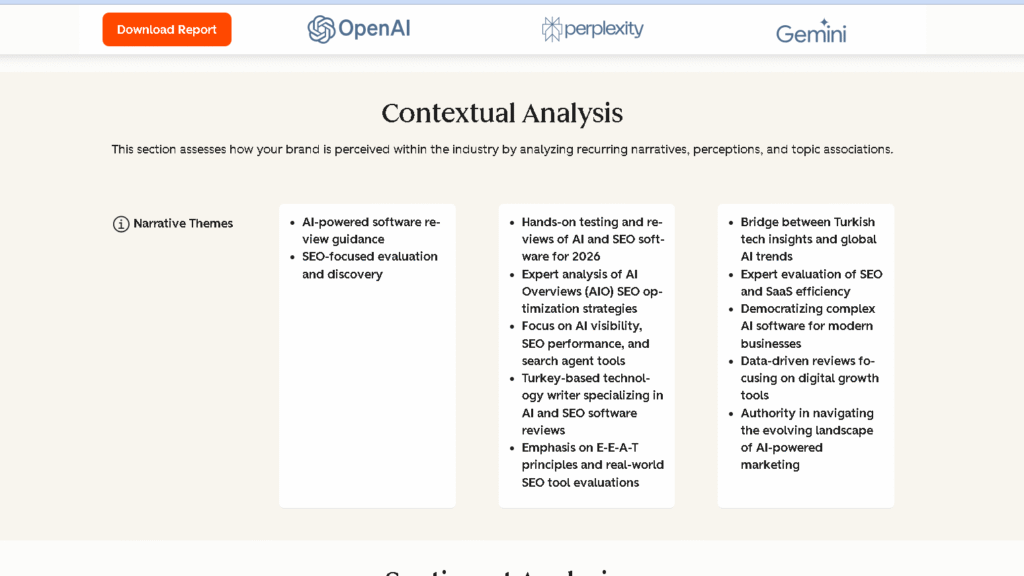
The narrative themes section was the most useful part of the whole report. This is where each AI system tells you what it actually associates with your brand.
ChatGPT associated nenawow.com with two themes. AI-powered software review guidance. SEO-focused evaluation and discovery. Thin, but not wrong.
Perplexity returned six. Hands-on testing and reviews of AI and SEO software. Expert analysis of AI Overviews. Focus on AI visibility and search agent tools. Turkey-based technology writer. E-E-A-T principles. Bridge between Turkish tech insights and global AI trends.
That last theme surprised me. I did not expect Perplexity to surface the Turkey angle as a distinct narrative. But not many English-language AI tool review sites are based in Antalya. That specificity is a differentiator, and Perplexity found it. Gemini found it too.
What this tells you is that the AI systems are not just tracking whether you exist. They are tracking what you are known for. If the themes they return do not match the content you are trying to build authority around, that is a gap to close.
I saw the same pattern while testing major SEO brands in my AI Visibility Benchmark, where different AI systems associated the same companies with very different strengths and expertise.
What the Scores Tell You to Do Next
The growth areas section of my report flagged three things for ChatGPT: stronger authority signals, more decision support content beyond basic reviews, and differentiation through original data.
I will not argue with any of those. But the most actionable finding came from the source analysis, not the growth areas section.
“Insufficient verifiable third-party coverage.” That one line explains my ChatGPT score better than any number does. ChatGPT needs to find my site referenced on platforms it trusts before it will raise its confidence score. That means getting listed on Product Hunt. That means being included in third-party roundups with real domain authority. That means earning more YouTube mentions from creators in this space.
None of that happens overnight. But knowing exactly what to target is more useful than a generic suggestion to “build authority.”
If you’re wondering what kinds of pages AI assistants actually prefer to reference, read my guide on What Makes Content More Likely to Be Cited by AI? It breaks down the content characteristics that increase the chances of earning citations across ChatGPT, Perplexity, and Gemini.
How to Run This on Your Own Site
The process takes about ten minutes and costs nothing.
Go to hubspot.com and search for the AEO Grader, or search “HubSpot AEO Grader” and it will come up directly. Enter your website URL. Select your industry from the dropdown. Add your service type — be specific here, not just “blogging” but “AI tool reviews” or “SEO software comparisons.” Add your country. Run the report.
When the report loads, go to the source analysis section first. Not the overall score. Not the brand recognition number. The source analysis. That section tells you whether each platform is working from reliable data about your site or making inferences. If it says “Reliable Data: No” on ChatGPT, your off-site work is the priority. If it says “Reliable Data: Yes,” your on-site content is what to focus on next.
Then look at the narrative themes section. Read what each AI system actually associates with your brand. If the themes match your content strategy, you are on track. If they do not, you have a clarity problem that more content alone will not fix.
Download the PDF. Date it. That report is your baseline. Everything you do from here gets measured against it.
What I Am Doing With My Results
I plan to run this again in 90 days. Between now and then I will publish a cluster of AI visibility articles, get nenawow.com listed on Product Hunt, and work on earning more external references that ChatGPT can find.
If my ChatGPT score moves from 32 upward, I will know the off-site work landed. If Perplexity holds strong or climbs, I will know the live content is doing its job. Those are real conclusions I can draw from a free tool run twice with three months of work in between.
So the question is not whether a score of 32 or 45 is good or bad. The question is what it looks like in 90 days. That is how you use this tool.
What This Cannot Tell You
The grader is a snapshot, not a monitoring tool. It does not track changes over time, send alerts when your scores shift, or show you which specific prompts are triggering your brand in AI answers.
The mention counts are also not precise measurements. My Perplexity report showed 1,420 mentions and 3,850 comparison mentions. Those numbers almost certainly come from aggregated indexed content, not from running thousands of individual queries against Perplexity. Treat them as directional signals, not exact counts.
And the polarization scores — mine came in at 22 out of 100 on ChatGPT — are framed as good news by the tool, meaning low controversy. The honest read is simpler. Low polarization mostly means low awareness. You cannot divide opinion you have not yet reached.
If you want ongoing monitoring rather than a one-time snapshot, you need a dedicated tool. Rankscale starts at around $20 per month with multi-engine coverage. Otterly has a 14-day free trial with no credit card. Trakkr has a free-forever plan covering six AI models. Those are the budget options worth looking at next.
If your goal is specifically to measure how often your business appears inside Google’s AI-generated search results, my guide on How to Track Business Appearance in Google AI Overviews covers the best methods and tools for doing exactly that.
Final Thoughts
AI visibility is becoming just as important as Google rankings.
A free report won’t fix your visibility overnight, but it gives you a benchmark you can improve over time.
Run the report today, save the PDF, and compare your results again in 90 days.
Frequently Asked Questions
What is AI visibility and why does it matter for bloggers?
AI visibility is how often and how accurately AI systems like ChatGPT, Perplexity, and Gemini mention or cite your site when answering questions in your niche. It matters for bloggers because a growing share of people now get recommendations directly from AI assistants rather than clicking through search results. If AI systems do not know your site exists, you miss that traffic entirely.
How is AI visibility different from Google rankings?
Google rankings measure where your URL appears in search results pages. AI visibility measures whether your brand gets mentioned or cited inside AI-generated answers. A site can rank well on Google and be invisible in AI answers, and vice versa. They draw from different sources and reward different signals.
Is the HubSpot AEO Grader accurate?
The scores are directional, not precise. ChatGPT and Gemini scores reflect fixed training data with knowledge cutoffs in 2025, so they do not show real-time status. Perplexity scores are closer to current because Perplexity searches the live web. Treat the report as a starting benchmark rather than an exact measurement, and look at the source analysis section for the most actionable findings.
What is a good AEO score for a small blog?
The tool does not publish a clear scoring rubric, but based on my report, scores above 40 are described as “on the right track” and scores below 35 are flagged as having “room for growth.” For a niche independent site in its first three years, a Perplexity score in the 40 to 55 range is a reasonable starting point. The score matters less than the trend over time.
What should I fix first after running the AEO Grader?
Look at the source analysis section. If ChatGPT or Gemini flags “Reliable Data: No,” the fix is off-site work — getting listed on platforms like Product Hunt, earning mentions from YouTube creators in your space, and building third-party references that AI systems can find and trust. If sentiment is low but data reliability is marked yes, the fix is on-site — clearer entity signals, better structured content, stronger E-E-A-T markers.
How often should I run the AEO Grader?
Once every 90 days is a reasonable cadence. Running it more often adds noise rather than signal because the ChatGPT and Gemini scores update with training data cycles, not in real time. Run it, take action, wait 90 days, run it again. The gap between runs is where the work happens.