
AI share of voice used to mean one thing. How much of the conversation in your category belongs to you versus your competitors, measured across media mentions, search visibility, or social reach. AI share of voice is the same idea, pointed at a different conversation. How often does an AI model mention your brand, compared to everyone else competing for the same question.
I started tracking this on my own site mostly by accident, while trying to make sense of why three different AI visibility tools gave me three different numbers for the same domain. Share of voice turned out to be the metric that made those numbers actually mean something, instead of just sitting there as totals with nothing to compare them against.
This is what I have found. What the metric actually measures. Why a raw citation count without it tells you less than you think. What my own numbers showed once I started looking at it this way. And what I would actually do to move that number, since explaining a metric is not the same as improving it.
AI share of voice is one way to measure AI visibility, but it is only one part of a broader picture. If you’re new to the topic, my guide on What Is AI Visibility explains how brands appear across ChatGPT, Gemini, AI Overviews, and other AI search experiences.
Disclaimer: I may earn a small commission on purchases made through links on this page, at no extra cost to you. This supports honest, independent reviews.
Nena’s Quick Verdict
AI share of voice measures how much of the AI-generated conversation in your niche belongs to your brand. Unlike citation counts, it adds competitive context, making it one of the most useful metrics for evaluating AI visibility.
Table of Contents
What AI Share of Voice Actually Means
AI share of voice is the percentage of AI-generated answers, on a given topic or set of queries, that mention your brand instead of a competitor’s. It is a relative number, not an absolute one. That distinction matters more than it sounds like it should.
A raw citation count tells you how many times you showed up. Share of voice tells you how many times you showed up out of everyone who could have. Those are different questions, and only one of them tells you whether you are actually winning the category or just present in it.
Here is the simple version. If an AI model answers a question about your space ten times, and your brand gets mentioned in four of those ten answers, your share of voice on that question is 40 percent. The other 60 percent went to competitors, or to nobody specific at all.
Why a Citation Count Alone Is Not Enough
I learned this the slow way, by sitting with my own numbers and not understanding what they actually meant until I compared them against something.
Ahrefs’ free checker showed nenawow.com with 58 total mentions across AI platforms. That number, sitting alone, tells you almost nothing. Fifty-eight mentions in a category where competitors get cited 5 times total is a real win. Fifty-eight mentions in a category where competitors get cited 5,000 times is barely a presence at all.
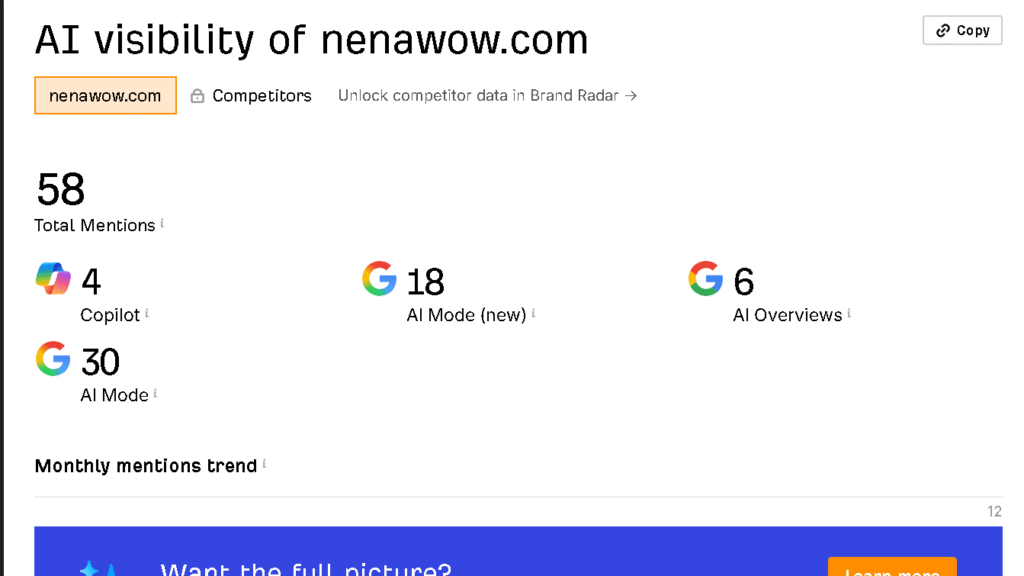
The number needs a denominator. Citations without share of voice is like knowing your revenue without knowing your market size. You can feel good about a big number and still be losing badly, because you never checked what the rest of the category looked like.
The Comparison That Made This Real for Me
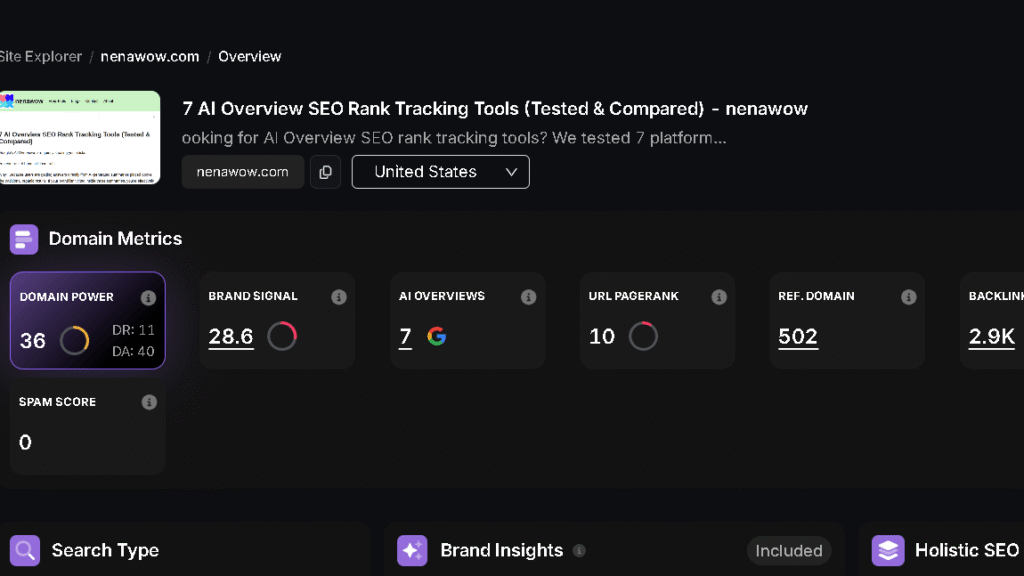
I ran nenawow.com against three competitors in the AI tool directory space, using Search Atlas’s side-by-side view. This is the same data that has anchored most of what I have learned about AI visibility on my own site, and it is the clearest share of voice lesson I have found anywhere in my testing.
If you’re not familiar with the platform, my Search Atlas Review covers how it measures AI visibility, AI Overviews, brand signals, and competitor performance.
| Site | Domain Power | Brand Signal | AI Overviews |
|---|---|---|---|
| nenawow.com | 36 | 28.6 | 7 |
| Futurepedia | 49 | 48.9 | 179 |
| There’s An AI For That | 62 | 77.1 | 247 |
| Toolify | 48 | 75.6 | 1 |
Add those four AI Overview counts together and you get 434 total appearances across the group. My share of that total comes out to roughly 1.6 percent. Not my citation count in isolation. My share of the actual conversation happening across this specific competitive set.
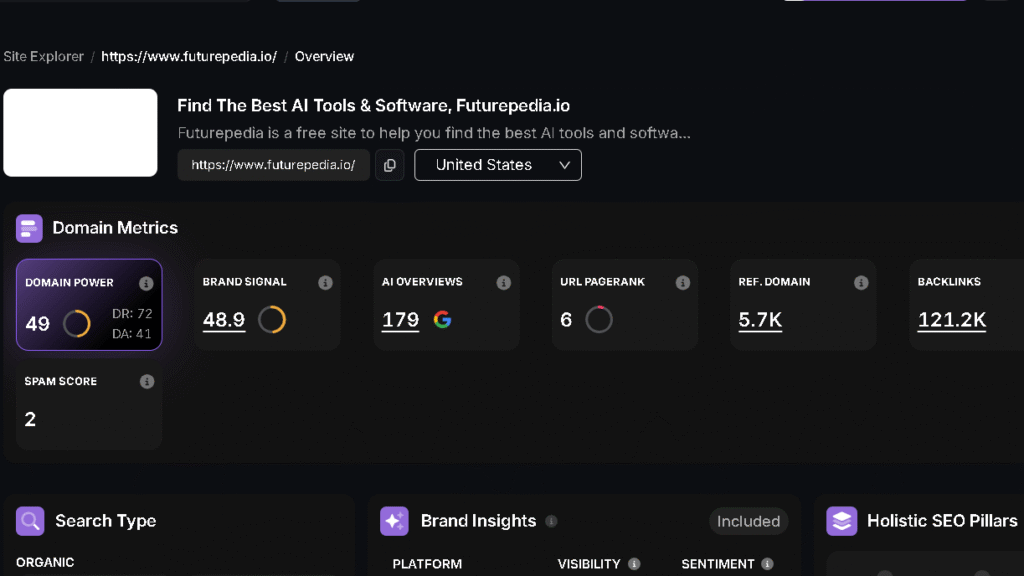
That number changes how I read my own performance. Seven AI Overview appearances felt like a real result before I ran this comparison. Against a category where one competitor alone holds 247 of the 434 total appearances, seven starts to look like a rounding error. Share of voice is what made that visible. The raw count never would have.
What Toolify’s Numbers Teach You About Share of Voice Specifically
I keep coming back to Toolify in this cluster because its numbers break the assumption most people carry into this topic, and share of voice is where that breakdown matters most.
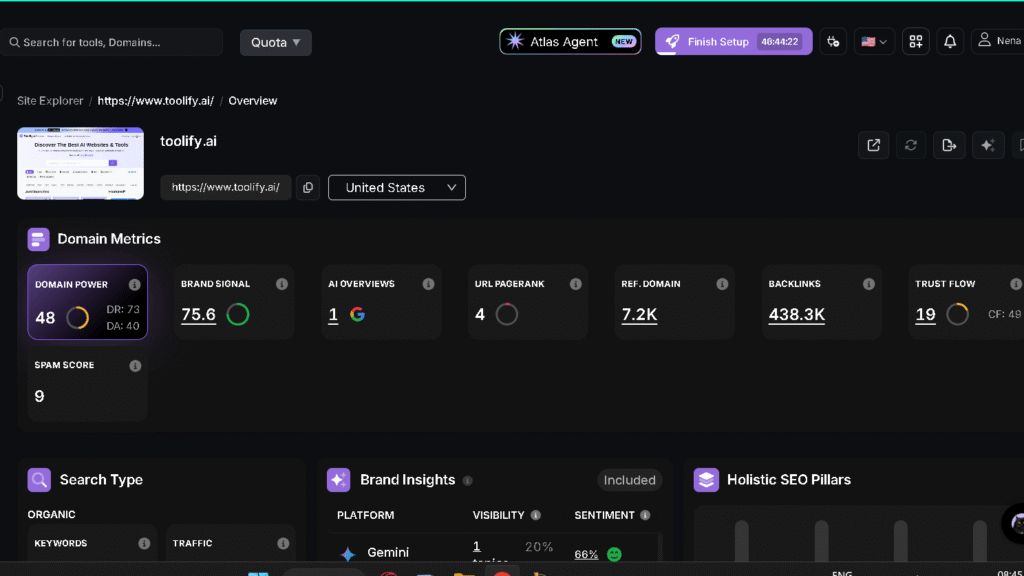
Toolify’s Domain Power and Brand Signal scores sit close to the strongest performer in the table. By traditional authority measures, Toolify should command a real share of voice in this category. Its actual AI Overview count is 1, which works out to a share of voice near zero against a 434-mention total.
That is not a citation problem. It is a share of voice problem with a specific, visible cause. Toolify has the standing to compete for a real piece of the conversation and is not getting any of it. A site in that position is not invisible. It is present and still losing, which is a different problem than not being seen at all, and it needs a different fix.
How Share of Voice Differs Across Platforms
Not every AI platform splits the conversation the same way, and checking only one gives you a partial, possibly misleading picture of where you actually stand.
Semrush’s breakdown of my own site showed citations split unevenly across four platforms. Google AI Mode accounted for 135 citations. ChatGPT brought 68. Gemini brought 59. AI Overviews specifically brought 21. Nearly double my share came from one platform compared to my next-best source.
That unevenness is the point. A brand with strong share of voice on Perplexity might have almost none on ChatGPT, and a single blended number across all platforms hides that completely. If your customers mostly use one specific AI tool, your share of voice on that one platform matters more than your blended total across all of them, even if the blended number looks more impressive on a slide.
The way AI platforms select sources varies significantly. During my testing for this ChatGPT Review and Gemini Review, I found noticeable differences in how each model cites websites, brands, and original sources.
How to Calculate Your Own Share of Voice
You do not need anything complicated to start. Pick a set of queries that represent your actual category, the questions a real customer would ask an AI model when comparing options in your space.
Run those queries, or use a tracking tool that runs them for you, and count how many times your brand appears against how many times any brand in your category appears. Divide your count by the total. That is your share of voice for that specific query set, on that specific platform, at that specific moment.
Do this across competitors deliberately, the way I did with the Search Atlas comparison, rather than just checking your own number in isolation. A share of voice number with no competitive context is just a citation count wearing a more impressive name.
Share of voice is often discussed alongside GEO (Generative Engine Optimization), but they are not the same thing. My guide on AI Visibility vs GEO explains where these concepts overlap and where they measure completely different aspects of AI search performance.
What a Low Share of Voice Actually Tells You
A low number is not automatically bad news. It depends entirely on what is driving it.
If your low share of voice comes from low overall authority, the kind Search Atlas’s Domain Power and Brand Signal scores reflect, the fix runs through the same fundamentals that improve any kind of visibility. More original content. Stronger topical depth. Real authority built over time.
If your low share of voice looks like Toolify’s, strong authority with almost nothing to show for it, the problem sits somewhere more specific. Content structure. Extractability. Whether your pages hand a model a clean, citable claim or bury it under generic phrasing that could belong to anyone. That is a content problem, not an authority problem, and it needs a content fix, not more backlinks.
So which one is it for you? You will not know until you check the comparison, the same way I had to run mine before I understood what my own number actually meant.
How I Would Improve Share of Voice
Knowing the number is not the same as moving it, so here is what I would actually do, in order.
Build topical depth first. A single strong page competes for one query. A real cluster of connected pages competes for the whole conversation around a topic, which is the only way to meaningfully change a share number rather than nudge one data point.
Create original data next. Generic content cannot win share of voice against a hundred other generic pages saying the same thing. A named test, a real screenshot, a first-party number, gives a model something to cite that nobody else can offer.
Structure content clearly. Direct answers near the top of a section beat the same information buried under three paragraphs of setup. Extractable claims are what actually get pulled into an answer, not just present information.
Track competitors on a real schedule, not once. Share of voice only means something against a current total, and that total moves as competitors publish. A number from six months ago is not your share of voice today.
Monitor citations across more than one tool. Each platform measures differently, and watching only one gives you a partial, possibly misleading trend. Check the direction, not the exact figure, and check it often enough to catch a real shift.
Tracking Share of Voice Over Time
A single share of voice check is a snapshot. The real value shows up once you have several of them, spaced out, pointed at the same query set.
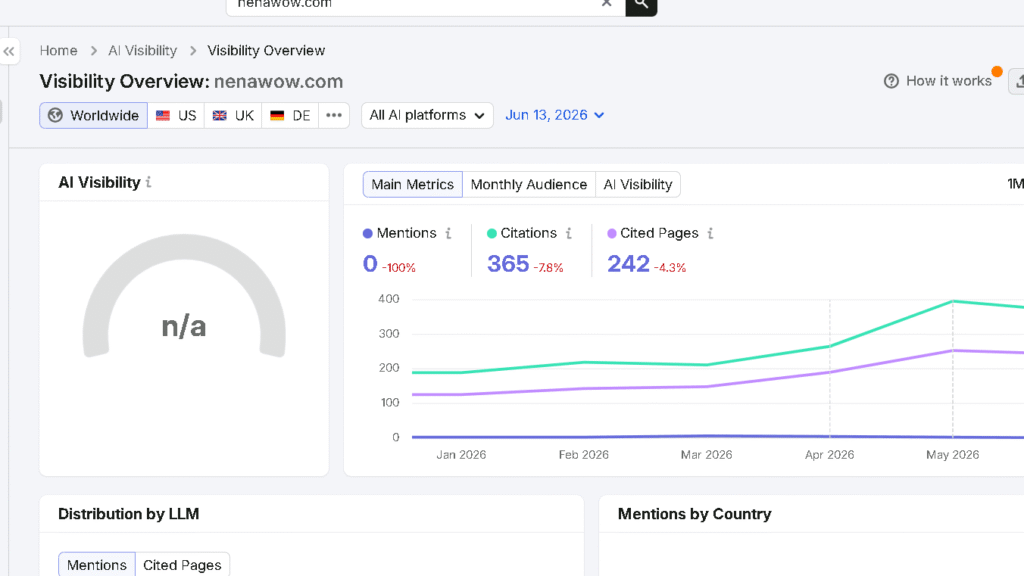
My own AI citation count, according to Semrush, grew from close to zero to 365 total citations across 242 cited pages over roughly three months. I do not have a clean share of voice trend line to match that growth yet, because I only started thinking about this metric properly partway through that period. That gap is its own lesson. Start tracking share of voice early, even with a rough method, rather than waiting until you have a polished process, because the trend is worth more than any single number and you cannot reconstruct a trend after the fact.
A Simple Way to Use This Going Forward
Check your raw citation count first, the way most tools default to reporting it. Then ask what total you are a share of, using a real competitor comparison rather than assuming your number means something on its own.
Watch for the Toolify pattern specifically. Strong fundamentals, low share, is a sign your content itself needs work, not your underlying authority. Watch for the opposite too. A site with modest authority earning a surprisingly high share is doing something with content structure and originality worth studying and repeating.
Treat the number as a trend, not a verdict, and start tracking it before you think you need to. The version of this metric that actually helps you is the one you have been watching for months, not the one you check once and try to interpret cold.
FAQ
AI share of voice is the percentage of AI-generated answers on a given topic that mention your brand compared to competitors, rather than a raw count of how many times you were cited. It tells you how much of the actual conversation belongs to you.
A citation count is an absolute number with no context. Share of voice divides that number by the total mentions across your competitive set, which tells you whether your citation count represents real category presence or a tiny fraction of a much larger conversation.
Pick a set of real customer queries for your category, run them across competitors using an AI visibility tool or manual checks, and divide your brand’s mention count by the total mentions across everyone tracked. Repeat across platforms separately, since share of voice often varies by AI tool.
Yes. In a competitor comparison I ran, one site with strong Domain Power and Brand Signal scores had an AI Overview count of just 1 against a competitive total of 434, putting its share of voice near zero despite real underlying authority.
Yes, often significantly. In my own data, citations split unevenly across platforms, with one source accounting for nearly double the next-largest. A brand can hold a strong share on one AI platform and almost none on another.
Treat it as a trend rather than a one-time check. A single snapshot tells you where you stand today but nothing about direction.