
I have pages on nenawow.com that rank well in Google and barely register in any AI visibility tool I check. Not one page. A pattern across the site, once I started looking page by page instead of just at the domain total. If you have ever wondered why your site ranks but gets no AI citations, the answer is usually not what most publishers expect.
That contradiction is what got me into this whole investigation. Ranking has been the trusted scoreboard for years. Watching a page hold a solid position and still come back at zero, or close to it, in an AI citation check does not match what that scoreboard was supposed to mean.
If you have looked at your own AI visibility numbers next to your rankings and felt the same confusion, you are looking at the same gap I was. This article is what I found once I stopped assuming the two scoreboards were supposed to agree.
Disclaimer: I may earn a small commission on purchases made through links on this page, at no extra cost to you. This supports honest, independent reviews.
Table of Contents
The Assumption Most Publishers Make
If I rank, AI will cite me. That is the assumption sitting underneath almost every confused reaction I see to this topic, including the one I had.
It sounds logical, and that is exactly why it survives so well. Google rankings have been the trusted scoreboard for two decades. A page that ranks well has presumably earned trust, covers the topic competently, and beats out competing pages on some real measure of quality. Carrying that assumption into AI search feels like a small, safe extension. Same content. Same authority. Just a new place for it to show up.
Except AI models are not reading your rank. They are reading your page, on its own terms, and deciding fresh whether it answers the question well enough to extract a claim from. Your Google ranking never enters that decision directly. It might correlate with the kind of content that gets cited. It is not the same thing as being the kind of content that gets cited.
Why Rankings and Citations Are Different
I have real data on this, not just a theory, and it is the clearest single example I have found anywhere in my own testing.
I ran nenawow.com against three competitors in the AI tool directory space, using Search Atlas‘s side-by-side comparison. One result in that table is worth slowing down for.
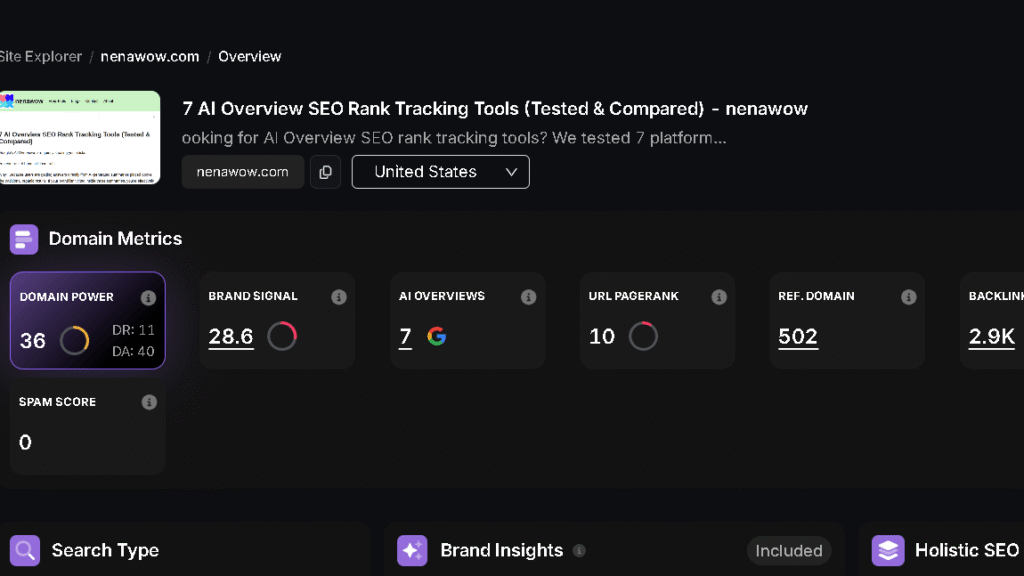
| Site | Domain Power | Brand Signal | AI Overviews |
|---|---|---|---|
| nenawow.com | 36 | 28.6 | 7 |
| Futurepedia | 49 | 48.9 | 179 |
| There’s An AI For That | 62 | 77.1 | 247 |
| Toolify | 48 | 75.6 | 1 |
Toolify. Domain Power close to Futurepedia’s. Brand Signal at 75.6, nearly the strongest score in the table. By every traditional measure of site strength, the measure that usually tracks with strong rankings, Toolify should be showing up in AI Overviews constantly.
Its AI Overview count came back as 1.
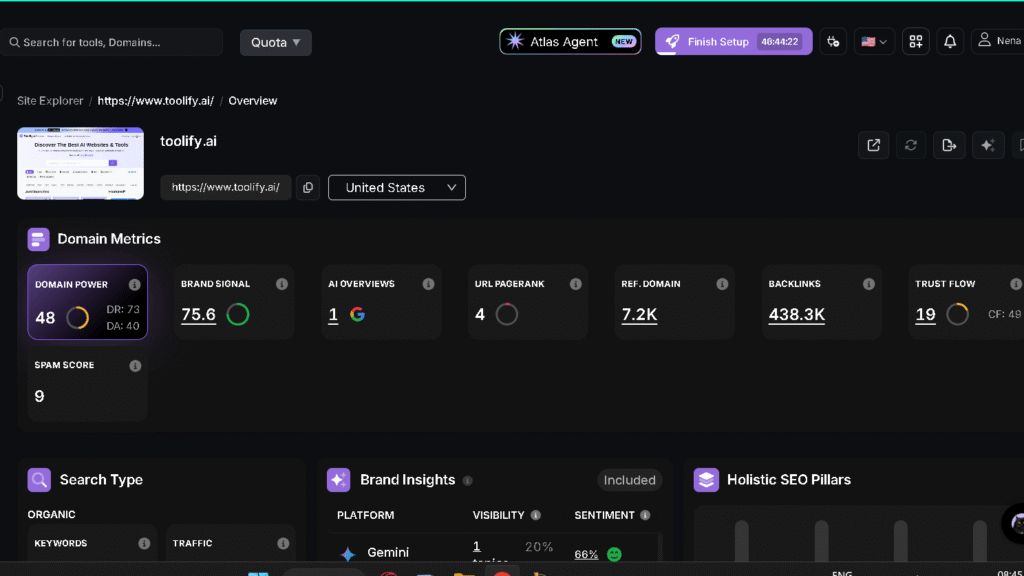
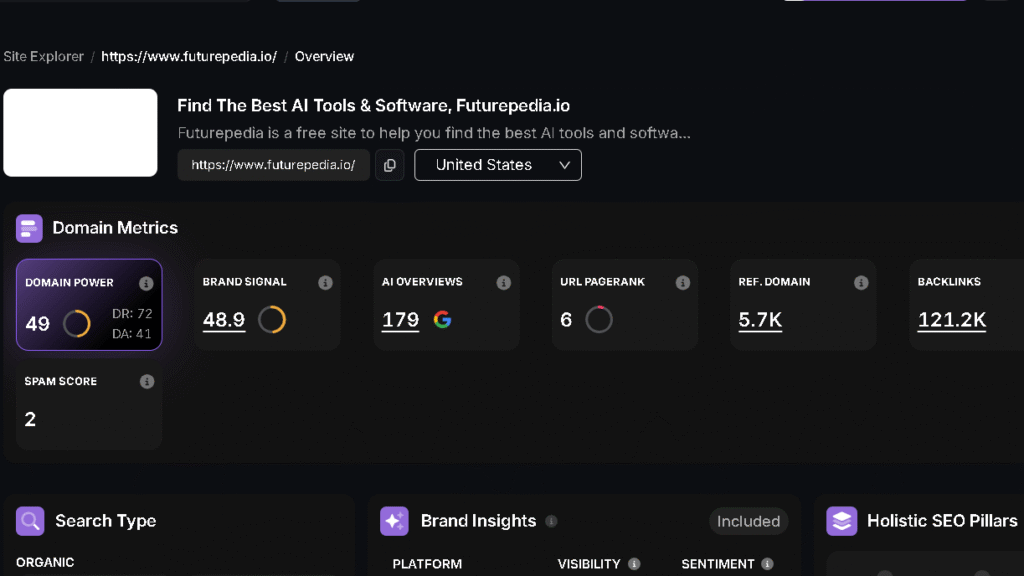
If ranking strength and AI citations moved together the way most people assume, this result should not exist. A site with that much authority behind it should produce a roughly proportional citation count. It did not. Toolify has the rankings, the backlinks, the brand strength, and almost none of it is converting into AI visibility.
That is not a one-off glitch. It is the clearest proof I have that these are two separate systems, evaluating two different things, and a strong score in one does not guarantee anything in the other.
Reason One: Your Content Answers Topics, Not Questions
This is the gap I keep finding most often when I check a page that ranks but does not get cited.
A page built to rank well often covers a topic broadly. Background, context, a wide sweep of related subtopics, all of it useful for someone browsing and reading top to bottom. That structure works for search rankings, where dwell time and topical coverage both help.
AI models are not browsing. They are answering a specific question, and they need a page that hands them a clean, extractable claim near where the question lives. A page that spends three paragraphs building up to an answer is harder to pull from than a page that states the answer directly and then explains it. The information might be identical. The extractability is not.
Direct answers. Concise explanations. Clear claims stated plainly, not buried under throat-clearing. That is the structural difference between a page built for rankings and a page built to be cited, and most ranking pages were never built with the second goal in mind.
Reason Two: No Original Information
This is the biggest one, and it is the reason my own AI visibility numbers moved at all.
A page that summarizes what ten other sites already say has nothing for an AI model to prefer your version over. If the same claim exists on five other pages, worded slightly differently, you are not the source. You are one interchangeable copy of a claim that exists everywhere.
Original data flips that. A named test with a specific result. A real screenshot from inside a tool. First-party numbers nobody else has, because nobody else ran the test. That is the entire reason my Grammarly vs Ginger comparison, built around an actual side-by-side test I ran, became my single most AI-cited page. There was a specific claim on that page that did not exist anywhere else in the same form.
This is also the difference between two ways of writing about the same product. “Promptwatch helps users improve visibility across AI platforms” is a sentence that could sit on a hundred different pages, written by a hundred different people who never opened the tool. “I ran Promptwatch against my own site and pulled the actual numbers it returned” is a claim only a page built on real testing can make. AI models extracting a citable answer have an obvious reason to prefer the second kind of sentence over the first.
Reason Three and Four: Weak Entities and Generic Phrasing
These two problems show up together so often that I have started thinking of them as one issue with two symptoms.
An entity is a named, specific thing. A brand. A tool. A product. Pages that name things clearly and consistently give an AI model something concrete to attach a claim to. Pages that talk around a topic in general terms force the model to do extra work figuring out what a given sentence is actually about, and extra work is exactly what gets a page skipped in favor of one that is already clear.
I noticed the entity gap most clearly comparing two of my own articles on a similar subject. My “Search Atlas vs Semrush” piece names two specific tools in the title and in nearly every paragraph. An older, broader piece I wrote on choosing an SEO tool used phrases like “platforms in this category” through most of its body instead of naming the tools directly. The named comparison is the one that shows up in AI citation checks. The general piece, covering similar ground, almost never does.
Generic phrasing is the same problem at the sentence level. If a paragraph could sit on any competitor’s page with the brand name swapped out, it is not actually about anything specific, even if it sounds informative. “This tool offers strong features for content creators” could describe a hundred different products. “Search Atlas’s Content Genius produced a usable brief in roughly an hour during my testing” can only describe one. The fix for both problems is the same fix. Name the thing. State the specific claim. Stop writing around the subject and write directly about it.
Reason Five: Your Site Is Not Topically Clear
The last reason is structural, and it is the one that took me longest to actually fix.
A single strong page sitting alone, with no surrounding cluster of related content, sends a weaker topical signal than the same page sitting inside a connected group of articles that all reinforce the same subject. Internal linking matters here for a reason close to its old SEO purpose, but the audience reading those signals now includes AI models trying to figure out how authoritative your site actually is on a given topic.
This is the part of my own site I am actively still building, not a problem I have already solved. My AI visibility cluster currently links a guide on what AI visibility actually means to a piece on why GEO and AI visibility get confused, and both of those link to individual tool reviews as I publish them. None of those pages existed in connected form a few months ago. They were separate posts with no shared spine.
I cannot yet show you a citation count tied directly to that linking structure, because the cluster is too new for that data to be clean. What I can show you is the principle behind it, borrowed directly from what already worked on the rest of my site. My highest-cited pages are not random standalone posts. They sit inside SEO and AI-tool clusters that have existed long enough to build real internal linking between them.
What Changed My Own Results
I did not fix this with a single article. It showed up gradually, once I started applying the reasons above on purpose instead of by accident.
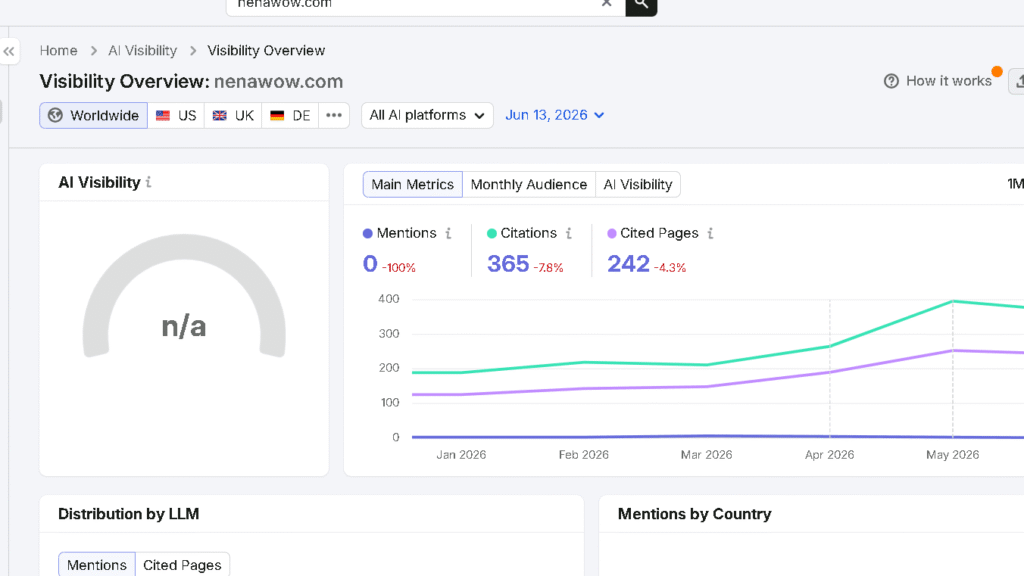
My AI citation count, according to Semrush, grew from close to zero to 365 total citations across 242 cited pages over roughly three months. That growth was not even across the site. A handful of pages did almost all of the work, and the rest of the site barely moved.
Ahrefs’ Brand Radar data showed the same pattern from a different angle.
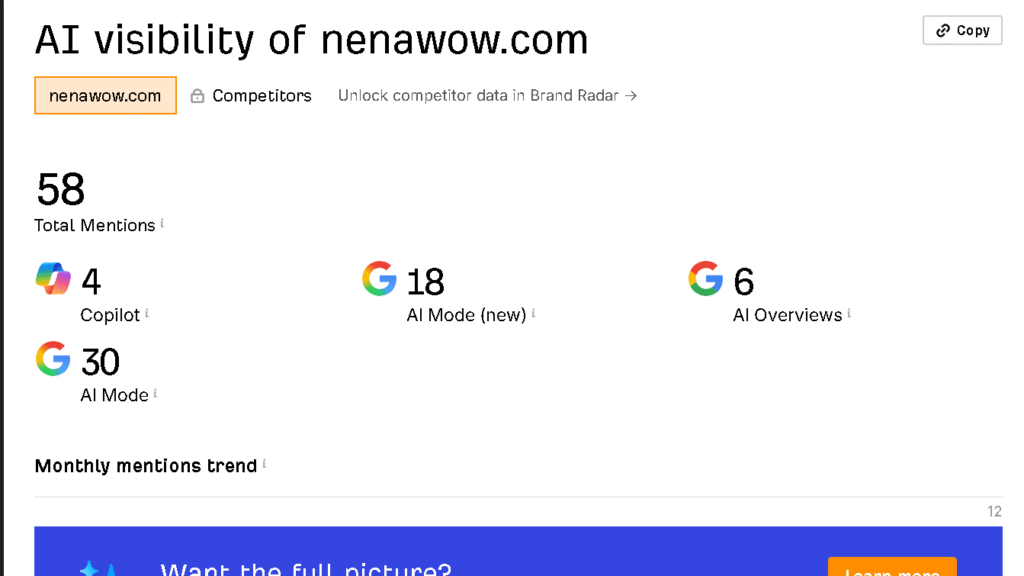
My single most cited page, by a clear margin, is the Grammarly vs Ginger comparison, cited 5 times in AI responses that mention my domain, including 3 citations pointing directly back to my own URL. Comparison content, the kind built around a named test with a clear verdict, kept outperforming broader, more general pieces, even ones that ranked just as well in Google.
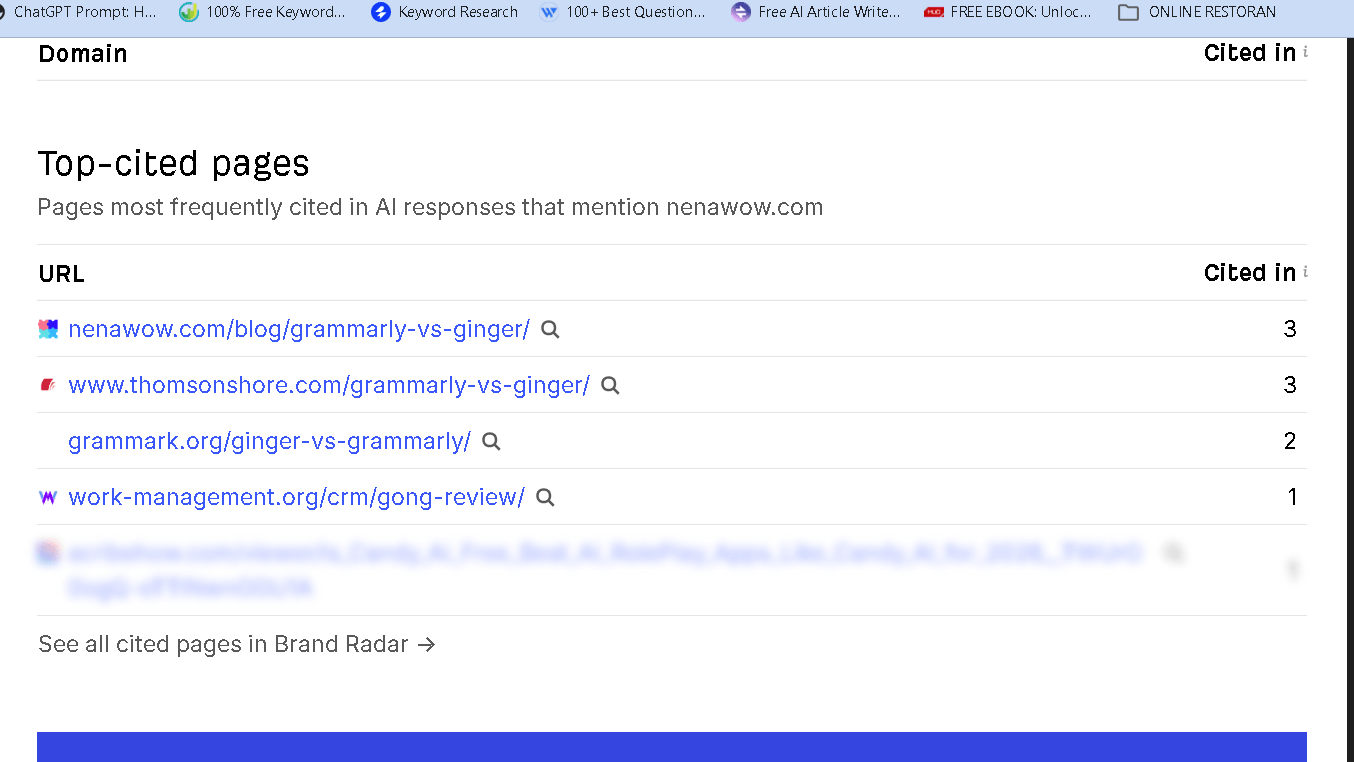
That consistency is the part that actually convinced me. Not one good month. The same kind of page, the comparison built on original data, winning across every tool I checked and every month I tracked it.
Nena’s Quick Verdict: Strong Google rankings do not guarantee AI citations. In my testing, pages built around original data, named entities, screenshots, and direct answers consistently attracted more AI citations than broader informational content.
If You Rank But Get No AI Citations
A short list, based on what actually moved my own numbers rather than a general theory of what should work.
Add original tests. A specific, named result beats a general summary every time I have checked.
Add screenshots. Real, verifiable proof reads differently to a model trying to extract a confident claim.
Add comparisons. My highest-cited page by far is a head-to-head with a clear winner, not a broad overview.
Name the entities. Specific brands and tools, stated plainly, beat vague category language.
Improve internal linking. A page sitting inside a real topical cluster sends a stronger signal than the same page standing alone.
Update content. Freshness seems to matter, even where I cannot put an exact number on how much.
Monitor AI visibility. Check more than one tool, and watch the trend over months instead of reacting to a single snapshot.
FAQ
Ranking and AI citation are measured by different systems, looking at different signals. A page can satisfy Google’s ranking factors without containing the kind of extractable, specific, original claim that AI models look for when building an answer. Strong rankings do not guarantee strong AI visibility.
No. In a competitor comparison I ran, one site with strong Domain Power and Brand Signal scores, the kind that usually accompany strong rankings, had an AI Overview count of just 1, while a site with similar overall strength had nearly 250. Strong SEO fundamentals do not reliably predict strong AI citation counts.
Publish original data instead of summarizing existing content. Use named tests with specific numbers, real screenshots, and clear comparisons between named entities.
Not directly. ChatGPT and similar AI models evaluate content on its own terms when generating an answer, rather than pulling from or deferring to a page’s position in Google’s search results. A page ranking on page four can still get cited if it answers the question more directly than a page ranking first.
In my own testing, weeks rather than days. New articles consistently took longer to register in any AI visibility tool than older comparison pieces did, even when the new content followed the same approach.
In my own testing, yes, more than any other single factor. My single most cited page across every tool I checked is built entirely around a first-party comparison test.