
How does ChatGPT decide what products to recommend? I wanted to find out whether ChatGPT product recommendations consistently favor the same brands, change with intent, or depend on the sources sitting behind the answer. So I ran 50 shopping prompts across 10 product categories and recorded every top recommendation, cited source, and shopping card.
Each category got five prompts run in a fresh chat, no follow-up questions, no request for sources. I just asked and recorded what came back. The categories were wireless headphones, laptops, running shoes, coffee makers, office chairs, robot vacuums, moisturizers, air fryers, smartwatches, and travel backpacks. Inside each one I varied the intent five ways: a broad best-of query, a budget version, and three category-specific angles like use case, feature, or a price ceiling.
That structure mattered. It let me see not just what ChatGPT recommends, but how much a small change in wording moves the answer. The short version: some categories are owned by one brand almost completely, others fall apart the moment you change a single word, and the sources ChatGPT cites do not always match the product it actually picks. That last part surprised me the most.
Table of Contents
Nena’s Quick Verdict
Across 50 ChatGPT shopping prompts, I found that recommendation visibility was highly category-dependent. Osprey won all five travel-backpack tests, while coffee makers and running shoes produced five different winners. The most surprising result was shopping visibility: product-card coverage ranged from 0% to 100% across closely related prompts, even when the same product kept winning.
How I Ran the Test
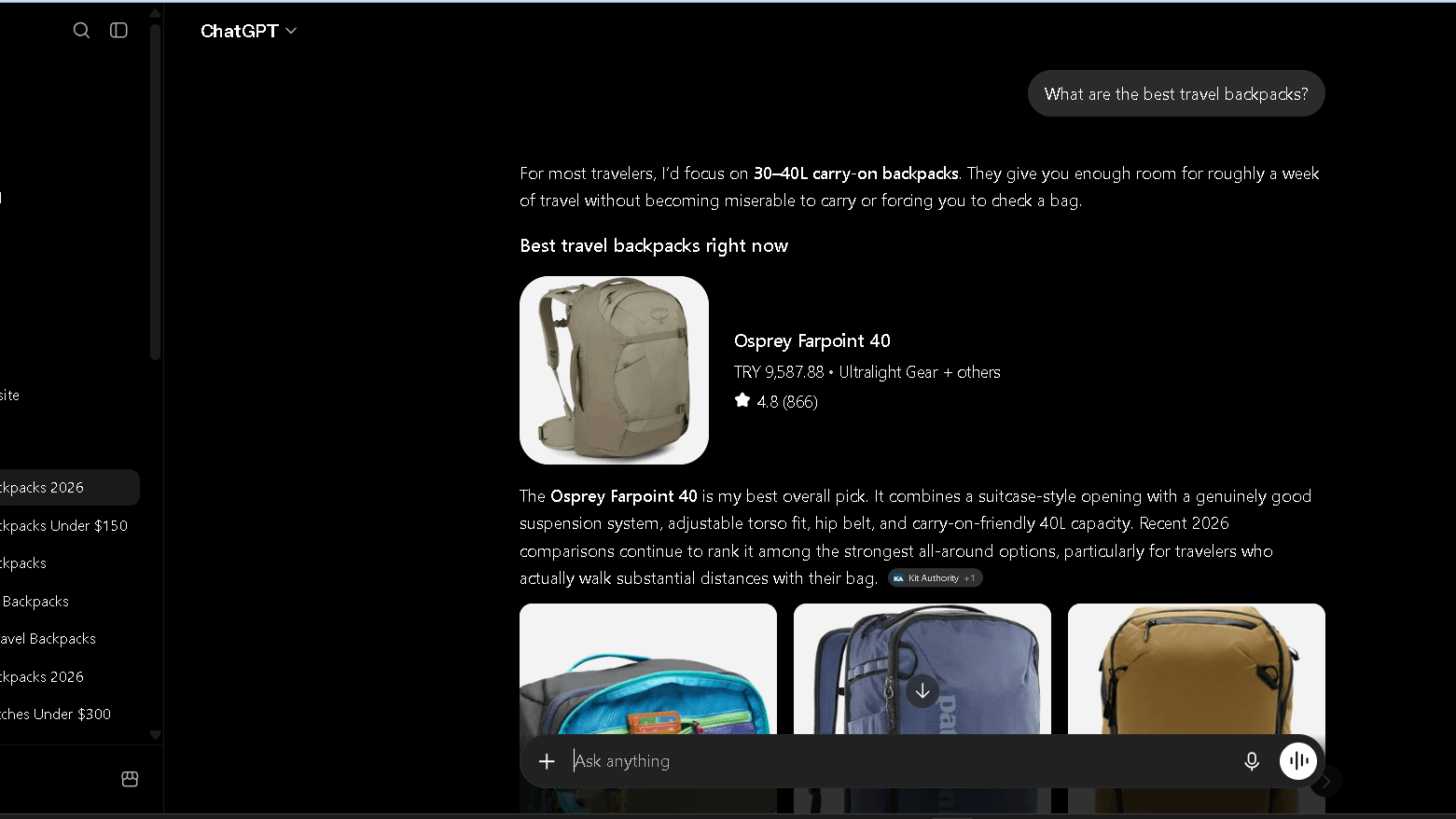
Every prompt ran in a brand-new chat, typed exactly as written, with no context carried over from a previous test. I recorded the first response only: the ranked products, the brand behind each one, whichever domains got named as sources, and whether a shopping card or product image showed up next to the pick.
That last field turned out to matter more than I expected. More on that below.
One limit up front. This is a snapshot from August 2026. Prices shift, shopping inventory shifts, and how ChatGPT recommends products can shift with it. Run the same 50 prompts in six months and some of these numbers will move. What I am reporting is a pattern caught at one point in time, not a fixed ranking.
Finding 1: Some Categories Are Basically Owned by One Brand
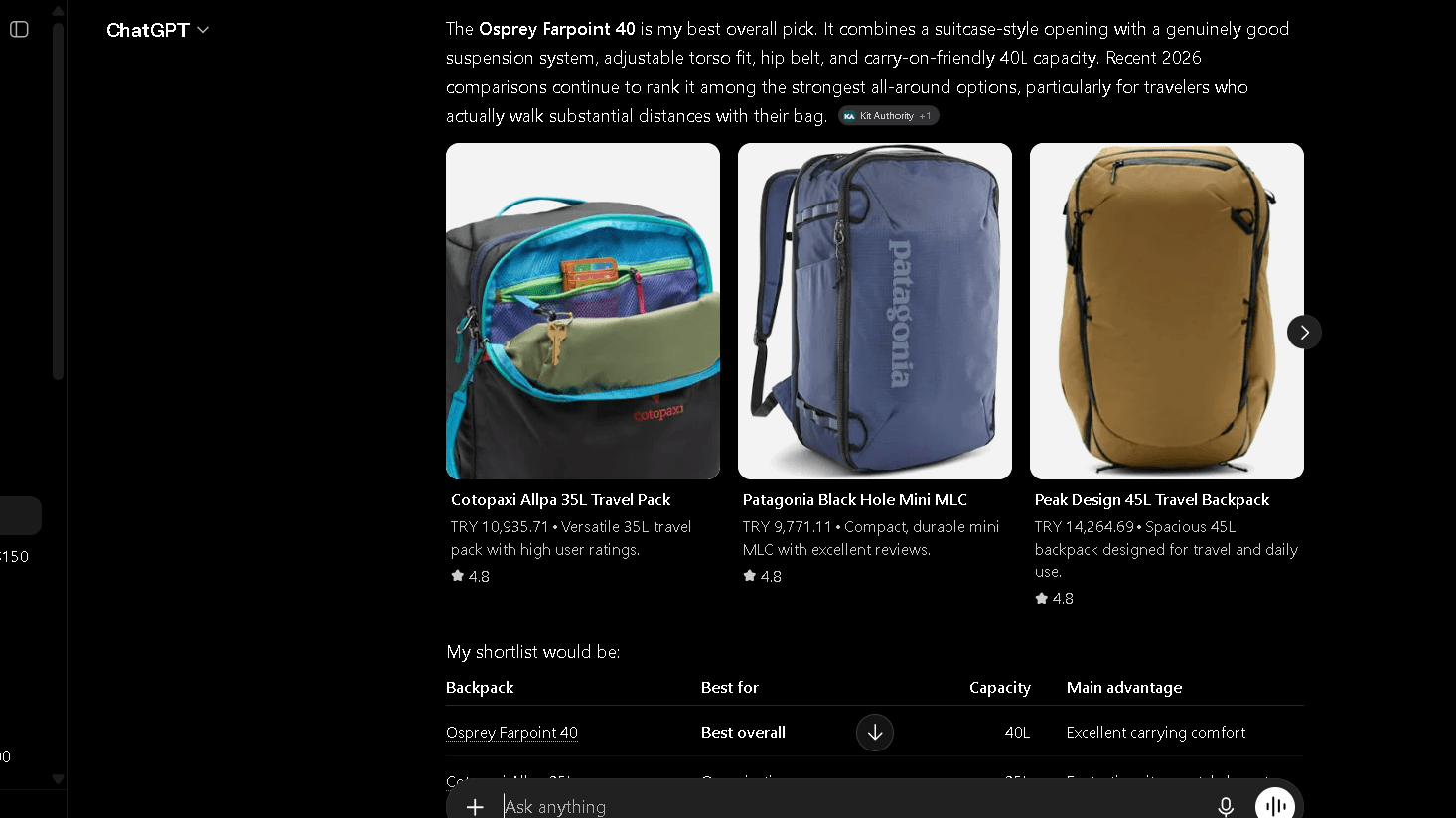
Travel backpacks gave me the cleanest result in the whole test. Osprey took the number one brand position in all five prompts. Not four out of five. Five out of five. The Osprey Farpoint 40 specifically was the top individual product in four of those five, losing only to its own sibling, the Osprey Daylite Carry-On 35L, in the budget query.
That is not a fluke. Three other categories showed the same shape at a slightly lower rate.
| Category | Number one brand concentration |
|---|---|
| Travel backpacks | Osprey, 5 of 5 |
| Laptops | Apple, 4 of 5 |
| Air fryers | COSORI, 4 of 5 |
| Moisturizers | CeraVe, 4 of 5 |
| Coffee makers | 5 different winners |
| Running shoes | 5 different winners |
Apple won four of five laptop prompts, only losing the budget slot to a Lenovo IdeaPad. COSORI won four of five air fryer prompts. CeraVe won four of five moisturizer prompts. In each case, one brand became the default answer across nearly every version of the question, budget aside.
In this benchmark, budget wording often produced a different shortlist rather than simply a cheaper version of the general winner. That held across travel backpacks, laptops, and several other categories. If your product sits in the budget tier, you are not competing against the category leader. You are competing in a separate bracket.
Finding 2: Change the Intent, the Winner Changes Too
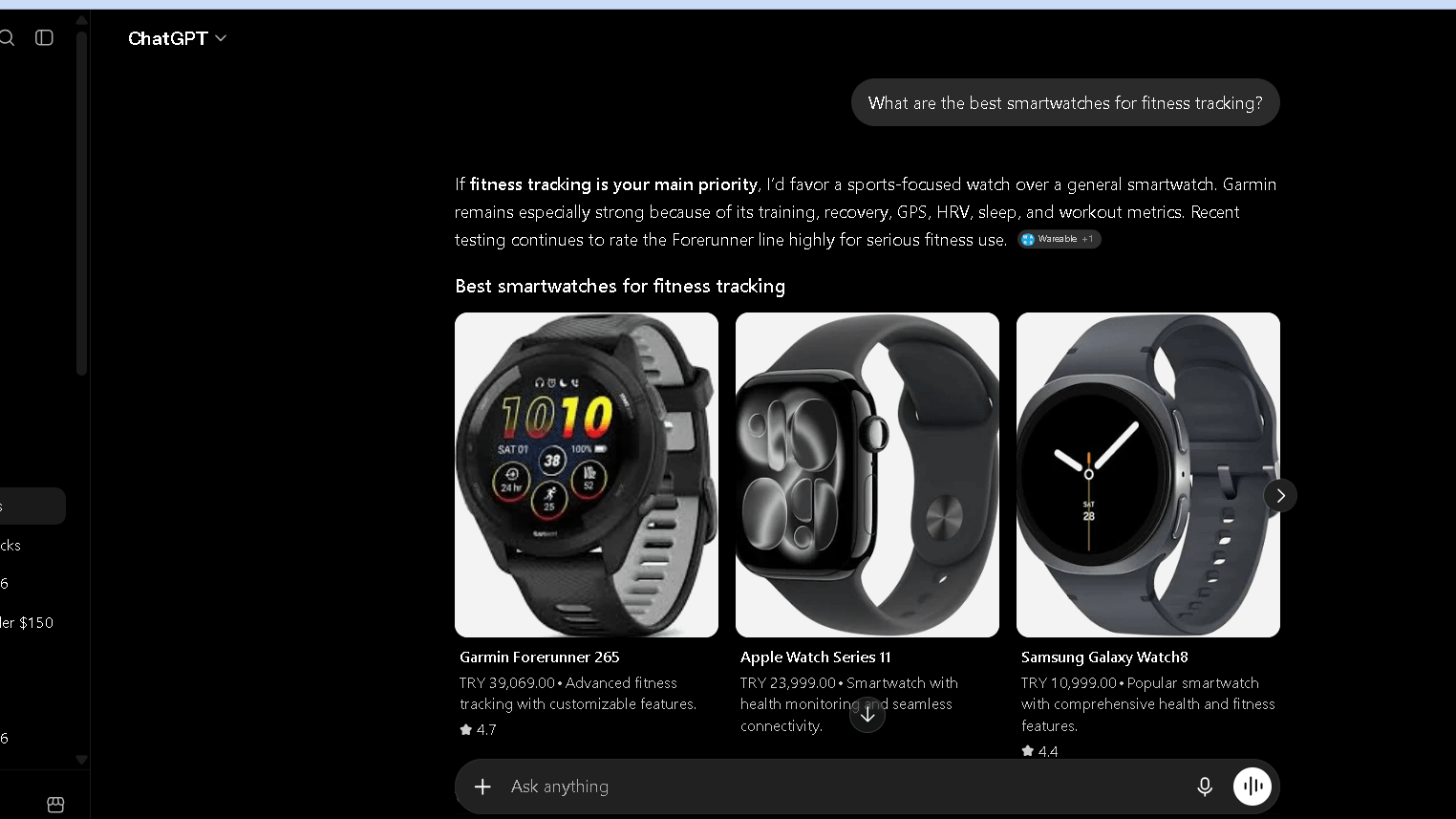
Now the opposite case. Coffee makers produced five different number one brands across five prompts: Technivorm, Cuisinart, Nespresso, Breville, and Ninja. Running shoes did the same thing, splitting across Adidas, Puma, Brooks, ASICS, and HOKA. Smartwatches shifted with ecosystem and use case, moving from Apple to Amazfit to Garmin to Samsung depending on whether I asked about budget, fitness, or Android compatibility.
That is a real split in how these categories behave. Travel backpacks and air fryers reward one brand almost no matter how you phrase the question. Coffee makers and running shoes reward no one consistently. Intent decides the winner more than the category does.
If you sell into a fragmented category like this, chasing one single best-of query is close to pointless. There is no single query. There are five, and each one has its own winner.
Finding 3: Brands Start Owning an Attribute, Not Just a Mention
This is the part I find most useful editorially, more than the raw win counts. Inside the travel backpack cluster, the Osprey Farpoint 40 kept getting recommended for the same reason across nearly every prompt: carrying comfort. Not design, not price, not capacity. Comfort, specifically the harness and hip belt, came up almost every time.
Around it, a stable secondary pattern formed. Cotopaxi’s Allpa got recommended for organization. Patagonia’s Black Hole line got recommended for rugged, compact versatility. Peak Design got tied to premium tech carry. Aer got tied to business travel. That is not five brands competing for the same slot. That is five brands each holding a different position in how products got recommended across the cluster.
I saw a lighter version of this elsewhere too. Steelcase Gesture kept showing up for premium ergonomics. Roborock’s Saros 10R kept showing up for hard-floor and all-around cleaning. CeraVe kept showing up for affordable, barrier-focused hydration. The pattern held: once a product earns a specific reason for being recommended, that reason tends to travel with it across prompts.
Finding 4: The Same Publishers Keep Showing Up
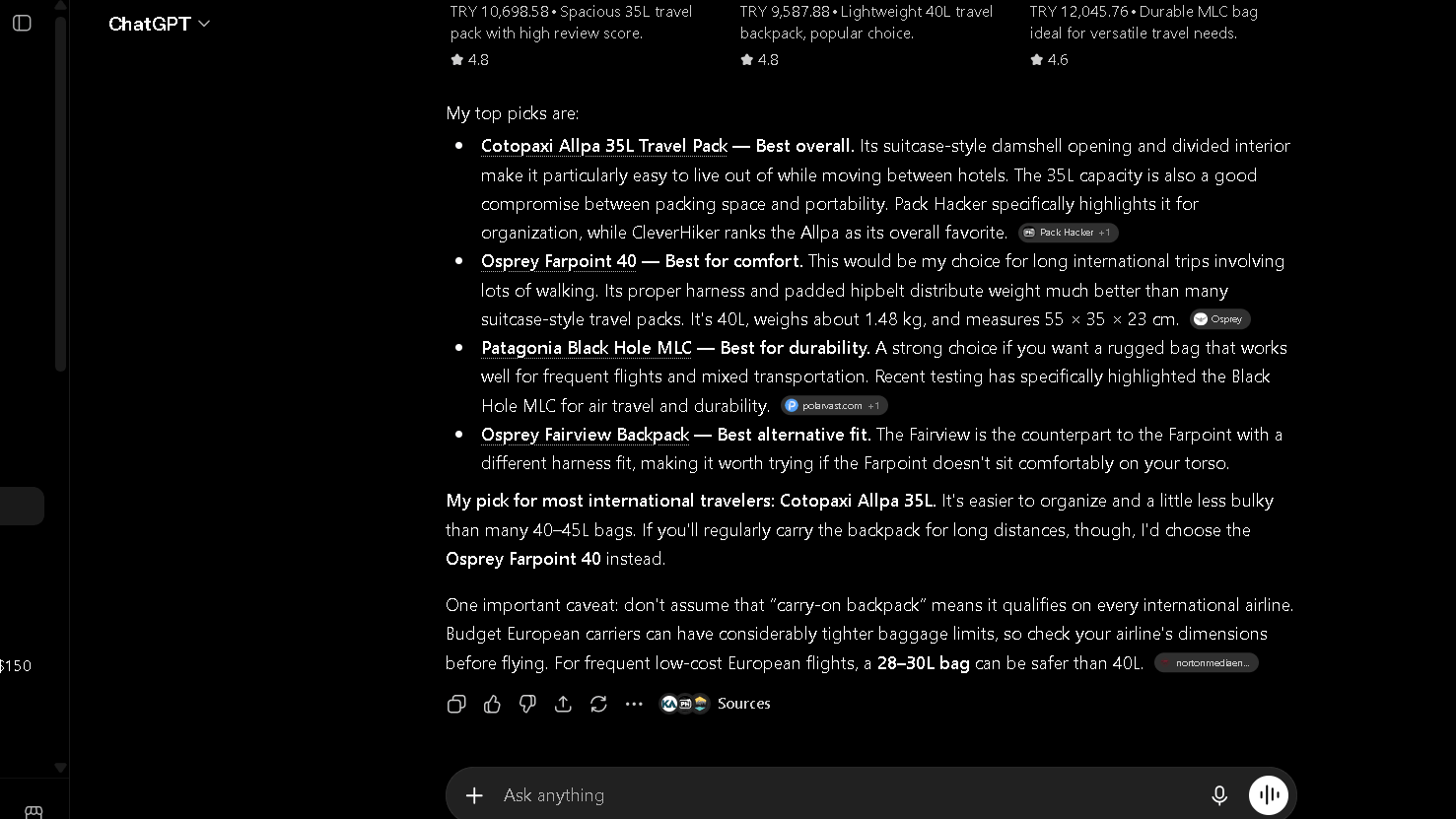
I also tracked which sites got cited as supporting evidence. WIRED appeared in five of five office chair prompts. Pack Hacker appeared in five of five travel backpack prompts. Tom’s Guide showed up in four of five office chair prompts as a second, slightly less consistent authority.
That is a real signal about how ChatGPT builds its answers. It is not pulling from a random publisher each time. Inside a given category, it keeps returning to the same handful of specialist sites, treating them as a trusted layer underneath its own synthesis. If you run a review site and want more product visibility in ChatGPT, becoming that category authority for one specific niche looks like a stronger bet than trying to rank for everything at once.
Finding 5: ChatGPT Does Not Just Copy the Source’s Own Ranking
Here is the part that changed how I think about citations. In the travel backpack cluster, I watched ChatGPT cite Kit Authority as supporting evidence for the Cotopaxi Allpa, even in prompts where Kit Authority’s own published ranking put the Allpa ahead of the Farpoint. ChatGPT still put the Farpoint first. It used the source for evidence, not for the final verdict.
So being cited is not the same as being obeyed. ChatGPT appears to pull specific facts and comparative claims from multiple sources, then build its own ranking from the combination. A publisher’s number one pick is one input among several, not a rule ChatGPT has to follow.
That distinction matters if you care about AI product recommendations. Getting cited is good. Getting cited as the deciding vote is a different, harder thing.
Finding 6: Shopping Cards Are a Separate Layer From the Recommendation Itself
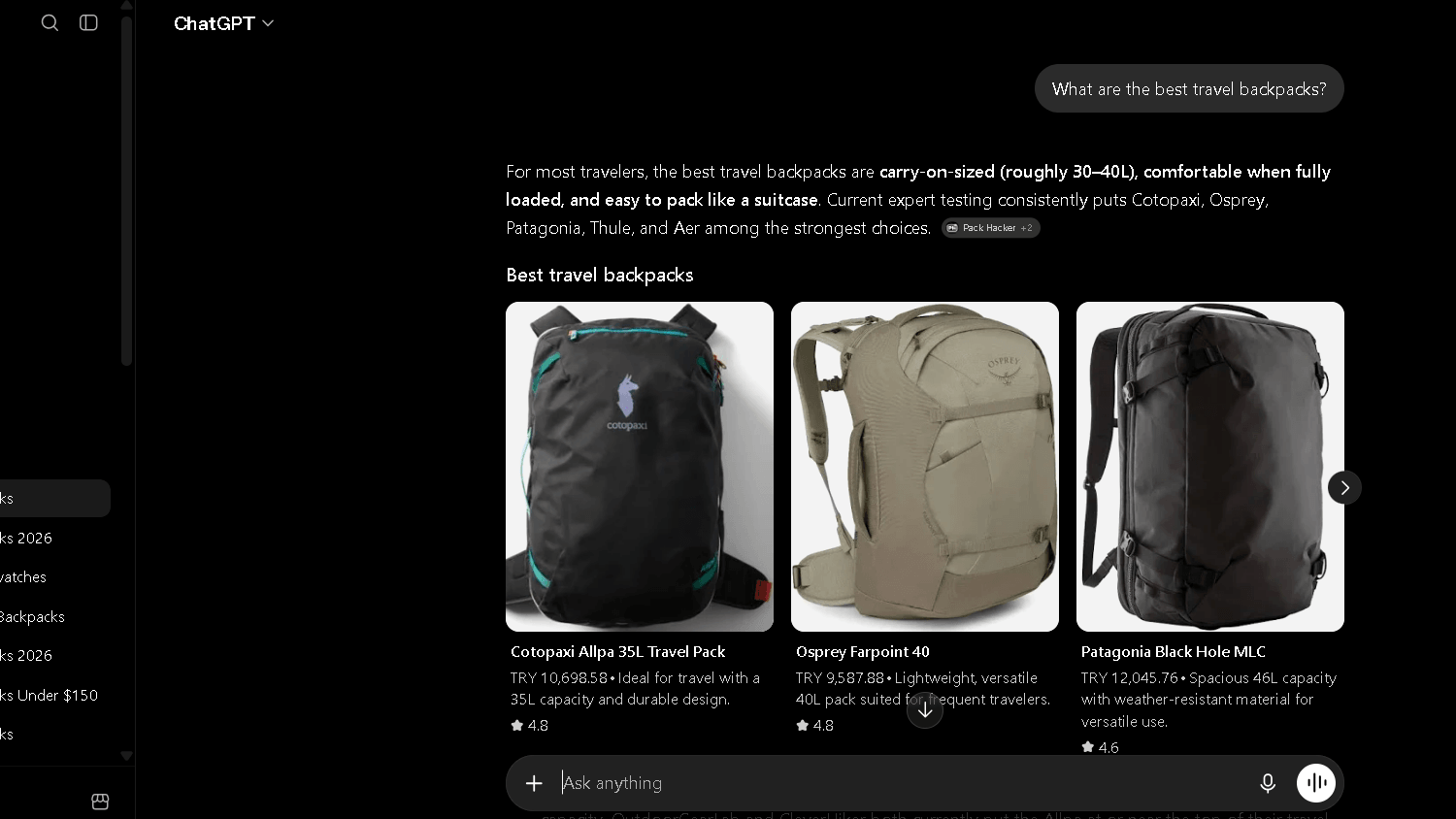
This is the finding I would lead with if I only got to keep one. Across the five travel backpack prompts, product card coverage moved like this:
| Prompt intent | Product-card coverage |
|---|---|
| General | 0% |
| Budget | 67% |
| Carry-on | 20% |
| International | 100% |
| Under $150 | 100% |
Same category. Closely related prompts. Often the exact same product, the Osprey Farpoint 40, recommended in every single one. Read that again. The same product, top pick in four of five prompts, showed up with a shopping card in some answers and with nothing but plain text in others.
Being the top pick and being shown as a shopping result did not consistently move together in this benchmark. That gap is real. If you are only tracking whether your product gets mentioned, you are measuring half the picture. The other half, whether it gets a card, an image, a price, and a buy-adjacent presentation, seems to run on its own separate logic.
The Travel Backpack Cluster, in Full
This category gave me the strongest and cleanest data in the whole test, so it is worth laying out prompt by prompt.
| Prompt | Intent | Number one pick | Product-card coverage | Recurring sources |
|---|---|---|---|---|
| 46 | General best-of | Osprey Farpoint 40 | 0 of 8 | Pack Hacker |
| 47 | Budget | Osprey Daylite Carry-On 35L | 4 of 6 (67%) | Pack Hacker, OutdoorGearLab |
| 48 | Carry-on | Osprey Farpoint 40 | 1 of 5 (20%) | Osprey official, Pack Hacker, Kit Authority |
| 49 | International travel | Osprey Farpoint 40 | 5 of 5 (100%) | Pack Hacker, Kit Authority, Aeronautics Magazine |
| 50 | Under $150 | Osprey Farpoint 40 | 5 of 5 (100%) | Kit Authority, Pack Hacker, Patagonia official, Nomad Outfit |
Osprey won brand-level first place in all five prompts. Pack Hacker got cited in all five. And the card swing, from zero coverage to full coverage across prompts about the same core product, is the clearest single piece of evidence I have for treating recommendation rank and shopping visibility as two different things to track.
What Makes a Brand More Likely to Be Recommended by ChatGPT?
I want to be careful here, because 50 prompts run once is a strong pattern, not proof of how the system works underneath. Even so, a few things looked worth acting on.
Owning a specific reason beats chasing a generic one. The Farpoint 40 did not win because it was mentioned the most. It won because comfort, one clear attribute, kept attaching to it across nearly every prompt. The pattern suggests that a specific recommendation reason may be more valuable than a generic claim.
Category authority looks more valuable than broad citation volume. WIRED at five of five office chair prompts and Pack Hacker at five of five travel backpack prompts both suggest that showing up reliably inside one niche beats scattered coverage across many.
Getting cited is not the finish line. ChatGPT used sources as evidence, then made its own call, sometimes against that source’s own top pick. Content that supplies clear, checkable facts seems more useful to that process than content that just asserts a ranking.
Track shopping visibility on its own. It swings independently from the recommendation itself. A product can be the top pick in plain text and still show up with no card, no image, and no price. If your product data is not connecting to that shopping layer, that is a separate fix from getting mentioned in the first place.
For brands, AI visibility is no longer just about being mentioned or cited. My results suggest product recommendation visibility is worth tracking as its own layer, alongside citations and share of voice. A brand can be cited without winning the recommendation, recommended without getting a shopping card, or repeatedly tied to one narrow buying intent. Those are different things, and they are worth measuring separately.
The Limits of This Test
I ran each prompt once, in a fresh chat, during one testing window in August 2026. Repeat the same 50 prompts next month and some of these rankings will shift, especially the budget and shopping-card results, since those depend on live inventory and pricing more than the others. Fifty prompts is a real sample for manual testing, but it is not a statistically representative slice of every commercial query a person might type.
I also did not ask ChatGPT to explain its reasoning or reveal what it weighed internally. Everything here comes from observed outputs, not from the model telling me how it works. I can tell you what showed up. I cannot tell you why, beyond what the pattern itself suggests.
Related Reading
Do News Websites Block AI Crawlers? I Tested 13 Major Publishers
How I Found My Own AI Search Visibility Gap
How to Check AI Visibility for Free (With Real Data From My Site
What Makes Content More Likely to Be Cited by AI?
AI Visibility Benchmark 2026: I Tested 9 Leading SEO Websites
Frequently Asked Questions
Does ChatGPT always recommend the same product for a given category?
No. It depends heavily on the category. Travel backpacks, laptops, air fryers, and moisturizers each had one brand win most or all of the five prompts I tested. Coffee makers and running shoes went the other way, producing five different winners across five prompts in the same category.
Does getting cited by ChatGPT mean a brand will be recommended?
Not automatically. In this test, ChatGPT sometimes cited a source whose own top pick differed from the product ChatGPT ultimately recommended. Citations look like supporting evidence inside a broader synthesis, not a rule ChatGPT follows directly.
Why did the same product show up with a shopping card in some answers and not others?
That is one of the clearest findings in this test. Across five closely related travel backpack prompts, card coverage for the same recurring products ranged from 0 percent to 100 percent. Recommendation rank and shopping-card visibility behaved differently across these tests, suggesting they should be measured separately.
Is this benchmark repeatable?
The prompts and method are repeatable. The results are not guaranteed to match, since how ChatGPT recommends products, shopping inventory, and pricing all shift over time. Treat this as a snapshot from one testing period, not a fixed ranking.