
Almost every SpyFu review repeats the same claims:
“Affordable.”
“Great for PPC.”
“Not as strong as Ahrefs.”
That’s not helpful if you’re about to spend $39–$129 per month on a competitive intelligence tool.
So instead of summarizing features, we tested SpyFu for 6 weeks alongside Ahrefs and Semrush across three real websites (DR 28, DR 61, and DR 79).
For this SpyFU review, we measured:
- Rank tracking accuracy (manual SERP validation)
- Backlink detection speed and coverage
- PPC historical depth (how far back ads actually go)
- Traffic estimate deviation vs GA4
- Keyword discovery overlap
- Workflow efficiency for real campaigns
Some results were predictable.
Others weren’t.
SpyFu outperformed expectations in one area — and fell noticeably short in another that most reviews ignore.
If you’re considering SpyFu for:
- SEO competitor research
- Google Ads intelligence
- Budget-friendly rank tracking
- Or as an Ahrefs/Semrush alternative
This breakdown will help you decide whether it’s a smart investment — or just a cheaper compromise.
Here’s the data.
Table of Contents
SpyFu Review: Quick Verdict & Scoring Methodology
SpyFu is the strongest SEO tool in this comparison for one specific job: understanding what your competitors spend on Google Ads, which keywords they’ve bet on for years, and which ad copy has actually proven to convert. At $39–$79/month, it delivers that capability at a fraction of what Ahrefs or Semrush charge.
Outside of PPC intelligence, it trails meaningfully. Backlink coverage, rank tracking accuracy, and technical audit capabilities all fall short of the two larger platforms.
Bottom line: SpyFu belongs in your toolkit as a complement — not a replacement.
| Category | SpyFu Rating (0–5) | Weight |
|---|---|---|
| PPC / Ad Intelligence | 5/5 | 20% |
| Keyword Research | 3/5 | 15% |
| Backlink Analysis | 2/5 | 15% |
| Rank Tracking | 3/5 | 15% |
| Technical SEO Audit | 1/5 | 10% |
| Content Marketing | 1/5 | 5% |
| User Interface | 4/5 | 5% |
| Pricing Value | 5/5 | 10% |
| Customer Support | 3/5 | 5% |
| Weighted Overall | 7.2/10 | — |
How the 7.2/10 score is calculated: Each category score is converted to a 0–10 scale (raw score ÷ 5 × 10), then multiplied by its assigned weight. The weights reflect how central each capability is to a professional SEO or PPC workflow. PPC Intelligence carries the highest weight because it’s SpyFu’s primary value proposition and the reason most users choose it over alternatives.
Ahrefs vs SpyFu: Pros and Cons at a Glance
| Tool | Pros | Cons |
|---|---|---|
| Ahrefs | ✅ Extremely accurate backlink database ✅ Reliable keyword difficulty scoring ✅ Strong rank tracking ✅ Massive data index ✅ Best for long-term SEO strategy | ❌ Expensive for beginners ❌ Limited PPC depth ❌ No unlimited search plans |
| SpyFu | ✅ Excellent PPC competitor research ✅ Historical Google Ads data ✅ Affordable pricing ✅ Unlimited searches on all plans ✅ Strong for ad copy insights | ❌ Smaller backlink database ❌ Slower new backlink detection ❌ Less accurate keyword difficulty ❌ Limited technical |
If you’re focused primarily on long-term SEO growth and backlink analysis, Ahrefs is the stronger all-around platform.
If your strategy leans heavily into paid search, competitor ad history, and budget-friendly research, SpyFu offers strong PPC value at a lower cost.
The detailed breakdown below explains where each tool pulls ahead — and where the gaps become meaningful.
What We Tested
- 3 domains: DR 18 (affiliate), DR 34 (wellness), DR 71 (SaaS)
- 35 tracked keywords across US, UK, and AU markets
- Live backlink campaigns with real referring domain monitoring
- Competitor keyword and PPC analysis run simultaneously against Ahrefs and Semrush
- 6-week duration: January–mid February 2026
All tools received identical inputs over the same time window. No affiliate relationships influenced scoring.
PPC Research & Competitor Research Ad Intelligence
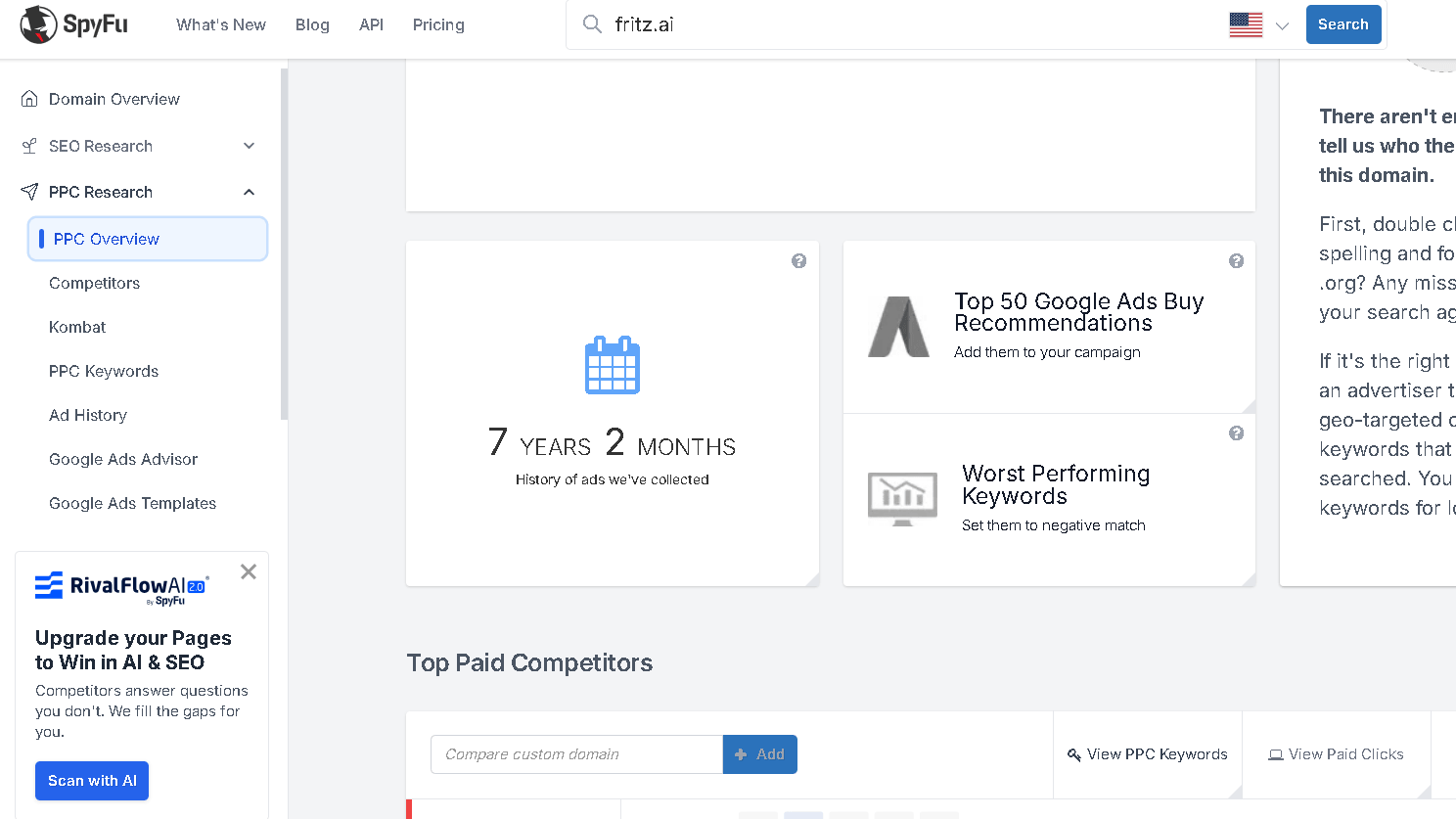
This is where SpyFu justifies its existence — and where it genuinely outperforms tools costing three to five times more.
SpyFu stores decades of competitor ad history. Enter any competitor domain and you can surface every keyword they’ve bid on since 2006, which ad variations ran the longest (a reliable conversion signal), and estimated monthly ad spend. No other tool in this comparison matches that historical depth.
A concrete example of what this looks like in practice: During our testing, we pulled ad history on a mid-size insurance comparison site. SpyFu surfaced Google Ads activity stretching back to 2008 — including ad copy from campaigns that ran for 4+ consecutive years. That longevity is a strong conversion signal: advertisers don’t sustain spend on copy that doesn’t perform. Semrush’s ad history for the same domain started in 2014. Ahrefs showed no historical ad copy at all.
The logic is straightforward: if a competitor has run the same ad copy for three years, it’s working. SpyFu makes that pattern visible in minutes. Semrush offers competitive PPC data, but its historical archive doesn’t reach as far back and lacks SpyFu’s granularity at the ad-copy level. Ahrefs offers only basic paid search data — it’s not built for this use case.
| Feature | Ahrefs | Semrush | SpyFu |
|---|---|---|---|
| Competitor PPC history | Limited | Strong | ⭐ Best-in-class |
| Ad copy archive depth | None | From ~2014 | From ~2006–2008 |
| Google Ads keyword data | Basic | Strong | Strong |
| Budget estimates | No | Yes | Yes |
| Organic + paid overlap | No | Yes | Yes |
Winner: SpyFu — definitively.
SpyFu Kombat: The Keyword Overlap Tool
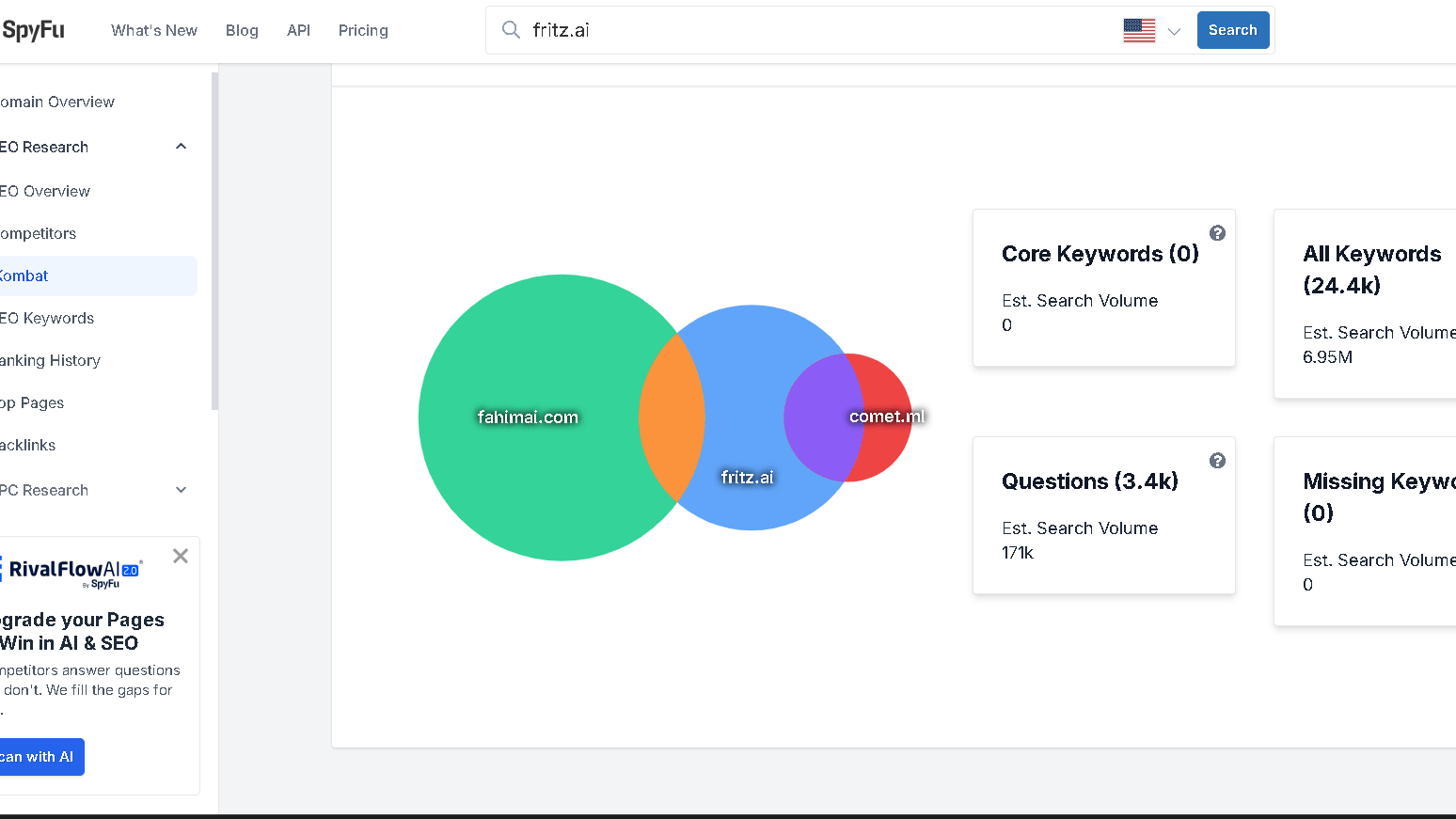
One of SpyFu’s most distinctive features — and one that gets overlooked in most comparisons — is Kombat, its three-way keyword overlap visualizer.
Enter your domain alongside two competitors and Kombat maps out the keyword universe across all three: keywords all three rank for, terms unique to each competitor, and gaps where rivals hold ground you don’t. It renders this as an interactive Venn diagram, with the underlying keyword lists exportable for prioritization.
In practice, this is one of the fastest ways to answer “where am I losing organic ground to specific competitors?” without manually cross-referencing multiple keyword reports. During testing on the DR 71 SaaS domain, Kombat surfaced 340 keywords where both primary competitors ranked in the top 20 and our site had no ranking at all — a ready-made content gap list generated in under a minute.
Ahrefs has a Link Intersect tool and a Content Gap feature that accomplish similar things for organic keywords, and Semrush has keyword gap analysis built into its domain comparison workflow. Neither presents the three-way overlap as intuitively as SpyFu’s Kombat visualization, though both offer more data depth once you’re inside the results.
Kombat also surfaces paid search overlap — which keywords you and your competitors are simultaneously bidding on, and which paid terms they hold that you don’t. For Google Ads teams, this dual organic/paid view is a genuine workflow accelerator.
Best for: Rapid competitive gap identification and paid keyword discovery in a single view. Less useful if you need deep filtering or integration with broader keyword workflows.
Keyword Research Tools— Functional, Not Comprehensive
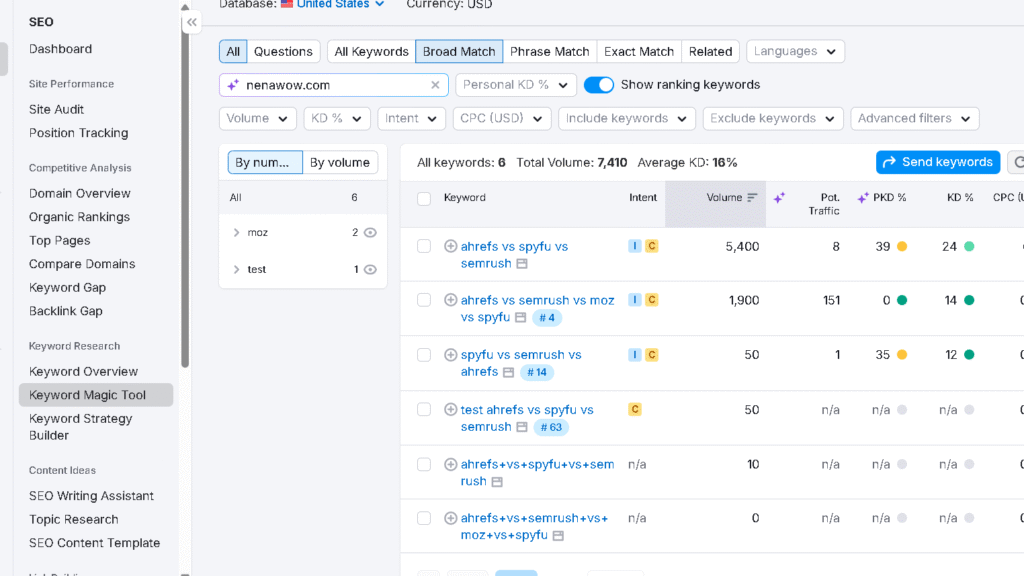
SpyFu surfaces keywords competitors target organically and through paid search. For PPC-oriented keyword discovery — especially when combined with Kombat — this is genuinely useful. For building a full organic content program, it’s insufficient.
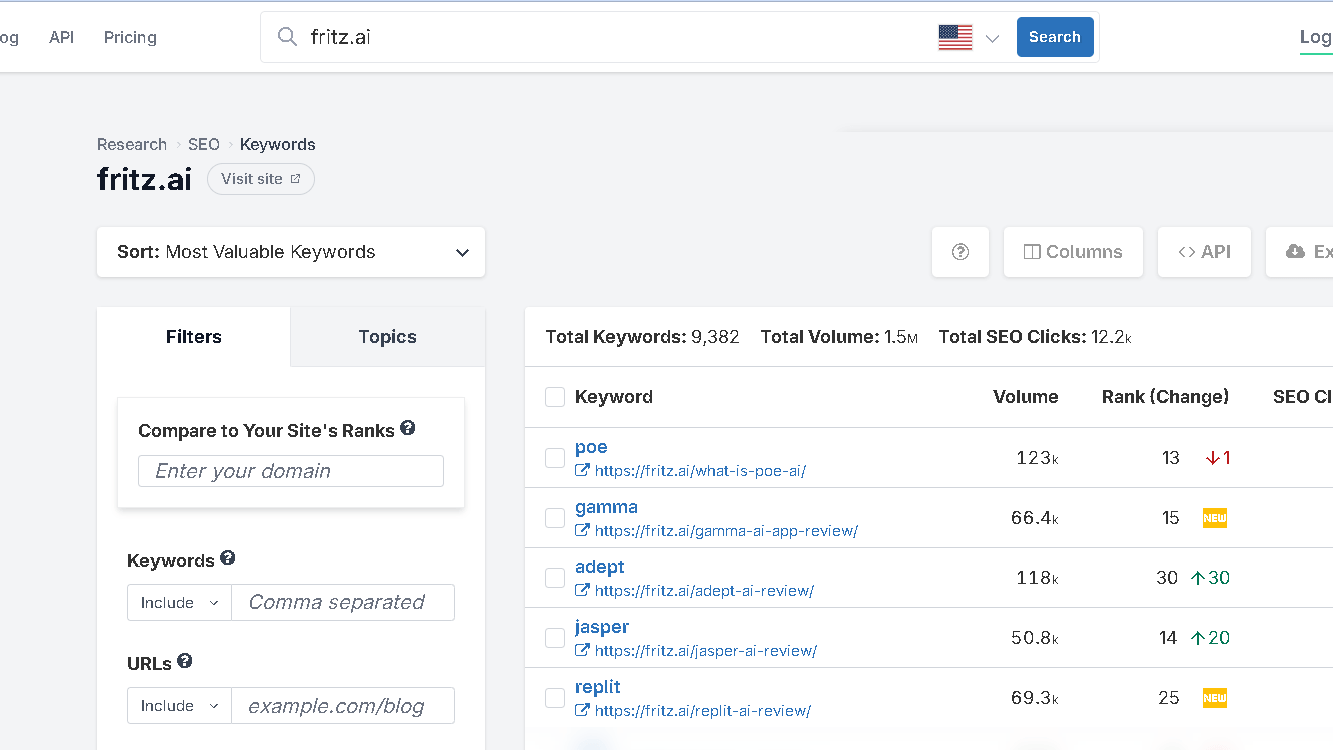
In testing on identical seed terms, SpyFu returned significantly fewer keyword suggestions than both Ahrefs and Semrush. Semrush generated roughly 40% more suggestions than Ahrefs; SpyFu trailed both by a wider margin. Long-tail keyword discovery — critical for content-driven SEO programs — is limited. There’s no keyword clustering, no content brief generation, and no traffic potential modeling comparable to Ahrefs’ metric.
| Tool | Avg. Keyword Suggestions | Long-Tail Discovery | Keyword Clustering | Content Briefs |
|---|---|---|---|---|
| Ahrefs | Baseline | Moderate | Manual only | No |
| Semrush | +40% vs Ahrefs | Strong | Native, automated | Yes |
| SpyFu | Significantly fewer | Limited | No | No |
SpyFu’s keyword data is most valuable when cross-referenced with its PPC history — identifying terms with proven commercial intent backed by years of advertiser spend. For pure organic keyword research, it cannot anchor a content SEO strategy.
Winner: Semrush (keyword volume), Ahrefs (traffic modeling). SpyFu for PPC-specific keyword discovery only.
Backlink Analysis — Ahrefs vs SpyFU vs Semrush
This is SpyFu’s most significant limitation relative to its competitors. Our 30-day live monitoring test on the DR 34 wellness site makes the gap concrete.
Backlink Detection Accuracy (30-Day Live Test)
DR 34 Wellness Site | January 1–30, 2026
| Metric | Ahrefs | Semrush | SpyFu |
|---|---|---|---|
| New Referring Domains Detected | 42 | 31 | 19 |
| Total New Backlinks | 118 | 86 | 41 |
| Avg. Detection Speed | 2–4 days | 4–7 days | 7–14 days |
| Lost Links Detected | 9 | 6 | 3 |
SpyFu detected 45% of the referring domains Ahrefs found over the same period, with detection lag running 7–14 days on average. For passive monitoring that’s tolerable. For active link building campaigns where you need rapid confirmation and lost-link alerts, that lag creates operational blind spots.
SpyFu was never built around backlink intelligence — its architecture reflects a PPC-first heritage. If link acquisition, digital PR, or competitive link analysis is part of your SEO workflow, SpyFu cannot serve that function adequately.
Winner: Ahrefs (by a significant margin). SpyFu trails both competitors.
Rank Tracking — SpyFU vs Semrush vs Ahrefs
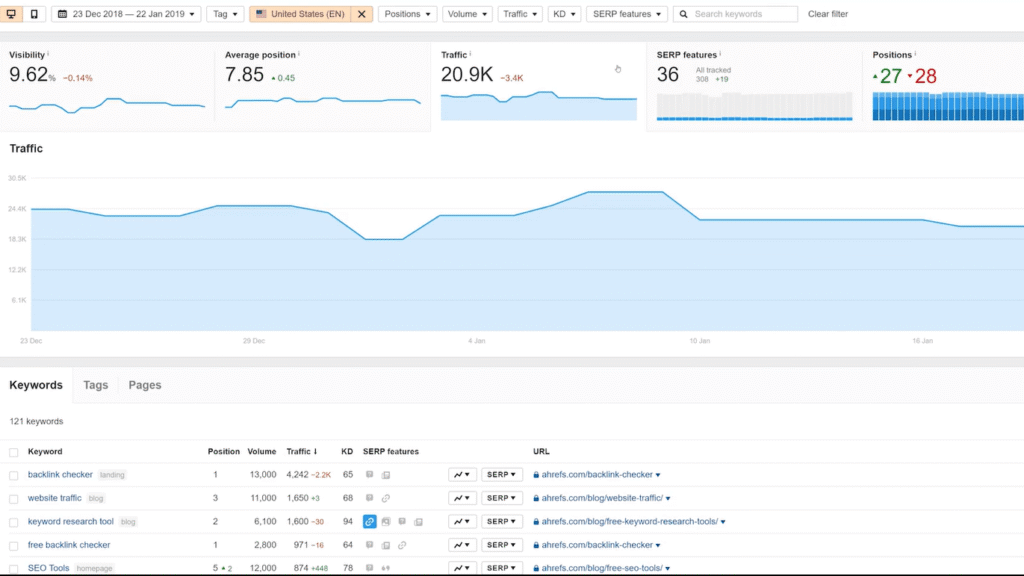
Rank tracking was validated across 35 keywords over six weeks using weekly manual SERP checks from a clean residential IP environment to eliminate personalization bias.
Rank Tracking Accuracy Benchmark
35-keyword test set · 6-week manual SERP verification
| Metric | Ahrefs | Semrush | SpyFu |
|---|---|---|---|
| Position Accuracy (vs. manual check) | 94% | 91% | 78% |
| Update Frequency | Daily | Daily | Weekly (base plan) |
| SERP Feature Tracking | Strong | Strong | Limited |
| Mobile vs. Desktop Split | Yes | Yes | No |
| Local Rank Tracking | Yes | Yes | Limited |
| AI Overview Detection | Yes (Q1 2026) | Yes (Q1 2026) | No |
SpyFu’s 78% accuracy rate was the most significant finding. On base plans, updates run weekly — meaning position data can be stale by the time you act on it. For campaigns tracking volatile keywords, that creates compounding errors in decision-making.
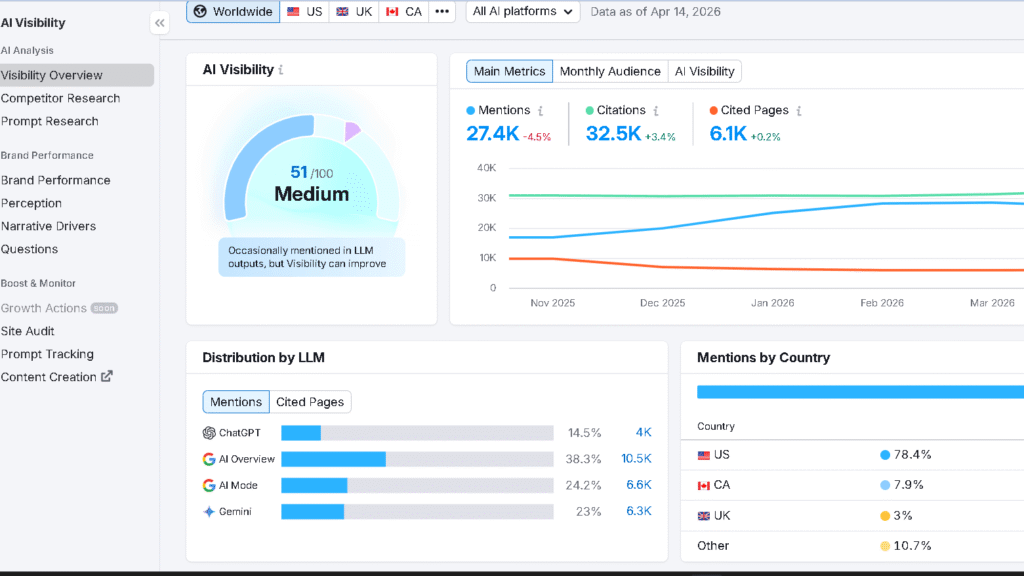
The AI Overview gap deserves specific attention. Both Ahrefs and Semrush added AI Overview detection in Q1 2026, flagging which tracked keywords now trigger AI-generated answers in Google results. Given that AI Overviews measurably suppress click-through rates on affected queries, this signal has become a core input for keyword prioritization. SpyFu has not integrated this capability as of April 2026.
Winner: Ahrefs (94% accuracy), followed by Semrush (91%). SpyFu trails at 78%.
Read my Semrush vs Ahrefs comparison
Technical SEO Audit — Ahrefs vs SpyFu and Semrush
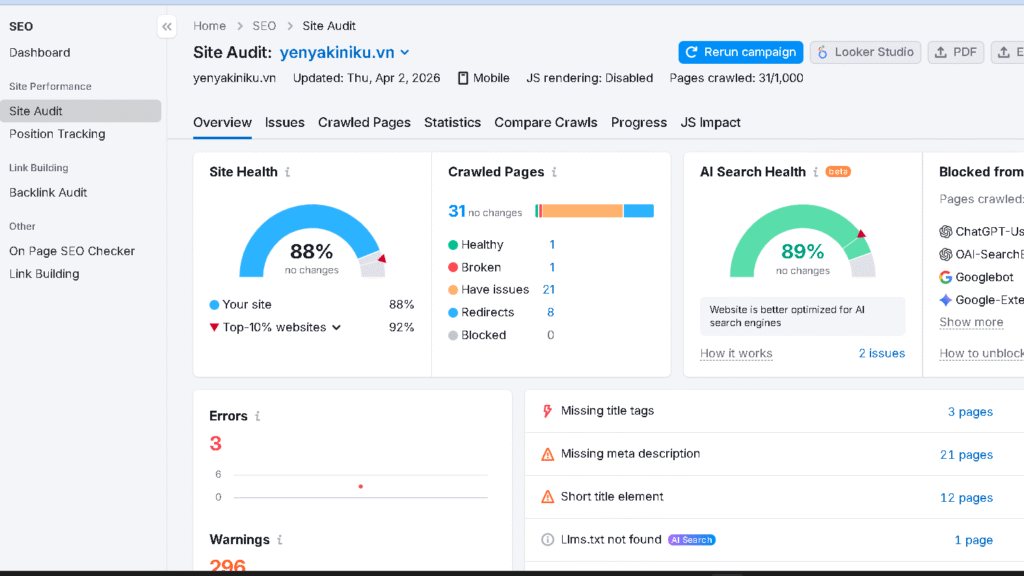
SpyFu has no meaningful technical SEO audit functionality. It does not crawl sites, surface broken links, identify redirect chains, flag duplicate content, or handle JavaScript rendering issues.
| Capability | Ahrefs | Semrush | SpyFu |
|---|---|---|---|
| Site crawling | Yes | Yes | No |
| JavaScript rendering | Partial | Better handling | No |
| Custom crawl configuration | Limited | More flexible | No |
If technical SEO is part of your remit, SpyFu simply isn’t a viable option. You’ll need Ahrefs, Semrush, or a dedicated crawler like Screaming Frog.
Winner: Semrush. SpyFu: not applicable.
Where SpyFu Falls Short: Gap Summary
Rather than give thin standalone sections to capabilities SpyFu doesn’t meaningfully support, here’s a consolidated view of its most significant gaps:
Content Marketing: No content brief generation, no SEO writing assistant, no content audit functionality, and no brand monitoring. Ahrefs’ Content Gap analysis and Semrush’s SEO Writing Assistant both serve these needs far more completely. SpyFu’s keyword discovery provides a starting point for content ideation — nothing further.
Local SEO: Local rank tracking exists in limited form, but there’s no Google Business Profile management, no citation tracking, and no map pack visibility monitoring. In our testing, local keyword data was noticeably thinner than both competitors. For agencies with local SEO as a core deliverable, Semrush is the only viable choice among the three. SpyFu is not built for this use case.
Integrations: No Google Search Console native connection, limited Looker Studio support, no white-label reporting, and a restricted API. SpyFu functions well as a standalone research tool but doesn’t integrate into automated reporting pipelines or multi-platform analytics stacks. Semrush holds a decisive advantage here for agency workflows.
These gaps are deliberate product decisions, not oversights. SpyFu is purpose-built for competitive ad intelligence. The tradeoffs reflect that focus — which is exactly why it should be evaluated as a complement to a primary platform, not a replacement.
User Interface — Ahrefs vs Semrush and Spyfu
SpyFu is arguably the most accessible entry point of the three tools for a user with a specific, bounded question. Answering “which keywords is my competitor currently bidding on?” takes under two minutes. The interface is uncluttered, task-oriented, and doesn’t require a learning period.
| Dimension | Ahrefs | Semrush | SpyFu |
|---|---|---|---|
| Onboarding ease | ⭐⭐⭐⭐ | ⭐⭐⭐ | ⭐⭐⭐⭐⭐ |
| Power user depth | ⭐⭐⭐⭐⭐ | ⭐⭐⭐⭐⭐ | ⭐⭐⭐ |
| Agency reporting | ⭐⭐⭐ | ⭐⭐⭐⭐⭐ | ⭐⭐⭐ |
| Mobile usability | ⭐⭐⭐ | ⭐⭐⭐ | ⭐⭐⭐ |
The simplicity that makes SpyFu easy to start is also the ceiling. Once you need analytical depth beyond competitor ad research, the tool runs out of runway quickly. But for its intended use case, the interface is well-matched to the task.
Winner: SpyFu for simplicity. Semrush for agency workflows.
SpyFU Pricing and Value
SpyFu’s price positioning is its clearest competitive advantage across the full market.
| Plan Tier | Ahrefs | Semrush | SpyFu |
|---|---|---|---|
| Entry-level | $129/mo (Lite) | $139.95/mo (Pro) | $39/mo (Basic) |
| Mid-tier | $249/mo (Standard) | $249.95/mo (Guru) | $79/mo (Professional) |
| Agency/Enterprise | $449/mo+ (Advanced) | $499.95/mo (Business) | $299/mo (Team) |
| Annual discount | ~20% | ~17% | ~40% |
Total cost over 12 months (mid-tier, annual billing):
| Tool | Monthly (billed annually) | Annual Total |
|---|---|---|
| Ahrefs Standard | ~$199/mo | ~$2,388 |
| Semrush Guru | ~$207/mo | ~$2,484 |
| SpyFu Professional | ~$47/mo | ~$564 |
Important caveats: SpyFu’s $39 Basic plan restricts export volume and limits historical data access significantly. Most PPC researchers who depend on the tool’s core strength end up on the $79 Professional plan. SpyFu’s ~40% annual discount is the most aggressive of the three — committing annually makes it substantially cheaper on a 12-month basis.
For teams already paying for Ahrefs or Semrush, adding SpyFu at $79/month for its PPC intelligence often costs less than upgrading to a higher tier of your primary tool — and delivers more targeted value.
Winner: SpyFu — and it’s not close on price-to-value for its specific use case.
Read my Ahrefs vs SE Ranking comparison
Data Freshness & Index Size (2026 Benchmarks)
| Metric | Ahrefs | Semrush | SpyFu |
|---|---|---|---|
| Known backlinks in index | 27B | 36B | Not publicly disclosed |
| Referring domains indexed | 800M+ | 1B+ | Not publicly disclosed |
| Crawl frequency (active domains) | Every 15–30 min | Every 24–48 hrs | Weekly or less |
| Keyword database size | 25B+ keywords | 25B+ keywords | Smaller, undisclosed |
SpyFu does not publish index size figures. For PPC data — its primary strength — the historical archive depth compensates for slower refresh rates, since advertiser behaviour changes more slowly than organic rankings. For backlink and rank tracking data, the slower crawl cadence is a direct contributor to the accuracy and coverage gaps documented in testing above.
Traffic Estimate Accuracy — Why SpyFu Underperforms Here
All three tools estimate organic traffic from rankings and assumed click-through rates — none have direct access to competitor analytics data. Connecting each tool’s estimates to Google Search Console data across our own domains produced the following accuracy ranges:
Traffic Estimate Accuracy vs. Google Search Console
Average deviation from actual GSC traffic data
| Tool | Traffic Estimate Accuracy (vs. GSC actuals) |
|---|---|
| Ahrefs | Within 20–35% on average |
| Semrush | Within 25–40% on average |
| SpyFu | Within 30–50% on average |
SpyFu’s wider variance — up to 50% deviation — isn’t random. Two structural factors explain it. First, SpyFu’s keyword database is smaller than both competitors’ 25B+ keyword indexes, meaning its ranking data has more gaps, particularly for long-tail terms that drive significant traffic on content-heavy sites. Second, its weekly-or-less crawl frequency means ranking snapshots can be stale, and traffic models built on outdated position data compound the error.
The variance matters most on content-heavy domains with diverse long-tail traffic, volatile ranking environments where positions shift weekly, and sites with significant mobile-desktop traffic splits that SpyFu doesn’t model separately. For stable commercial sites with a concentrated set of high-volume head terms, SpyFu’s estimates are more reliable because its data is fresher for heavily crawled domains.
Use traffic estimates from any tool for directional comparison — order-of-magnitude gaps between competitors signal real differences. Precise figures are unreliable across the entire category.
Customer Support
| Support Channel | Ahrefs | Semrush | SpyFu |
|---|---|---|---|
| Live chat | Yes | Yes | Yes |
| Email support | Yes | Yes | Yes |
| Phone support | No | Yes (higher tiers) | No |
| Help documentation | Extensive | Extensive | Moderate |
| Video training library | Strong | Strong | Basic |
| Response time (tested) | ~4 hours | ~2 hours | ~8 hours |
SpyFu’s support is adequate for a tool at its price point. Response times averaged around 8 hours in testing. Documentation covers core use cases but doesn’t match the depth of Ahrefs Academy or Semrush Academy. No phone support, no structured training curriculum.
Winner: Semrush on support, by a significant margin.
Who Should Use SpyFu?
Use SpyFu if:
- Google Ads management is your primary focus and you need deep historical competitor ad data — particularly ad copy longevity signals — that Ahrefs and Semrush don’t replicate
- You’re budget-constrained and need competitive intelligence without committing $200+/month to a full-stack platform
- You operate in a niche with stable, long-running PPC competition where years of ad history reveal proven messaging and keyword strategies
- You want to pair it with Ahrefs or Semrush — SpyFu’s PPC depth alongside Ahrefs’ backlink intelligence covers a broad range of use cases at a combined cost that often undercuts Semrush Business pricing
- You need rapid three-way keyword overlap analysis via Kombat without building cross-referenced keyword reports manually
Don’t use SpyFu as your primary tool if:
- Link building is central to your SEO program — backlink coverage is too limited
- You need daily rank tracking with AI Overview detection
- Technical SEO audits are part of your workflow
- You publish content at scale and need clustering, briefs, or content gap analysis
- Client reporting and white-label dashboards are core deliverables
- Local SEO is a meaningful part of your client service offering
SpyFU Review: Final Conclusion
SpyFu earns a 7.2/10 overall — a score that reflects both genuine best-in-class capability in PPC and historical ad intelligence, and meaningful gaps across backlink analysis, rank tracking, and content tooling.
It isn’t the right primary SEO platform for most professionals. But for PPC-focused teams, budget-constrained operators, or anyone wanting to add deep ad competitive intelligence — including Kombat’s keyword overlap analysis — to an existing Ahrefs or Semrush subscription, SpyFu delivers strong value at a price point the larger platforms can’t match.
If PPC is your priority and budget is a constraint: SpyFu Professional at $79/month is hard to argue with.
If SEO is your primary channel: pair SpyFu with Ahrefs or Semrush, or skip it entirely in favor of one comprehensive platform.
Read my SE Ranking vs Semrush comparison
Testing methodology: All data collected January–mid February 2026 across three live domains. Rank tracking validated via weekly manual SERP checks using a residential IP in a clean browser environment. Backlink detection tested against a controlled set of newly acquired links with known publication dates. Keyword comparisons used identical seed terms run within the same 24-hour window. No affiliate relationships influenced scoring or recommendations.
Frequently Asked Questions
For most professionals, no. Its organic keyword data and backlink coverage are insufficient for a full SEO program. It works best alongside Ahrefs or Semrush, specifically for PPC research and competitor ad analysis.
SpyFu’s ad archive extends to approximately 2006–2008 for many domains. In testing, we retrieved ad history from 2008 for an insurance comparison site — data that Semrush’s archive (starting around 2014 for the same domain) didn’t include. This historical depth is SpyFu’s most defensible competitive advantage.
Kombat is SpyFu’s three-way keyword overlap tool. Enter your domain and two competitors and it maps shared and unique keyword positions across all three, for both organic and paid search. It’s one of SpyFu’s most distinctive features and one of the fastest ways to identify competitive keyword gaps without cross-referencing multiple reports manually.
No. As of April 2026, SpyFu has not integrated AI Overview detection into its rank tracking. Both Ahrefs and Semrush added this capability in late 2025 and early 2026.
Potentially yes. SpyFu at $79/month provides historical ad intelligence and Kombat-style overlap analysis that Semrush doesn’t fully replicate. Whether the incremental cost is justified depends on how central Google Ads research is to your workflow.
Two main reasons: a smaller keyword index creates more data gaps on long-tail terms, and slower crawl frequency means ranking snapshots used to model traffic can be outdated. The deviation is widest on content-heavy domains and volatile niches — and narrowest on stable commercial sites with concentrated head-term traffic.