
Most Sudowrite reviews focus on features. This one focuses on what happens after weeks of real use. Sudowrite feels impressive immediately. Most AI writing tools do. The more interesting question is what happens after the second week, once the excitement fades and the writing stops feeling like a discovery. That is when you find out what a tool actually costs you.
I used Sudowrite every day for 30 days across three projects: a short story collection, a fantasy novel opening, and a set of character-driven scenes I had been stuck on for months. In the 200-suggestion acceptance test, I kept 89 suggestions in full or with light edits. That is a 44 percent keep rate overall. It dropped from 61 percent in week one to 31 percent by week four. That single number tells you more than any feature list will.
Sudowrite Review Quick Verdict
| Category | Verdict |
|---|---|
| Best for | Fiction writers with blank-page paralysis, fast drafters, burnout recovery |
| Worst for | Literary writers who need original depth, perfectionists, non-fiction |
| Biggest strength | Creative momentum on stuck scenes and brainstorming |
| Biggest weakness | Prose repetition and tonal flattening after extended use |
| Pricing | From around $19 to $59 per month |
| Overall verdict | Genuinely useful for two weeks. The friction that follows is real. |
The gap between week one and week four is the review. Everything else is context.
What Sudowrite Feels Like During the First Few Days
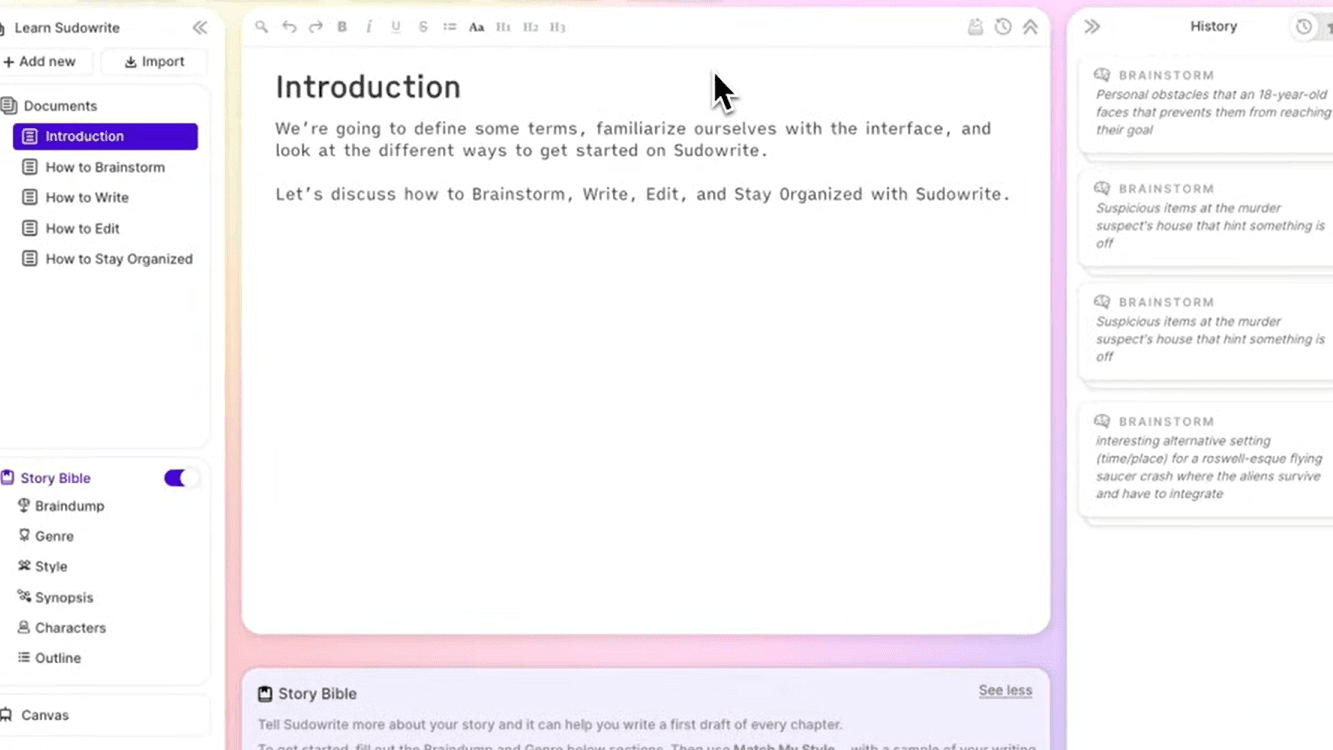
The onboarding is fast. You drop your manuscript into the editor, highlight a section, and pick what you need: a continuation, a rewrite, a brainstorm, a sensory description. The tool responds in two to four seconds. That is fast enough to stay inside the creative rhythm rather than breaking it every time.
The first output that stopped me came on day two. I was stuck on a scene where a character finds out her brother has died. I had written four versions and hated all of them. Sudowrite gave me an indirect approach that stayed inside the character’s body rather than spelling out the grief in plain terms. I kept it almost word for word. I probably should have been more suspicious of that.
That kind of early hit builds trust faster than the tool deserves. By day three I was running Sudowrite on almost every paragraph I felt uncertain about, which in a first draft is most of them. That felt like productivity. I understand now that it was something else.
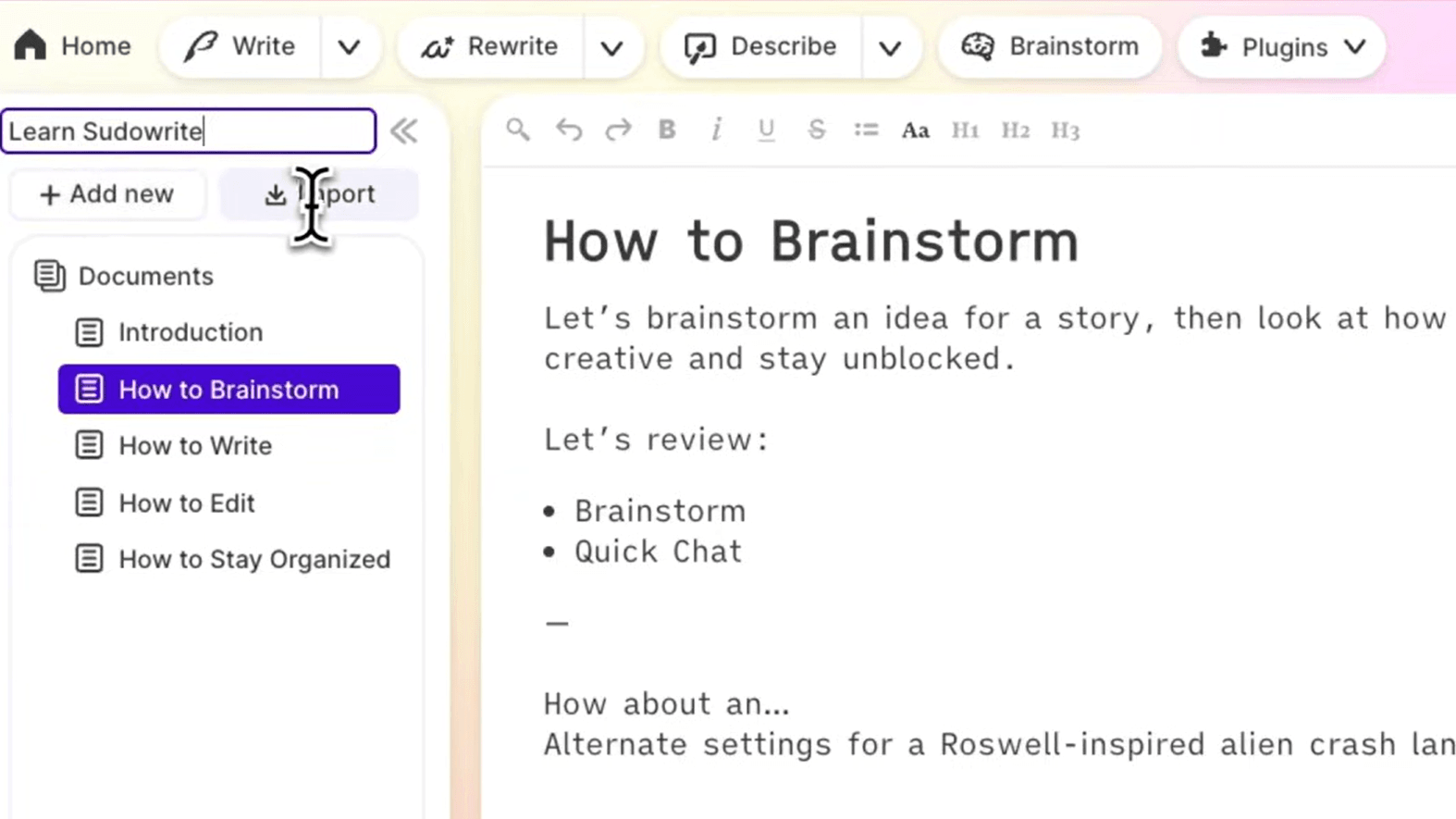
The brainstorm feature is the strongest part of the tool, and it stayed that way across the full month. You give it a character, a conflict, a scene question, and it returns eight to ten directions the story could go. I used it on seven stuck scenes in the first week. It gave me something usable on five of them. Named ideas. Emotional turns. Angles I would not have reached alone.
What Changes After Week Two
The repetition does not arrive all at once. It edges in. By day ten I was noticing similar phrasing across different scenes. Descriptions of rain. Descriptions of silence. The way faces look when people are trying not to cry. The vocabulary was overlapping in ways that felt less like a style and more like a pattern I had not chosen.
I ran a direct test on day fourteen. I asked Sudowrite to describe the same emotional beat, a character realising they are alone in a room, across six scenes in six different genres. Four of the six used the word hollow. Three used some version of the quiet pressed in. That is not random variation. That is a ceiling.
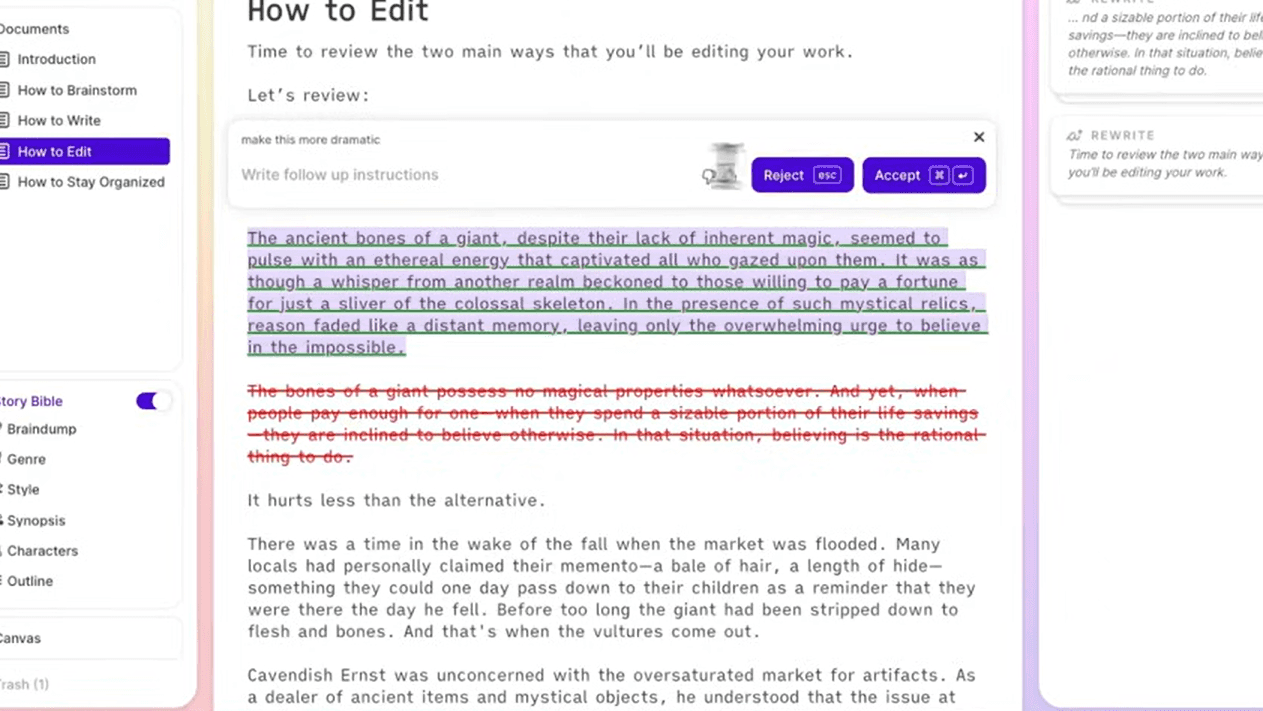
By week three I was editing Sudowrite output more heavily than I was using it. The tool had moved from creative partner to raw material supplier without any announcement. There is genuine value in raw material. It is just a different value than the one the marketing promises, and the price does not change to reflect the shift.
Sudowrite Experience Over Time
| Time Period | What Feels Good | What Starts Changing |
|---|---|---|
| Week 1 | Fast output, strong brainstorming, creative momentum | Very little visible friction |
| Week 2 | Still useful for scene generation | Repetition begins appearing |
| Week 3 | Brainstorm tool remains valuable | Editing burden rises noticeably |
| Week 4 | Useful for selective use | Tonal flattening becomes difficult to ignore |
| Long-Term | Effective for breaking writer’s block | Less effective as a primary writing partner |
What I had not expected was the effect on my own drafting. More on that later.
Sudowrite Features That Actually Matter in Daily Writing
The features that held up over 30 days are fewer than the list implies. The ones I returned to were the brainstorm tool, the rewrite function, and the describe feature for sensory detail.
The brainstorm tool is durable in a way the prose tools are not. Even in week four, when the sentence-level suggestions felt worn, the brainstorm panel was still returning directions I had not considered. The reason is simple. Ideas repeat less quickly than phrases. Operating at the concept level insulates it from the repetition problem longer.
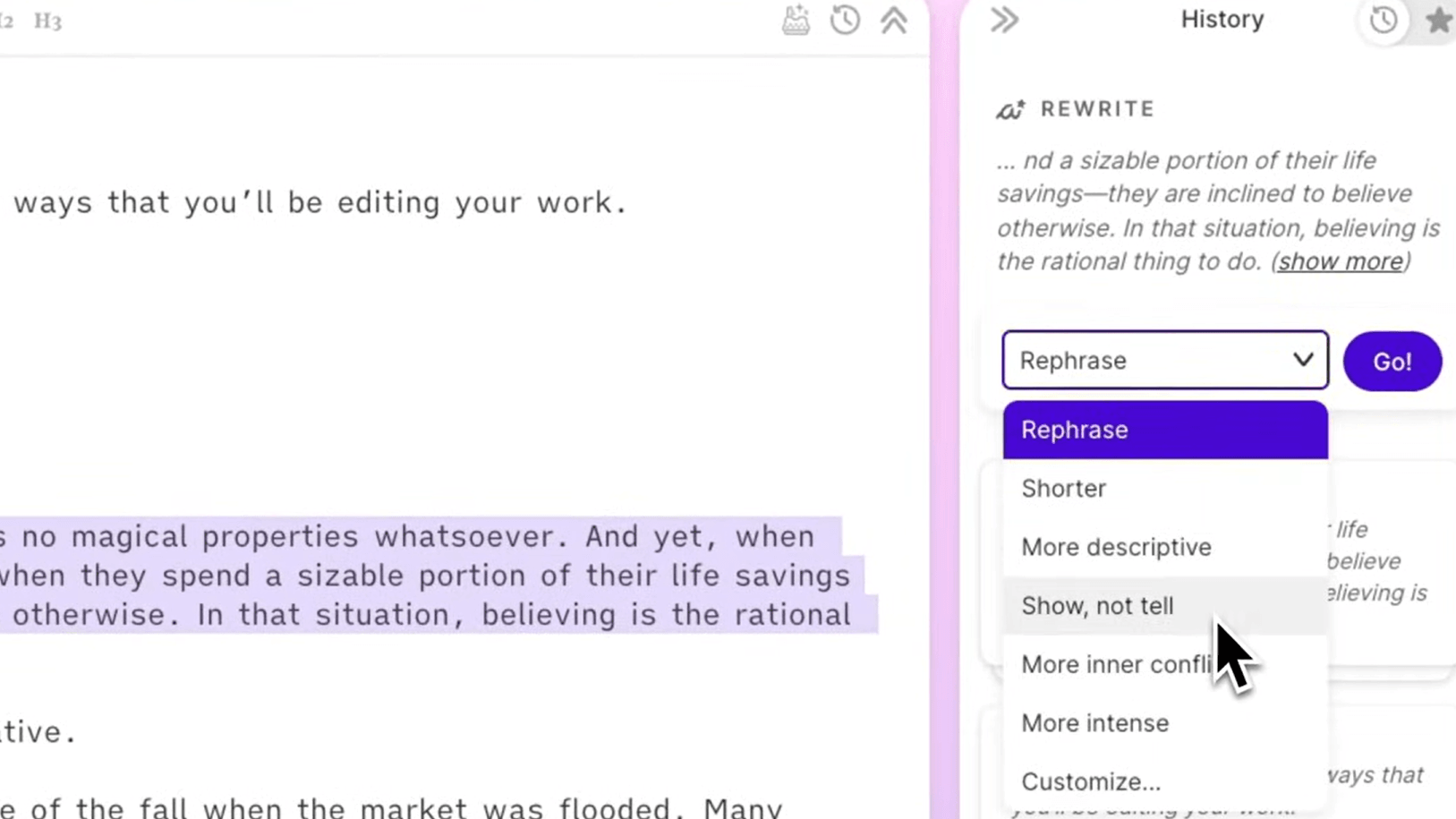
The rewrite function is more useful than the continuation feature, and I want to name that clearly because most Sudowrite guides lead with continuation. Rewrite gives you five alternatives on a sentence you already have. Continuation commits to one direction and keeps going. Options keep you in the driver’s seat. Continuation hands over the wheel.
The describe feature is strong early and weaker later. It generates sensory detail with real texture in the first couple of weeks. Warm wood. Cold glass. The smell of something close to burning. By week three those images started arriving in scenes where they did not quite fit, but Sudowrite offered them anyway. Not wrong. Just familiar.
The story engine is a separate tool designed for long-form projects. It asks you to build a story bible and commit a project to its structure. I ran one test project through it for two weeks. The coherence held at a basic level. The prose felt like a first draft of a first draft. It reads like scaffolding with aspirations.
Which Sudowrite Features Hold Up Best?
| Feature | Week 1 Value | Week 4 Value | Long-Term Verdict |
|---|---|---|---|
| Brainstorm | Excellent | Excellent | Most durable feature |
| Rewrite | Very Good | Good | Useful with selective use |
| Describe | Excellent | Moderate | Becomes repetitive |
| Continuation | Good | Moderate | Requires more editing over time |
| Story Engine | Promising | Mixed | Useful structure, weak prose |
Where Sudowrite Starts Becoming Frustrating
The first frustration is tonal flattening. Sudowrite writes in a kind of default literary register that is smooth, controlled, and broadly inoffensive. It does not write badly. It writes safely. Safe prose in fiction is a slow problem. You do not notice the risk it poses until you read back three chapters and everything sounds like it came from the same cautious place.
The second problem took me longer to name. Sudowrite draws from a set of roughly ten recurring images across different scene types. Light through windows. Weight in the chest. The ground under your feet. Something described as hollow. These are not clichés in the traditional sense. They are competent literary images. The problem is that they appear whether or not they belong. The tool reaches for comfort. Fiction, as a rule, should not.
The third problem is the one that bothered me most, because it was about me and not the tool. By week two I was reaching for Sudowrite on sentences I could have written myself. Not because I was stuck. Because the suggestion felt faster than trusting my own judgment. That is a habit that looks like efficiency from the inside. It took me until week three to see what it actually was.
To be fair, this is not unique to Sudowrite. Any tool that reduces friction in a task can create dependency on that reduction. But writers who are already anxious about their output are the most vulnerable to it, and they are also the most likely Sudowrite customers. The anxiety does not dissolve when you outsource the sentence. It relocates.
Sudowrite Pricing: Is It Worth Paying For Long-Term?
| Plan | Monthly Price | Words Per Month | Best For | Real Limitation |
|---|---|---|---|---|
| Hobby | Around $19 | 30,000 | Occasional use, short projects | Gone in four to five active days |
| Professional | Around $29 | 90,000 | Regular fiction writers | Enough for consistent use |
| Max | Around $59 | 300,000 | Heavy drafters, high-volume use | High cost when keep rate drops |
The Hobby plan runs out faster than it sounds. 30,000 words looks generous until you account for brainstorm outputs, multiple rewrites of the same scene, and the describe feature pulling additional word count. A writer doing real daily work will hit the ceiling by midweek. That friction is clearly intentional.
The Professional plan at $29 per month is where the honest math happens. In week one at a 61 percent keep rate, $29 felt easy to justify. By week four at 31 percent, I was holding the price differently in my head. The subscription does not adjust when the value does.
Whether it is worth it long-term comes down to one question: are you using it on specific stuck moments or running it across everything you write? The first use case holds value. The second one erodes faster than the billing cycle.
Sudowrite vs ChatGPT for Fiction Writing
These tools solve different problems and compete less directly than the comparison searches suggest.
| Category | Sudowrite | ChatGPT |
|---|---|---|
| Fiction-specific tools | Strong out of the box | Weak without heavy prompting |
| Prose quality for literary fiction | Higher, less setup needed | Generic without context |
| Workflow speed | Fast, low friction | Slower, prompt-dependent |
| Repetition over time | Visible by week three | Present but different patterns |
| Editing burden | Medium and growing | High from the start |
| Pricing | $19 to $59 per month | Free to $20 per month |
| Best use case | Stuck scenes, early drafting | Structure, revision, interrogation |
ChatGPT demands more from you upfront. Context, tone, voice, character history. Sudowrite absorbs some of that automatically when your manuscript is in the editor. Less setup means faster flow. It also means less control over what the tool is reaching for.
In practice, ChatGPT gives you control without momentum and Sudowrite gives you momentum without control. Early in a draft, momentum usually wins. Later in a draft, control matters more. Most writers who use both end up switching between them depending on where they are in the project rather than committing to one.
Writers focused on fiction usually compare Sudowrite with ChatGPT or NovelAI. Content marketers and bloggers often look elsewhere. In my Writesonic review, I found a tool built much more around marketing workflows, SEO content, and production speed than creative storytelling.
Sudowrite vs NovelAI
NovelAI is built for genre fiction, specifically the end of the market that wants atmosphere, commitment to strangeness, and prose that leans into its genre rather than softening for a general reader. The comparison with Sudowrite is less a features comparison than a personality comparison.
I ran the same grief scene through both tools. Sudowrite returned something restrained and emotionally measured. NovelAI returned something rawer, stranger, and harder to use directly, but more interesting as a starting point. NovelAI was more willing to go somewhere specific. Sudowrite was more worried about going somewhere wrong.
For writers who work in fantasy, horror, or science fiction and do not mind heavier editing in exchange for more vivid output, NovelAI is worth a serious look. For writers who want clean prose they can drop into a draft with minimal cleanup, Sudowrite is the better daily tool. The editing burden question is the real deciding factor.
Is Sudowrite Right for You?
| Writer Type | Recommendation |
|---|---|
| Fiction writers with writer’s block | Strong fit |
| Fast first-draft writers | Strong fit |
| Burned-out writers needing momentum | Strong fit |
| Literary fiction writers | Use cautiously |
| Perfectionists | Probably not a good fit |
| Non-fiction writers | Better alternatives exist |
| Writers expecting complete manuscripts | Not recommended |
Who Should Actually Use Sudowrite
Fiction writers who hit a wall on specific scenes will get real value here. The brainstorm and describe tools are genuinely good at unsticking a scene that has been sitting for days. That is a concrete and common problem, and Sudowrite handles it better than anything else I have tested at this price.
Writers recovering from creative burnout are also a reasonable fit. The tool works as a pressure valve. You hand it the scene, take eight options back, and pick the one that feels least wrong. That process can restart creative momentum that has gone quiet without requiring the full weight of an original decision.
Fast drafters who treat first drafts as raw material and expect to rewrite most of it will also hold value here longer than writers who edit as they go. Writing against a suggestion is often faster than writing from silence, and faster drafts give you more material to revise toward something good.
Who Should Avoid Sudowrite
Literary writers who need their prose to feel distinctively their own will run into the ceiling quickly. Sudowrite writes in a register that is smooth rather than individual. Smooth is useful. It is not the same as distinctive, and the gap between them is exactly where literary fiction lives.
Perfectionists will struggle with the rejection math. When you are keeping 31 percent of suggestions, the tool costs you reading time on every session. That is not a time saving dressed as efficiency. It is a time cost that grows the longer you rely on the tool broadly rather than selectively.
Writers expecting Sudowrite to carry a whole project should lower that expectation before they subscribe. Scenes, yes. Sentences, yes. Story logic, emotional arc, structural decisions, thematic coherence. Those remain entirely yours, regardless of how the tool is described.
The Real Reason Writers Keep Paying for Sudowrite
It is not the prose quality. By week three, most writers have already noticed the repetition and the flattening. They keep paying because the blank page is still frightening and Sudowrite makes it go away.
That is a real thing to buy. Blank-page anxiety is one of the most common and least talked-about problems in a writing practice, and it is genuinely hard to solve on your own. Having a tool that always gives you something to react to, that removes the silence between your last sentence and the next one, is a kind of relief that does not show up in any feature comparison.
The honest framing is this. The emotional value of that relief is separate from the literary value of the output. They are not the same purchase. Most writers paying for Sudowrite after the first month are paying for the relief. That is a legitimate reason. It is worth knowing, clearly, that that is what you are paying for.
Best Alternatives to Sudowrite
| Tool | Best For | Emotional Position | Prose Style |
|---|---|---|---|
| ChatGPT | Structural work, flexible brainstorming | High control, lower momentum | Generic without heavy setup |
| Claude | Long-form consistency, voice preservation | Measured, less spontaneous | More contextually aware, higher ceiling |
| NovelAI | Genre fiction, immersive drafting | Rawer, more committed to strangeness | Willing to go somewhere specific |
| Jasper | Marketing copy, non-fiction | Commercial, fast | Polished but not literary |
| GrammarlyGO | Light editing and clarity | Safe, low-risk | Corrective rather than generative |
Claude is the alternative I would point literary fiction writers toward most directly. It holds character voice better across longer projects, takes specific instructions without drifting away from them, and produces prose that varies more in rhythm. If you’re deciding between general-purpose AI assistants, my Claude vs ChatGPT comparison explores where each tool performs better during long-form writing and creative workflows.
If your goal is publishing blog content rather than fiction, optimization tools become more important than creative drafting tools. My Surfer SEO review explains how content optimization fits into a publishing workflow once the writing is finished.
NeuronWriter takes a similar approach but focuses more heavily on content optimization and search intent analysis. In my NeuronWriter review, I found it more useful for SEO-focused articles than creative projects where originality matters more than rankings.
Pros and Cons After Long-Term Use
| Pros | Cons |
|---|---|
| Brainstorm tool stays useful across the full month | Prose repetition visible by week two |
| Fast, low-friction workflow from inside the editor | Tonal flattening that grows slowly and arrives all at once |
| Describe feature generates real texture early on | Dependency formation, the quiet kind you do not notice |
| Reliable at unsticking blocked scenes | Hobby plan caps too low for serious daily use |
| Rewrite function gives options rather than direction | Story engine output reads like ambitious scaffolding |
| Genuinely reduces creative paralysis | Keep rate drop by week four changes the value calculation |
Sudowrite Review: Final Verdict
Sudowrite earns its subscription price for a specific kind of writer at a specific stage of the work. The brainstorm tool is the strongest and most durable feature. The prose generation tools are strong early and predictable later. The story engine is ambitious and currently underwhelming. The dependency risk is real and worth naming before you build a writing habit around the tool.
The ceiling arrives around week three. By then the recurring images are familiar, the tonal patterns are visible, and the editing burden has quietly grown to match what the tool was supposed to replace. Writers who adapt by using Sudowrite more selectively get more from it long-term than writers who run it across every uncertain sentence.
What Sudowrite gives you is momentum. Momentum is genuinely valuable. It is not the same as voice, and voice is what fiction ultimately runs on. Go in knowing that distinction and the tool earns its place. Go in hoping the tool will write the novel for you, and you will be disappointed somewhere around day twelve.
The apps are solid. The prose is not always.
FAQ
For fiction writers dealing with paralysis on specific scenes, yes. The brainstorm and rewrite tools carry real value in the first two weeks, and the brainstorm tool holds that value longer. Long-term ROI depends almost entirely on whether you use the tool selectively or broadly.
Not robotic. Smooth is the more accurate word, and smooth is a different problem. The prose is clean and competent but gravitates toward safe, familiar imagery over time.
For early drafting and stuck scenes in a novel, yes. For holding consistent voice, emotional arc, and structural logic across a full-length manuscript, it requires heavy human oversight.
No. It produces scenes and sentences. It does not produce story logic, emotional truth, character motivation, or thematic coherence. Those remain entirely the writer’s responsibility, regardless of how the tool is positioned. Sudowrite is a drafting assistant.
For fiction-specific workflows with low setup friction, yes. Sudowrite produces cleaner literary prose out of the box and does not require the prompt engineering that ChatGPT needs for good fiction output.
Yes, reliably by week three. In the 200-suggestion acceptance test, keep rate fell from 61 percent in week one to 31 percent by week four. Prose vocabulary, recurring imagery, and sentence rhythm repeat across different scenes and genres.