
This is the latest piece in the NenaWow Generative Engine Shopping Index. I have now tested the same 50 shopping prompts across ChatGPT, Claude, and Google AI Mode, using the same categories and the same method for recording recommendations.
The question was simple. Does Google AI Mode hold one fixed favorite in each product category, or does the answer move once I change a few words? After 50 prompts, the answer is clear. It moves. Sometimes it moves a lot.
Table of Contents
How I Ran the Test
I used 10 categories: wireless headphones, laptops, running shoes, coffee makers, office chairs, robot vacuums, moisturizers, air fryers, smartwatches, and travel backpacks. Each category got five prompts, one general question followed by four variations built around budget, use case, audience, or a price ceiling.
I recorded the first concrete product Google AI Mode named as the top pick. Where I had the full response saved, I also logged the runners-up, the sources cited, and how the ranking order shifted between prompts. That extra detail turned out to matter more than I expected.
I need to flag one honest gap before going further. Three of the five laptop results and four of the five running shoe results were not fully preserved from the live test session. I am not filling those in from memory or guessing. What I kept for both categories confirms the prompt structure and one full result each, and I have marked exactly where the gap sits in the table below.
Google AI Mode Product Recommendations: Which Brands Win?
Here is how many different brands took the number one spot within each five-prompt group, based on the complete data I have.
| Category | Different #1 brands | Pattern |
|---|---|---|
| Robot vacuums | 2 | Highly concentrated |
| Travel backpacks | 3 | Concentrated |
| Wireless headphones | 3 | Concentrated |
| Coffee makers | 3 | Concentrated |
| Moisturizers | 3 | Concentrated |
| Office chairs | 4 | Highly intent-sensitive |
| Air fryers | 4 | Highly intent-sensitive |
| Smartwatches | 4 | Highly intent-sensitive |
| Laptops | Incomplete data | 2 of 5 results preserved, both Apple |
| Running shoes | Incomplete data | 1 of 5 results preserved |
Robot vacuums sit at the tight end, splitting between just two brands across all five prompts. Office chairs, air fryers, and smartwatches sit at the loose end, changing brand on nearly every version of the question. That range is the finding, and it holds even with two categories still short on data.
Air Fryers Gave Five Prompts, Four Different Winners
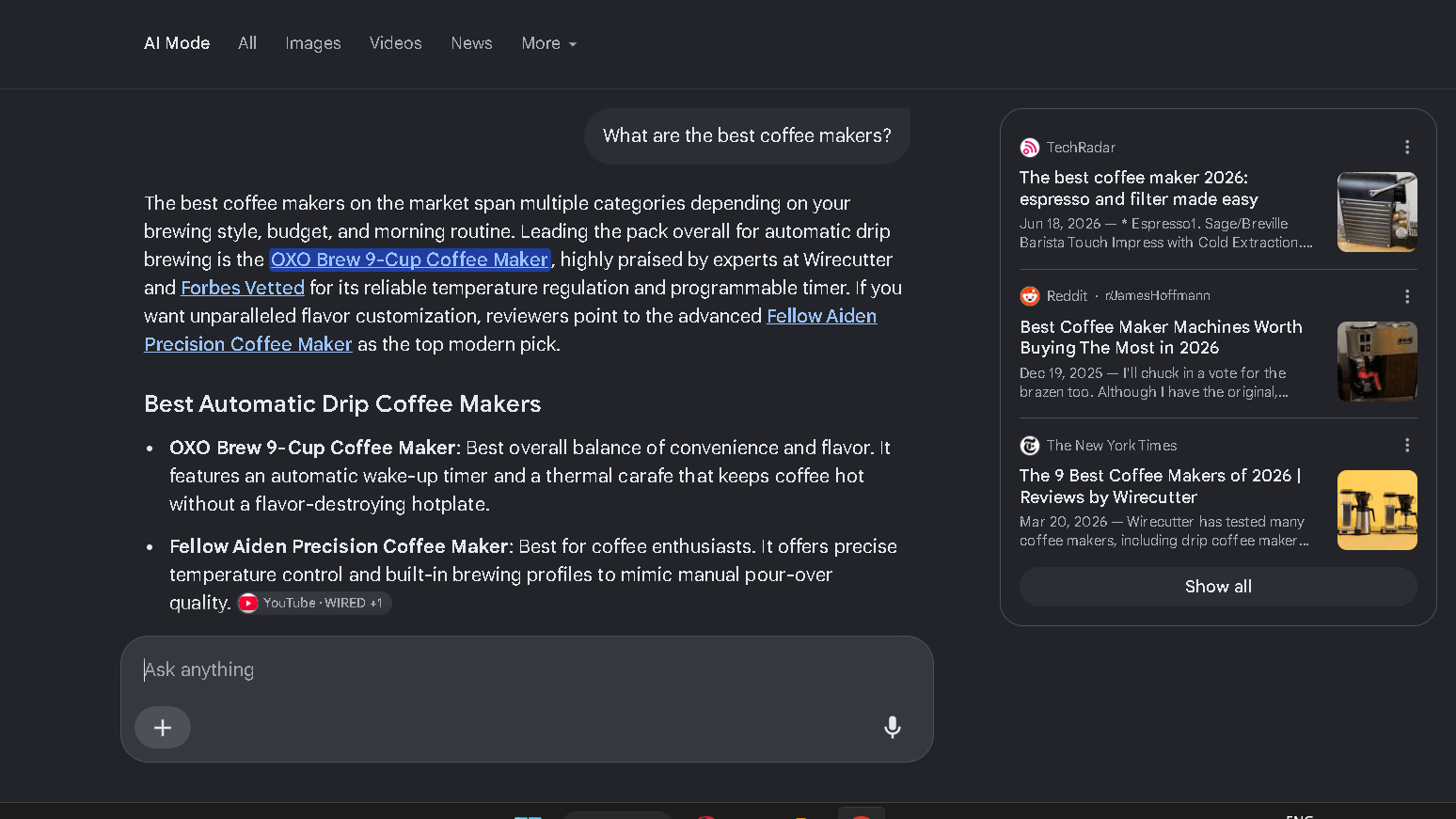
Air fryers made the pattern obvious fast. The general query returned the Instant Pot Vortex Plus. Budget returned the Gourmia GAF486. Family returned the Ninja Foodi DZ550. Compact returned the Instant Pot Vortex Mini. Under $150 returned the Cosori TurboBlaze.
Ninja shows up across nearly every air fryer result in this study, yet it only reached the top spot once, on the family-sized query specifically. That gap between showing up and winning is worth sitting with. Wide visibility and the number one position are not the same thing here.
Osprey and tomtoc Survived Every Backpack Query
Travel backpacks gave me the cleanest data in the whole study, because I had all five full responses intact. That let me track exact rank position, not just whether a brand appeared at all.
Osprey’s Farpoint or Fairview 40 showed up in all five prompts. Its position moved from #2 on the general query to #3 on carry-on, #3 again on international, #2 on budget, and finally #1 on the under-$150 prompt. That is a brand holding a spot near the top no matter how the question changed.
tomtoc’s Navigator T-66 also appeared in all five prompts, but its path looked completely different. It sat at #7 on the general query, barely visible. Budget moved it straight to #1. Carry-on dropped it to #5. International held it at #5. Under $150 brought it back up to #2. Generic search barely notices tomtoc. The moment budget enters the prompt, it jumps to the top.
How Google AI Mode Product Recommendations Change With Budget
Backpacks made this easiest to see, but it repeated across the study. Cotopaxi, Aer, and Peak Design all dominate the general, carry-on, and international backpack prompts. All three disappear the moment price becomes the constraint. Under $150, the list shifts to Osprey, tomtoc, REI, and Bagsmart, and none of the premium names return.
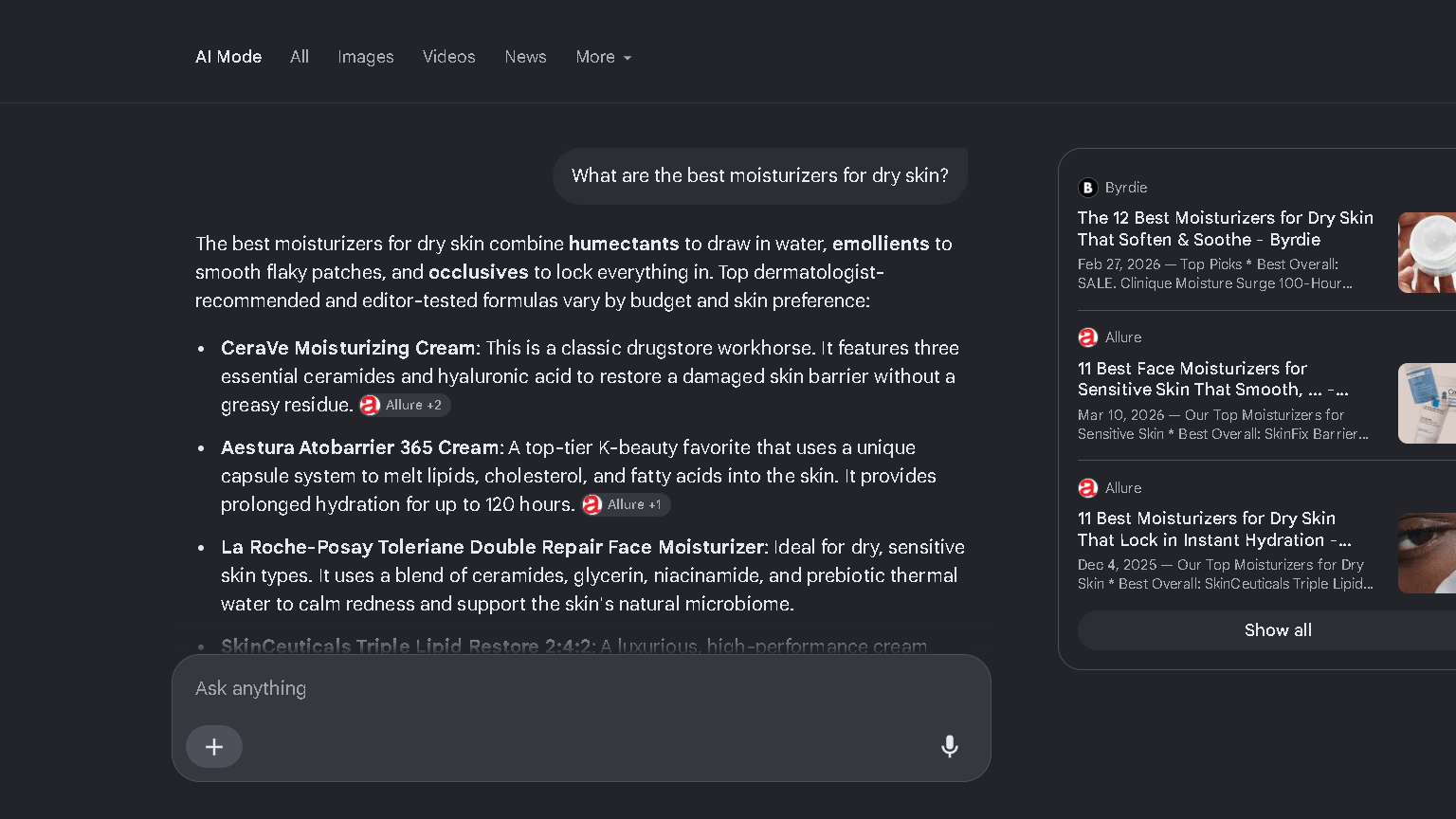
The same thing happened with robot vacuums. General favored the Dreame X60 Max Ultra Complete. Budget switched straight to the Roborock Q10 S5+, which then repeated as the winner for the under-$500 prompt too. Moisturizers followed the pattern as well. CeraVe won both the dry-skin prompt and the budget prompt outright, which suggests Google links that brand to affordability almost as strongly as it links it to sensitive or dry skin.
Here is the issue with treating “best X” and “best budget X” as the same search. They are not. They pull from different shortlists, sometimes with zero overlap at all.
Google AI Mode Product Recommendations Change by Use Case
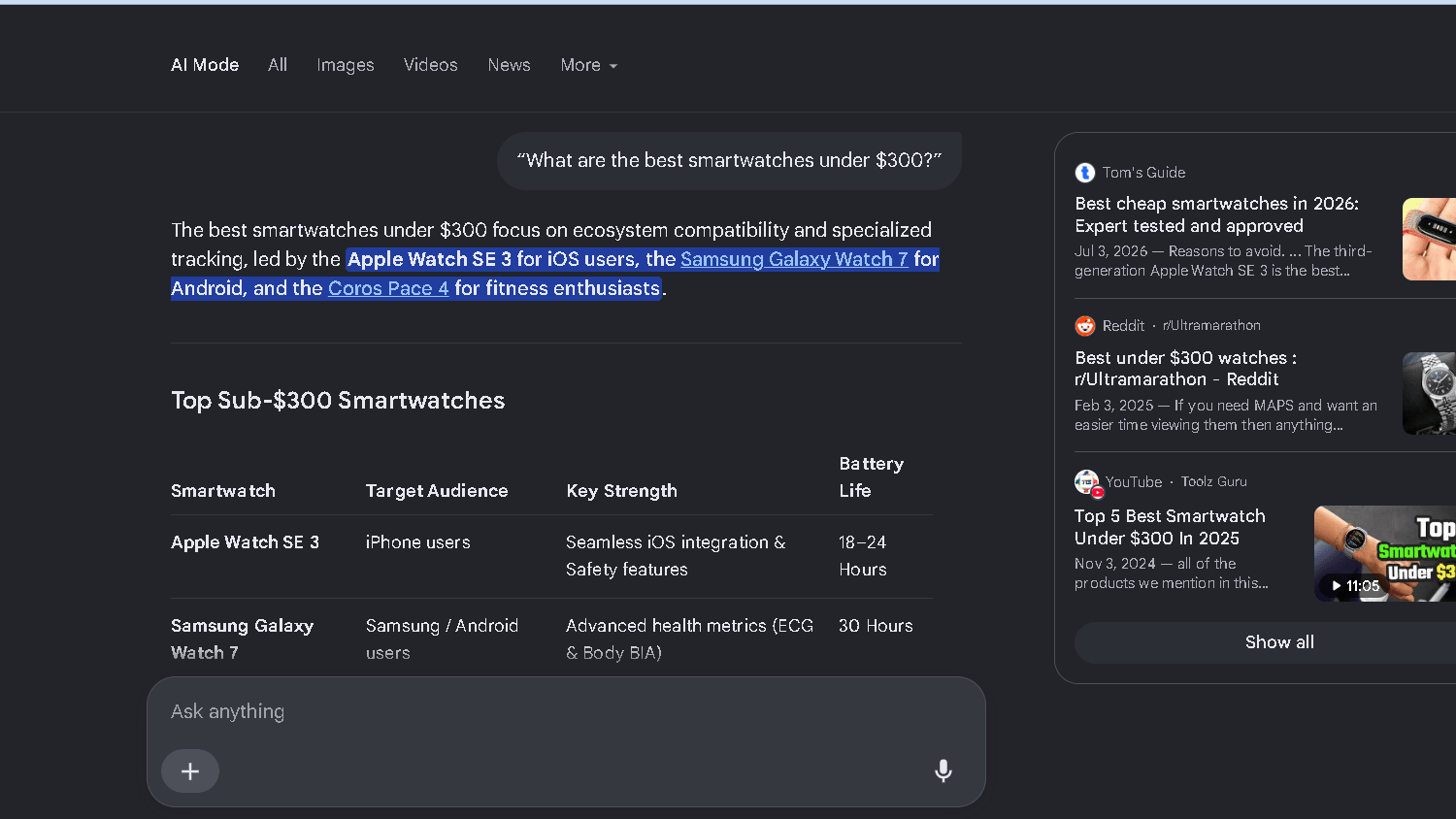
Smartwatches told a similar story to backpacks, just organized around phone compatibility instead of price alone. The general query split by device: Apple Watch Series 11 for iPhone users, Samsung Galaxy Watch 8 for Android. Budget pulled in the Huawei Watch Fit 4. Fitness tracking pulled in the Garmin Vivoactive 6, beating both Apple and Google’s own Pixel Watch on that specific use case.
So is Google picking one favorite smartwatch? Not really. It is picking a favorite for the specific person asking, and compatibility overrides almost everything else once it enters the question.
Robot Vacuums and Office Chairs Split Along Different Lines
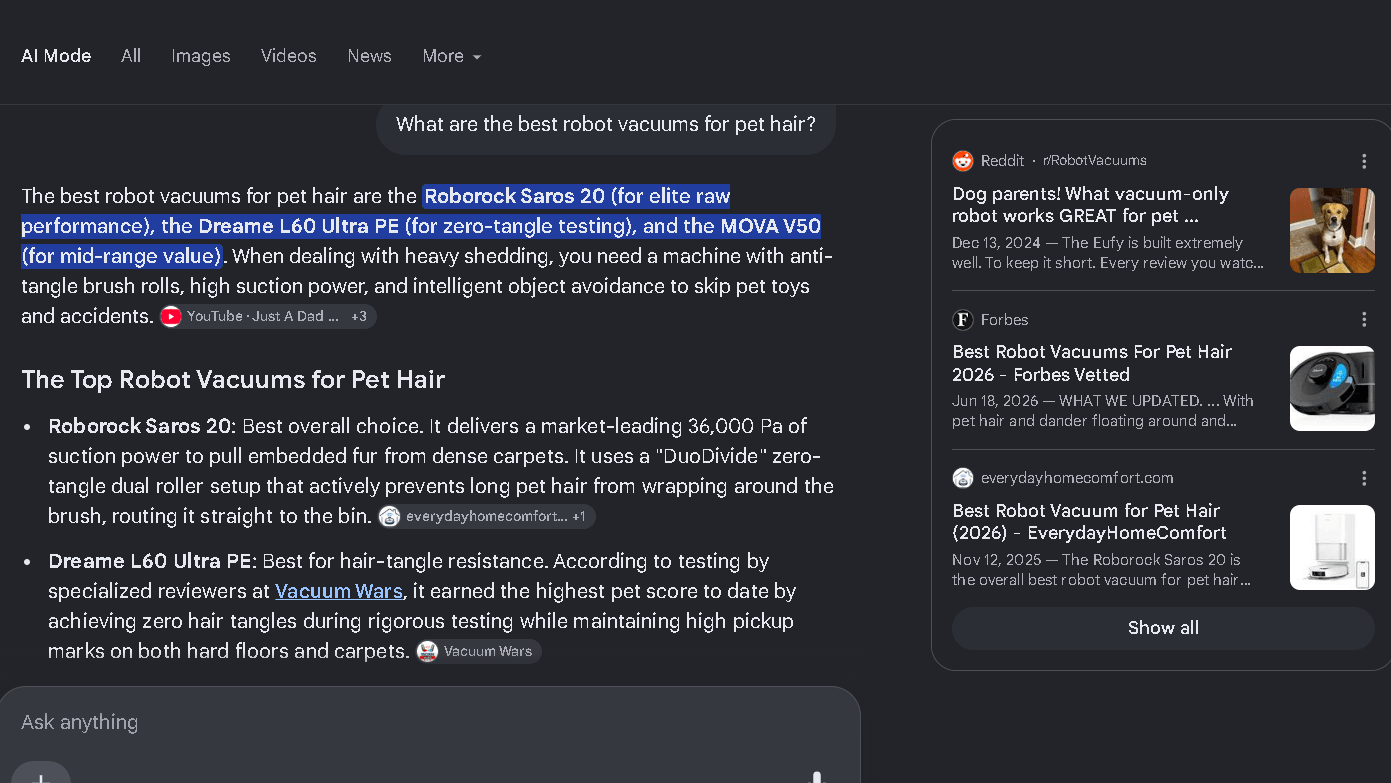
Robot vacuums stayed the most concentrated category in the study, splitting between just two brands across all five prompts. Dreame took general and pet hair. Roborock took budget, hardwood, and under $500. But the exact model never repeated for either brand. Q10 S5+ won budget and under $500. Saros 10R won hardwood on its own. Same brand, different product, matched to the job.
Office chairs went the other way, splitting four ways across five prompts. Herman Miller Aeron led the general query. Sihoo M57 took budget. Steelcase Gesture took both ergonomic and work-from-home. Colamy took the strict under-$300 prompt outright, a name that never appeared in the general or ergonomic results at all. That is a product built almost entirely around one price bracket, at least based on what Google surfaced here.
Brand Totals Across the Complete Data
Counting the first-named product for every prompt with full data, here is how the top brands stacked up.
| Brand | #1 appearances |
|---|---|
| Apple | 4 |
| Sony | 3 |
| Roborock | 3 |
| Cotopaxi | 3 |
| Ninja | 3 |
| Steelcase | 2 |
| Dreame | 2 |
| CeraVe | 2 |
| La Roche-Posay | 2 |
| Instant Pot | 2 |
| OXO | 2 |
Apple’s total includes both of the preserved laptop results, so treat that number as partial rather than final. Sony’s three wins came entirely from headphones, on the general, travel, and noise-cancelling prompts. Cotopaxi’s three wins came entirely from backpacks, on general, carry-on, and international. Ninja’s three came from two different categories, coffee makers and air fryers, which is a wider spread than Sony or Cotopaxi managed inside one category alone. Raw totals hide that kind of difference if you do not look underneath them.
How Google AI Mode Chooses Product Recommendations
What separated these answers from a plain product list was the reasoning attached to each pick. For hardwood-floor robot vacuums, Google talked about roller material, water control, and scratch avoidance. For pet-hair vacuums, it shifted to tangle resistance and waste avoidance. For small-kitchen coffee makers, it gave actual countertop widths. For family air fryers, it focused on basket capacity and dual-zone cooking.
That tells me the system is not just matching keywords to products. It is building a small case for why a specific product fits the specific job in the prompt. The reasoning changed as much as the product did.
Sources Behind Google AI Mode Product Recommendations
Across the 50 prompts, I saw citations from Wirecutter, WIRED, CNET, PCMag, Forbes, RTINGS, TechRadar, GearLab, RunRepeat, Pack Hacker, Allure, Byrdie, Vacuum Wars, and Reddit threads, among others. That range covers professional testing labs, general editorial outlets, niche specialist sites, and community discussion, often inside the same answer.
That mix matters for anyone thinking about visibility here. A single glowing review on one site is unlikely to be the whole story. Google’s shopping answers read like a synthesis of several source types working together, not a copy of one outlet’s ranking.
Several prompts also triggered a follow-up question instead of an immediate pick. Google asked about flooring type before finishing a robot vacuum answer, about phone ecosystem before a smartwatch pick, about skin type, family size, and kitchen space in their respective categories. The visible answer to a broad prompt is sometimes only the opening move.
Where the Test Has Real Limits
I want to be straight about this part, because it matters for how much weight you put on the results. Three of the five laptop results and four of the five running shoe results were not preserved with product-level detail from the live session. I am not guessing at those numbers. What survived from those two categories confirms the prompt structure and nothing beyond that.
Every prompt in this test also ran once. I did not rerun any query to check for day-to-day variance, so I cannot say how stable a single result would be if I asked again tomorrow. This is a snapshot from one testing window, not a permanent map of Google’s shopping behavior.
So I am not claiming permanent rankings here. I am not claiming to have reverse-engineered how Google ranks products internally. What I have is a documented pattern from the prompts I could fully record, over a short window. That is a real signal. It is not proof of a fixed algorithm.
A Framework Worth Testing Further
Based on what showed up across this test, brand visibility in Google AI Mode looks like it breaks into at least four separate signals. Brand coverage, or how often the name shows up at all. SKU persistence, or whether the exact same product survives multiple versions of the question. Rank stability, or whether that product stays near the top when intent shifts, the way Osprey did. Intent ownership, or whether one product becomes the default answer to a specific need, the way Garmin did with fitness tracking.
This is my proposed framework for reading this kind of data, built from what I observed in this test. It is not Google’s formula, and I am not claiming it is. But treating those four signals separately gave me a much clearer picture than lumping everything into one “does the brand appear” checkbox.
The Bottom Line
The biggest lesson from this round was not that Google has a locked list of favorite products. It was that changing two or three words in a shopping question can pull up an almost entirely different shortlist, and how much it changes depends on the category.
Robot vacuums stayed tight around two brands. Office chairs, air fryers, and smartwatches split four ways apiece. Osprey and tomtoc both proved that surviving every version of a question is possible, they just got there by very different routes, one through steady rank and one through a single sharp jump on price.
For anyone trying to show up in these answers, the target keeps narrowing. Owning “best [category]” is one goal. Owning “best budget [category]” or “best [category] for [specific job]” looks like a separate and, in several cases here, more achievable one.
Related Reading
Claude Product Recommendations 2026: I Tested 50 Prompts
How Does ChatGPT Decide What Products to Recommend?
Do News Websites Block AI Crawlers? I Tested 13 Major Publishers
How I Found My Own AI Search Visibility Gap
HubSpot AEO Grader Review (2026): I Tested It on My Website
How to Check AI Visibility for Free (With Real Data From My Site)
AI Visibility Benchmark 2026: I Tested 9 Leading SEO Websites
FAQ
Does this prove how Google AI Mode ranks products internally?
No. This documents what Google AI Mode returned across the prompts I could fully record, during one testing window. It shows a pattern in the outputs, not the mechanism behind them.
Why are the laptop and running shoe sections thinner than the rest?
Three of the five laptop results and four of the five running shoe results were not fully preserved from the original test session. Rather than invent numbers to fill the gap, I reported only what survived intact and marked the rest as missing.
Is Osprey now the safest brand to recommend for travel backpacks?
Within this test, Osprey held a top-three spot across all five backpack prompts, which is a strong pattern. I would not call that a permanent guarantee. It is a signal worth tracking over a longer window, not a settled fact.
Should brands stop targeting the generic “best [category]” search?
Not entirely, but this test suggests it should not be the only target. Several strong performers here, including tomtoc and Garmin, won by owning one specific version of the question rather than the broad one.