
I went into this test expecting Claude to have a fixed shortlist of favorite products in each category. That happened sometimes. It did not happen consistently.
I ran 50 shopping prompts through Claude Sonnet 5 across 10 product categories. Five prompts per category, each one shifting the intent while the product stayed the same. Same headphones question, five different angles. Same laptop question, five different angles. I wanted to know one thing: how much does the wording of a shopping question change Claude product recommendations?
The result surprised me more than I expected. CeraVe took every single moisturizer prompt. Five for five, no matter how I asked. Coffee makers went the other way completely. Five prompts, five different winning brands, zero repeats. That gap is the whole story of this test — Claude’s product recommendations can be rock-solid in one category and wide open in another, and the only thing that changed was the angle of the question.
Table of Contents
How I Ran the Test
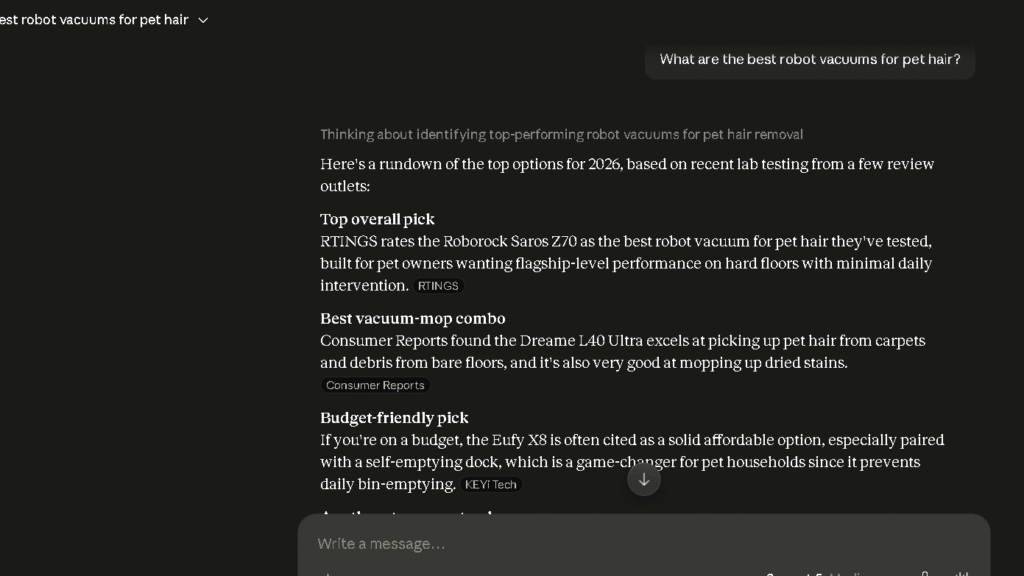
I picked 10 categories: wireless headphones, laptops, running shoes, coffee makers, office chairs, robot vacuums, moisturizers, air fryers, smartwatches, and travel backpacks. For each one, I asked a general “best” question, then four variations that changed budget, use case, compatibility, or a price ceiling.
I recorded the first concrete product Claude named as the number one pick. That rule mattered because Claude did not always declare a clean winner. Sometimes it gave a table. Sometimes it asked me a question first. Sometimes it offered a “best overall” and three runners-up in the same breath. To keep the method consistent, I always logged the first real product recommendation in the final answer.
Each prompt ran once. I am not claiming this reveals Claude’s ranking algorithm. I am reporting what Claude returned during this specific test, in this specific account, on these specific days. That distinction matters, and I will come back to it.
The Concentration Numbers, Category by Category
Here is how many different brands took the number one spot within each five-prompt group.
| Category | Different #1 brands | Pattern |
|---|---|---|
| Moisturizers | 1 | Maximum concentration |
| Laptops | 2 | Highly concentrated |
| Wireless headphones | 2 | Highly concentrated |
| Air fryers | 2 | Highly concentrated |
| Robot vacuums | 3 | Moderate concentration |
| Running shoes | 4 | Highly intent-sensitive |
| Office chairs | 4 | Highly intent-sensitive |
| Smartwatches | 4 | Highly intent-sensitive |
| Travel backpacks | 4 | Highly intent-sensitive |
| Coffee makers | 5 | Maximum fragmentation |
That range is the finding. One brand owned an entire category. Five prompts in coffee makers produced five different brands. Nothing in between explains both of those results with the same story.
CeraVe Owned Moisturizers Completely
CeraVe won all five moisturizer prompts. Dry skin, budget, sensitive skin, SPF, and under thirty dollars. Every single one came back CeraVe.
The exact product moved. Dry skin and budget and sensitive skin all pointed to the plain CeraVe Moisturizing Cream. Once SPF entered the question, Claude switched to the AM Facial Moisturizing Lotion, first at SPF 50, then at SPF 30 for the under-thirty prompt. So the brand held. The product underneath it did not.
That is worth sitting with for a second. Brand dominance and product dominance are not the same thing. CeraVe captured the brand layer in full. It only captured one specific product at the SKU layer, and even that shifted once SPF came up.
Coffee Makers Fell Apart Completely
Coffee makers ran in the opposite direction. General question, budget question, small kitchen question, built-in grinder question, under-150 question. Five prompts. Five different winning brands. No repeats at all.
General pointed to Technivorm. Budget pointed to Hamilton Beach. Small kitchen pointed to Bodum. Built-in grinder pointed to Breville. Under 150 dollars pointed to OXO. The generic “best coffee maker” answer gave me almost no signal about what would win once I added a real constraint.
This is the clearest evidence in the whole test that generic visibility and use-case visibility are not the same thing. A brand could be Claude’s answer to “best coffee maker” and still lose every specific version of that question. Coffee makers showed that distinction more clearly than any other category in my test.
Apple Held Laptops, But Not the Same Laptop
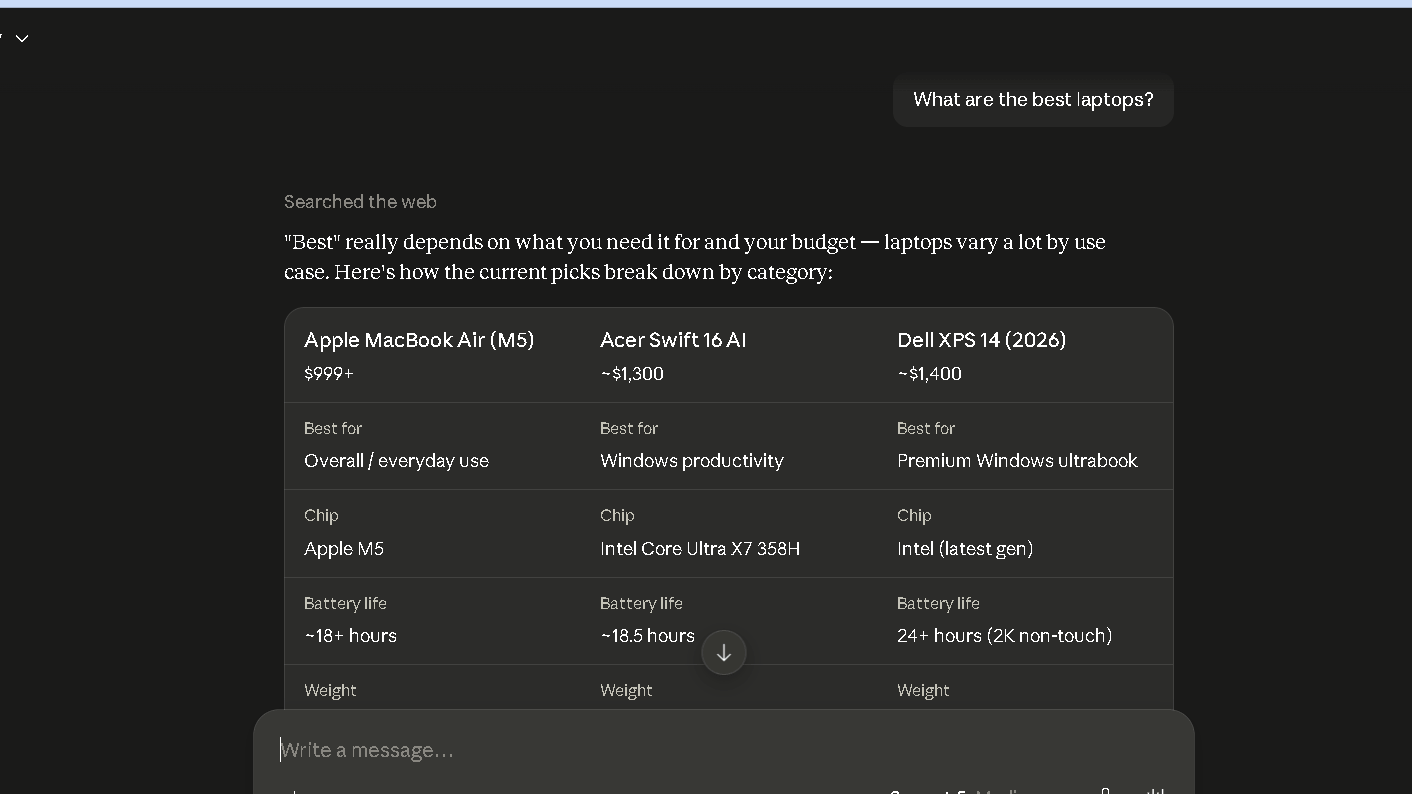
Apple took four of the five laptop prompts. General, college students, video editing, and under $1,000 all came back Apple. The one loss was the budget prompt, where Claude picked the Lenovo IdeaPad Slim 3x instead.
Apple did not win every prompt with the same machine. Claude moved between the MacBook Air M5, the MacBook Air M4, and the MacBook Pro M4 Pro or Max depending on the use case. Same brand, different machine, matched to the specific ask.
That pattern repeats what I saw with CeraVe. Owning the brand slot does not mean owning one fixed product. Claude adjusted the exact pick to fit the intent even while keeping the brand steady.
Sony Owned Performance, Soundcore Owned Price
Headphones split cleanly along one line. Sony WH-1000XM6 took the general prompt, the travel prompt, and the noise-cancelling prompt. Three wins in a row on anything performance-related.
The moment price became the constraint, Sony disappeared. Budget headphones went to a Soundcore option. Under $100 went to the Soundcore Space One. Sony never showed up once price entered the question.
That is a clean split. Sony held the broad and performance-driven prompts. Soundcore held the price-sensitive ones. Neither brand tried to compete outside its lane, at least not in this test.
Air Fryers Became a Two-Brand Race
Only two brands ever hit number one in the air fryer category. Ninja and COSORI split all five prompts between them.
Ninja won the general question and the family-oriented question, both with the Foodi DZ550. COSORI took the rest: budget, compact, and under $150, split between the TurboBlaze and the Lite CAF-LI211. So Ninja owned the broad and family use case. COSORI owned everything priced or sized down.
That is use-case ownership inside a single category, and it showed up almost as cleanly as the Sony versus Soundcore split.
Smartwatches Moved With Every Single Constraint
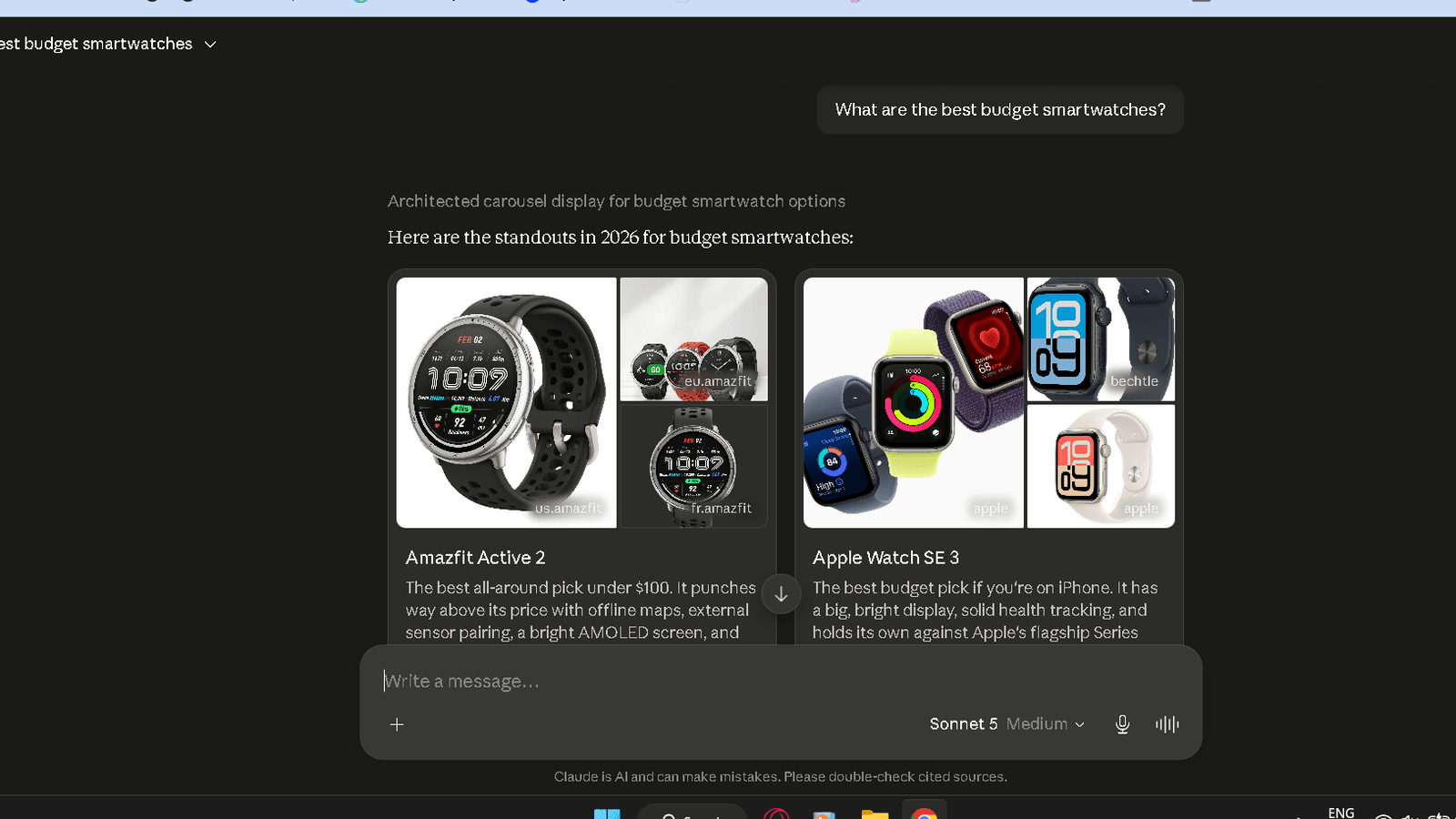
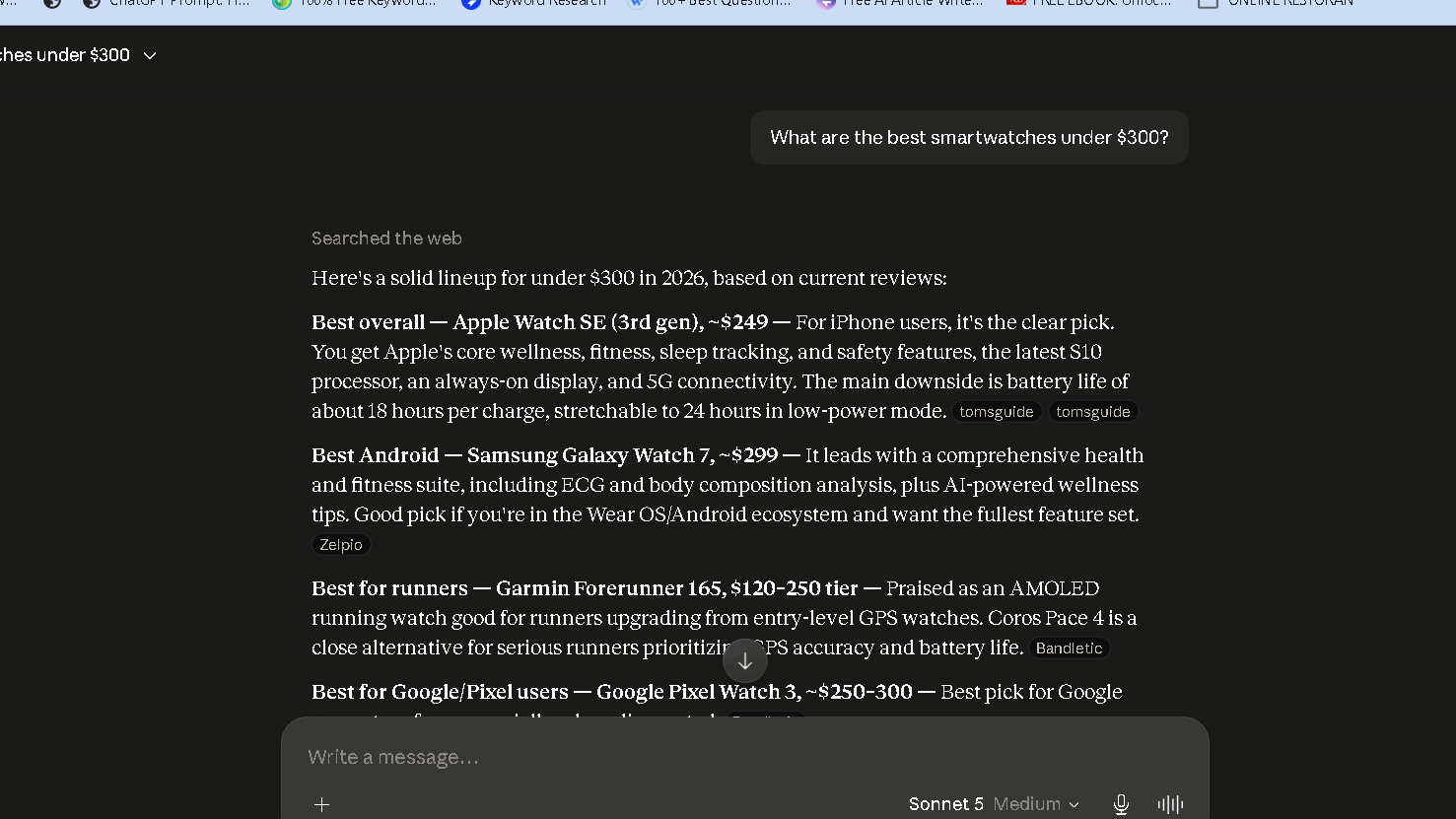
Smartwatches gave me the sharpest intent-switching of the whole test. General went to the Apple Watch Series 11. Budget went to the Amazfit Active 2. Fitness tracking went to the Garmin fenix 8. Android compatibility went to the Samsung Galaxy Watch 8. Under $300 came back to Apple, this time the Watch SE.
Four brands, five prompts. Apple only won twice, and even then with two different watches. What struck me most was the Android result. Apple lost that one instantly the moment compatibility became the deciding factor. Compatibility overrode everything else Apple had going for it in the general query.
So is it worth treating a category like this as one market? Not based on what I saw here. Smartwatches behaved like five separate decisions wearing one product label.
Running Shoes, Office Chairs, Robot Vacuums, and Travel Backpacks
The rest of the categories landed somewhere between CeraVe’s total lock and coffee makers’ total scatter.
Running shoes split four ways. ASICS took the general query, New Balance took both budget and long-distance, Brooks took beginners, and HOKA took the walking-and-running combination prompt. New Balance was the only brand to repeat.
Office chairs also split four ways. Steelcase held general, Branch held budget, Herman Miller held both ergonomic and work-from-home, and SIHOO took under $300. Herman Miller was the one repeat winner.
Robot vacuums split into three clear territories. Dreame took general and under $500. Roborock took pet hair and hardwood floors, both. eufy took budget on its own. Travel backpacks split four ways too, with Peak Design holding general and carry-on, while REI, Cotopaxi, and Osprey each took one price or use-case prompt.
Brand Totals Across All 50 Prompts
Apple led the raw count with six number-one finishes. CeraVe followed with five. Sony and COSORI tied at three each.
| Brand | #1 appearances |
|---|---|
| Apple | 6 |
| CeraVe | 5 |
| Sony | 3 |
| COSORI | 3 |
| New Balance | 2 |
| Herman Miller | 2 |
| Dreame | 2 |
| Roborock | 2 |
| Ninja | 2 |
| Peak Design | 2 |
Raw totals hide something important here. Apple’s six wins came from two entirely different categories, laptops and smartwatches. CeraVe’s five wins all came from one category. Apple showed strength that crossed categories. CeraVe showed strength that ran deep inside a single one. Those are different things, and treating them as the same number would miss the point.
Budget Meant Something Different in Every Category
Claude did not seem to apply one fixed idea of what counts as cheap. The Amazfit Active 2, priced around $100 to $130, got called the best pick under $100 for the budget smartwatch prompt. That is already a stretch at the top end.
The Branch Ergonomic Chair, priced at $359, got labeled the best all-around budget pick for office chairs. REI’s Ruckpack 40 at roughly $140 counted as budget for travel backpacks, while Osprey’s Farpoint at around $160 was the answer for the under-$150 prompt, which sits slightly outside that ceiling itself.
What that means is Claude appeared to judge budget relative to what a normal price looks like inside each category, rather than against one universal low number. A $359 office chair and a $130 smartwatch got the same “budget” label because each one sits low for its own market. Worth noting: prompts using a hard number, like “under $150,” produced more literal, consistent answers than prompts using the word “budget” alone.
Two Kinds of Visibility, Not One
Claude did not present results the same way twice. Some answers came with product cards and images. Some cited RTINGS or Consumer Reports by name. Some gave me a plain list with no source at all. A few asked me a clarifying question before naming anything.
That means there are really two separate layers worth measuring here. One is recommendation visibility: does Claude actually name the brand as the answer? The other is presentation visibility: does it also show an image, a retailer link, or a named source backing the pick? A brand can win the first without getting the second. I saw that happen more than once in this test.
Named sources that showed up repeatedly included RTINGS, Consumer Reports, Tom’s Guide, TechRadar, Forbes, Engadget, and RunRepeat, among others. Claude leaned on phrases like “top pick,” “clear consensus winner,” and “across multiple test labs” when citing that kind of authority. I cannot say from this test how much those sources actually drove the pick versus simply got mentioned alongside it. That causal link is a question for a different study.
Where the Test Has Real Limits
I want to be straight about this part, because it matters for how much weight you put on the results. Claude occasionally pulled in context from outside the prompt itself, including things tied to my own account, like regional details and past conversation history. That means this was not a clean, anonymous benchmark. It was Claude responding inside an account that already had some context loaded.
I also ran every prompt exactly once. Fifty prompts give a real pattern across categories, but they do not tell me how much a single prompt’s answer would shift if I ran it again tomorrow. Claude could give a different pick on a rerun. I have no way to know from this data alone.
So I am not claiming permanent rankings here. I am not claiming to have reverse-engineered how Claude ranks products internally. What I have is a documented pattern from 50 real prompts, run once each, in one account, over a short window. That is a real signal. It is not proof of a fixed algorithm.
What This Means If You Sell a Product
The practical question changes once you see this data. Asking “does Claude recommend my brand for best headphones” is only half the picture. The more useful question is which specific shopper problem Claude already connects your product to.
Garmin owns fitness tracking in smartwatches, not the whole category. Roborock owns pet hair and hardwood floors, not robot vacuums broadly. COSORI owns budget and compact air fryers, while Ninja holds the general and family slot. Herman Miller owns ergonomic and work-from-home office chairs specifically, not office chairs as a whole.
None of those brands needed to dominate their category to show up as the answer. They needed to own one narrow, valuable version of the question. That is a smaller target, and in this test, it looked like an achievable one.
The Bottom Line
After 50 prompts, the real lesson was not that Claude keeps a fixed list of favorite brands. It was that the answer moves with the shopper’s intent, and how much it moves depends entirely on the category.
CeraVe never lost a single moisturizer prompt. Coffee makers never repeated a winner across five tries. Most categories landed somewhere in between, splitting three or four ways once a real constraint entered the question. That range tells you something the average “best of” list never will.
The opportunity is not becoming Claude’s universal answer for an entire category. It is becoming the obvious answer to one specific, valuable question. That is a smaller goal. It is also a more realistic one.
Related Reading
How Does ChatGPT Decide What Products to Recommend?
Do News Websites Block AI Crawlers? I Tested 13 Major Publishers
How I Found My Own AI Search Visibility Gap
HubSpot AEO Grader Review (2026): I Tested It on My Website
How to Check AI Visibility for Free (With Real Data From My Site)
AI Visibility Benchmark 2026: I Tested 9 Leading SEO Websites
FAQ
Does this study prove how Claude’s recommendation algorithm works?
No. It documents outputs from 50 prompts run once each, in one account. It does not reveal Claude’s internal ranking logic, and I am not claiming that it does.
Why did some categories stay locked to one brand while others split five ways?
I cannot say for certain from this data. What I can say is that categories with a strong reputational leader, like CeraVe in moisturizers, held together tightly, while categories with many valid use cases, like coffee makers, split apart the moment a real constraint entered the prompt.
Should brands try to win the general “best” query first?
Based on this test, winning the general query did not guarantee winning the specific ones. Coffee makers, running shoes, and smartwatches all showed the generic winner losing once budget, fitness, or compatibility became the deciding factor. A narrower, well-owned use case looked just as valuable as the broad win.
Could these results change if the prompts were run again?
Yes. Each prompt ran once, and Claude could return a different pick on a rerun. This is a pattern from one test window, not a permanent ranking.