
I signed up for AthenaHQ‘s free tier and ran it against nenawow.com for a full month. Not a demo account. Not a screenshot from their sales page. My own site, my own prompts, my own citation numbers.
The short version: the free tier gave me a real mention rate, a real citation rate, and a root cause for why a competitor was beating me on five specific searches. It also failed to deliver a promised report, mixed up my own pricing tier, and never once mentioned WordPress anywhere in its integrations. Both things are true, and this review holds both at once.
AthenaHQ Review: Nena’s Quick Verdict
AthenaHQ’s free Essential tier gives you real prompt-level data, not a teaser. My July numbers came back honest, if thin: a 44.4% mention rate and a 27.6% share of voice against named competitors, plus a diagnosis that traced a competitor’s entire lead to one domain. The free lead-gen “10-minute audit” on the homepage, though, took nearly two hours and never arrived at all.
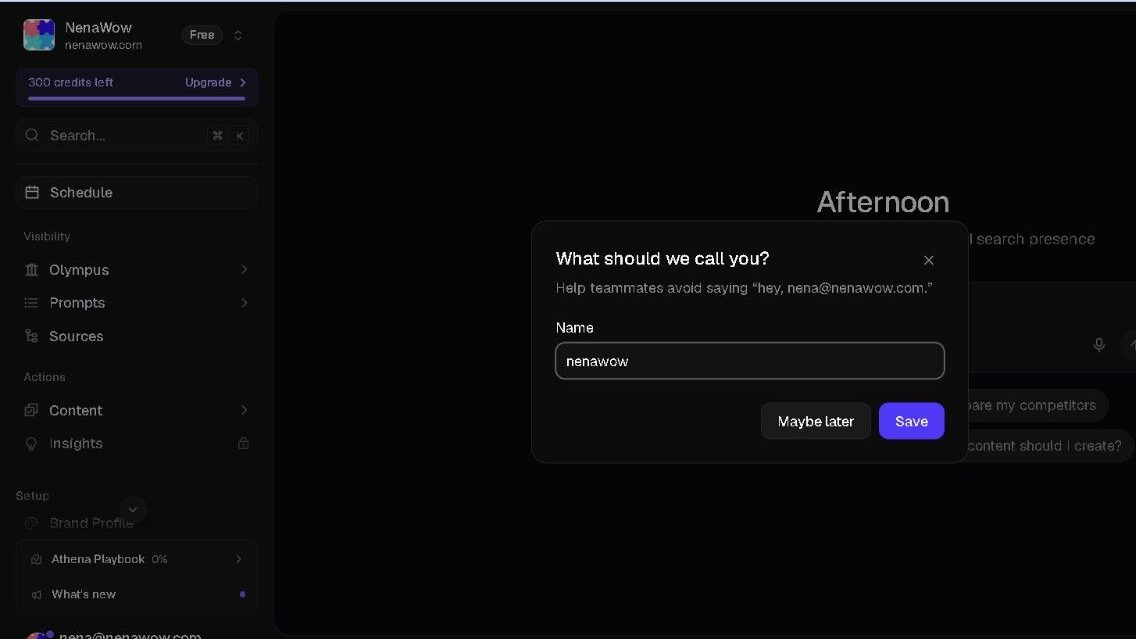
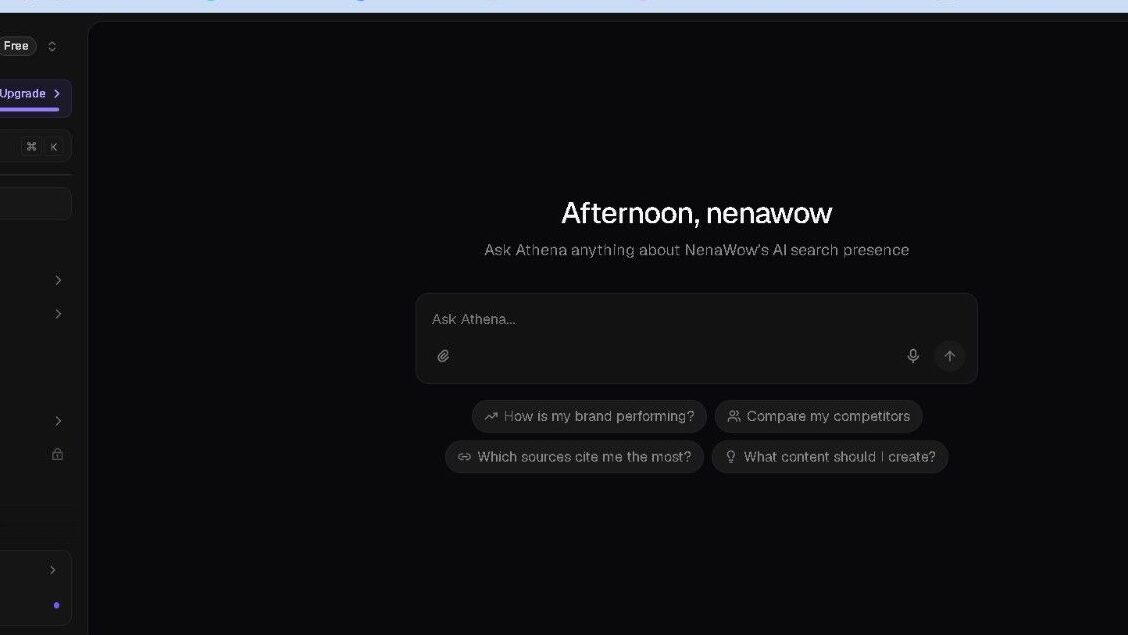
Table of Contents
What I Actually Tested
I did two separate things here. First, the homepage’s free “Get Free Audit” flow, the one promising results in 10 minutes. Second, when that stalled, I signed up for the actual Essential free account instead and ran a month of real tracking on nenawow.com, connected to my own Google Search Console account for keyword data. Everything past this point is labeled by which of the two produced it.
The Free Audit Funnel Didn’t Deliver
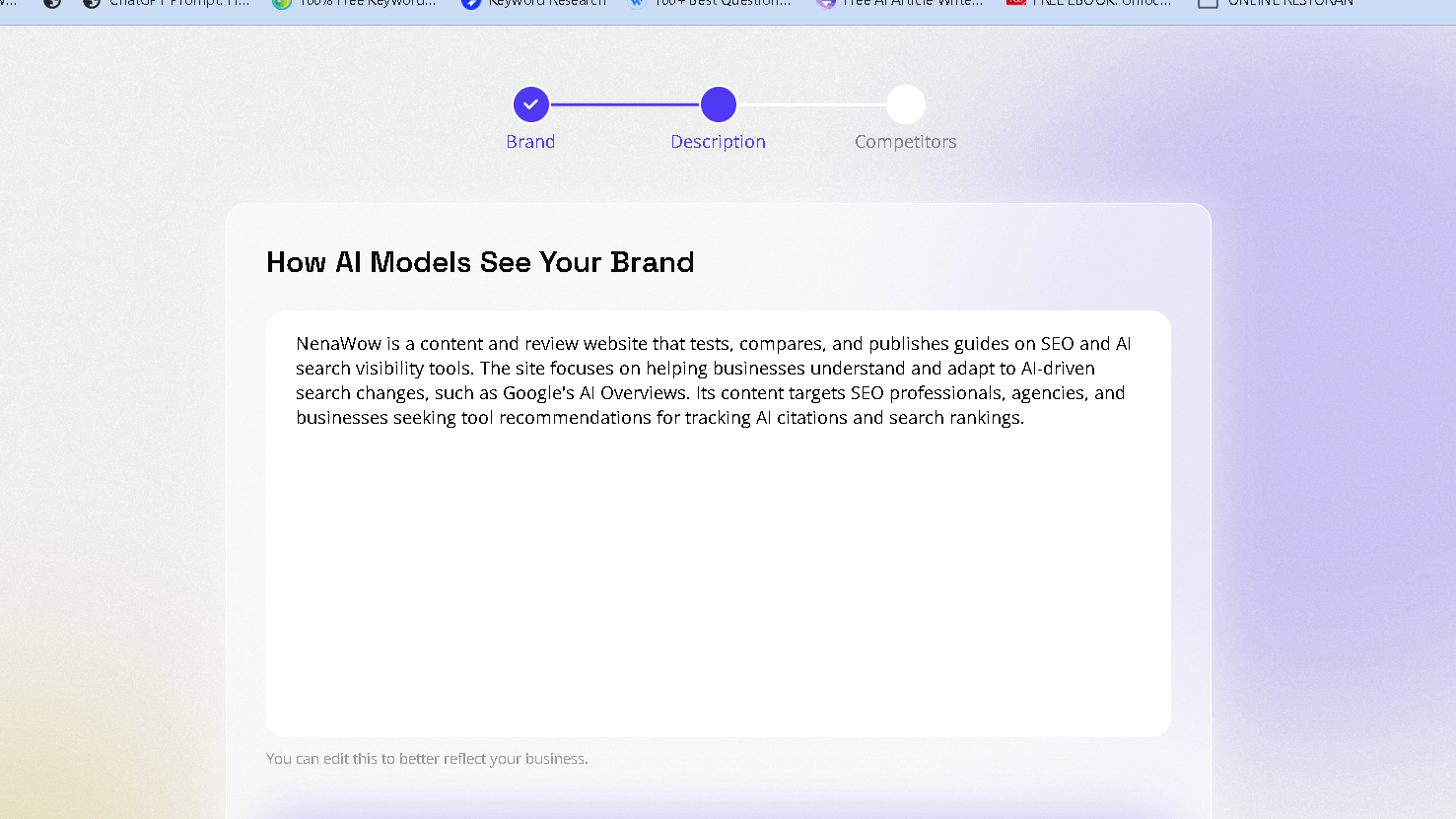
AthenaHQ‘s homepage promises a free audit in 10 minutes. The onboarding form alone took me 12 minutes, brand details, an auto-generated description, a competitor list. Once submitted, the site said the audit would arrive by email “within an hour.”
I submitted that form at 12:16. I checked my inbox, spam folder included, at 14:05. Nearly two hours later, nothing had arrived.
| Promise | Reality |
|---|---|
| Audit in 10 minutes | Form alone took 12 minutes |
| Report within an hour | Nothing after nearly 2 hours |
That’s a real gap between the promise and the product, and it’s the first thing worth knowing before you hand over your email address.
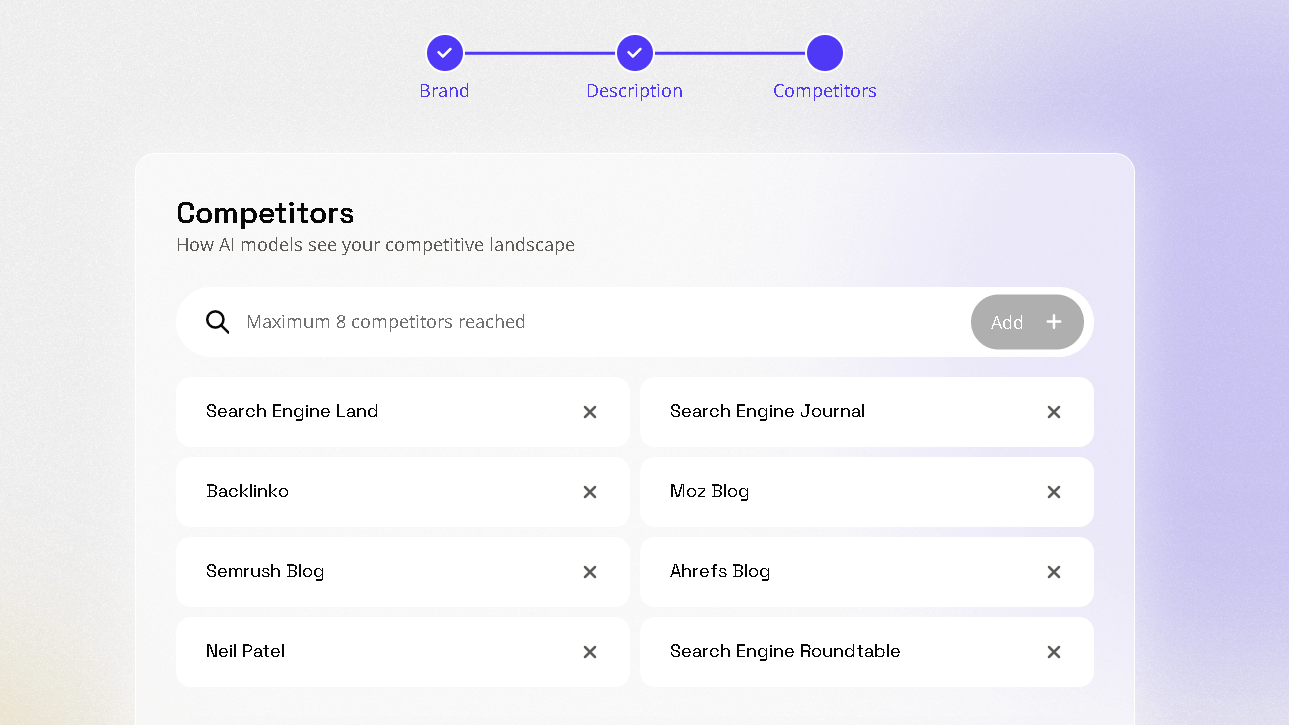
The audit flow’s auto-generated brand description was solid, it correctly called NenaWow a content and review site aimed at SEO professionals and agencies. Its auto-suggested competitor list was not: all eight slots filled with major SEO publishers, Search Engine Land, Moz Blog, Neil Patel, none of them my actual competitive set.
Signing Up for the Real Thing
With the audit stuck, I signed up for the Essential free tier directly at app.athenahq.ai. One barrier worth flagging: it only accepts work email addresses, not free providers. My nenawow.com address went through fine, so it’s checking for a real custom domain rather than a whitelist, but any reader running a site under a personal Gmail gets blocked before they start.
Inside the real app, onboarding got my category wrong in a different way than the audit did, calling NenaWow “SaaS & Software” and “an SEO intelligence platform.” Neither is accurate. Two onboarding flows from the same company, two contradicting reads of what my site is.
The auto-generated prompt list was better than the competitor list had been. Seven of ten prompts were well-targeted, non-branded searches my actual audience would run. One assumed something false, a prompt about “agency pricing plans” I don’t sell, so I swapped it out and added two branded prompts of my own, bringing my working set to 12. Every number below reflects that edited list, not Athena’s untouched defaults. I also connected my Google Search Console account at this step, which Athena uses to refine its prompt suggestions against my actual ranking keywords.
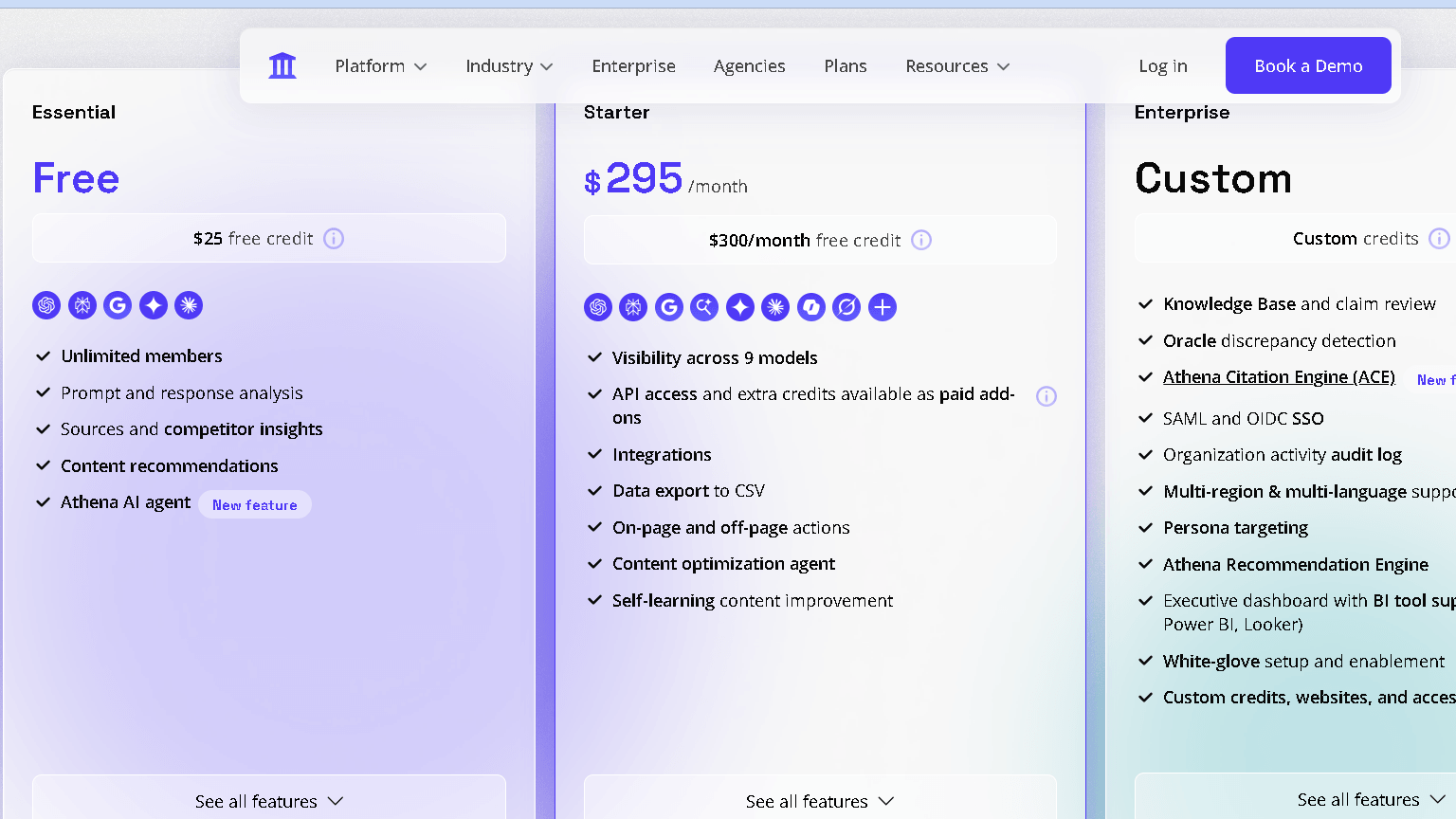
The Pricing Page Doesn’t Match the Real Account
| Tier | Price | Pricing Page Credit | My Actual Account |
|---|---|---|---|
| Essential | Free | $25 free credit | 300 credits |
| Starter | $295/month | $300/month free credit | Not tested |
| Enterprise | Custom | Custom credits | Not tested |
The pricing page says $25. My account showed 300 credits. I don’t know if that’s an unexplained dollar-to-credit conversion or a real inconsistency. Either way: check your own account. Don’t take the pricing page’s word for it.
The Essential tier gives you five models at 1 credit each, ChatGPT, Google AI Overview, Perplexity, Gemini, Copilot. Three more, Grok, Claude, and DeepSeek, cost 5 credits each and stay locked even on this free tier. Worth noting, since I’m writing this on Claude: the model doing this review costs five times more to track than the one writing about it.
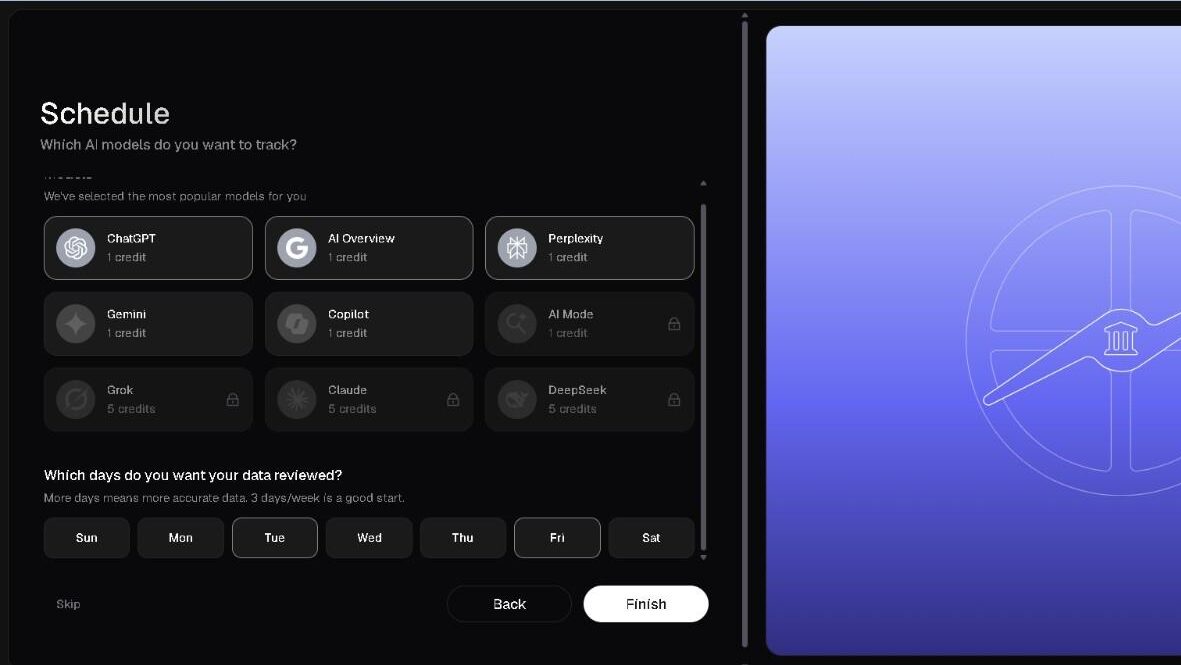
I left the defaults as offered, tracking ChatGPT, AI Overview, and Perplexity, checked Tuesday and Friday. That’s what a first-time user gets without digging into settings.
The July Mention Rate Test
Thirty days, my own site, real prompts. Athena itself flagged the sample as small, “treat these as directional,” more honesty upfront than I expected from a tool trying to sell me an upgrade.
| Metric | Result |
|---|---|
| Responses Tracked | 30 |
| Mention Rate | 44.4% |
| Absolute Mention Rate | 26.7% |
| Citation Rate | 16.7% |
| Share of Voice | 27.6% |
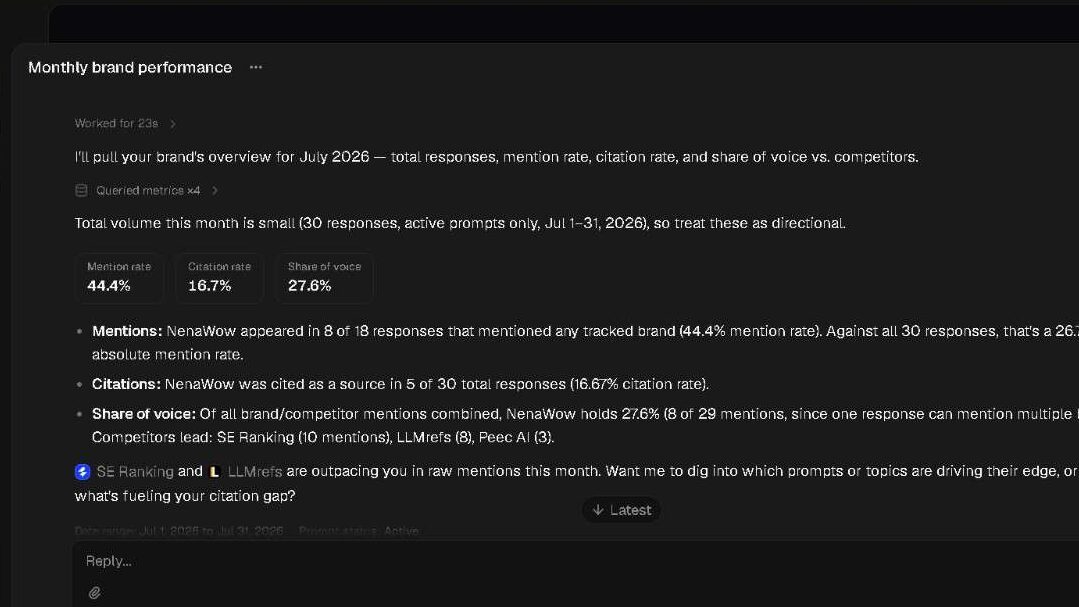
| Competitor | Mentions |
|---|---|
| SE Ranking | 10 |
| NenaWow | 8 |
| LLMrefs | 8 |
| Peec AI | 3 |
That’s a real number, not a sales pitch. And it’s thin enough that I wanted to know why.
Finding the Actual Gap
I asked Athena directly why SE Ranking and LLMrefs were ahead, and it didn’t just repeat the totals back.
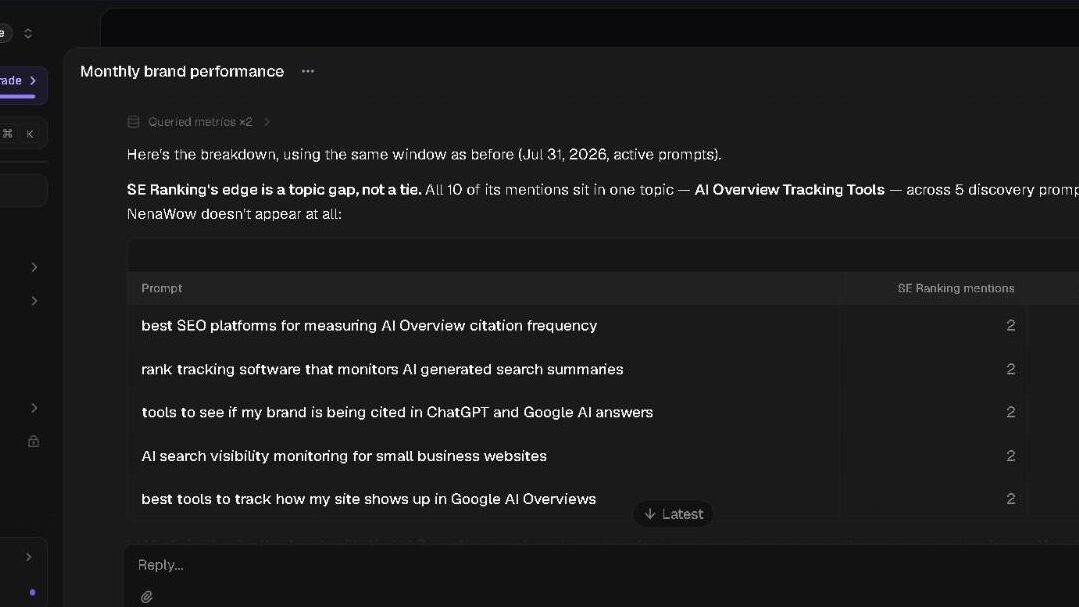
SE Ranking’s lead was a topic problem, not a general one. All 10 of its mentions sat inside a single topic, AI Overview Tracking Tools, across five discovery prompts where NenaWow had zero presence. Not low presence. Zero.
| Prompt | SE Ranking Mentions | NenaWow Mentions |
|---|---|---|
| best SEO platforms for measuring AI Overview citation frequency | 2 | 0 |
| rank tracking software that monitors AI generated search summaries | 2 | 0 |
| tools to see if my brand is being cited in ChatGPT and Google AI answers | 2 | 0 |
| AI search visibility monitoring for small business websites | 2 | 0 |
| best tools to track how my site shows up in Google AI Overviews | 2 | 0 |
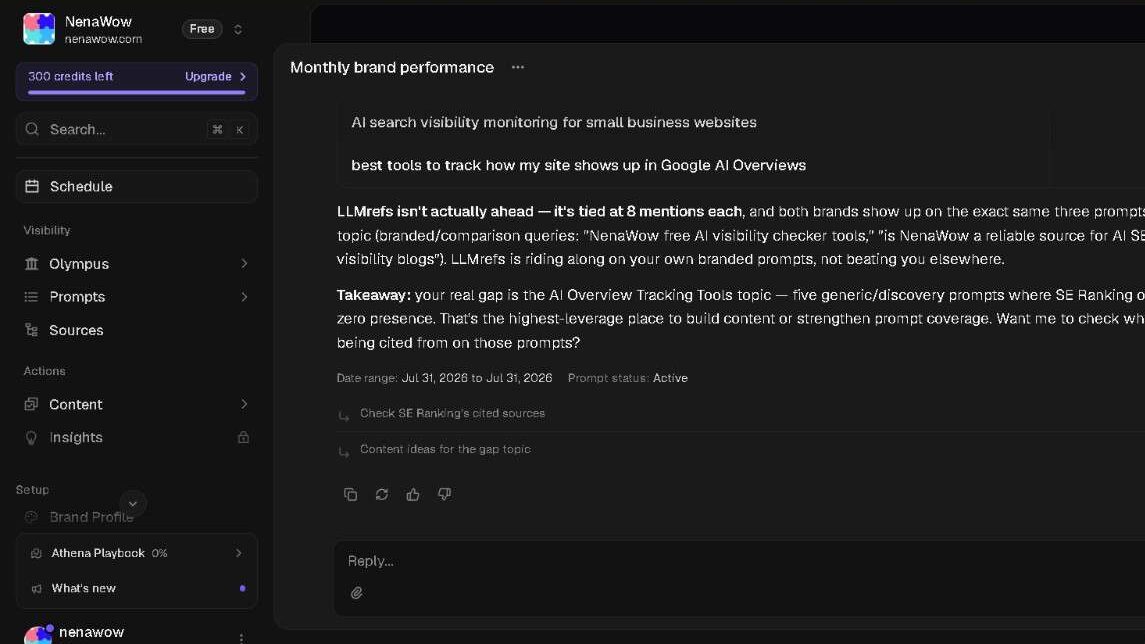
LLMrefs wasn’t ahead at all. It was tied with me, 8 mentions each, on my own branded, comparison-style prompts. LLMrefs was riding along on searches about my brand, not beating me elsewhere. Is a competitor actually ahead of you, or just present where you already are? Different questions, and the raw mention count alone doesn’t tell you which.
The Root Cause Traced to One Domain
One more question: where were SE Ranking’s citations on those five prompts coming from?
| Citing Domain | Responses Citing It |
|---|---|
| seranking.com | 4 of 30 |
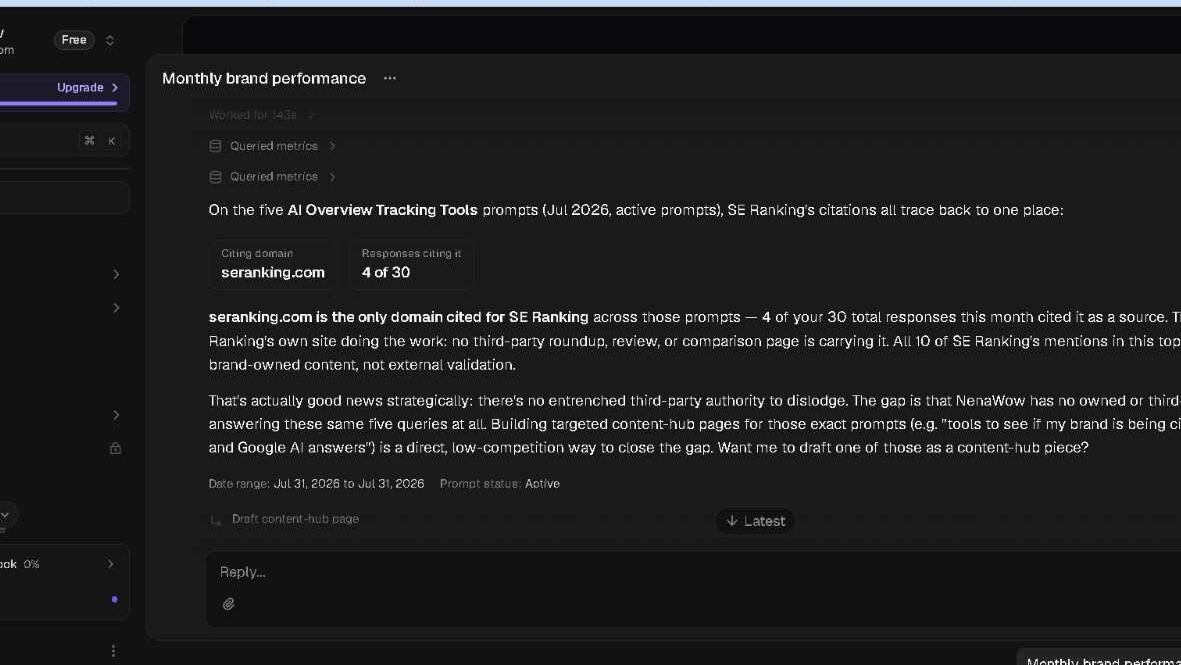
One domain, cited in 4 of 30 responses. No third-party roundup, no independent review, backing it. All 10 of SE Ranking’s mentions in that topic rode on brand-owned content alone. Athena’s own read: there’s no entrenched third-party authority to dislodge, since SE Ranking hasn’t earned any. The gap is that NenaWow has no content at all answering those five prompts. That’s a real, specific, low-competition opening, not a vague nudge to “make more content.”
Testing the Content Draft Feature
Athena offered to draft a content-hub page targeting that exact gap. I said yes.
| Action | Credit Cost |
|---|---|
| Analysis questions (mention breakdown, gap check, source trace) | 0 |
| Content draft generation | 40 |
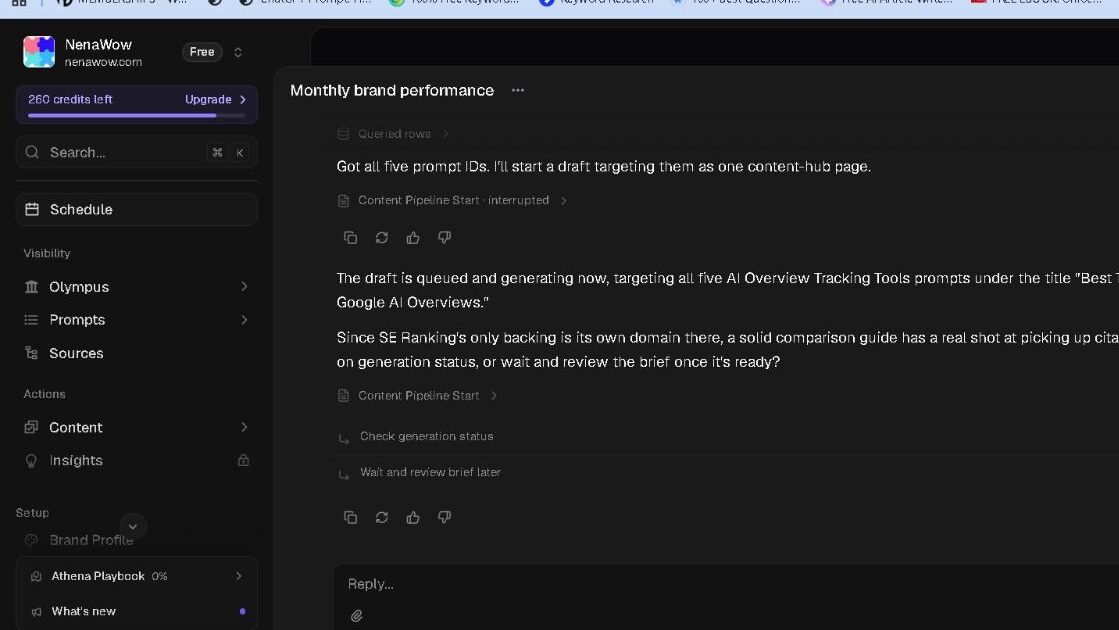
The draft took roughly 23 minutes from acceptance to finished text, landing around 2,700 words across 7 sections, including a comparison table and a small-business worksheet. That table is the part worth calling out.
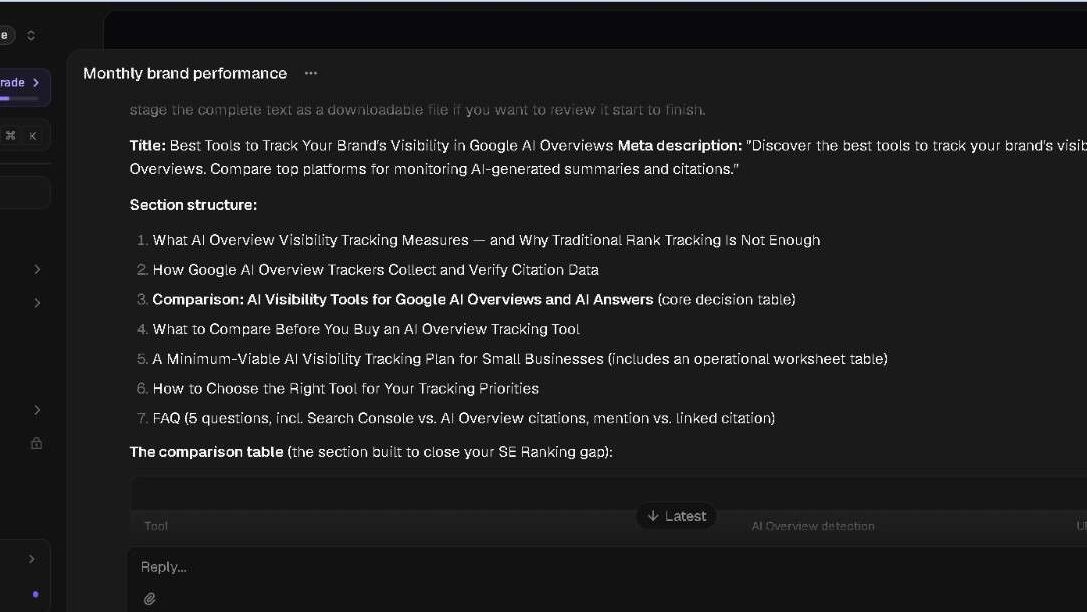
Rather than inventing competitor features it couldn’t verify, Athena labeled its own claims “(per NenaWow),” labeled SE Ranking’s claims “(per SitePoint),” and marked everything unconfirmed for LLMrefs, Peec AI, Scrunch AI, and its own product as “Confirm with vendor.” No filled-in guesses standing in as fact. That’s the same rule I hold my own testing to.
What’s Missing
WordPress never came up, not in the general integrations list (GA4, Vercel, Cloudflare, Webflow), not on the Ecommerce page (Shopify only). If your site runs on WordPress, and most of my readers’ sites do, there’s no direct connection here.
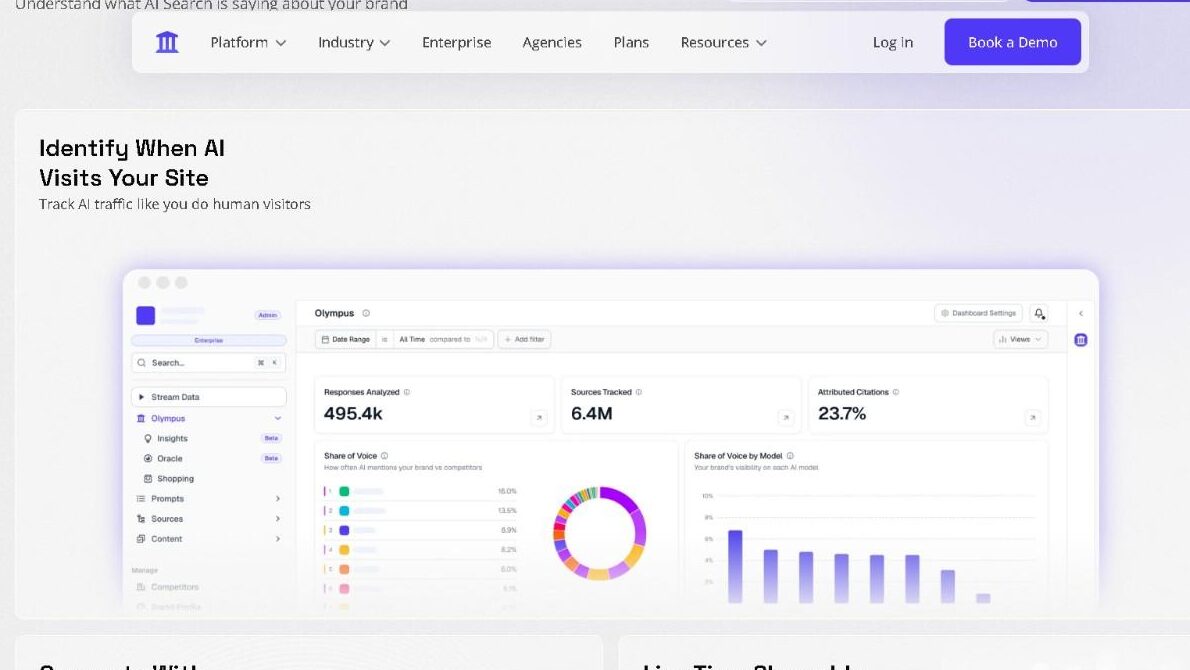
Insights sits locked behind a padlock icon even inside a live, paid-eligible account. Two more features, Prompt Volume and Oracle, the accuracy-monitoring tool, are gated to Enterprise specifically and marked Beta even there.
Scorecard
| Category | Score |
|---|---|
| AI Tracking Depth | 9.0 |
| Ease of Use | 7.0 |
| Dashboard | 8.0 |
| Reporting | 8.5 |
| Free Plan | 8.5 |
| Integrations | 5.0 |
| Overall | 7.7 |
Ease of Use and Integrations pull the overall score down, the onboarding miscategorized my site twice and WordPress is absent entirely. AI Tracking Depth and Reporting carry it, since the root-cause diagnosis is the best I’ve seen from any free tier I’ve tested in this cluster.
Final Verdict
The free Essential tier is not a teaser account. It gave me a real mention rate, a real citation rate, and a root-cause diagnosis I could act on, not just a number to stare at. The lead-gen audit funnel on the homepage is a different story: nearly two hours with nothing delivered against a “10 minute” promise is not a rounding error.
If you want AthenaHQ’s data, skip the homepage form and sign up for the actual free account instead. It’s slower to set up, but it’s the version that works.
AthenaHQ Alternatives
I’ve tested some of these in more depth than others, so treat this as a starting point, not a full comparison yet.
Search Atlas — the tool I already use for competitor Domain Power and Brand Signal tracking, covered in my full Search Atlas review.
Profound — Enterprise-focused, no free tier, Starter plan gates AI Overview tracking behind a higher-priced tier. I have not run a full test yet.
PromptWatch — multi-LLM brand monitoring with a 7-day trial, covered briefly in my AI Overview tracking guide.
Otterly — budget-friendly AI Overview tracking starting around $29/month, not yet tested directly on nenawow.com.
FAQ
Is AthenaHQ’s free tier actually useful, or just a lead magnet?
Based on my own month of testing, the Essential tier is genuinely functional. It gave me real prompt-level mention and citation data, not a locked preview. The separate “free audit” lead-gen form on the homepage failed to deliver anything after nearly two hours in my test.
How much does AthenaHQ’s Essential tier cost?
Essential is free. The pricing page lists $25 in free credit, but my actual account showed 300 credits once created, worth confirming in your own dashboard rather than trusting the marketing page number.
Does AthenaHQ work with WordPress?
Not directly, based on what I found. Its integrations pages list GA4, Vercel, Cloudflare, and Webflow for general use, and Shopify specifically for ecommerce. WordPress does not appear anywhere.
What does AthenaHQ’s competitor analysis actually show you?
More than a mention count. When I asked why two named competitors were outpacing me, Athena traced one lead to five specific search topics where I had zero presence, and traced the other to a tie on my own branded searches rather than a real advantage. It then identified the exact domain behind a competitor’s citations.
Does content generation cost extra on the free tier?
Yes. Asking Athena questions about your data cost nothing during my testing. Generating an actual draft article cost 40 of my 300 free credits, which puts a real ceiling on how many pieces you could draft before needing to upgrade.