
I have used both of these tools every day for over a month. Not for demos. Not for a single test session. For real work — drafts, research tasks, code fixes, fact checks, and the kind of repetitive daily prompts that show you what an AI is actually like when the novelty is gone. Here is my honest ChatGPT vs Grok comparison 2026.
My verdict is not simple. These are different tools built for different mental modes. Which one you want depends on what you are actually here for.
Table of Contents
Grok vs ChatGPT Comparison 2026: Quick Verdict
| Category | ChatGPT | Grok | Winner |
|---|---|---|---|
| Writing quality | Strong, consistent | Good but uneven | ChatGPT |
| Real-time information | Web search, slower | Live X feed, faster | Grok |
| Editing burden | Low | Medium | ChatGPT |
| Math benchmarks | 86% AIME 2025 | 95% AIME 2025 | Grok |
| Coding (SWE-bench) | 74.9% | 69.1% | ChatGPT |
| Integrations | 60+ apps | X ecosystem only | ChatGPT |
| Pricing (paid tier) | $20/month Plus | $30/month SuperGrok | ChatGPT |
| Trust after 30 days | High | Medium-high | ChatGPT |
ChatGPT is the safer daily driver. Grok is faster on live data and stronger on math. That gap is real, and it shapes everything below.
How I Tested Both Tools
My tests ran over five weeks across two structured passes and ongoing daily use. I kept a simple log: every time I had to rewrite, verify, or correct an output before using it, I marked it. That log is what drives the editing burden numbers below.
I ran both tools on a set of writing prompts, research questions, and factual lookups. Same prompts, both tools, tracked separately. The writing prompts ranged from short email drafts to longer editorial pieces. The factual questions covered recent AI news, product pricing, and a handful of current events from the week I was testing.
I am not going to claim perfect laboratory conditions. I used these tools the way most people actually use them — in a real workday, with real deadlines, and real consequences if the output was wrong. That is the test that matters.
At a Glance
| Feature | ChatGPT | Grok |
|---|---|---|
| Developer | OpenAI | xAI (Elon Musk) |
| Current model | GPT-5.5 | Grok 4 |
| Free tier | Yes, limited | Yes, ~10 prompts/2 hours on X |
| Paid tier | $20/month Plus | $30/month SuperGrok |
| Image generation | DALL-E built in | Imagine model built in |
| Real-time search | Yes | Yes, native X feed |
| Custom tools | 60+ integrations, custom GPTs | xAI ecosystem only |
| Context window | Large | Larger, lower cost |
| Voice mode | Yes | Limited |
What Changed After Two Weeks of Daily Use
Week one with both tools felt roughly equal. Week two is where the differences showed up.
With ChatGPT, I noticed I had settled into a rhythm. I knew what kinds of prompts it handled well. I stopped second-guessing the output on writing tasks. That comfort is not trivial. It is what makes a tool actually useful in a busy day.
With Grok, I was still checking more often. Not because it was wrong all the time. Because the range of its outputs was wider. Sometimes it was sharper than anything ChatGPT gave me. Sometimes it was looser, chattier, and less usable without a rewrite.
By session twelve or thirteen, a pattern had settled in. I reached for ChatGPT when I needed something clean on the first pass. I reached for Grok when I wanted a fast answer on something happening right now. That split held for the rest of the test.
| Task | ChatGPT | Grok | Winner |
|---|---|---|---|
| Long-form drafts | Consistent, low edit burden | Good but wider variance | ChatGPT |
| Breaking news | Web search, some lag | Live X feed, faster | Grok |
| Social trend monitoring | Usable | Native, much better | Grok |
| Email drafts | Clean on first pass | Fine, a bit informal | ChatGPT |
| Research summaries | Careful, well sourced | Fast, less cautious | ChatGPT |
| Brainstorming | Structured | More spontaneous | Tie |
Writing Quality Comparison
This is where ChatGPT has a real lead. I found it on the second day and it held for five weeks.
This matches what I found in my ChatGPT vs Claude comparison, where Claude was the only assistant that consistently challenged ChatGPT on long-form writing quality.
I gave both tools the same prompt: write a 600-word editorial introduction for a review of an Surfer SEO writing tool. Aimed at a professional tech audience, first-person, no filler. Here is roughly what each tool gave me.
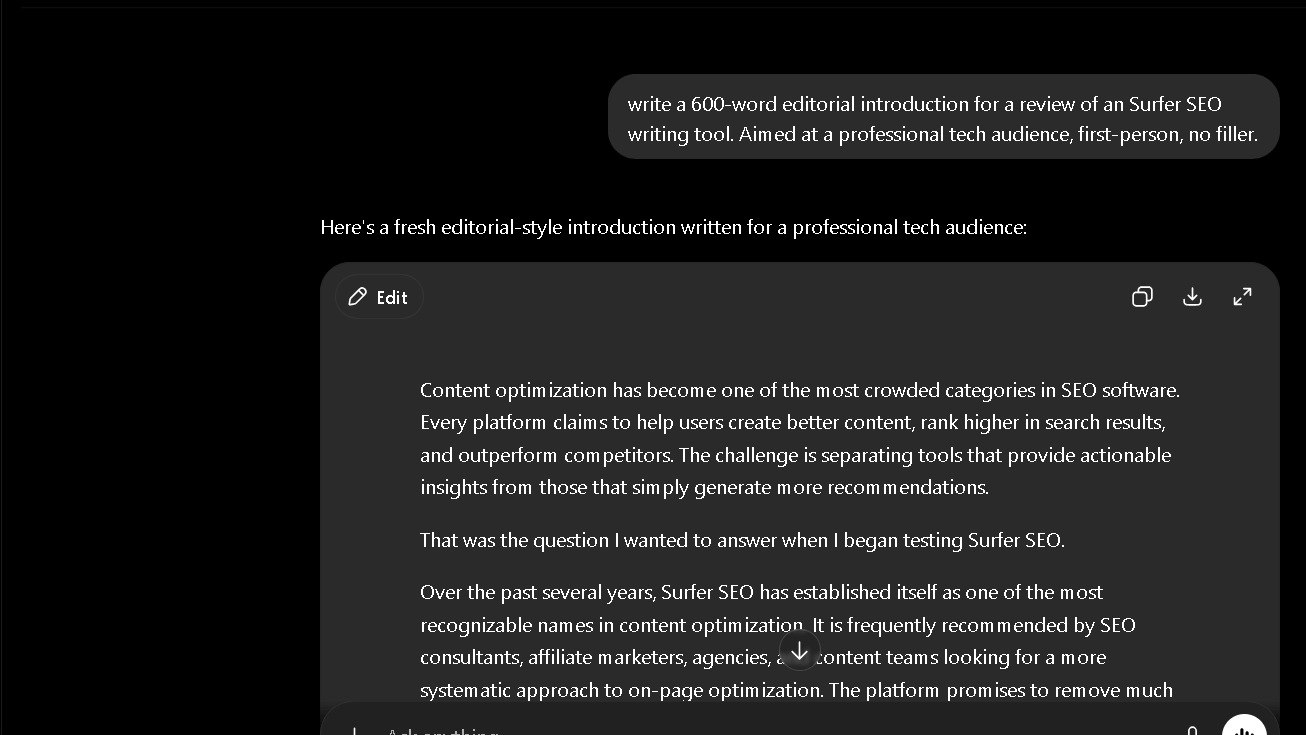
ChatGPT opened with a specific claim about workflow friction, moved into a clear thesis, and held the same register through the full piece. The voice was flat in spots. But it was flat in a way I could lift. One paragraph needed cutting. That was the extent of my work.
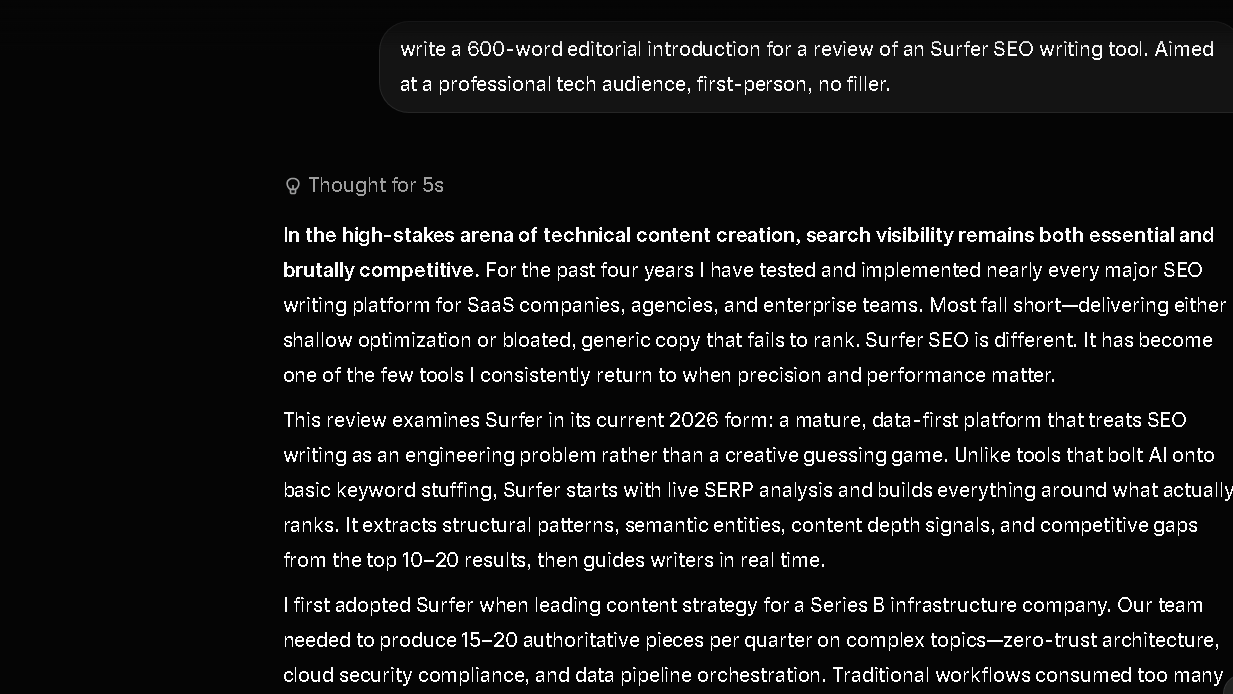
Grok opened with a more interesting first line. It had personality from the jump, a slightly wry observation about AI hype that I actually liked. Then paragraph three arrived and the register shifted — a bit more casual, looser word choices, a sentence that ended with something like “and honestly, it shows.” That phrase is fine in a blog comment. It is not fine in a piece I am about to put my name on.
The Consistency Gap
The thing is, I wanted to use Grok’s opening. I almost did. But when I tested this same prompt three more times across different topics — a product comparison, a software tutorial intro, a company profile — the pattern repeated each time. Strong start. Register drift somewhere around the 300-word mark. A line or two that needed rebuilding. ChatGPT’s openings were less arresting. Its middles were more reliable. Reliable wins when you are producing a lot of work.
ChatGPT stays in register throughout a long piece. Grok sometimes shifts tone mid-document, especially past the 800-word mark. That shift is small on any single draft. Across a writing workflow where you are producing several pieces a week, it costs real time.
Worth noting: Grok’s shorter outputs are genuinely strong. Ask it for a punchy paragraph, a social caption, or a quick observation and it often outperforms ChatGPT on that narrow task. The quality variance grows with length. Short Grok is often good. Long Grok is unpredictable.
What the Editing Burden Actually Looks Like
Over the five weeks of daily use, I tracked every output I had to fix before using it. The threshold was simple: if I spent more than two minutes rewriting or restructuring, it counted as an intervention.
Across writing tasks, ChatGPT needed that kind of work on roughly one in five outputs. Grok needed it on closer to one in three. That tracks with what I described above. It is not that Grok produces bad writing. It is that it produces writing with a wider swing, and the downswings cost time.
The specific failure modes were different too. ChatGPT’s edits were mostly about voice — lifting flat phrases, cutting hedging language, adding a sharper opener. Grok’s edits were more structural — fixing register drift, cutting the chattier asides, or rewriting a conclusion that had gone loose. Structural edits take longer. That is the gap in practice.
Research and Fact Gathering
Here is where the comparison gets more complicated.
Grok pulls live data from X faster than ChatGPT pulls web search results. If you need to know what is trending, what people are saying about a product launch today, or what just happened in a fast-moving story, Grok is the right tool. That feed is useful. I tested it on a week’s worth of AI news and it was accurate on most of what I asked.
For example, I gave this prompt: summarize the major AI assistant launches from the past 30 days and explain which are most relevant for content creators. Here are the answers.
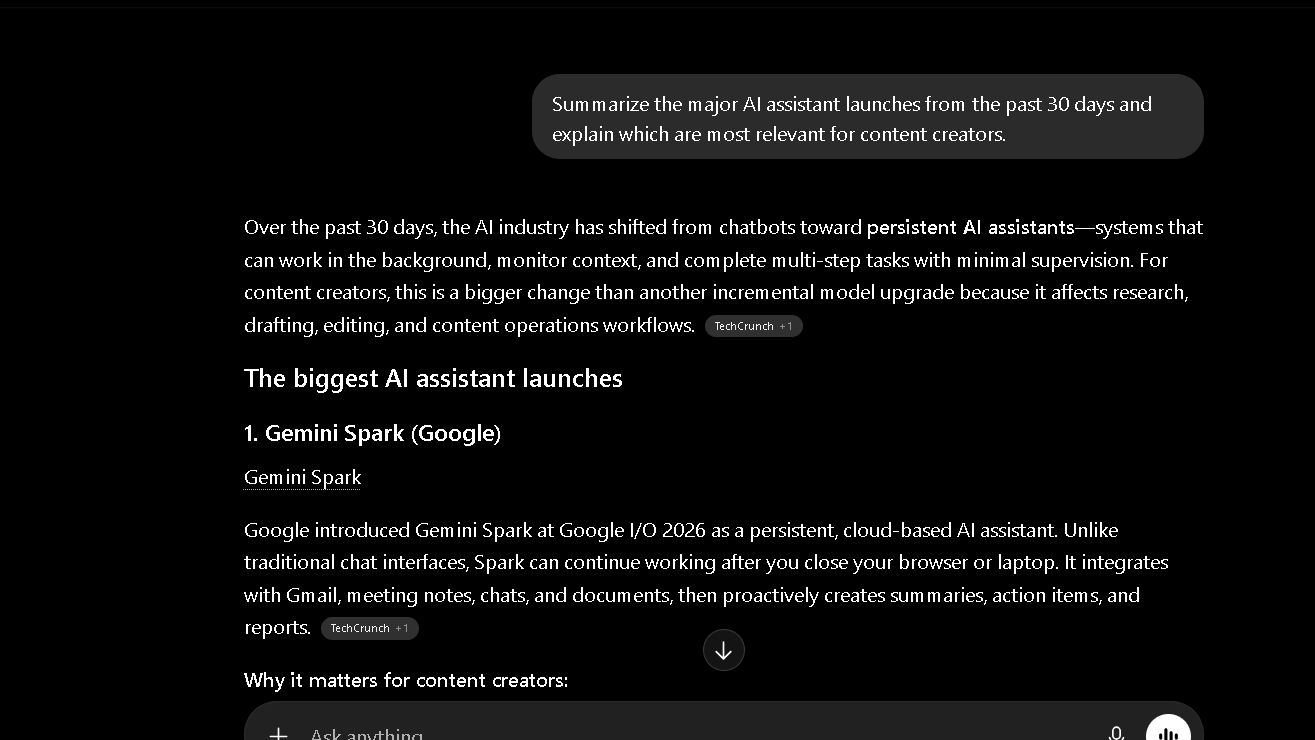
ChatGPT is more careful about what it does not know. It hedges more. That can feel slow, but after 30 days I trust that caution. The times it said “I’m not certain about this” were almost always the times I should have been checking anyway.
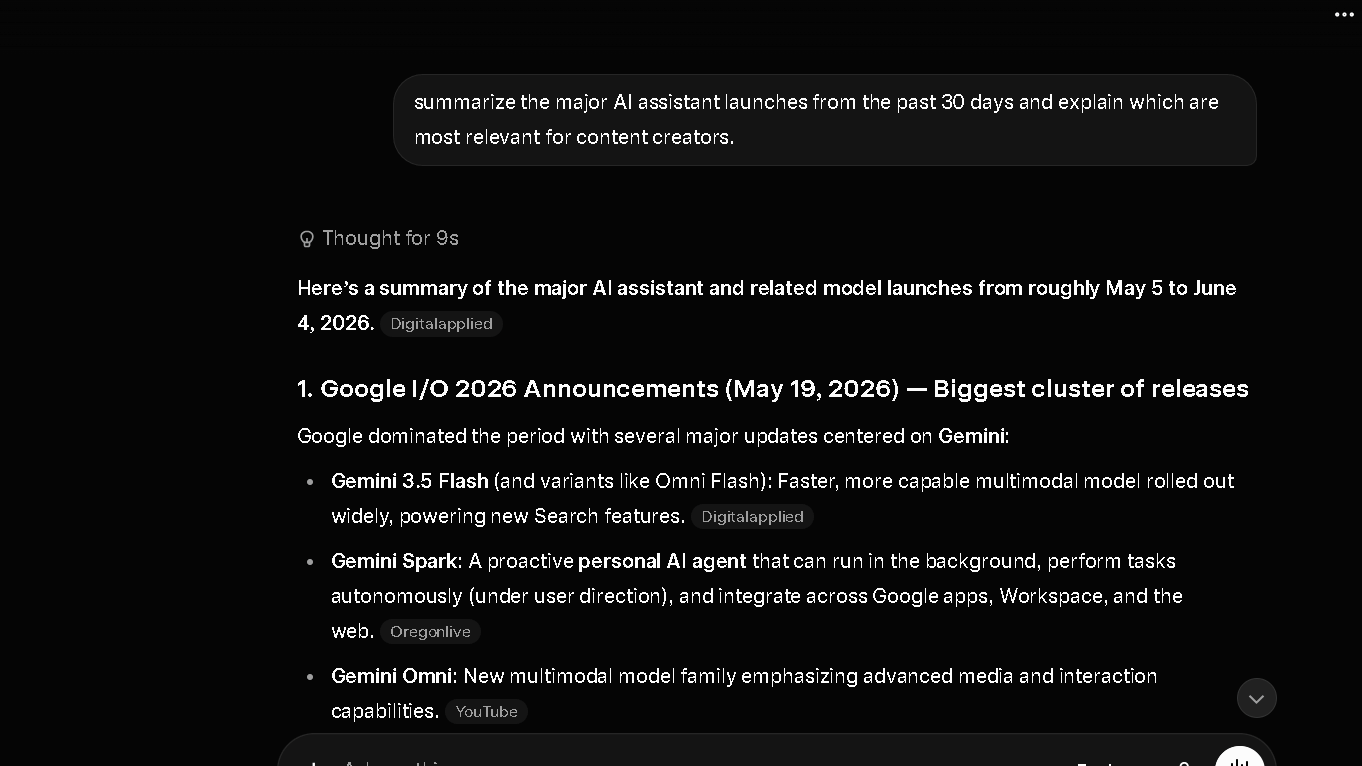
For research that draws on historical depth or peer-reviewed sources, ChatGPT is steadier. Grok is better for the live layer. The question is not which AI is smarter. It is which kind of information you need right now.
Coding and Technical Tasks
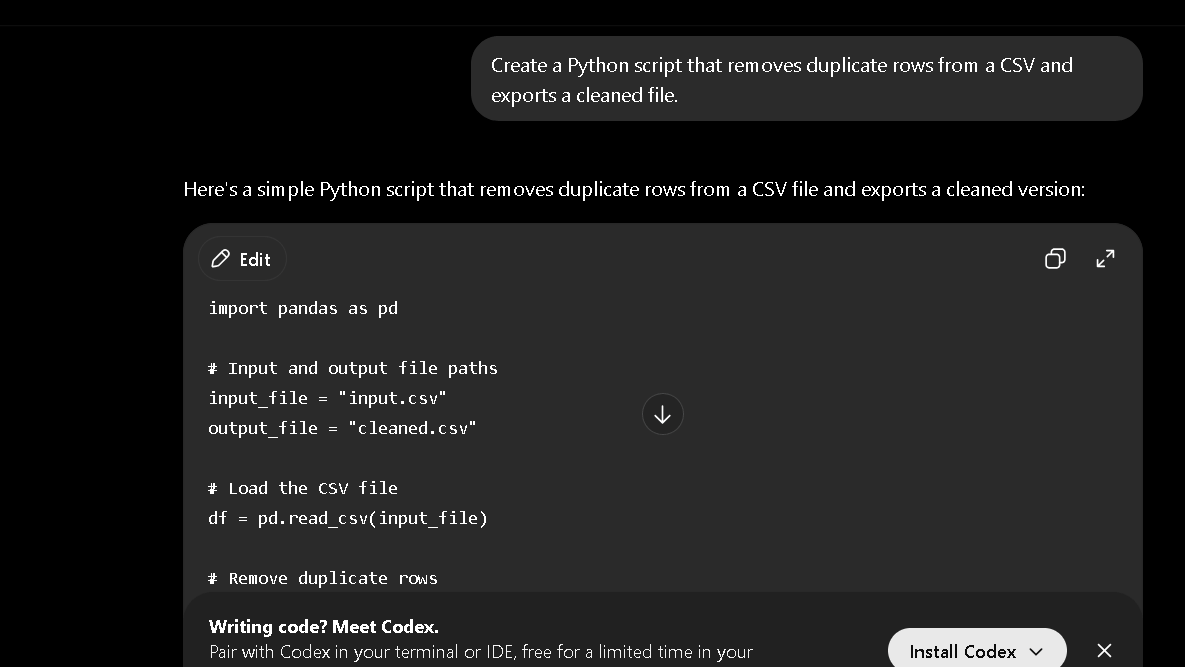
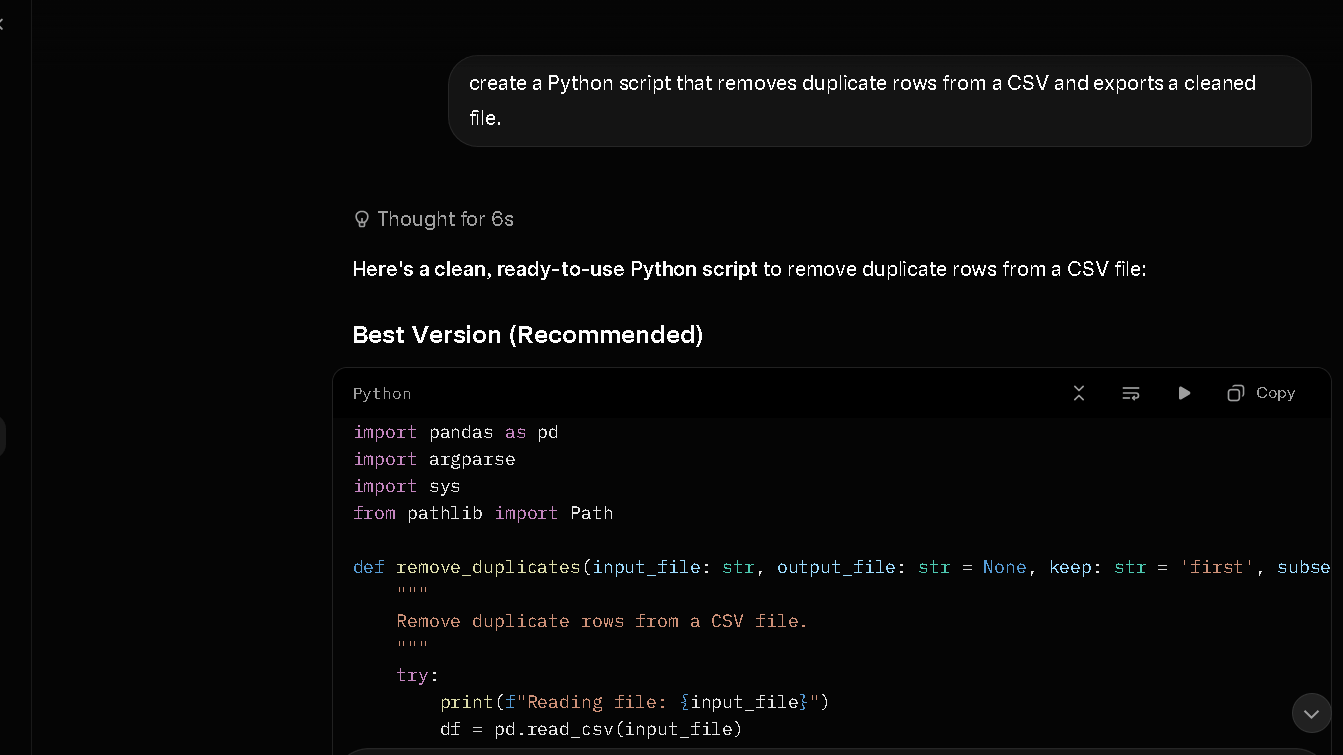
Both tools handled a Python script I asked for: CSV processing, a basic API call, and error handling. Both got it right. ChatGPT’s explanation was cleaner and I needed one clarification follow-up. Grok’s code worked but came with a longer, less structured explanation that I skimmed.
I gave both tools this prompt: create a Python script that removes duplicate rows from a CSV and exports a cleaned file. Here is what each tool gave me.
On benchmarks, Grok 4 scores 95 percent on AIME 2025 math problems. ChatGPT’s o3 scores 86 percent. That gap is real for math-heavy work. If you are doing quantitative analysis, solving equations, or building anything numerically complex, Grok has a clear edge there.
For production coding, ChatGPT leads. It scores 74.9 percent on SWE-bench Verified versus Grok’s 69.1 percent. That benchmark measures real-world software tasks, not just completions. The gap is not enormous, but over a week of coding work it shows.
Which AI Creates Less Editing Work?
The honest answer is: it depends on the task, but ChatGPT wins on writing and Grok wins on lookups.
For writing tasks, ChatGPT required meaningful revision on roughly one in five outputs during my five weeks of daily use. Grok required it on closer to one in three. That is the practical gap. ChatGPT creates less editing work on text-heavy tasks where structure and voice consistency matter. Grok creates less lookup work on real-time topics where speed is the variable.
The same thing appeared in my ChatGPT vs Grammarly comparison, where ChatGPT produced stronger first drafts but still benefited from a dedicated editing tool during final review.
If your daily work is mostly writing, drafting, and producing clean output, the ChatGPT advantage builds fast over a week. If your daily work involves monitoring live events, social listening, or quick factual lookups on current things, Grok’s friction drops and its speed advantage takes over.
Which AI Creates More Decision Fatigue?
This is the question I wish someone had answered before I started testing. It took me three weeks to even notice it was happening.
Decision fatigue with AI tools is not about bad outputs. It is about the mental overhead of deciding whether to trust an output, how much to fix it, and whether to re-prompt or just rewrite. That overhead is small per interaction. It compounds badly across a full day.
With Grok, I made more micro-decisions. Every output with personality in it required a fast judgment call: does this tone fit, or do I need to sand it down? Every confident factual answer required a quick check: is this current, or is Grok presenting something from six months ago like it happened this morning? Those checks became automatic. Automatic does not mean free. Attention is the thing you run out of first on a heavy day.
With ChatGPT, the decisions were narrower. Almost always one judgment: is this flat enough to need a voice pass? That question has a fast answer. I just read the first paragraph and I know.
Cognitive load does not show up in output quality. It shows up at 4 in the afternoon. By week two, I was ending Grok sessions more tired than ChatGPT sessions of the same length. Grok had asked me to make more small calls along the way. Small calls add up.
The flip side: for brainstorming and open-ended thinking, Grok’s unpredictability kept me more engaged. The extra decisions felt like part of the value.
Grok creates more fatigue on production tasks. ChatGPT creates more fatigue on creative ones. Which kind you can live with depends on what fills most of your day.
Which AI Do I Trust More After 30 Days?
ChatGPT. And not by a small margin on text tasks.
The trust question is not about raw accuracy. It is about predictability. Can you feel when the AI is confident versus when it is guessing? ChatGPT signals uncertainty better. It will say it is not sure. Grok will sometimes answer with the same confidence regardless of whether the answer is solid or approximate.
I tested both tools on a set of factual questions drawn from recent AI news and current product pricing. Grok answered every question with the same assured tone. A few of those answers were outdated. ChatGPT flagged its uncertainty on the questions where things had recently changed. That calibration matters when you are using AI output in anything people will actually read.
For live events, I flip that trust in Grok’s direction. It genuinely has better access to what is happening right now. The trust I give each tool is topic-dependent, not blanket.
| Trust Category | ChatGPT | Grok |
|---|---|---|
| Long-form accuracy | High | Medium |
| Confidence calibration | Good | Weaker |
| Current events | Medium | High |
| Source transparency | Good | Less consistent |
| Fact correction behavior | Proactive | Reactive |
The Frustrations That Appear Over Time
ChatGPT’s main friction is prompt dependency on complex tasks. If you give it a vague brief, it produces a safe but generic output. You have to push it. That is not a flaw exactly, but it means the quality ceiling is partly on you.
I noticed a similar pattern in my ChatGPT vs Notion AI comparison. ChatGPT usually produces stronger output, but the quality of the result depends heavily on the quality of the prompt.
Grok’s main friction is variance. The same prompt given twice can produce two outputs that feel written by different writers. That unpredictability is fine for brainstorming. It is a problem when you need consistent output across a workflow.
The Personality You Cannot Fully Turn Off
By week three, I noticed another Grok pattern. The personality that felt fresh and useful in week one had started to feel like a layer you cannot turn off. Grok has a tone — wry, slightly irreverent, a bit knowing — and it applies that tone whether you want it or not. Ask it for a flat product description and it finds a way to add a little editorializing. Ask it for a formal summary and the final sentence sometimes has a small wink in it. At first this felt like character. By week three it felt like a tic.
The deeper issue is that Grok seems to have a default register that sits about fifteen degrees from professional neutral. That register is genuinely useful for some tasks — brainstorming, social copy, anything where a bit of personality adds rather than subtracts. But it is hard to turn off. I tried explicit prompting: “write in a flat, neutral, professional tone.” It helped. Grok would comply for two or three paragraphs and then drift back. The personality would seep in through word choices, through a slightly pointed aside, through a closer that felt more blog than document.
ChatGPT has the opposite problem. Its default register is almost too flat. It produces clean, well-structured output that often needs a human voice added to it. But flat is easier to lift than wry is to strip. If you are editing for a professional context, starting from ChatGPT’s neutral and adding personality is faster than starting from Grok’s personality and trying to neutralize it. That difference is small per output. Across a week of work it becomes the deciding factor.
Why Some Users Switch to Grok
The real-time feed is the main reason. If your work depends on current events, X platform data, or you are simply tired of AI that feels frozen in time, Grok solves that problem well. The access to a live feed of social conversation is something ChatGPT does not match natively.
The math strength also draws people. Anyone doing quantitative work who has compared the two on harder problems often lands on Grok. That 95 percent AIME score is not marketing. The benchmark is real and the gap is meaningful for anyone doing heavy numerical work.
Grok also appeals to users who find ChatGPT’s tone too cautious or flat. The personality is genuine, and for some tasks — brainstorming, ideation, social content — it makes the tool more enjoyable and faster to use.
Why Some Users Eventually Return to ChatGPT
The editing burden. That is almost always the answer.
Users who produce a lot of written output often find that the time they save on a current-events lookup does not offset the time they lose rewriting Grok’s inconsistent long-form output. The workflow math does not favor Grok once writing volume goes up.
The integrations gap also pulls people back. ChatGPT connects to over 60 third-party apps. Grok’s ecosystem is mostly X and xAI’s own tools. If your workflow depends on third-party connections, custom GPTs, or an API you use heavily, ChatGPT is the only practical choice.
Pricing Comparison
| Plan | ChatGPT | Grok |
|---|---|---|
| Free | Yes, GPT-5 limited | Yes, ~10 prompts/2 hours on X |
| Entry paid | $20/month (Plus) | $10/month (SuperGrok Lite) |
| Full paid | $20/month (Plus) | $30/month (SuperGrok) |
| Team plan | $25/user/month | Not available |
| Premium | $200/month | $40/month (X Premium+) |
| API input cost | ~$1.25/million tokens | $3/million tokens (Grok 4) |
ChatGPT offers better value at the standard paid tier. Twenty dollars a month for Plus gives you GPT-5.5, DALL-E, voice mode, and custom GPTs. SuperGrok at $30 gives you the full Grok 4 and higher usage limits, but fewer integrations and no comparable custom tools layer.
For API access, ChatGPT is significantly cheaper. That matters if you are building on top of either platform.
Who Should Use ChatGPT
Writers, content creators, and anyone producing regular long-form output. People who need reliable integrations with existing tools. Developers working with the API at scale. Business users who need workflow consistency and team plans. Anyone who values lower editing burden over raw novelty.
ChatGPT is the right default for most daily work. It is not the most exciting tool in the market. It does not need to be.
Who Should Use Grok
People whose work is directly tied to current events, social media trends, or the X platform. Researchers and analysts who need live data fast. Users doing heavy math or quantitative work where the benchmark gap is meaningful. Anyone who finds ChatGPT’s tone too cautious and wants something looser.
Grok is the right tool when recency is the variable that matters most. That combination is harder to find than it looks.
Best Alternatives
| Tool | Best For | Price |
|---|---|---|
| Claude | Long-form writing, careful reasoning | Free / $20/month Pro |
| Gemini | Google Workspace integration, research | Free / $19.99/month Advanced |
| Perplexity | Citation-based research | Free / $20/month Pro |
| Microsoft Copilot | Microsoft 365 users | Free / included in M365 |
| DeepSeek | Budget API access | Very low cost |
If writing quality is your top concern, Claude is worth a serious look. If cited research is your primary need, Perplexity handles that more cleanly than either ChatGPT or Grok.
Pros and Cons
| ChatGPT Pros | ChatGPT Cons | |
|---|---|---|
| Lower editing burden on writing | Vague prompts produce generic output | |
| 60+ integrations | More expensive API than rivals | |
| Consistent voice in long-form | Real-time data is slower | |
| Better confidence calibration | Can feel flat or cautious | |
| Cheaper Plus plan | Less distinct personality |
| Grok Pros | Grok Cons | |
|---|---|---|
| Live X feed, real-time data | Higher editing burden on writing | |
| Stronger math benchmarks | Output variance is wide | |
| Larger context window | Fewer integrations | |
| Distinct personality works for short tasks | That personality is hard to turn off | |
| Fast current-events answers | Confidence not well-calibrated |
Final Verdict
After 30 days, I use ChatGPT as my primary tool and Grok as my real-time layer.
ChatGPT creates less work. It stays consistent across long drafts, integrates with the tools I already use, and tells me when it does not know something. That last thing matters more than most reviews acknowledge.
Grok is genuinely better at the live layer. If I need to know what is happening right now on X, what a current product costs, or how a recent story is being discussed, Grok is faster and more directly connected to that data. I reach for it several times a week.
So is it worth paying for both? For most people, no. If you are choosing one, ChatGPT at $20 a month gives you more consistent daily value. If you live in current events or need the math edge, SuperGrok at $30 is a fair trade. Just know what you are paying for.
Which one you want depends on what you are actually here for.
FAQ
Grok is better for real-time information, live X data, and math-heavy tasks. ChatGPT is better for writing, consistent long-form output, workflow integrations, and lower editing burden. Neither is universally better.
ChatGPT produces more reliable long-form answers and is better calibrated about what it does not know. Grok provides faster access to current information but applies similar confidence to accurate and approximate answers alike.
ChatGPT. Across five weeks of daily use, it required meaningful revision on roughly one in five writing outputs. Grok required it on closer to one in three. The gap is consistent and shows up on any writing-heavy workflow.
It depends on the type of research. Grok wins on current events and live social data. ChatGPT wins on depth, sourcing, and handling topics that require careful fact-checking.
ChatGPT Plus costs $20 a month. SuperGrok costs $30 a month. ChatGPT also offers cheaper API access at roughly $1.25 per million input tokens versus $3 for Grok 4.
Yes. Grok has a native real-time feed from X and web search access. This is one of its clearest practical advantages over ChatGPT, which uses web browsing but with slightly more lag on fast-moving stories.
Yes, and that is how I use them. ChatGPT handles drafts, integrations, and most daily writing. Grok handles live data lookups and current events. The combination covers most gaps, though it does mean paying for two tools.