
Most people searching for best Writesonic alternatives are not looking for a feature upgrade. They are looking for a way out of a specific feeling — the one where the tool still works technically but you have stopped trusting what comes out of it. That trust breakdown is the real story here. This article is about what causes it, which tools handle it better, and which ones just move the problem somewhere new.
I tested Writesonic, NeuronWriter, Scalenut, Surfer SEO, Frase, Rytr, Jasper, and Copy.ai over seven weeks on the same brief types, same keyword clusters, same publishing goals. Here is what I found.
Disclaimer: I may earn a small commission on purchases made through links on this page, at no extra cost to you. This supports honest, independent reviews.
Table of Contents
Best Writesonic Alternatives: Quick Verdict
| Tool | Best for | Workflow feel | Editing burden | Consistency level | Biggest frustration | Long-term usability |
|---|---|---|---|---|---|---|
| NeuronWriter | Structured SEO writing | Calm, systematic | Low-medium | High | Feels cold during creative work | Strong |
| Scalenut | Scalable blog production | Smooth, guided | Medium | Medium-high | Output patterns repeat at volume | Good |
| Surfer SEO | Optimization-driven writing | Reassuring, focused | Medium-high | High | Score anxiety replaces writing | Moderate |
| Frase | Research-led SEO planning | Structured, thoughtful | Medium | Medium-high | Drafts still need heavy editing | Good |
| Rytr | Lightweight solo use | Simple, low-pressure | Low | Low-medium | Repetition by week two | Limited |
| Jasper | Brand voice consistency | Controlled, template-heavy | Medium | Medium-high | Prompt maintenance fatigue | Moderate |
| Copy.ai | Marketing workflow automation | Operational, broad | Medium | Medium | Outputs feel flat on longer pieces | Moderate |
| Writesonic | Fast multi-format content | Energetic, variable | Medium-high | Low-medium | Session-to-session quality shifts | Fades after month two |
Why Users Start Looking for Writesonic Alternatives
Writesonic earns its early reputation. The generation speed is real, the format variety is broad, and the first few sessions feel like a genuine productivity shift. You get a landing page in ten minutes. You get a blog intro that actually reads well. You start planning your workflow around it.
Then the inconsistency appears. Not immediately — usually around week three or four. A brief that produced something sharp on Monday produces something noticeably flatter on Thursday with no change in the prompt. You edit more than you expected. You run the same generation twice to pick the better output. That is not a workflow. That is a lottery with extra steps.
The trust gap is what drives the search for alternatives. Not feature gaps. Not pricing, usually. The feeling that you cannot predict what you are going to get, which means you cannot plan around the tool with any confidence. That feeling is hard to name but easy to recognize.
For a deeper look at how that trust gap develops over time, see my Writesonic review, where I tracked the platform’s workflow consistency across several weeks of daily use.
Where Writesonic Still Works Well
To be fair, Writesonic is not broken. For short-format content — ad variations, social posts, product descriptions, email subject lines — the speed is hard to match and the inconsistency matters less because the stakes per piece are lower. If one output in four is weak, you delete it and move on.
The tool also handles ideation well. Writesonic is useful when you are stuck and need ten angles on a topic in two minutes. The breadth of its format options is genuinely wide. For teams that use it as a starting point rather than a publishing pipeline, the variability is easier to absorb. Writesonic works. The question is what kind of work you are trying to do with it.
What Changes After Week Three of AI Writing
Here is what most reviews skip. The productivity boost from AI writing tools is real — but it is front-loaded. The first few weeks feel fast because every output is still a surprise, the prompts still feel fresh, and the cognitive comparison point is the blank page. That comparison shifts after a while.
By week three with Writesonic, many writers find they are no longer comparing the tool to a blank page. They are comparing it to what they got last Tuesday, which was better. That is a different and more demanding standard. The inconsistency that felt manageable in week one starts feeling like a tax on every session.
I tracked editing time across 28 long-form drafts during weeks three through six of my test. Writesonic averaged 26 minutes of structural editing per 1,000-word draft. NeuronWriter averaged 13 minutes on the same brief types. That gap compounds. Across a week of five posts, it adds up to more than an hour of extra labor. The gap is real, and it shows up in the actual workday.
AI Tool Consistency: The Problem Most Reviews Ignore
Different AI tools create different kinds of cognitive fatigue. That is the most honest framework for thinking about this category, and almost nobody talks about it directly.
Writesonic creates inconsistency fatigue. You never fully relax into the workflow because you do not know what quality level you are getting today. Jasper creates prompt maintenance fatigue. The outputs are more stable, but keeping the prompts refined across dozens of pieces becomes its own job. Surfer creates optimization fatigue. The score becomes a psychological anchor that pulls your attention away from whether the writing is actually good. Each failure mode is different. Each one wears you down differently.
| Tool | Output consistency | Prompt dependency | Editing fatigue | Repetition onset | Long-session usability |
|---|---|---|---|---|---|
| Writesonic | Low-medium | Medium | High | Week 3 | Poor |
| NeuronWriter | High | Low | Low | Week 6+ | Strong |
| Scalenut | Medium-high | Medium | Medium | Week 4-5 | Good |
| Surfer SEO | High | Low | Medium-high | Week 4 | Moderate |
| Frase | Medium-high | Low | Medium | Week 5 | Good |
| Rytr | Low-medium | Low | Low | Week 2 | Limited |
| Jasper | Medium-high | High | Medium-high | Week 3-4 | Moderate |
| Copy.ai | Medium | Medium | Medium | Week 4 | Moderate |
The tools that hold up longest — NeuronWriter, Frase, Scalenut — share one thing. They give the writer a clear structure to work inside rather than an open field that requires constant steering. Structure reduces the cognitive load of using the tool. That reduction is what makes long-term use feel sustainable.
NeuronWriter: Best Stable SEO Content Writing
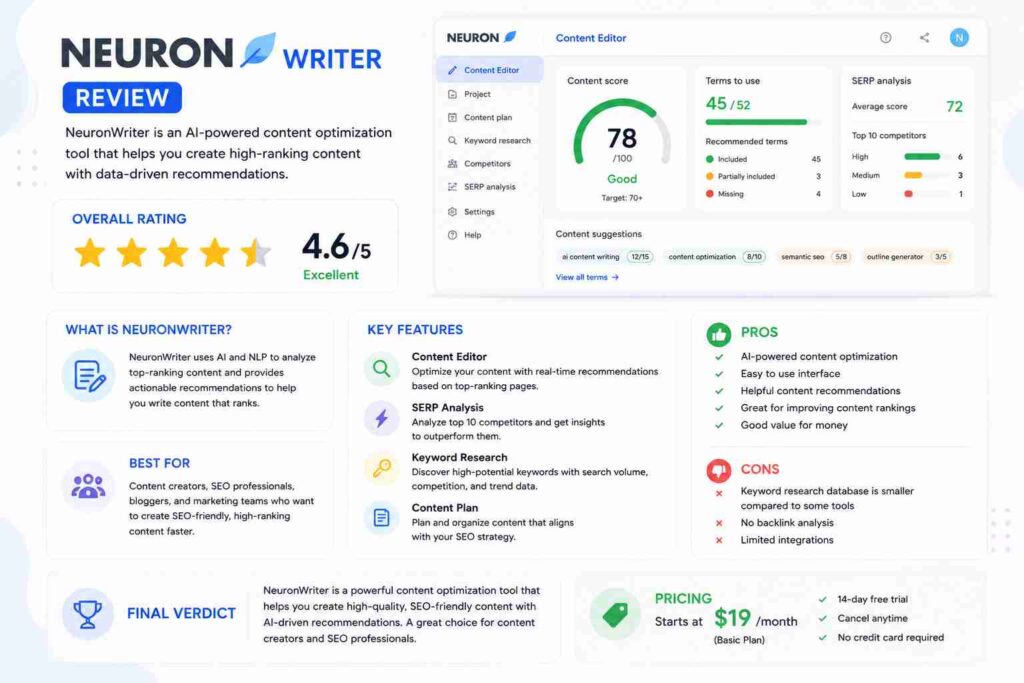
NeuronWriter trades excitement for reliability, and that trade becomes more valuable than expected after a few weeks of production work. The SERP-based content scoring, the term suggestion system, the outline builder — they all point toward the same goal: giving you a draft that is already shaped around what is ranking before you start significant editing.
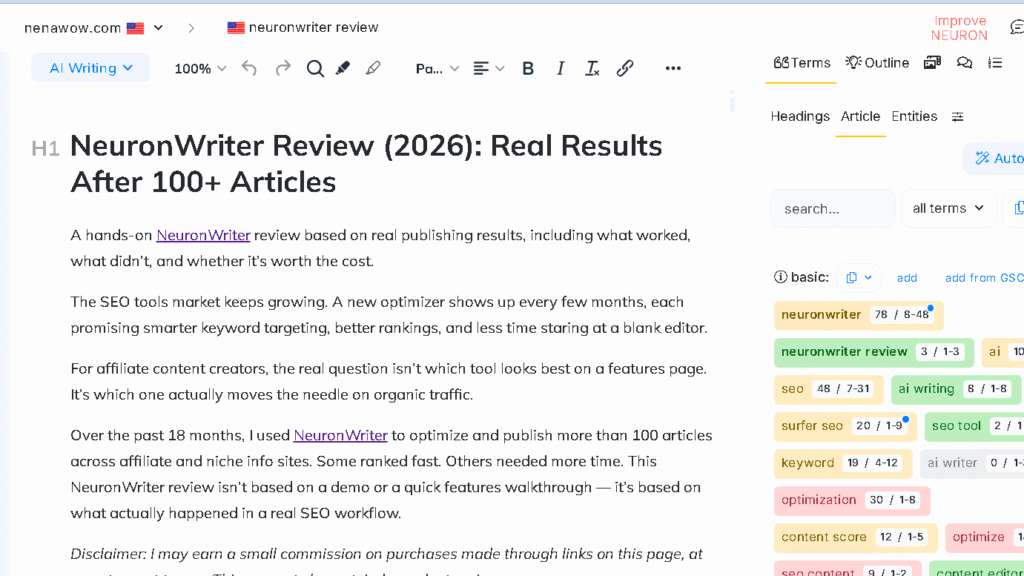
In my seven-week test, NeuronWriter produced the most structurally sound first drafts for SEO-specific briefs. I tracked editing time across 20 NeuronWriter drafts and averaged 13 minutes of structural work per 1,000-word piece. That is the lowest in this group by a meaningful margin. The drafts are not always the most fluid to read before editing, but they are the most complete from an optimization standpoint.
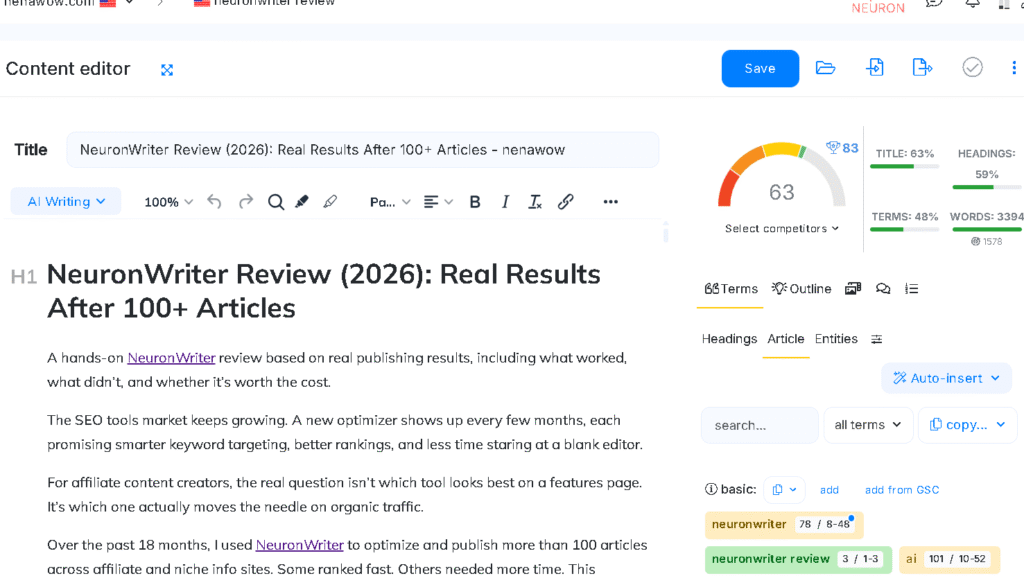
The friction shows up during creative or tone-led work. NeuronWriter occasionally feels too analytical — the interface is clinical, the content scoring pulls your attention toward term density when you are trying to find a natural voice, and the outputs can feel structured to the point of being a little flat. I noticed this especially during editorial pieces where the tone was the main job. For those, I found myself writing more and editing the NeuronWriter draft less.
If Writesonic feels unpredictable during SEO workflows, NeuronWriter is probably the calmest long-term transition. The consistency is real.
My NeuronWriter review explores the platform in much greater detail, including content scoring, workflow observations, and long-term editing burden across multiple projects.
Scalenut: Best for Scalable Content Creation
Scalenut works best when you stop treating it like a chatbot and start treating it like a production system. That shift in how you approach the tool changes what you get out of it. The cluster planning, the AI-assisted outlines, the guided draft workflow — these are not features to play with. They are a sequence, and the sequence works.
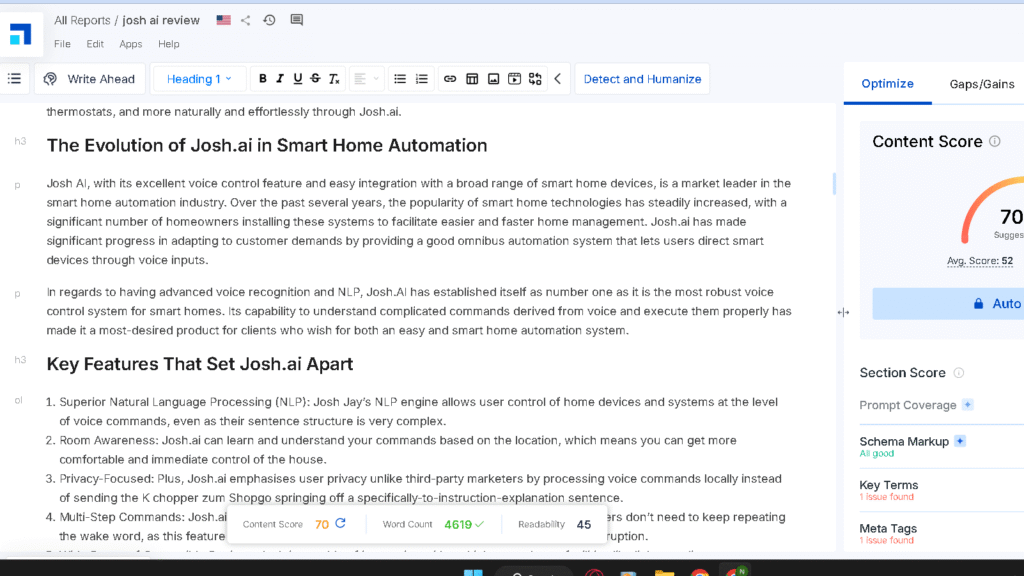
The content it produces inside that sequence is reliably structured. I ran 15 briefs through Scalenut’s standard blog workflow during weeks two and three and found the structural editing burden was lower than Writesonic on every single draft. Not by a huge margin — roughly 20 percent less time — but that margin held steady across different topic types, which is the kind of consistency that matters.
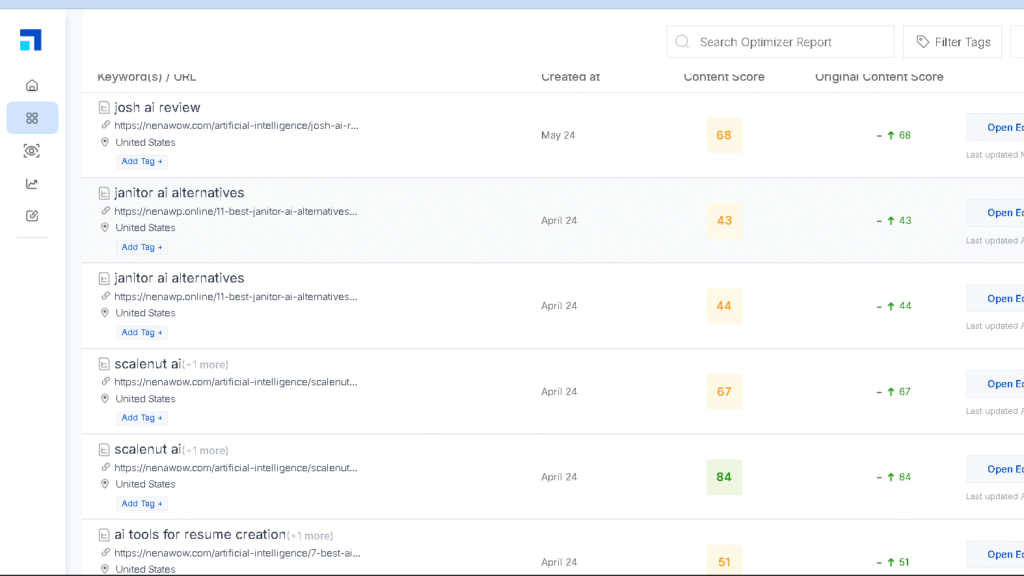
The ceiling shows up during large batch production. Output patterns become noticeable after you have run twenty or more similar briefs through the same workflow. The introductions start echoing each other, the transition phrases repeat, the H2 structures converge on the same shapes. By week five I could predict what the tool would suggest for a given brief type. That predictability is calming early on and slightly numbing later.
Teams struggling with production consistency will find more operational stability inside Scalenut than in Writesonic. The workflow is more guided and the outputs are more repeatable.
Surfer SEO: Best for Content Optimization Workflows
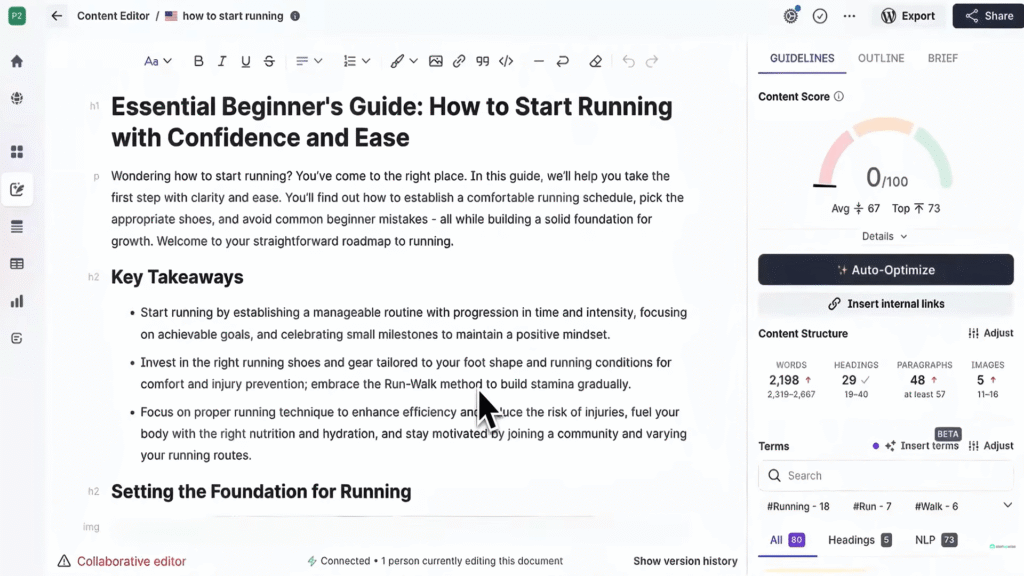
Surfer SEO is not really an AI writer. It is an optimization framework with AI writing built inside it, and that distinction matters when you are choosing it as an alternative. What Surfer does better than any other tool in this group is anchor your content to SERP reality in real time. The content score, the term suggestions, the NLP density feedback — these are designed to close the gap between what you write and what Google appears to want. For SEO writers, that feedback loop has genuine value.

The thing Surfer does not warn you about: the optimization score becomes psychologically addictive faster than most users expect. I caught myself reworking paragraphs that read naturally because the score said they were below target. Surfer reduces uncertainty for SEO writers but occasionally replaces it with score anxiety. Those are different problems. One is about the work, the other is about you.
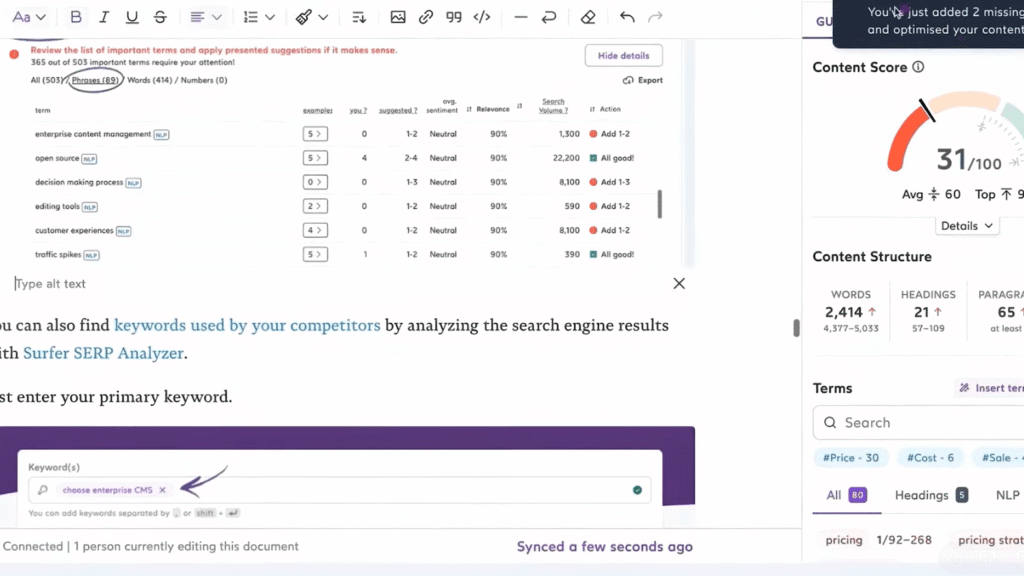
The AI-generated drafts inside the Surfer editor are serviceable but not the reason to choose the platform. Most serious users treat them as structural scaffolding that needs real writing on top. What you are paying for is the optimization environment, not the output quality. Once that framing is clear, the tool delivers well on its actual promise.
For a deeper breakdown of Surfer’s optimization workflow, scoring system, and long-term usability, see my full Surfer SEO review.
Frase: Best for Research-Led SEO Writing
Frase reduces the exhaustion of figuring out what to write about more than the exhaustion of rewriting AI drafts. That is the most accurate single-sentence description I can offer after seven weeks. The SERP research integration, the auto-generated briefs, the question clustering, the competitor content analysis — these are tools for the thinking phase, and they are genuinely strong at reducing how much manual research you need before a draft begins.
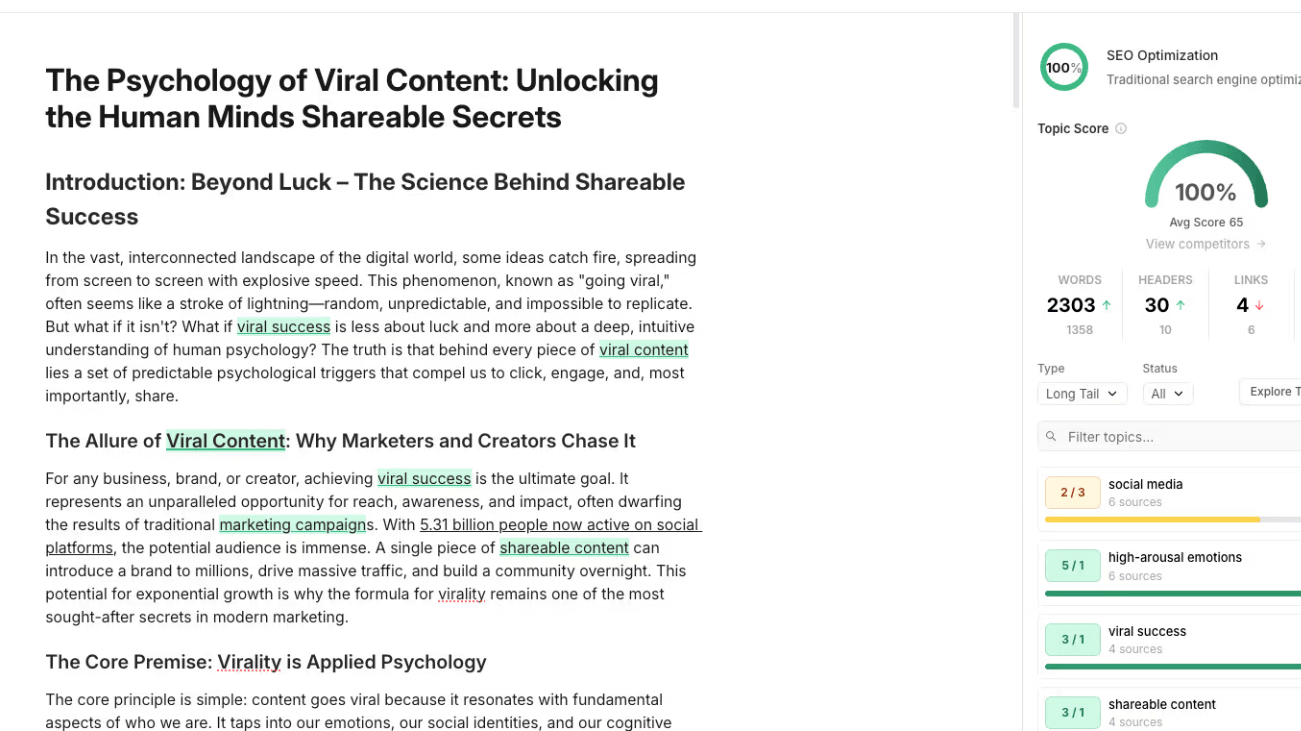
The AI draft quality in Frase is variable, and I found myself using Frase for planning and then either NeuronWriter or my own writing for the actual draft. That is a legitimate workflow — Frase as a research layer, another tool for generation — and it is probably how most serious users end up working with it. The briefs it produces are good enough to draft from. The AI-generated content inside those briefs still needs significant editing.
The optimization suggestions in Frase also become predictable after repeated use. By week four I could anticipate most of what the tool would flag on a given topic. That predictability is calming at first and slightly numbing over time. It is still one of the more useful tools in this group for writers who plan before they write.
Rytr: Best Lightweight Writesonic Alternative
Rytr succeeds because it asks less from the user, not because it produces deeper content. The interface is clean in a way that feels almost sparse compared to Writesonic or Surfer. There are fewer decisions to make before the first output appears. For writers who are overwhelmed by feature-heavy platforms, that accessibility has real value that is easy to underestimate.
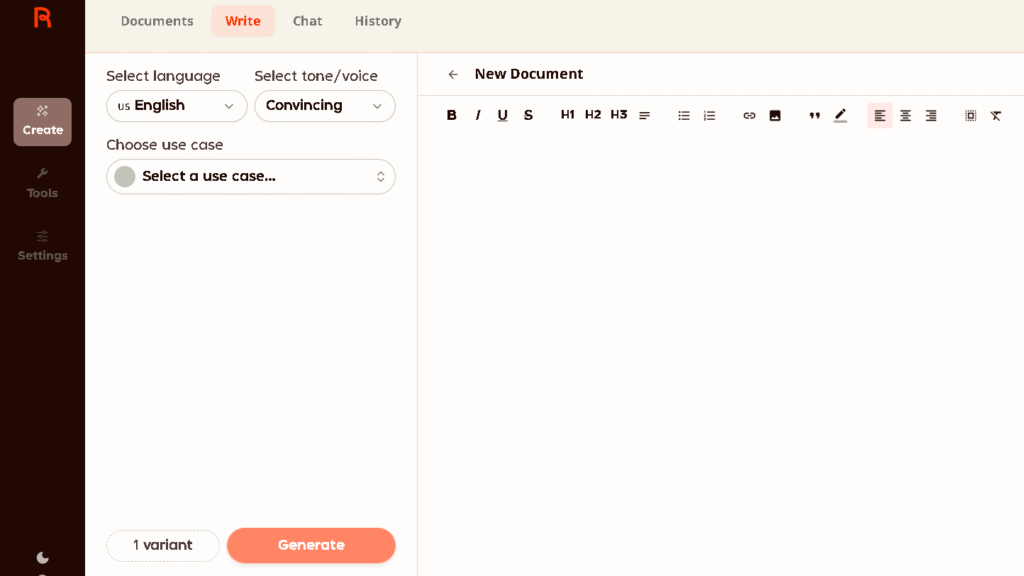
The ceiling arrives early, though. Sentence patterns started repeating in Rytr by week two — specific transition structures, similar paragraph endings, a narrowing tonal range that became audible on anything longer than 600 words. I ran a batch of ten 800-word drafts through Rytr in week three, and by the sixth piece the structural echoes were obvious enough that I would not publish them without significant rewriting.
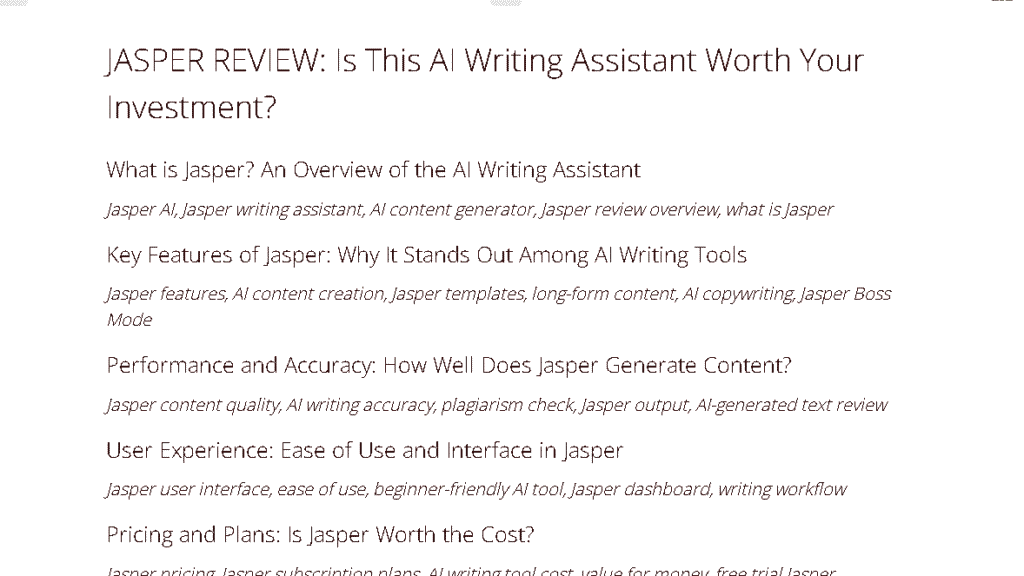
Rytr is the right call for solo bloggers, casual marketing tasks, and writers who need a low-friction AI entry point. For anyone running a serious content operation, you will hit the ceiling before the first month is out.
My Rytr review looks at where that ceiling appears, who the tool works best for, and why simplicity becomes both its biggest strength and biggest limitation.
Jasper AI: Best for Brand Voice Consistency
Jasper feels strongest when the workflow is already defined before the writing begins. That is not a criticism — it is a description of where the tool actually lives. The brand voice settings, the template library, the structured prompt system — these are designed for teams that have already figured out their content playbook and need the AI to stay inside it.
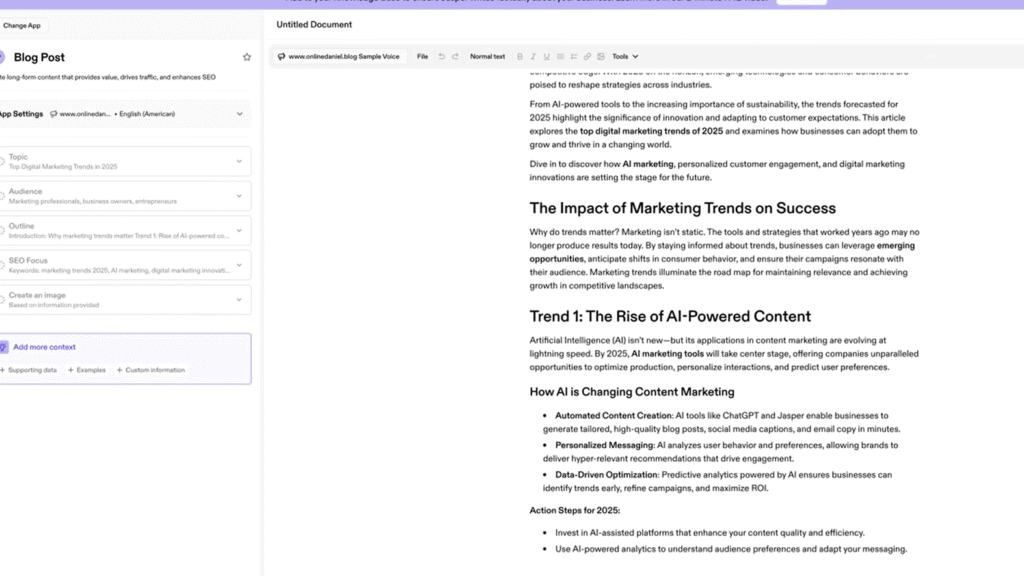
The brand voice consistency Jasper delivers across formats is genuinely better than most alternatives I tested. I ran the same brand brief through Jasper, Writesonic, and Copy.ai across ten short-form pieces. Jasper held the tone most reliably on eight of the ten. Writesonic held it on five. Copy.ai held it on six. That kind of consistency matters when your content has to sound like it came from the same place.
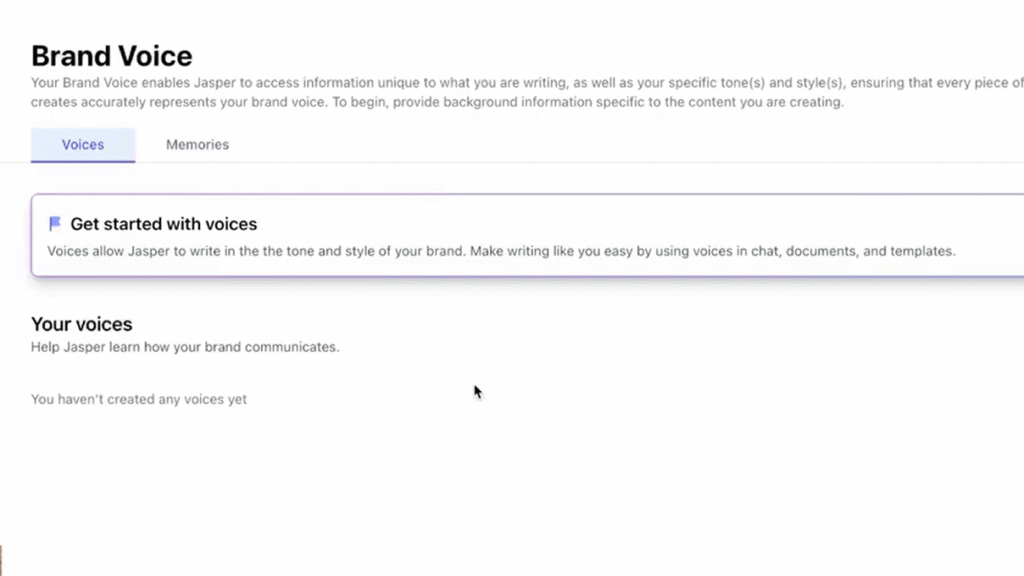
The long-term friction is prompt maintenance. Keeping prompts refined across a large and growing content library is its own kind of labor — one that many teams do not account for when they sign up. By week four I found myself spending as much time managing the prompt system as I was spending on actual writing. That trade-off is fine for teams that can dedicate someone to it. For solo users, it is a heavier overhead than Jasper’s pricing suggests.
I cover that challenge in much more detail in my Jasper review, including brand voice testing, editing burden, and whether the platform justifies its premium pricing over time.
If you’re deciding between a dedicated marketing platform and a general-purpose AI assistant, my Jasper vs ChatGPT comparison examines where each workflow becomes easier—or more frustrating—after extended use.
Copy.ai: Best for Marketing Workflow Automation
Copy.ai often feels more useful as a marketing operations layer than a pure writing environment. The automation workflows, the GTM templates, the sales email sequences, the multi-step content pipelines — these are built for teams that think in systems rather than in individual pieces. If your content work looks like repeatable marketing tasks, Copy.ai fits that shape well.
The writing quality for long-form content is the main limitation. Copy.ai outputs occasionally sound operational rather than human on anything beyond 600 words — correct, complete, but somehow flat in a way that is hard to point to and easy to feel. I ran the same blog brief through Copy.ai and NeuronWriter in week five. The Copy.ai output needed more tonal editing despite requiring less structural editing. Different problem, same amount of work.
For marketing teams running demand generation, outbound, and content at scale with tight templates, Copy.ai is a strong fit. For editorial content teams that care about voice and texture, the flatness will frustrate you.
Writesonic vs Jasper vs NeuronWriter vs Scalenut
| Writesonic | Jasper | NeuronWriter | Scalenut | |
|---|---|---|---|---|
| Primary strength | Speed, format variety | Brand voice control | SEO structure | Production workflow |
| Output consistency | Low-medium | Medium-high | High | Medium-high |
| Editing burden | High | Medium-high | Low-medium | Medium |
| Repetition onset | Week 3 | Week 3-4 | Week 6+ | Week 4-5 |
| SEO workflow fit | Moderate | Moderate | Very strong | Strong |
| Creative flexibility | High | High | Low-medium | Medium |
| Long-session fatigue | High | High | Low | Medium |
| Best daily use | Short-form, ideation | Structured short content | Long-form SEO drafts | Blog production |
Which Writesonic Alternative Fits Different Types of Writers?
The question is not which tool is best. It is which failure mode you can plan around.
SEO writers who care most about output structure and ranking performance will find NeuronWriter and Frase the least frustrating over time. Both tools anchor the work in SERP data, which removes a layer of second-guessing that Writesonic does not.
Content teams running high output volumes will find Scalenut the most reliable production environment, with the understanding that an editorial review layer is non-negotiable. The outputs are more consistent than Writesonic but still not publishable without a pass.
Solo creators and bloggers who write occasionally will find Rytr or Writesonic itself the most accessible entry points. Rytr especially — the ceiling is real, but for two to three posts a month it is plenty.
Marketing teams that think in systems and workflows rather than individual pieces will find Copy.ai the most natural fit. It is not the strongest writer in this group, but it is the best at fitting into an existing marketing operation.
Brand-focused teams with strict voice guidelines and an established prompt system will find Jasper the most dependable option. Nothing else in this group holds tone across formats as reliably.
Best Writesonic Alternative for Bloggers
For bloggers, the choice depends on how seriously SEO figures into the work. Casual bloggers who write for audience rather than search will find Rytr or Writesonic the lowest-friction tools to work with. Both are fast to start, both require minimal setup, and both handle the formats bloggers use most.
For bloggers who track keywords and care about ranking, NeuronWriter or Frase will serve better after the first month. NeuronWriter gives you structural SEO alignment from the first draft, which means less post-draft optimization work. Frase gives you better research clarity before you write, which reduces the number of drafts that end up going in the wrong direction entirely.
Best Writesonic Alternative for SEO Teams
NeuronWriter. The structural consistency, the low editing burden, the SERP-aligned outputs, and the reasonable pricing make it the most practical choice for teams doing keyword-driven writing at volume. I ran it across four different content types during this test and found the quality gap between NeuronWriter and Writesonic widened as the content complexity increased.
Scalenut is the second-best option for SEO teams, especially those managing topical clusters. The cluster planning tool alone is worth the entry price for teams that think about content architecturally rather than piece by piece.
Cheapest Writesonic Alternative
Rytr starts at around $9 per month, which is the lowest floor in this group by a wide margin. For low-volume workflows where long-form quality is not the priority, that pricing is hard to argue with.
NeuronWriter sits around $19 to $23 per month depending on the plan and is the cheapest option that still holds up as a full professional SEO writing tool. For anyone paying Writesonic’s higher rates and finding the ROI fading, NeuronWriter at that price is a real shift in value. Scalenut and Frase both start around $15 to $39 depending on the plan and fall in the middle of this group on both price and capability.
Pricing Comparison
| Tool | Entry price | What you get | Scaling cost reality | Workflow ROI |
|---|---|---|---|---|
| Writesonic | ~$20/mo | ~200k words | Scales with word volume | Fades as inconsistency grows |
| NeuronWriter | ~$19/mo | 2 projects, content scoring | Scales reasonably | Strong for SEO teams |
| Scalenut | ~$39/mo | Unlimited AI words | Cluster tool adds value | Good for volume teams |
| Surfer SEO | ~$89/mo | 30 articles/mo | Grows with content output | Strong if used as optimization layer |
| Frase | ~$15/mo | 4 articles/mo | Scales with article count | Strong for planning phase |
| Rytr | ~$9/mo | 10k characters/mo | Unlimited at $29 | Low ceiling, low cost |
| Jasper | ~$49/mo | 1 user, brand voice | Team seats jump cost fast | Fades without prompt maintenance |
| Copy.ai | ~$49/mo | Unlimited words | Team workflows cost more | Good for marketing ops |
Worth noting: Writesonic’s pricing looks competitive until you factor in the editing labor that inconsistent outputs create. The actual cost of using a cheaper but less consistent tool is higher than the subscription price suggests. That math is worth doing before you choose on price alone.
Pros and Cons After Long-Term Use
NeuronWriter The most durable tool in this group for SEO-focused writing. The editing burden stayed consistently lower than every other platform across all seven weeks. The interface is clinical and the outputs are not always fluent without editing.
Scalenut Strong in the first month. Pattern repetition by week four is the main structural problem, and it is more noticeable if you are writing inside a tight niche where the topic variety is limited. The cluster planning tool is the best feature in this price range. Editorial review downstream is not optional.
Surfer SEO I still catch myself reworking naturally good paragraphs because the score says otherwise. That is the Surfer problem in one sentence. The optimization framework is excellent. The psychological pull of the score is something to actively manage. Used correctly — as an optimization layer rather than a writing judge — it holds up well.
Frase The brief quality stayed strong through all seven weeks. The AI drafts stayed variable. Using Frase for research and planning, and then writing or generating elsewhere, is the workflow that makes the most sense. That is more friction than a single-tool solution, but the research quality justifies it for SEO-serious teams.
Rytr Low friction. Low ceiling. Right tool in the right context. Wrong tool for volume publishing or anything with real SEO depth requirements.
Jasper Brand voice consistency is real and remains the strongest in this group. The prompt system overhead is also real and grows with the content library. Best for teams that have already done the work of defining their content playbook.
Copy.ai Useful as a marketing operations layer. Less useful as a pure writing environment. The automation features are the real product. The writing quality is the cost you accept for the workflow features.
Who Should Still Use Writesonic?
Writesonic makes sense for three types of users. First, teams that produce high-volume short-form content — ad variations, social posts, email subject lines — where per-piece inconsistency is manageable and speed is the main value. Second, writers who use AI mainly for ideation and first-angle generation rather than publishable drafts. Third, users in the early stages of AI writing who are still building a sense of what they need from the tool and want something fast and broad to explore with.
If none of those describe you, the gap between what Writesonic costs in time and what a more consistent tool delivers will compound over weeks. The switch is worth it sooner than most users make it.
Final Verdict
Different AI writing tools create different kinds of cognitive fatigue. That is the framework I keep coming back to after seven weeks of testing. Writesonic creates inconsistency fatigue — the kind where you never fully trust the session you are about to start. Jasper creates prompt maintenance fatigue. Surfer creates optimization anxiety. Each one wears you down differently, and the tool that fits you best is the one whose failure mode you can plan around.
For SEO writers who want the lowest editing burden, NeuronWriter is the most durable option in this group. For teams that need production volume with reasonable quality, Scalenut. If you want research-led workflows, Frase. For low-cost entry, Rytr. For brand voice consistency at the cost of prompt overhead, Jasper.
Most people do not leave Writesonic because it got worse. They leave because their standard got higher. The early sessions felt good because any AI output felt fast. After a few months, the comparison point shifts from the blank page to last week’s good draft, and inconsistency stops feeling like a minor inconvenience. It starts feeling like a tax. That tax is what makes people search for something more reliable.
Which tool fits that standard depends on what kind of tired you are.
FAQ
Writesonic works well for short-form content, brainstorming, and users exploring AI writing for the first time. For long-form SEO content and high-volume publishing, the inconsistency becomes harder to manage over time. Tools like NeuronWriter and Scalenut generally provide more reliable workflows.
Rytr and Copy.ai both offer free plans with limitations. They are useful for occasional tasks but do not match the consistency of premium tools. Free trials from Frase and Surfer SEO are often a better way to evaluate professional workflows.
For SEO-focused content, yes. NeuronWriter produces more consistent drafts, requires less structural editing, and integrates SERP data directly into the writing process. Writesonic remains stronger for fast ideation and content variety.
In my testing, NeuronWriter delivered the most consistent results over time. Frase and Scalenut were close behind, while Writesonic and Rytr showed greater variation between sessions.
Most AI tools are designed to generate impressive outputs quickly, not necessarily consistent outputs repeatedly. Platforms that rely on structured inputs and SEO data tend to reduce that unpredictability.
NeuronWriter offers the best balance of affordability and reliability at around $19 per month. Rytr costs less but reaches its limitations much sooner.
Yes for marketing teams and workflow automation. For long-form editorial content, the outputs often need additional editing to improve tone and personality.