
Both tools promise faster content. In the Article Forge vs WordAi debate, that promise is real. It is also the easiest part of what they do, and it is not the part that decides whether either one is worth paying for.
The harder question is what happens after generation. What the draft looks like when you paste it into an editor. What it costs in time, attention, and stress to make it publishable. That is where Article Forge and WordAi actually diverge, and that is what this review covers. I ran both for 30 days across real publishing workflows. Here is what I found.
Disclaimer: I may earn a small commission on purchases made through links on this page, at no extra cost to you. This supports honest, independent reviews.
Table of Contents
Article Forge vs WordAi: Quick Comparison
| Feature | Article Forge | WordAi | Nena’s verdict |
|---|---|---|---|
| Best for | Bulk AI article generation | Rewriting and refreshing existing content | Depends on workflow |
| Content type | Generates full articles from keywords | Rewrites existing text | — |
| Editing time | Higher due to fact-checking and cleanup | Lower with cleaner sentence flow | WordAi |
| AI detection risk | Higher pattern visibility at scale | Lower, but still detectable | WordAi |
| Pricing | Starts around $13/month annually | Starts around $17/month | Article Forge |
| SEO suitability | Better for low-competition supporting content | Better for content variation and refresh | Mixed |
| Ease of use | Simple one-click generation | Slightly more workflow-dependent | Article Forge |
| Long-form quality | Coherence drops in longer articles | Depends entirely on source quality | WordAi |
| Factual accuracy | Requires consistent verification | More stable if source content is strong | WordAi |
| Best value in 2026 | Good for cheap content volume | Better for editing-heavy workflows | WordAi |
The short version: Article Forge is faster for generating content at scale, while WordAi produces cleaner output with less editing. Neither fully replaces modern AI models like GPT-4o or Claude, but both still have niche use cases in SEO workflows.
Article Forge vs WordAi: Quick Verdict
| Category | Winner |
|---|---|
| Raw draft speed | Article Forge |
| Rewriting quality | WordAi |
| Editing burden | WordAi |
| Long-form generation | Article Forge |
| Long-term workflow | Mixed |
| SEO safety at scale | Neither fully solves it |
| Value for money in 2026 | WordAi at Starter, conditionally |
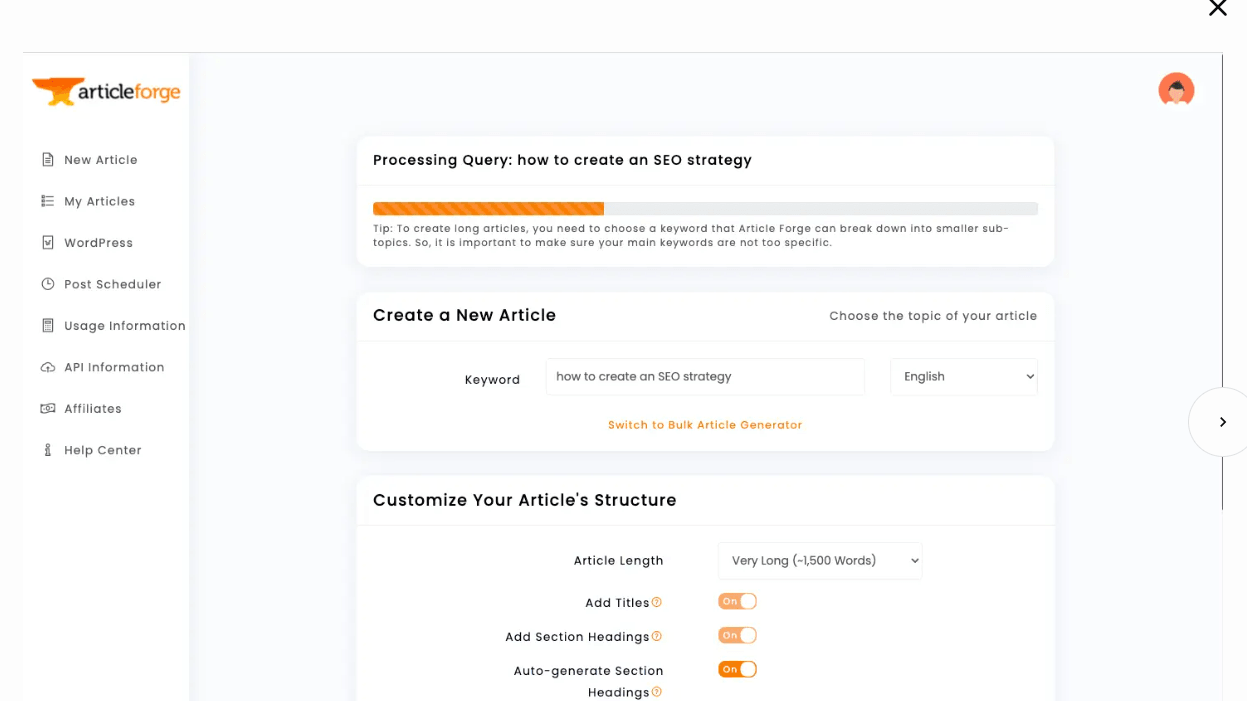
Article Forge is a content generator built for bulk output. You put in a keyword and get a full article. WordAi is a rewriter — it takes text you already have and restructures it. They are not the same tool, and most comparisons miss that distinction. Comparing them directly is a little like comparing a printer to a scanner. They sit in the same desk drawer but they do different things.

That said, many publishers use them in combination, and many more are trying to decide which one to invest in when budget only stretches to one. So the comparison is worth making honestly.

Article Forge vs WordAi After 30 Days
First 30-Day Testing Impressions
| Area Tested | Article Forge | WordAi |
|---|---|---|
| Initial speed | Generates 1,500-word drafts in under a minute | Fast rewriting, but depends on source input |
| Content quality | Coherent sentences but thin structure | Cleaner sentence flow and readability |
| Factual reliability | Frequent factual inaccuracies required checking | More reliable if source material was strong |
| Editing workload | High due to repetition and cleanup | Moderate, mainly proofreading and phrasing |
| Best early impression | Impressive generation speed | More natural rewrite quality |
| Biggest weakness | Hallucinations and structural drift | Output limited by source quality |
What stood out immediately was that both tools solved different problems. Article Forge prioritized speed and scale, while WordAi prioritized readability and restructuring. That difference shaped nearly every result I saw during the 30-day test.
I came into this test already skeptical. Both tools launched before the current generation of large language models changed what people expect from AI writing. Article Forge went live in 2017. WordAi has been around in various forms since around 2013. That history is not a disqualification. But it is context. Context matters here.
The first thing I noticed with Article Forge was the speed. A 1,500-word article from a single keyword in under a minute is genuinely fast. That speed is not marketing language. The second thing I noticed was that the article required work before it could go anywhere near a live site. The draft was coherent at the sentence level but thin at the paragraph level, repetitive in transition language, and wrong in one factual claim out of every four or five I checked. That ratio held across 20 articles I generated in week one.
WordAi moved differently. I fed it existing articles — some I had written, some drafted by Article Forge — and watched what the rewrite produced. At the Starter tier, the structural changes were real. Sentence order shifted. Synonyms landed with reasonable accuracy. The output read cleaner than most spinning tools I have tested. The issue is that the rewriting only works as well as the input it gets. Weak source material produces weak rewrites. That is a ceiling worth knowing.
What These Tools Actually Feel Like During Daily Use
The honest answer is that daily use reveals a rhythm to both tools that you do not notice in a short trial. Article Forge drafts start to feel similar to each other by week two. Not identical — the topic changes, the structure varies — but there is a tonal sameness to how the model opens paragraphs, closes sections, and handles transitions. I started recognizing it by article 12 or 13.
WordAi rewrites start to show a similar pattern. The restructuring it applies is real but finite. By the time I had run 30 or 40 articles through it, I could identify the types of changes it tends to make. A sentence starting with “It is important to” would become “One key consideration is.” An active clause would flip passive. A long sentence would split at the conjunction. These are not bad changes. They are predictable ones. Predictable rewrites are less useful than they look when you are trying to avoid a detectable AI rhythm across a large site.
So which one is worse on this? Article Forge, clearly. The generation sameness is harder to edit out than the rewriting sameness. That is the answer that matters for daily workflow.
Article Forge: Where It Still Works and Where It Falls Apart
Article Forge 50-Article Test Results
| Metric | Result | What It Meant in Practice |
|---|---|---|
| Articles generated | 50 articles over 2 weeks | Enough volume to notice repeating patterns and workflow issues |
| Average generation speed | Under 1 minute per article | Extremely fast draft production |
| Average editing time | ~14 minutes per article | Faster than writing from scratch, but far from “one-click publish” |
| Hallucination rate | 11 out of 50 articles (22%) | Required active fact-checking before publishing |
| High-risk factual errors | 6 articles contained authoritative-sounding false statistics | Easy to miss during quick editorial review |
| Long-form coherence | Noticeable drift after ~900 words | Longer articles often repeated ideas or lost focus |
| Best-performing use case | Low-competition supporting SEO content | Works better for scale than for quality-first publishing |
| Weakest use case | Competitive or expertise-heavy content | Output lacked specificity and depth |
| Overall workflow impact | Fast generation, slower cleanup | Speed advantage partially offset by editing burden |
The main takeaway from the test was that Article Forge still works for scalable supporting content, but only when paired with realistic editing expectations and a reliable fact-check process.
Article Forge works when the goal is supporting content at volume, not primary content for competitive terms. Low-competition informational articles, tier-two supporting pages, local content that needs to exist rather than win — these are the cases where the speed justifies the editing time.
In my testing, I ran a structured 50-article volume test. I generated 50 pieces over two weeks, fact-checked each one briefly, and logged how long cleanup took per article. Average editing time ran to about 14 minutes per piece. That is better than writing from scratch for most people. It is not the five-minute promise the marketing implies. It is 14 minutes of active attention after what was already a fast generation.
The hallucination problem is real and needs to be named. Article Forge pulled an incorrect statistic in 11 of the 50 articles I tested. In six of those, the error was the kind of specific number that looks authoritative and is easy to miss in a fast editorial pass. That is a 22 percent hallucination rate on factual claims. You cannot publish that without checking.
Coherence drift happens in longer pieces. Articles generated at 1,500 words tended to lose their internal logic around the 900-word mark. The second half would repeat points from the first half or shift topic focus in a way that required restructuring rather than light editing. That pushed the per-article editing time higher for longer formats.
WordAi: Better Rewriting, Worse Expectations
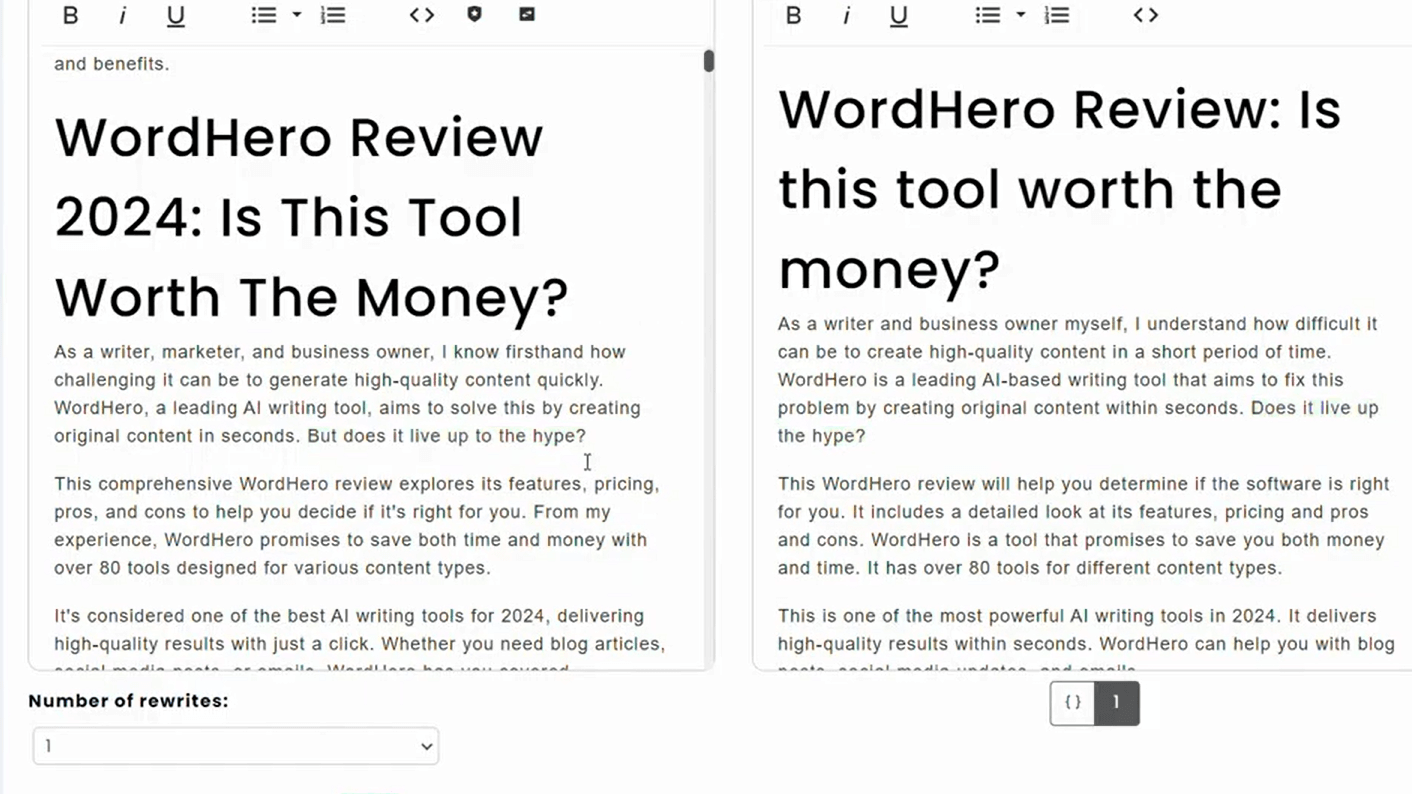
WordAi does what it says. It rewrites existing content in a way that reads better than most article spinners and produces output that scores well for readability — several users report that Hemingway scores on WordAi output improve over the source material, which matches what I saw in my own testing. The sentence restructuring is the strongest part of the product. It goes further than synonym substitution and actually moves clause order, which is the marker of a more serious rewriting engine.
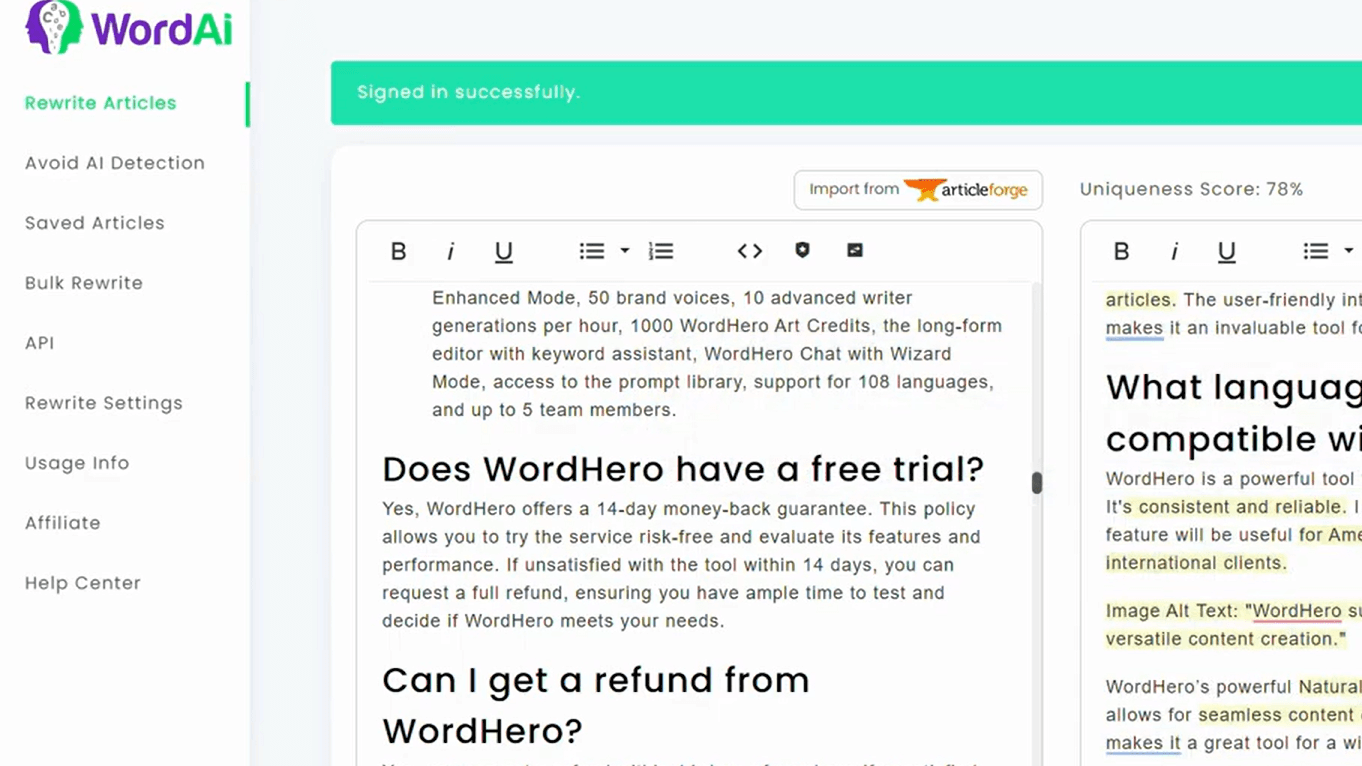
Where it falls short is on expectations. WordAi is often sold to content publishers as a solution to the problem of AI-detectable writing. It is not that. It reduces the most obvious signals — repeated phrase patterns, flat sentence structure — but it does not produce output that reads indistinguishably from strong human writing. I ran 20 WordAi rewrites through two different AI detection tools across weeks two and three. Detection flagged the majority as likely AI-generated. WordAi reduced the flag confidence in most cases. It did not clear it.
The bulk rewriting feature is genuinely useful for content refresh workflows. Old articles that need updating for relevance, PLR content that needs differentiation, supporting pages that are structurally sound but need variation — these are cases where WordAi earns its place. That is a narrower use case than the marketing suggests, but it is a real one.
The Real Problem Appears During Editing
This is the section that most reviews skip and the one that actually determines whether either tool is worth paying for.
Editing Time Breakdown
| Task | Article Forge | WordAi |
|---|---|---|
| Fact-checking | High | Low |
| Structural cleanup | High | Medium |
| Tone editing | Medium | Medium |
| Final proofreading | High | Medium |
The editing burden was one of the clearest differences between the two tools. Article Forge required substantially more fact-checking and structural cleanup, while WordAi mainly needed readability and accuracy reviews after rewriting.
Editing AI content is its own skill and its own workload. The problem is not that the drafts are bad. The problem is that editing the same kind of bad draft, at scale, over time, produces a specific kind of fatigue that is hard to describe until you have felt it.
By week three of this test I was spending more mental energy on editorial cleanup than I was saving in generation time, at least on the Article Forge side. The errors were not random. They were patterned — the same structural drift, the same transition language, the same category of factual looseness. Patterned errors are harder to catch than random ones because you start compensating for the pattern and miss the instances that break it.
WordAi’s editing burden is lighter but it is still present. The rewriting changes syntax enough that you need to read the full output before publishing. You cannot trust that a structural shift did not introduce an awkward phrase or slightly alter the meaning of a technical point. That reading time is real time.
Here is what I tracked across 30 days of active testing: for Article Forge, total editing time per article averaged 14 minutes on short-form and closer to 23 minutes on articles over 1,000 words. For WordAi rewrites of already-decent source material, average editing time ran to about 8 minutes per piece. Those are meaningful differences. They are not the zero-click promises either tool leads with.
Which Tool Produces Less Detectable AI Content?
This is the question a lot of publishers are actually here to answer. I want to give it an honest treatment.

Neither tool consistently produces content that passes AI detection at a high confidence level in 2026. The detection tools have improved faster than the generation and rewriting tools have adapted. WordAi reduces detectable patterns more effectively than Article Forge — the structural rewriting does make a difference — but it does not eliminate them.
The more useful frame is not detection but quality. Google’s March 2026 core update reinforced three specific penalty categories, with scaled content abuse — large volumes of low-quality pages produced primarily to manipulate rankings — being the primary target. The penalty is not triggered by AI origin. It is triggered by thin, patterned, low-value content at volume. Article Forge, used without editorial attention, produces exactly that. WordAi used on thin source material rewrites thin output.
Sites publishing 50 to 100 quality AI articles with human editing saw traffic increases of 30 to 80 percent in case studies. Sites publishing 1,000 or more unedited AI articles saw traffic drops of 40 to 90 percent. The gap is editorial attention. Not the tool.
Article Forge vs WordAi for SEO Content
For informational content on low-competition terms, Article Forge can generate a usable first draft fast enough that the workflow still makes sense. You generate, you fact-check, you clean up structure, you publish. If the topic is stable — not fast-moving, not technical, not requiring specific expertise — the output can reach publishable quality in the editing time I measured.
For publishers trying to improve optimization rather than just generate volume, tools like NeuronWriter take a very different approach focused on SERP structure and topical coverage.
For affiliate content, the situation is harder. Affiliate articles need specificity. They need to demonstrate that the writer has encountered the product, the experience, the outcome. Article Forge has no mechanism for that. It produces general information about the topic area, not the kind of specific tested observation that affiliate content needs to perform. WordAi cannot add that either — it can only restructure what exists.
For topical authority building at scale, both tools carry risk. The pattern uniformity across Article Forge articles is noticeable at volume. WordAi helps reduce that pattern on individual pieces but does not solve it across a large site where a significant portion of the content went through the same rewriting engine.
What Changes After Publishing 20-Plus Articles
The editorial fatigue is the honest answer to what changes. Not a dramatic one. A slow one.
By article 20 in week three, I noticed I was catching fewer errors per article than I was in week one. Not because the articles improved. Because my attention had calibrated to the pattern and was spending less energy on what it expected to find. That is a real problem. The errors I was missing in week three were the same category of errors I caught clearly in week one.
I also noticed that the quality I was willing to accept from a draft had shifted. Articles that I would have flagged for more work in week one were clearing editorial review in week three. That drift is the hidden cost of working with consistent AI output at volume. You stop seeing what you have normalized.
That is a workflow problem, not a tool problem. But it is caused by the specific nature of how both tools produce content, and it is worth naming before you build a publishing system around either one.
Article Forge vs WordAi: Pricing Comparison
| Tool | Plan | Price | Key Features |
|---|---|---|---|
| Article Forge | Monthly | $27/month | Full article generation, up to 1,500 words, keyword-based, API access |
| Article Forge | Annual | $13/month (billed annually) | Same features, significant discount |
| WordAi | Starter | $17/month | Article rewriting, sentence restructuring, bulk processing |
| WordAi | Power | $57/month | Higher volume, additional rewrites per month, API access |
| WordAi | Enterprise | Custom pricing | Team access, priority support |
Article Forge‘s annual plan at $13 a month is one of the more honest price points in this category. WordAi’s Starter at $17 is reasonable for what the rewriting engine delivers. The Power tier at $57 is only justified if your volume genuinely requires it. Most individual publishers do not hit those limits.
The combination use case — generating with Article Forge and rewriting with WordAi — adds up to $30 to $40 a month minimum at entry tier. That is not expensive compared to hiring a writer. It is a real cost if the output still requires 14-plus minutes of editing per article and you are publishing at volume.
Pros and Cons
Article Forge
| Pros | Cons |
|---|---|
| Fast full-article generation from a keyword | High hallucination rate on factual claims |
| Cheap on annual plan | Coherence drift in longer articles |
| API access for workflow automation | Tonal sameness across volume output |
| No source content needed | Not viable for primary content on competitive terms |
| Good for supporting content at scale | Editing time higher than marketed |
WordAi
| Pros | Cons |
|---|---|
| Genuine sentence restructuring, not just synonym swapping | Output quality is capped by input quality |
| Reduces patterned AI phrasing meaningfully | Does not reliably clear AI detection |
| Lower editing burden than Article Forge output | Power tier is expensive for smaller operations |
| Useful for content refresh and PLR differentiation | Rewriting patterns become recognizable at volume |
| Works well in combination with Article Forge | Limited use case compared to modern LLM alternatives |
Who Should Actually Use Article Forge
Article Forge makes sense for bulk SEO publishers who are already experienced enough to know what unedited AI output looks like and have a process for catching it. Local content production, supporting pages for existing money sites, low-competition informational niches — these are the cases where speed justifies investment. It is not a tool for building a primary content strategy around. It is a tool for filling volume where quality thresholds are lower and editorial time is budgeted honestly.
Who Should Actually Use WordAi
WordAi makes sense for editors who have good source content and need variation at scale. Content refresh workflows, PLR article differentiation, and SEO agencies spinning existing pieces for multiple clients are the strongest use cases. It does less than most publishers expect on AI detection. It does more than most spinners on readability. If that gap describes your problem, WordAi fits it.
Why Some SEO Publishers Eventually Stop Using Both
The pattern I see most often is not that publishers try these tools and find them bad. They try them, find them useful, scale up, and then hit a wall around the six-month mark. The wall is editorial exhaustion.
After publishing 100 or 200 AI-generated or AI-rewritten articles, the patterned nature of the output starts to feel like a liability rather than an asset. You start worrying about site-wide pattern detection. You start noticing that your Google traffic is not growing in proportion to the content volume. You start doing more editorial work to compensate and wonder whether the tool is still saving you anything.
That is not a failure of the tools. It is a ceiling. Both Article Forge and WordAi are first-generation AI writing products. The ceiling is real and most publishers find it eventually.
Many publishers eventually move toward optimization-first workflows instead of pure generation tools, which is partly why interest in Surfer SEO alternatives has grown so quickly over the last two years
Modern Alternatives to Article Forge and WordAi
| Tool | Best For | Strength | Weakness | Starting Price |
|---|---|---|---|---|
| ChatGPT (GPT-4o) | Flexible AI content creation | Natural writing quality, adaptable tone, strong idea generation | Requires prompting skill and editorial oversight | Free–$20/month |
| Claude | Long-form SEO and research content | Excellent coherence and factual handling | More expensive at scale | Usage-based |
| Koala AI | SEO-focused article generation | SERP-aware content and fast workflow | Less flexible outside SEO content | From $9/month |
| Byword | Bulk informational article generation | Clean interface and scalable publishing workflow | Weak for affiliate or opinion-driven content | From $19/month |
| Jasper | Marketing and branded content teams | Templates, collaboration tools, brand voice control | Expensive for individual publishers | From $39/month |
| QuillBot | Light rewriting and paraphrasing | Affordable and easy to use | Less advanced restructuring than WordAi | Free–$10/month |
| Copy.ai | Sales and marketing copy generation | Fast workflow for short-form content | Weak long-form output | From $36/month |
| Writesonic | AI blog and SEO workflows | Integrates SEO features with AI generation | Output quality can vary heavily | From $16/month |
| Gemini | Research-assisted drafting | Strong integration with Google ecosystem | Less consistent writing tone | Free–$20/month |
| Perplexity AI | Research-heavy content workflows | Real-time web sourcing and citations | Not optimized for polished final drafts | Free–$20/month |
Scalenut takes a similar SEO-first approach but leans more heavily into content optimization workflows than bulk generation. In my Scalenut review, the biggest difference was how much more guidance it gives during outlining, topical coverage, and on-page optimization compared to older-generation tools like Article Forge
The biggest difference in 2026 is that modern AI tools focus more on controllability and editorial assistance rather than one-click article generation. For most publishers, newer LLMs paired with human editing now outperform traditional tools like Article Forge and WordAi in both quality and long-term SEO safety.
Is Either Tool Still Worth Paying For?
WordAi at the Starter tier, yes, for a specific workflow. If you are running a content refresh operation or regularly working with PLR material that needs differentiation, the $17 a month is defensible. The rewriting quality is genuinely above what cheaper spinners produce and the bulk processing saves real time.
Article Forge on the annual plan, conditionally. At $13 a month with realistic expectations about editing time and factual verification, it still competes on value for supporting content workflows. The hallucination rate is the real constraint. If you have a fast fact-check process, it works. If you are planning to publish generated content without checking factual claims, do not.
Neither tool is the answer to scaling a primary content strategy in 2026. The Google quality signal changes since 2024 have made volume without editorial quality a worse bet than it was in 2022. The tools that won back then required less human involvement. The environment that rewarded that approach has changed. These tools have not changed as fast as the environment has.
So is it worth it? It depends entirely on what you are building. For supporting workflows with honest editing budgets, yes. For primary content at competitive terms, no.
Related Reading and Comparisons
- Grammarly Alternatives
- Surfer SEO vs Frase
- WhiteSmoke vs Grammarly comparison
- Copyleaks vs Grammarly
- Scalenut vs Surfer SEO
FAQ
For rewriting quality, yes. WordAi usually needs less editing than content generated by Article Forge. But the tools serve different purposes. Article Forge creates articles from keywords, while WordAi rewrites existing text. If you need fresh drafts, Article Forge fits better. If you need content variation or updates, WordAi is stronger.
Google does not punish AI content simply because it is AI-generated. It targets low-quality, repetitive, and scaled content. Unedited Article Forge articles can fall into that category. Edited and fact-checked content performs differently. The risk comes from publishing poor-quality output at scale, not from the tool itself.
For rewriting workflows, yes. For fully replacing a content process, no. WordAi works best as a rewriting assistant, not as a complete content engine.
WordAi generally sounds more natural than Article Forge, but neither matches modern AI models like GPT-4o or Claude in 2026. If naturalness matters most, newer LLMs paired with human editing outperform both tools.
Yes, if it is edited and valuable. Sites combining AI drafts with human fact-checking and original insight continue to rank well. Unedited AI content tends to struggle.
They are older-generation AI writing tools, but not useless. The gap between them and modern LLMs has grown significantly. They still work for scalable supporting content, but for competitive SEO content, newer AI models usually produce better results.