
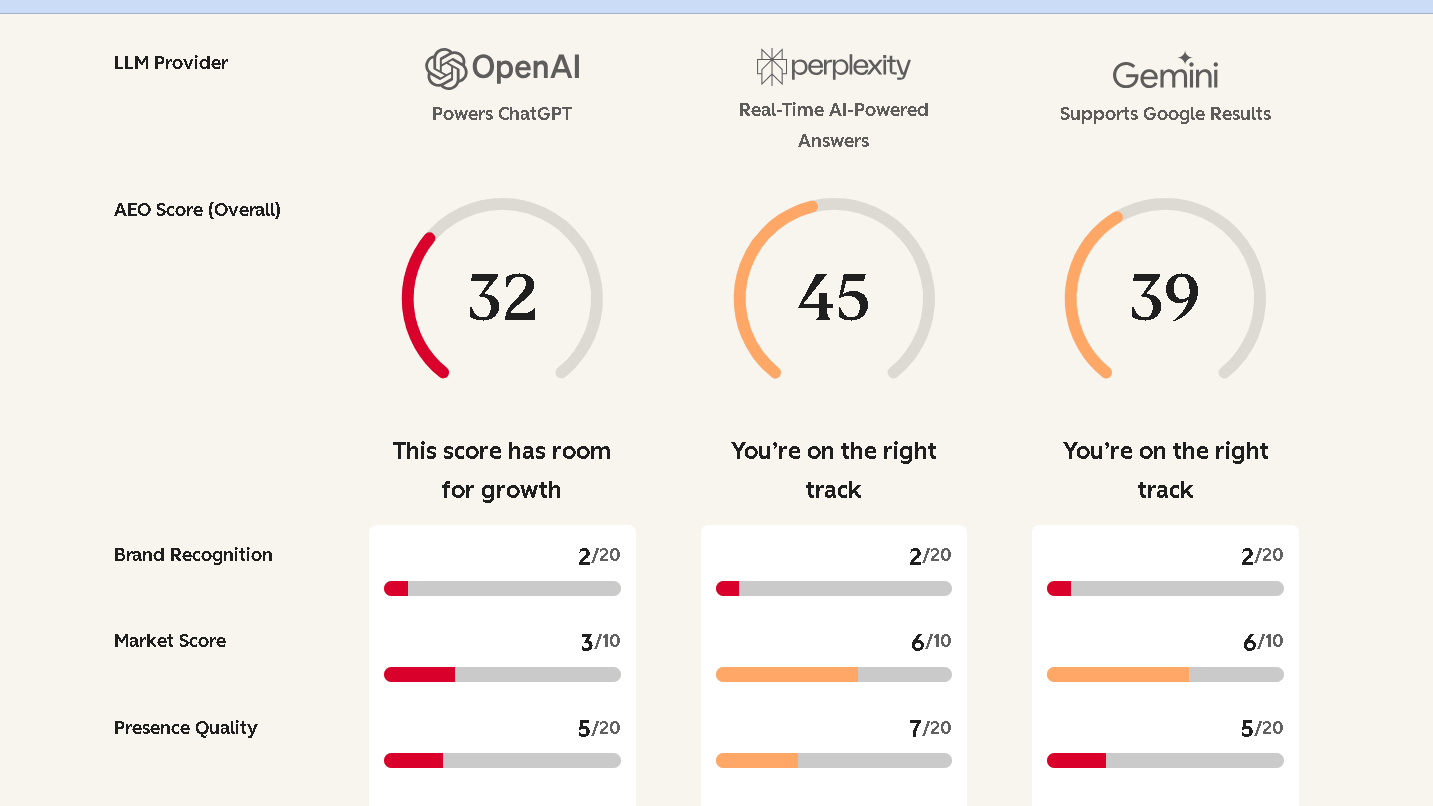
I ran the HubSpot AEO Grader on nenawow.com on June 23, 2026, and scored 32 on ChatGPT, 45 on Perplexity, and 39 on Gemini. Those three numbers are now my baseline. They are the before shot. Every piece of AI visibility content I publish from here will be measured against them.
That is the real reason to use this tool. Not the score. The before.
Nena’s Quick Verdict
- Rating: 4.9/5
- Free Plan: Yes
- Best For: AI visibility baselines
- Takes: ~2 minutes
- My Favorite Feature: Narrative Themes
- Biggest Limitation: No ongoing tracking
Table of Contents
What HubSpot AEO Grader Actually Is
HubSpot AEO Grader is a free AI visibility audit tool. You enter your website URL, your industry, your location, and the service your site offers. The tool then runs your brand through three AI systems — OpenAI’s GPT-5.4 mini, Perplexity, and Gemini 3 Flash Preview — and returns a scored report across five dimensions: brand recognition, market competition, presence quality, brand sentiment, and share of voice.
It takes about two minutes to generate. No credit card. No demo call.
Here is the issue with the scores though: ChatGPT and Gemini use fixed training data. GPT-5.4 mini has a knowledge cutoff of August 31, 2025. Gemini 3 Flash Preview cuts off at January 2025. Perplexity has no cutoff because it pulls live web results. The three scores you get are not measuring the same moment in time.
Keep that in mind when you read your report.
My Testing Setup
Website: nenawow.com Industry: Technology Service category: AI and SEO Software Reviews Location: Türkiye
I ran the report once, downloaded the PDF, and read every section before forming any conclusions. I did not cherry-pick the good numbers. Here, I am reporting all of them.
My Scores — The Full Picture
Here is what the grader returned across all five dimensions:
| Dimension | ChatGPT | Perplexity | Gemini |
|---|---|---|---|
| Overall AEO Score | 32/100 | 45/100 | 39/100 |
| Brand Recognition | 12/100 | 12/100 | 12/100 |
| Market Score | 3/10 | 6/10 | 6/10 |
| Presence Quality | 5/20 | 7/20 | 5/20 |
| Brand Sentiment | 21/40 | 29/40 | 26/40 |
| Share of Voice | 1/10 | 1/10 | 0/10 |
The Perplexity score is the strongest by a clear margin. The ChatGPT score is the floor. Gemini sits in the middle but its confidence level in the data is only 35 percent — the lowest of the three — meaning Gemini is the least sure about what it knows about my site.
That confidence gap matters more than the score itself. A 39 with 35 percent confidence is shakier than a 32 with 72 percent confidence. Perplexity runs at 85 percent confidence, which tells me it has the most data to work with.
The Finding That Changed How I Read the Report
The market competition section is where things get interesting. Under ChatGPT, nenawow.com showed 42 total mentions and 18 comparison mentions. Under Perplexity, those numbers jumped to 1,420 mentions and 3,850 comparison mentions.
That gap — 42 versus 1,420 — is not a small discrepancy. It tells a real story.
Perplexity finds my content because it searches the live web. ChatGPT is working from a training snapshot that ends in August 2025, and in that snapshot, nenawow.com does not have much third-party coverage yet. The pie charts make this plain. On ChatGPT, my competition is G2 at 24 percent, Capterra at 20 percent, TrustRadius at 12 percent. ChatGPT is filing me alongside review directories, not independent reviewers.
On Perplexity, the picture is different. My competitive set is Surfer SEO at 22 percent, NEURONwriter at 18 percent, Semrush at 15 percent, SE Ranking at 8 percent. Perplexity sees me as a content site competing with actual tools. Those are different things.
Being in the same conversation as Surfer and Semrush on Perplexity is a real signal that something is working.
Brand Recognition: 12/100 Across All Three
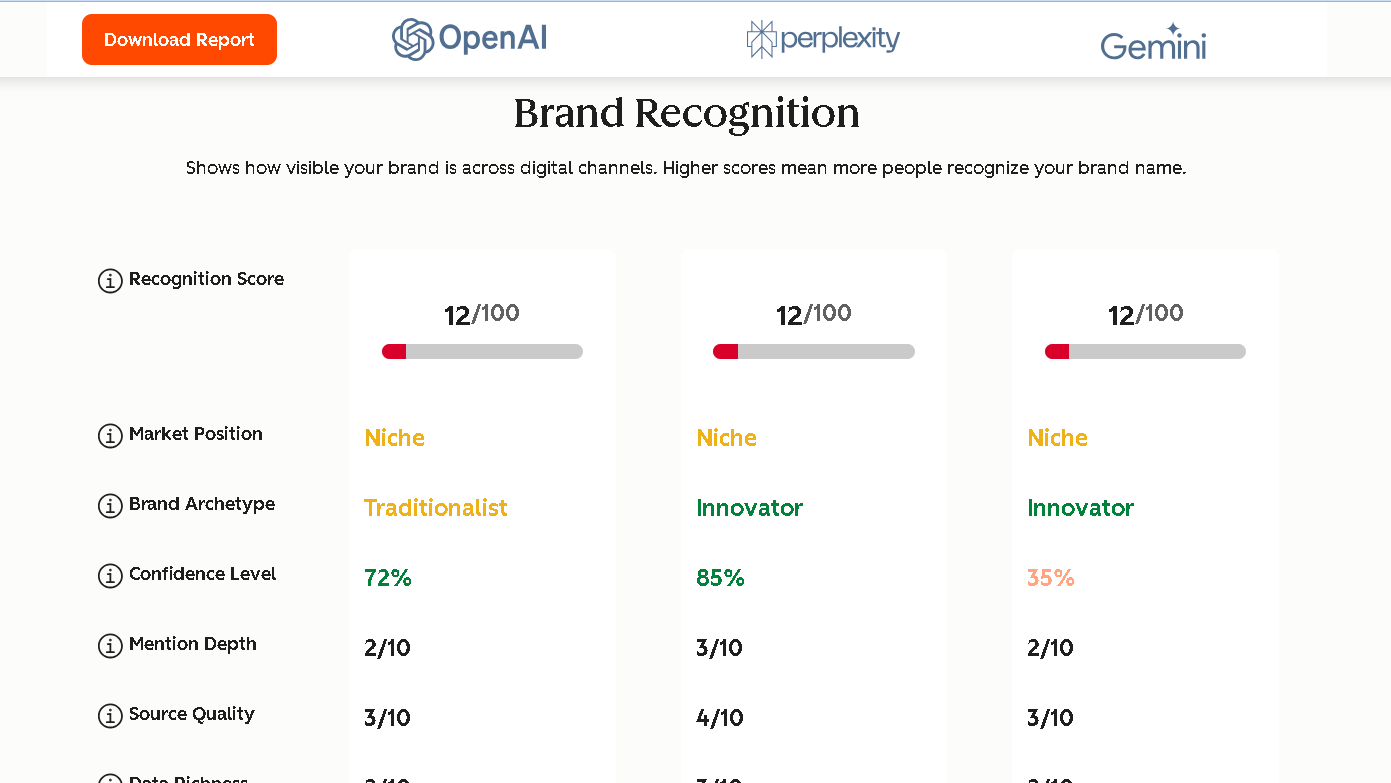
The recognition score is flat. Twelve out of 100 on every platform. Market position is “Niche” across the board.
To be fair, this is accurate. nenawow.com is a single-author independent review site with a Domain Rating around 11 and roughly three years of publishing history. A 12 is not a failure. It is an honest starting point.
What I found useful here is the breakdown below the headline number. Mention depth, source quality, and data richness all came in at 2 to 4 out of 10. Those are the levers I can pull. More third-party mentions, better source coverage, richer entity signals on the site itself.
The brand archetypes were interesting too. ChatGPT tagged me as “Traditionalist.” Perplexity and Gemini both tagged me as “Innovator.” The same site, three different reads. That inconsistency is itself a data point worth publishing.
Sentiment Analysis: The Score That Surprised Me
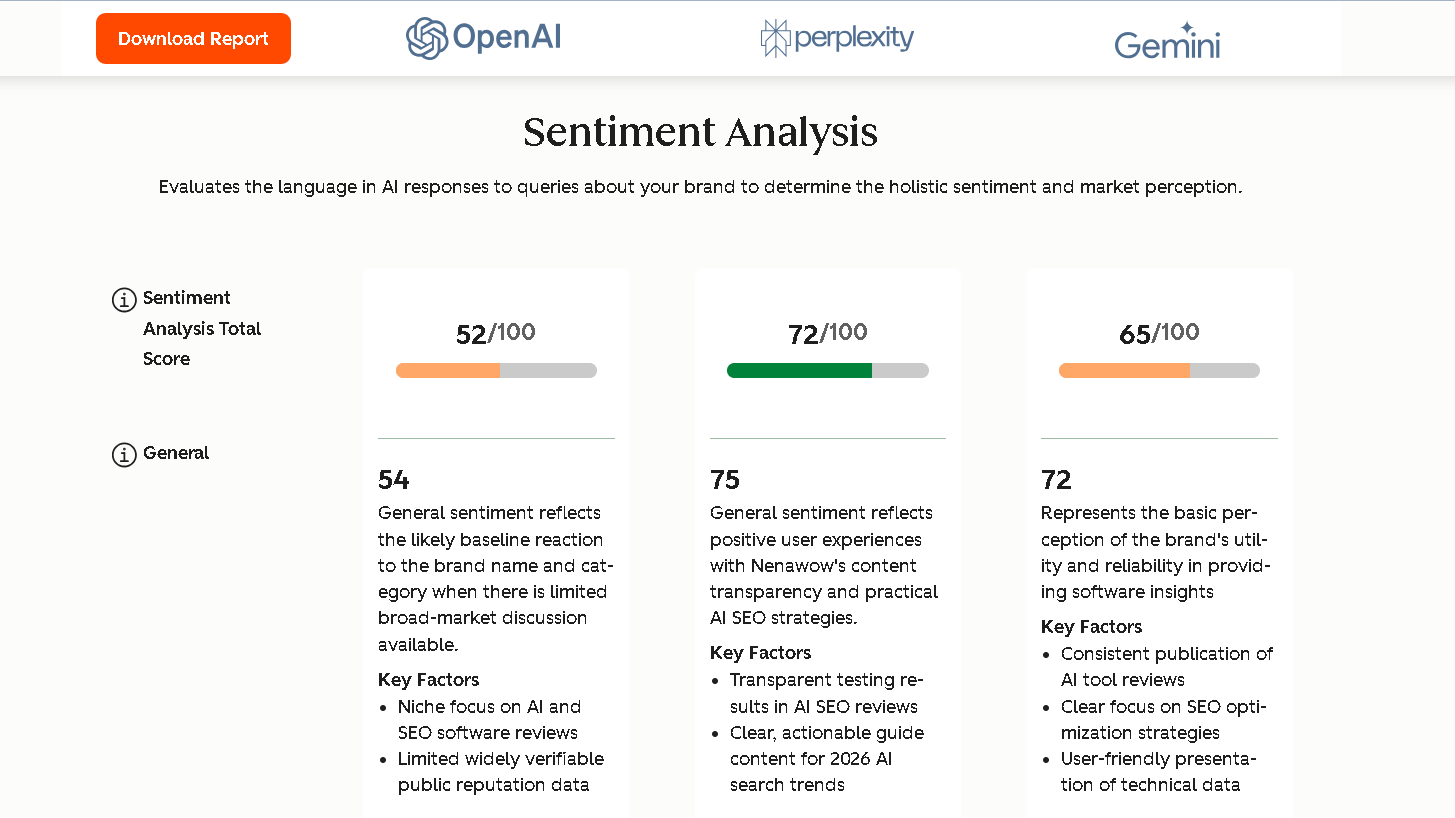
Overall sentiment scored 52 out of 100 on ChatGPT, 72 out of 100 on Perplexity, and 65 out of 100 on Gemini.
The Perplexity sentiment score of 72 is genuinely good for a niche site of this size. The tool broke it down into general sentiment at 75, contextual at 70, and source-based at 68. The source analysis on Perplexity even flagged specific places where my content shows up: the nenawow.com blog itself at 75, a Reddit SEO growth community at 70 where I get indirect references, and a YouTube AI Writers channel at 65 where my Koala AI review was linked.
The thing is, that YouTube link is doing real work. It is one external source that Perplexity can actually find and attribute. It shows how thin the margin is between being known and being invisible to these systems.
The ChatGPT source analysis marked “Reliable Data: No” and scored third-party review platforms at 45. That is the diagnosis. ChatGPT cannot find me on G2, Product Hunt, Clutch, or any major platform it trusts. Until that changes, my ChatGPT score will stay low regardless of how much I publish.
Narrative Themes: This Section Earned Its Place
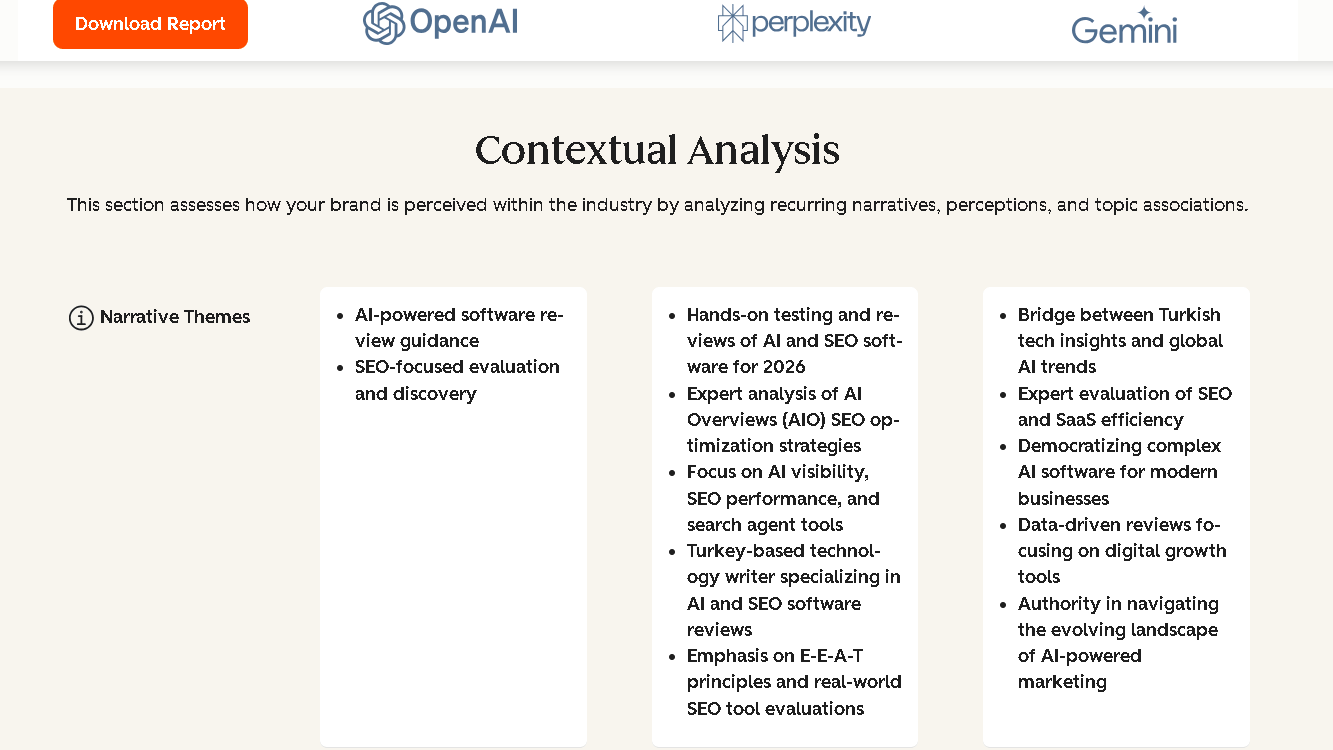
I expected generic output here. What I got was specific enough to be useful.
ChatGPT associated nenawow.com with two themes: AI-powered software review guidance and SEO-focused evaluation and discovery. Thin, but not wrong.
Perplexity returned six themes. Hands-on testing and reviews of AI and SEO software. Expert analysis of AI Overviews. Focus on AI visibility and search agent tools. Turkey-based technology writer. E-E-A-T principles. Bridge between Turkish tech insights and global AI trends.
That last one surprised me. I did not expect Perplexity to surface the Turkey angle as a distinct theme. But it makes sense — not many English-language AI tool review sites are based in Antalya. That is a real differentiator, and Perplexity found it.
Gemini added four more: bridge between Turkish tech and global AI, expert evaluation of SEO and SaaS, democratizing complex AI software, and authority in navigating AI-powered marketing. Some of that reads as inferred rather than verified, but the direction is right.
What the Growth Areas Section Actually Told Me
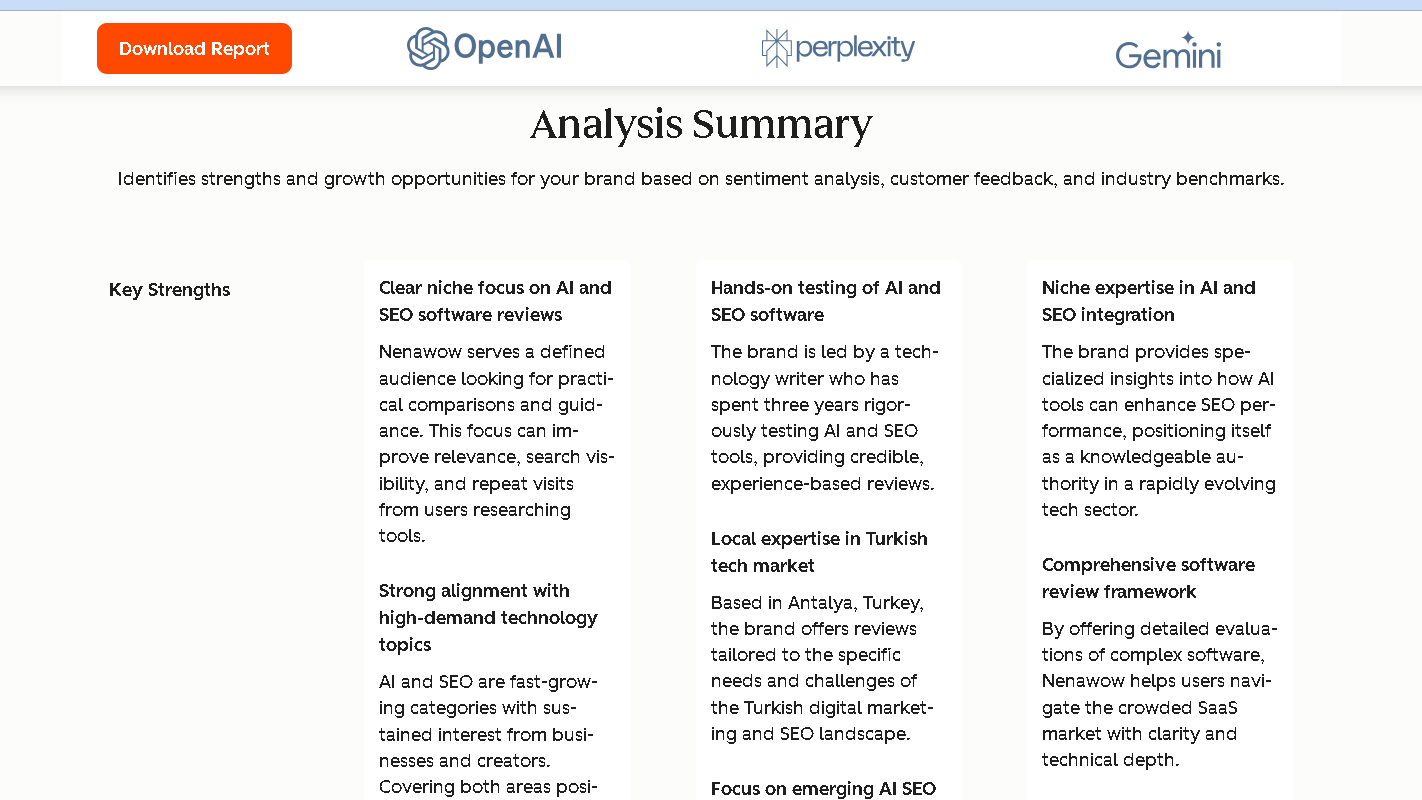
The report flagged three growth areas for ChatGPT: stronger authority and trust signals, expansion beyond basic reviews into decision support content, and differentiation through original insights and local relevance.
I will not argue with any of those. They are accurate.
The more useful finding came from the source analysis. “Insufficient verifiable third-party coverage” and “potential reliance on owned or niche content sources” — those two lines explain my ChatGPT score better than any number does. I need external entities to reference nenawow.com in ways ChatGPT can find and trust.
That means Product Hunt. That means third-party roundups with real domain authority, and more YouTube mentions. None of that is quick work, but at least now I know exactly what to target.
What the Tool Does Not Tell You
The grader is a snapshot. It runs once, returns data, and stops. There is no tracking over time, no alerts when your scores shift, no prompt-level data showing which specific questions trigger your brand. For ongoing monitoring you need something else entirely.
The methodology is also not fully transparent. HubSpot does not publish the exact formula behind each sub-score. The mention counts — especially that 1,420 Perplexity figure and the 3,850 comparison mentions — are almost certainly aggregated from indexed content, not from running thousands of individual queries. Treat them as directional, not literal.
The polarization scores are worth a second look too. Mine came in at 22 out of 100 on ChatGPT and 35 on Perplexity. The tool frames low polarization as a good sign, meaning no controversy. The honest read is simpler: low polarization mostly means low awareness. You cannot divide opinion you have not yet reached.
Who This Tool Is Actually For
If you run an independent review site, a niche blog, or a small SaaS and you have never measured your AI visibility before, this is the right starting point. It is free, fast, and gives you a named baseline with real numbers you can publish and track against.
If you already use a paid AI visibility platform like Hall, Otterly, or Rankscale, the grader adds the sentiment and narrative layers those tools do not cover. Run it alongside them, not instead of them.
If you need ongoing tracking, citation-level data, or competitor prompt analysis, this will not cover it. The grader is a diagnostic, not a monitoring tool.
Pros and Cons
Pros
- Free
- Fast
- Good narrative analysis
- Useful baseline
Cons
- No tracking
- Some generic recommendations
- Limited methodology transparency
My Verdict
I will run this again in 90 days. I will publish the AI visibility cluster I have mapped out, make the off-site moves the ChatGPT source analysis identified, and return with the exact same inputs to compare every number. If ChatGPT moves from 32 upward, I will know the work landed.
That is what makes this worth using. Not the score today. The gap you can close between now and the next run.
| ChatGPT | Perplexity | Gemini | |
|---|---|---|---|
| Overall Score | 32/100 | 45/100 | 39/100 |
| Brand Recognition | 12/100 | 12/100 | 12/100 |
| Sentiment | 52/100 | 72/100 | 65/100 |
| Market Score | 3/10 | 6/10 | 6/10 |
| Confidence Level | 72% | 85% | 35% |
| Third-Party Data | Unreliable | Unreliable | Reliable |
| Mentions | 42 | 1,420 | 840 |
Free to use. No card required. Best used as a baseline you plan to beat.
Frequently Asked Questions
What is HubSpot AEO Grader?
HubSpot AEO Grader is a free tool that scores your brand’s visibility across ChatGPT, Perplexity, and Gemini. It returns data on brand recognition, sentiment, market competition, and share of voice in about two minutes with no account required.
Is HubSpot AEO Grader free?
Yes. It is completely free with no credit card and no sign-up required. You enter your URL, your industry, your service type, and your location, and the tool generates a full PDF report.
How accurate are the AEO Grader scores?
The scores are directional, not precise. ChatGPT and Gemini scores reflect fixed training data with knowledge cutoffs in 2025, so they show past LLM training rather than live web data. Perplexity scores are closer to real-time because Perplexity searches the live web. Treat all scores as a starting benchmark rather than an exact measurement.
What is a good AEO score?
The tool does not publish a scoring rubric, but based on my report, scores above 40 are described as “on the right track” and scores below 35 are flagged as having “room for growth.” For a niche independent site, anything in the 40 to 60 range on Perplexity within the first three years of publishing is a reasonable place to build from.
Can HubSpot AEO Grader track my AI visibility over time?
No. It is a one-time snapshot tool with no ongoing monitoring, alerts, or historical trend data. If you want to track changes over time, you need a dedicated AI visibility platform like Otterly, or Rankscale alongside this grader.
What should I do after running the AEO Grader?
Look at the source analysis section first. That is the most actionable part of the report. If your ChatGPT score is low and the source analysis flags low third-party coverage, the fix is off-site work — getting listed on platforms like Product Hunt, earning mentions from YouTube creators in your space, and building more external references that ChatGPT can find and trust.