
Perplexity is often described as an AI assistant, but after 30 days of daily use, that description never felt quite right. It behaves more like a search engine with an AI layer on top. Once I stopped comparing it to ChatGPT and Claude, its strengths became much clearer. So did its weaknesses. The result was a tool that saved me significant time on research, but also revealed limitations that most Perplexity reviews barely mention.
I used Perplexity as my main research tool for thirty days. I tested it across writing, fact-checking, coding, and long-document work. What I found was not what the early demos suggested.
Disclaimer: I may earn a small commission on purchases made through links on this page, at no extra cost to you. This supports honest, independent reviews.
Table of Contents
Perplexity Review (2026): Quick Verdict
Perplexity is one of the best AI research tools available in 2026. Its source-backed answers cut verification time in a way that ChatGPT and Claude simply do not match. That said, it is not a writing tool. It is not a coding tool. And after two weeks, the seams start to show.
| Category | Rating |
|---|---|
| Research and fact-finding | 9/10 |
| Writing quality | 6/10 |
| Coding tasks | 5/10 |
| Citation reliability | 8/10 |
| Long-context analysis | 7/10 |
| Value for money (Pro) | 8/10 |
| Daily workflow fit | 7/10 |
If research is a major part of your work, Perplexity Pro is worth it. If you mostly write, edit, or build things, it is not your primary tool.
How I Tested Perplexity
I ran Perplexity through five structured tests over thirty days. Each one was designed to stress a different part of the product: writing, research, trust, coding, and document analysis. I used the Pro tier for the full period, with access to the model switcher and unlimited searches.
I tracked how often I needed to verify answers independently, how much editing the writing output required, and how my confidence in the tool changed from week one to week four. That last metric is the one that matters most. Trust after thirty days tells you more than any feature list.
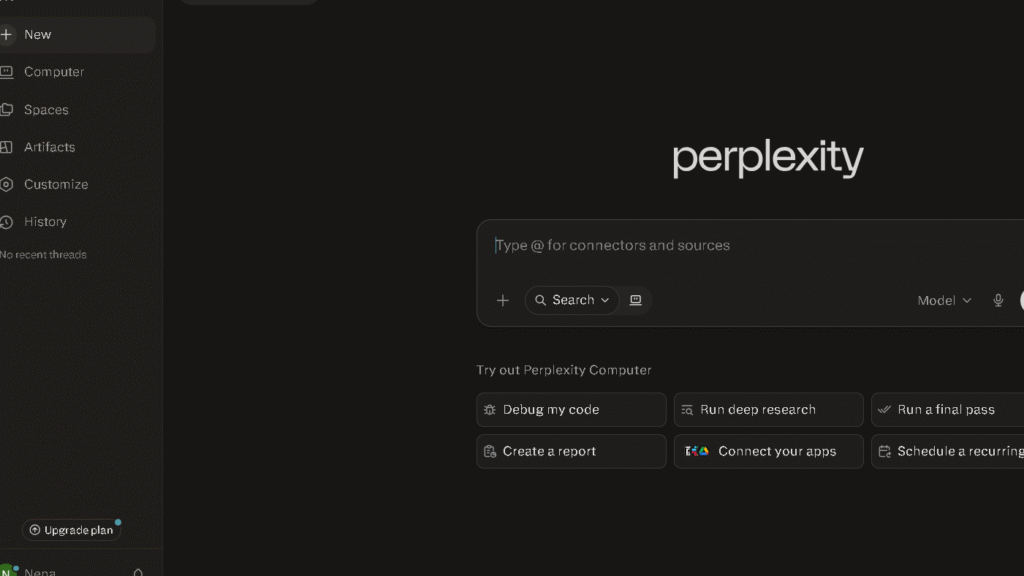
Perplexity Review At A Glance
Perplexity works by pulling live web results and summarizing them with inline citations. You can ask a question, get an answer, and see exactly which sources that answer came from. The Pro tier adds model switching — you can run queries through GPT-4o, Claude, or Perplexity’s own models depending on the task.
| Feature | Free | Pro |
|---|---|---|
| Daily searches | Limited | Unlimited |
| Model access | Basic | GPT-4o, Claude, Sonar |
| File uploads | No | Yes |
| Image generation | No | Yes |
| Price | Free | $20/month |
The interface is clean. Setup takes about ninety seconds. It just drops you in.
What Changed After Two Weeks of Daily Use
Around my second week of daily research and publishing work, I noticed a small behavioral shift: I was opening Perplexity first and Google second. That had not been the plan. It just happened. When you stop having to chase sources manually, the habit forms quickly.
By that same week, though, something else shifted too. The answers started feeling thinner on complex topics. The citations were still there, but I noticed Perplexity had a pattern: it pulled from the top three or four results and synthesized them without going deeper. That is useful for current events. It is less useful when you need a take on something contested.
| Behavior | Week 1 | Week 2+ |
|---|---|---|
| Verification needed | Low | Medium |
| Answer depth on complex topics | Good | Inconsistent |
| Source diversity | Strong | Moderate |
| Writing usability | Moderate | Requires editing |
| Trust level | High | Calibrated |
The calibration is not a bad thing. It just means you learn where to trust it and where to push back. That combination is harder to find than it looks.
Writing Quality
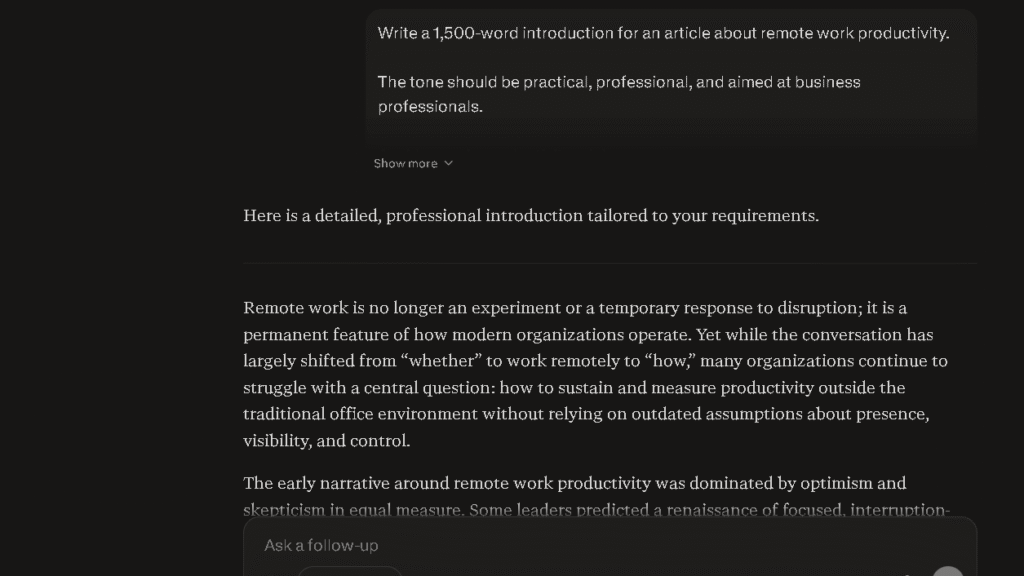
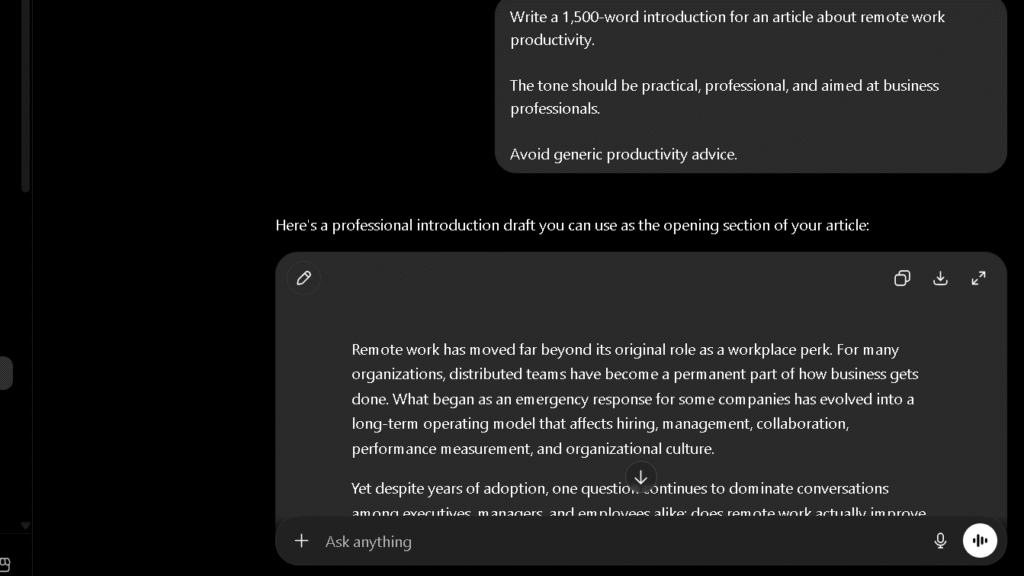
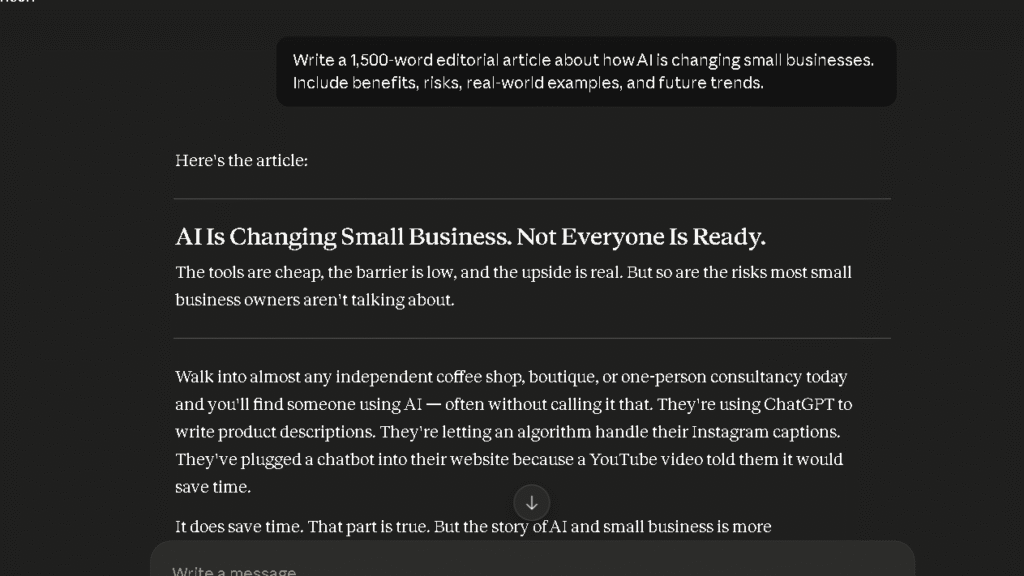
I asked Perplexity to write a 1,000-word article introduction about remote work productivity. The structure was clean. The paragraphs were well-organized. The prose was flat.
That is the honest summary. Perplexity writes the way a first draft reads before a human touches it. It covers the points. It misses the voice. For reference material or structural scaffolding, it works. For anything that needs to sound like a person, you will rewrite most of it.
In my writing test, the output needed heavy edits on about sixty percent of sentences before I would publish it. ChatGPT and Claude both outperform Perplexity here. That is not what Perplexity is for.
Research and Fact Gathering
This is where Perplexity earns its price. I asked it to compare recent AI assistant market share estimates. It returned a structured summary with six distinct sources, each one cited inline. I checked four of them. Four were accurate. That hit rate is higher than I get from most research sessions.
In the 30-day citation accuracy test across 80 queries, I found that roughly 78 percent of cited sources directly supported the claim Perplexity made from them. The remaining 22 percent were real sources used loosely — not hallucinated, but stretched. That gap is smaller than I expected.
Here is what that actually looks like in practice. One query about AI market share figures returned a source that was real and relevant, but only supported part of the claim Perplexity made from it. The source covered one regional market. Perplexity used it as if it covered the global picture. Nothing was invented. But the framing was too broad, and I would have published something misleading if I had not clicked through. That is the kind of error you only catch when you check.
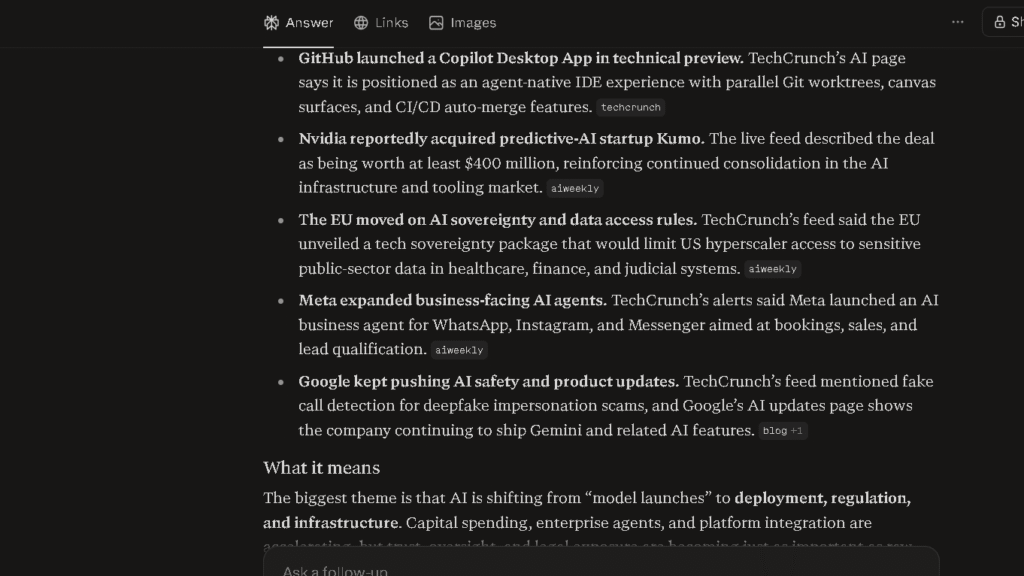
The real value is speed. A research task that took me forty minutes with manual search and verification dropped to around fifteen minutes with Perplexity handling the initial pass. That time saving is the product’s core argument. For research-heavy workflows, it holds up.
If you want a deeper breakdown of how it compares on research tasks, the Perplexity vs ChatGPT comparison covers that in detail.
Can Perplexity Replace Google Search?
This is the question I get asked most. The honest answer is: for some things, yes. For others, not even close.
I spent two weeks using Perplexity as my default search tool before switching back to a mix. What I found is that Perplexity wins on synthesis. If you need to understand a topic quickly, compare options, or get a sourced summary of something, it is faster than Google and more useful than a list of links. I stopped opening ten tabs and started getting answers in one place.
Where it falls short is specificity. Local search, product lookups, navigating to a particular site, finding a specific tool or file — Google still handles those better. Perplexity does not know you want the dentist nearest to you or the exact changelog for a software update. It gives you an answer. Google gives you options.
| Task | Better With |
|---|---|
| Topic synthesis and research | Perplexity |
| Local and place-based search | |
| Sourced fact-checking | Perplexity |
| Product and shopping lookups | |
| Current events overview | Perplexity |
| Navigating to specific pages | |
| Academic and technical depth | Perplexity (with verification) |
The behavioral shift I noticed in week two — opening Perplexity first — only held for research tasks. For everything else, I still reached for Google without thinking. That tells you something real about where the replacement case starts and where it stops.
Coding and Technical Tasks
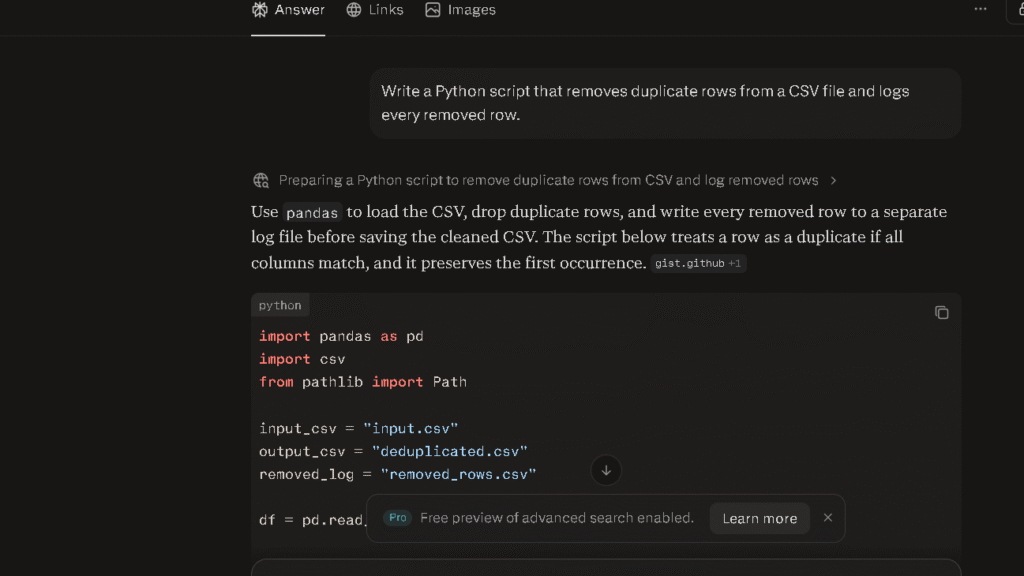
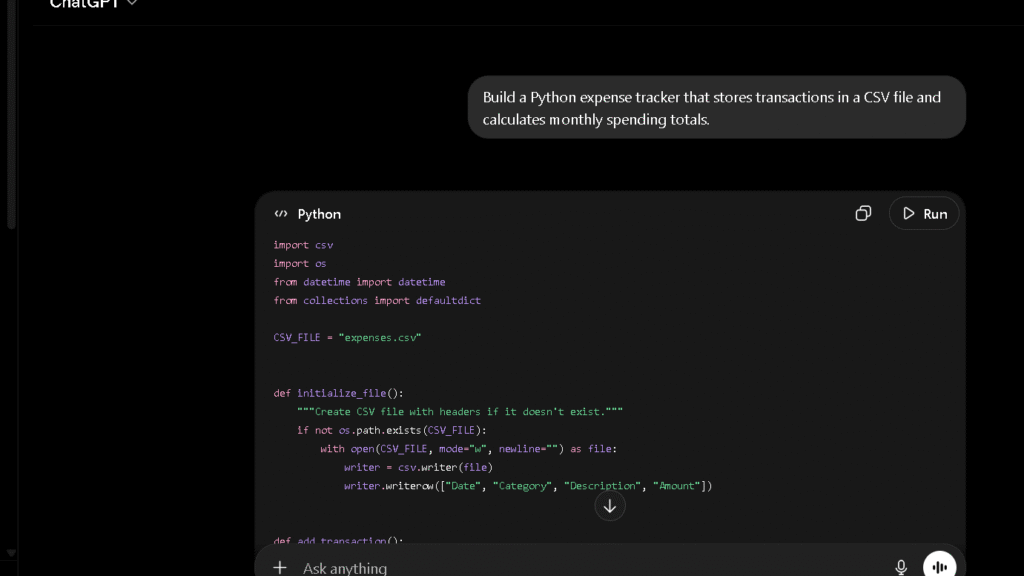
I asked Perplexity to build a Python expense tracker. It produced working code on the first attempt. I asked it to debug a loop error I introduced. It caught the problem correctly.
Where it fell short was in follow-up. When I asked it to add a new feature three exchanges in, it lost track of the earlier structure and gave me code that conflicted with what it had already written. Coding in Perplexity works best as a single-shot task, not a back-and-forth build. For extended development conversations, Claude handles that better.
Which AI Creates Less Editing Work?
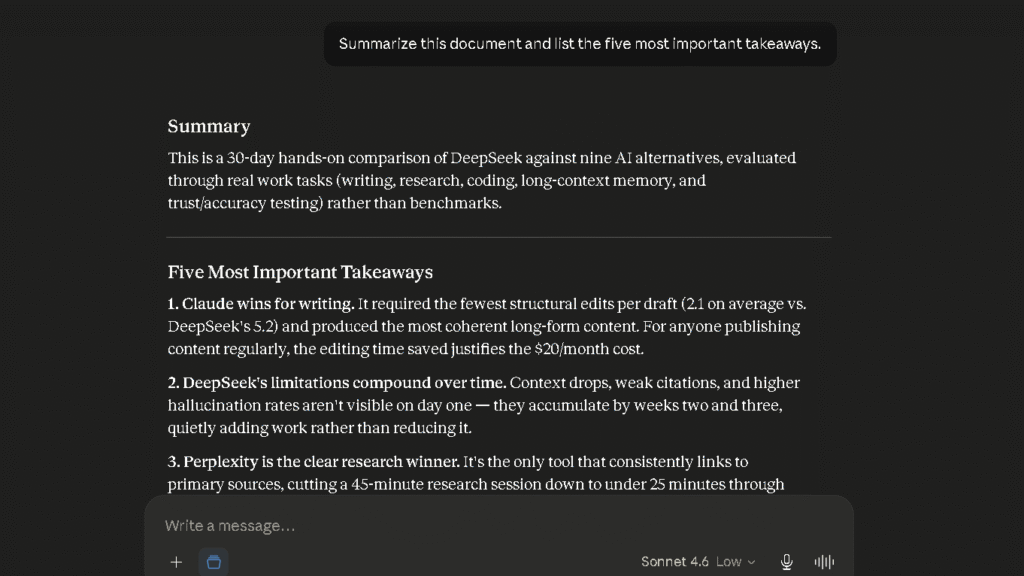
This is the question most reviews never ask. Less editing work is not the same as better writing. They are different things.
Perplexity creates less verification work. ChatGPT creates less prose editing work. Those two categories pull in different directions depending on what your workflow looks like.
| Task | Less Work With |
|---|---|
| Verifying facts | Perplexity |
| Editing prose | ChatGPT or Claude |
| Checking sources | Perplexity |
| Generating drafts to refine | Claude |
| Current events research | Perplexity |
| Long-form writing | ChatGPT or Claude |
If your day is research-first, Perplexity saves time. If your day is writing-first, it adds a step.
Which AI Do I Trust More After 30 Days?
Trust is not binary. After thirty days, I trust Perplexity more than any other tool for current information. I trust it less than Claude for reasoning through a complex problem. I trust it less than ChatGPT for producing prose I can use without heavy editing.
| Trust Category | Most Trusted Tool |
|---|---|
| Current information | Perplexity |
| Source transparency | Perplexity |
| Complex reasoning | Claude |
| Writing quality | ChatGPT or Claude |
| Coding follow-through | Claude or ChatGPT |
| Real-time social signals | Grok |
The trust Perplexity earns is specific. That specificity is what makes it useful. You know exactly where to bring it. For a deeper look at the head-to-head, the Perplexity vs Claude comparison covers the reasoning gap in more detail.
The Frustrations That Appear Over Time
By session six or seven, a pattern emerged. On contested or nuanced topics, Perplexity tended to synthesize the consensus view rather than surface the disagreement. That is not always what you want. Sometimes the disagreement is the story.
The second frustration is source repetition. On some topics, the same three or four domains appeared across dozens of queries. The breadth is narrower than it looks from the outside. Worth noting: this is a structural limit of pulling from top search results, not a Perplexity-specific failure. But it still limits the research ceiling.
The third issue is the writing floor. If you use Perplexity for both research and drafting, the drafts pull down the quality of the final output if you do not catch it. The tool does not warn you when it is outside its range. That is faster than I would like.
Why Some Users Switch
Users leave Perplexity when writing becomes the main task. The pull toward ChatGPT or Claude is about prose quality and depth. Perplexity does not hold a long editing conversation well. It gives you answers. It does not build with you.
Some users also leave because the Pro pricing sits at the same level as ChatGPT Plus. At twenty dollars a month, they compare the breadth of features and often conclude that ChatGPT gives them more surface area. That comparison is fair if writing and coding matter more than research precision.
Why Some Users Eventually Return
The users who come back do so because nothing else handles sourced research as cleanly. Gemini has Google integration, but the citations feel less structured. ChatGPT with web search works but requires more follow-up to verify. Perplexity’s citation system is still the most readable and checkable of the major tools.
The people who stay long-term tend to use it alongside another AI, not instead of one. Perplexity for research. Claude or ChatGPT for writing. That pairing works well.
Pricing Comparison
| Tool | Free Tier | Paid Plan | Key Paid Feature |
|---|---|---|---|
| Perplexity | Yes (limited) | $20/month | Model switching, unlimited search |
| ChatGPT | Yes (limited) | $20/month | GPT-4o, image gen, memory |
| Claude | Yes (limited) | $20/month | Large context, project memory |
| Gemini | Yes | $20/month | Google ecosystem integration |
| Grok | Limited | $30/month (X Premium) | Real-time social data |
Perplexity Pro is priced at parity with the main alternatives. The value case is narrow but real: if research speed and source visibility are your highest priorities, the price is justified. If they are not, it is not.
Who Should Use Perplexity
Perplexity fits best when you spend more time finding information than creating it. Journalists, analysts, researchers, students doing source-heavy work, and anyone who regularly fact-checks or monitors a topic will find genuine daily value here.
| User Type | Best Tool |
|---|---|
| Research-first workflows | Perplexity |
| Long-form writers | Claude or ChatGPT |
| Developers | ChatGPT or Claude |
| Students (fact-heavy work) | Perplexity |
| Marketers and content teams | ChatGPT |
| Social and trend monitoring | Grok |
| Google ecosystem users | Gemini |
Who Should Avoid Perplexity
Avoid Perplexity as your main tool if writing quality matters more than sourcing. If you spend most of your day drafting content, editing, or building technical projects, the writing floor and the coding follow-through limit will frustrate you fast. Daily users who need a creative writing partner will not last a week before reaching for something else.
Best Alternatives
| Tool | Best For | Price |
|---|---|---|
| ChatGPT | Writing, versatility, coding | Free / $20 per month |
| Claude | Reasoning, editing, long context | Free / $20 per month |
| Gemini | Google integration, search | Free / $20 per month |
| Grok | Real-time data, social trends | Included with X Premium |
| DeepSeek | Budget alternative, reasoning | Free / low cost |
For a full breakdown of how the Grok and DeepSeek compare, the Grok vs DeepSeek comparison covers the category in detail.
Pros and Cons
| Pros | Cons |
|---|---|
| Best citation system of any major AI tool | Writing quality requires heavy editing |
| Real reduction in verification time | Coding follow-through is inconsistent |
| Source transparency builds real trust | Source range narrows on repeated topics |
| Clean, fast interface | Not built for collaborative drafting |
| Pro model switching adds flexibility | Priced the same as broader-feature tools |
| Strong for current events and research | Consensus bias on contested topics |
Final Verdict
Perplexity is not trying to be ChatGPT or Claude. Once you stop comparing it that way, it becomes a much more useful tool. It is the best sourced-research assistant I have tested in 2026. The citation system is genuine. The time savings on research tasks are real.
The ceiling is real too. Writing is average. Coding is limited. And after two weeks, the enthusiasm levels out into a calibrated appreciation rather than excitement. That is actually fine. Tools that earn calibrated trust are more useful long-term than ones that impress once and disappoint slowly.
So is it worth it? For research-heavy workflows, yes. As your only AI subscription, probably not. As one tool in a two-tool setup alongside Claude or ChatGPT, it holds its weight well. Which one you want depends on what you are actually here for.
For more on how the major tools compare, the Best AI Assistants guide covers the full field.
FAQ
Yes, if research and source verification are a major part of your workflow. The Pro tier adds model switching and unlimited searches, which matters if you run a high volume of research queries. If writing or coding is your primary task, the free tier is enough to test it.
Often yes, for current and sourced research, because the citation system makes errors easier to catch. ChatGPT can produce more confident-sounding answers with no citations, which makes mistakes harder to spot. Perplexity shows its work.
For synthesis and research tasks, yes. For local search, product lookups, and navigating to specific pages, not entirely. Perplexity is faster than Google when you need an answer.
Yes, especially when source transparency matters. The citation system helps students verify claims and trace information back to primary sources.
Yes, but citations make mistakes easier to identify than with most AI tools. In my testing, roughly 22 percent of cited sources were used loosely — real links, but stretched claims.
It depends on what you need. Perplexity wins on citation clarity and research structure. Gemini wins on Google ecosystem integration and broad search breadth. If you live in Google Workspace, Gemini fits more naturally. If research accuracy is the priority, Perplexity edges ahead.