
You’re looking for tools to provide quick wins, and also increase your website’s visibility in the rankings.
It is a highly effective optimizer, Content Raptor focuses on pages with high potential and recommends specific changes.
It monitors rank changes so you can determine what fixes are worth the effort.
If you are looking for an efficient method of increasing organic traffic, without rewriting each blog post, Content Raptor can point you to the specific webpages and phrases that need to be changed.
The Content Raptor Review explains how the platform handles SEO optimization on-page.
The Contentraptor Review highlights how the Google Search Console integration provides information based on data.
As an specialized SEO device, the tool can help users increase traffic by identifying sites that require immediate attention.
You can expect clear comparisons with similar tools, price notes as well as practical steps to test the platform on your website.
In the end you’ll be able to determine if Content Raptor fits your optimization goals, and also how to begin using it on sites that have a high-ranking potential.
Key Benefits of Using Content Raptor
- Learn to Identify Quick Wins High-impression websites appear just below the top spots.
This will help you concentrate on editing that will yield the highest traffic growth.
- Data-Driven Optimization Employs an entity’s coverage score to suggest keywords for specific additions.
You will receive clear directions on the exact terms you should include and how to do it.
- Streamlined Workflow It works to WordPress as well as Google Search Console to pull information as well as push out updates.
This prevents manual copy-pasting, and speeds up the process of publishing.
- Integrated rank tracking: Monitors daily position shifts for mobile and desktop.
These shifts are linked to your edits, so you can determine which edits are driving results.
- AI-Powered Rewriting Rewrites at the paragraph level with a focus on missing entities.
This enhances the quality of content while also allowing the final human-based review.
- Centralized Project Management With an integrated Kanban board that helps you organize tasks that require optimization.
It helps manage massive SEO updates easier for agencies and teams.
Table of Contents
What Is Content Raptor?

The Content Raptor is a specific SEO tool designed to facilitate effective SEO workflow.
This tool for optimizing content aims to assist owners of websites and teams of content make specific adjustments that increase organic traffic.
Core Purpose and Vision
Content Raptor is focused on SEO optimization in order to boost the organic traffic to search engines.
It analyzes the top-ranked pages on an area and then scores the pages based on coverage by entity so that users can determine which articles require changes first.
Teams make use of these suggestions to incorporate relevant keywords and headings that are more concise or extend the sections search engines are expected to view.
The software helps with entity optimization by identifying the semantic gaps between your website and most popular results of a search.
The tool aims to win quickly Find pages that have impressions, but with low rankings and recommend specific additions which often help move pages higher on the page of results for search engines.
This method is ideal for agencies that require scalable, repeatable process optimization.
Who Created Content Raptor
A small team of product developers with backgrounds in SEO and software created Content Raptor.
The developers of the platform came up with the idea after researching SEO for their clients and recognizing the requirement for an editing tool that could combine SERP analysis along with rank tracking and content management into one location.
They created integrated solutions to WordPress as well as Google Search Console to pull real-time data on performance into the optimization process.
The developers aimed to create an easy-to-use interface to ensure that marketers can make updates without requiring technical background.
The team is focused on user-friendliness and speed, which means that editors and marketers who are not tech-savvy are able to apply suggestions directly via the dashboard.
Additionally, they added an AI Rewrite feature as well as project boards that allow agencies to manage multiple clients, without having to use various tools.
How Content Raptor Differs From Other SEO Tools
Content Raptor blends three functions frequently split between tools: gap analysis of content ranking tracking, the optimization of content in editors.
Contrary to the traditional keyword research platforms, it is a platform that focuses on entity coverage as well as editing on-page that is tied to the live Google Search Console data.
This means that suggestions are based on what the website is already ranking for, not just the top-volume keywords.
When compared to tools like SurferSEO, Frase AI as well as Clearscope, Content Raptor markets itself based on the value of its features and workflow capabilities.
It focuses on quick-win highlighting as well as WordPress push updates in order to save time.
This makes it convenient for editors to implement changes that are suggested quickly.
Agencies can benefit from view of projects and multi-site tracking, which reduce the need for manual reporting among tools.
Key Features and Capabilities
Content Raptor is focused on clear, practical tools to help editors identify quick wins, monitor the progress of edits, and make them more scalable.
The platform is a combination of an editor for content that evaluates the extent of coverage for an entity, a keywords tracking system, as well as an AI Rewrite engine.
It makes use of workflow automation to facilitate the process of optimizing content from concept to a published update.
Content Optimizer and Entity Scoring
The content optimizer analyzes the page against its top ranking competitors and generates the report on the coverage of an entity report which shows what concepts or terms are not covered by the page.
It provides it an an entity score per topic and highlights specific lines such as “add X entity to opening paragraph” or “expand H2 with Y term.”
Editors are able to paste text into the editor or connect to the CMS to work in their Content Editor.
The interface displays keywords that are not present and ideal word counts as well as benchmarks of competitors.
This helps editors prioritize edits to enhance the quality of their content without having to rewrite it completely.
Recommendations are presented as separate tasks (add phrase, insert paragraph, change heading).
Every suggestion relates to specific competitor evidence as well as the numeric coverage targets and teams are able to create specific changes that are aimed at specific rankings for keywords and gaps in the entity.
Rank Tracker and Keyword Performance
The rank tracker tracks keyword rankings for each page, and displays daily SE rankings changes for mobile and desktop.
The rank of links is moved on the optimization of content, letting users know how the changes in entity coverage correspond to increases in the number of keywords.
The user can add keywords on pages, and search for keywords by the topic or priority.
The tracker marks “near-wins” — queries that are ranked just below page one to let teams know that small changes can result in huge gains in search rankings.
Reports display impressions, clicks, as well as the history of your position derived from Google information when linked.
Filters for search regions as well as diverse search languages allow you to measure localized performance of keywords.
Users can view the performance of their business directly on the dashboard, and observe the impact of specific optimizations on the visibility of their data over time.
AI Rewrite Tool and Automation
The AI Rewrite tool provides paragraph-level rewrites which are targeted at particular entities and phrases.
Editors select the paragraph to revise and then determine the goal of coverage The tool then returns versions that are tuned to the desired entity, while also preserving the ability to read.
Rewrites are based on the credit model, which means teams concentrate credit on the most effective paragraphs.
Outputs are visible in the editor’s content area for rapid review and manual adjustment.
The software accelerates routine editing, but maintains an eye on the user to avoid the use of unnatural language.
Automation tools allow batch changes such as inserting keywords that are missing into meta titles, or updating several posts that share the same tag or applying template edits within the topic cluster.
It reduces repetitive work, and also helps create large-scale content across many pages.
Kanban Board for Project Management
Inbuilt Kanban board transforms optimization recommendations into tasks that can be tracked.
Each card is linked to a particular page, displays the expected impact and lists the needed editing of the entity or AI Rewrites.
Teams can assign their owners, create deadlines and then move cards through stages similar to Draft Review – Review and Publish.
Cards are synchronized with the content editor, and when an edit is completed the board updates its changes in status instantly.
Labels and filters can help prioritize tasks according to size of the opportunity, location, or client.
For agencies, access controls based on role make sure that analytics and changes are visible only to users who are authorized.
How Content Raptor Improves SEO Performance
Content Raptor is focused on edits which improve rankings and generate more traffic from SEO.
It locates websites with clear potential for traffic and offers specific changes to the page.
Teams can act quickly to increase their performance.
Content Optimization Strategies
Content Raptor analyses the top-ranked competitors and creates specific, line-by-line changes to improve the quality of content.
It lists keywords as well as entities, and suggests the best places to include themfor instance, “add keyword X to H2” or “include entity Y in opening paragraph.”
Editors can copy suggestions, or make changes available into WordPress to avoid copy-paste mistakes.
The tool also recommends optimal word counts and readability goals.
It flags terms that are overused and provides AI revisions to paragraphs that require more coverage of a subject.
Users are given tasks to complete, such as changing headings, adding an entire paragraph, or enlarging sentences to increase relevancy and increase engagement.
- Faster quick optimization by prioritizing high-impact tweaks.
- A clear guideline on frequency of keywords as well as headings and coverage for entities.
- Integration with CMS for reducing the amount of manual work required and make publishing faster.
Identifying High Opportunity Pages
Content Raptor ranks high opportunity websites based on traffic potential and their position in the search results.
It shows pages that have a high rank (often at the top of page 2) for relevant searches but don’t have full coverage of keywords.
These pages with high potential give you more chances to win quick wins.
Optimizing meta data in conjunction with the body text will increase the rate of click-throughs for these URLs.
The platform draws Google Search Console data to analyze impressions and the average positions.
This allows teams to focus on pages that have high views however, they have a low average rank.
Content Raptor sort these pages so that teams can concentrate on changes that are most likely to move the needle.
Practical results include prioritized tasks lists and internal linking ideas, as well as notes about technical problems.
This will help you decide whether to update content, merge pages, or make new sections to catch missed intentions to search.
Data-Driven Optimization Recommendations
Recommendations result from comparing a page’s content against top competitors as well as real data from the query.
Content Raptor provides a numerical coverage score for entities as well as keywords, indicating the gaps to fill.
This makes recommendations quantifiable and re-usable.
The tool connects suggestions to anticipated traffic impact and changes to rank band.
Users receive priority editing as well as estimated gains and the ability to test A/B meta-changes.
Daily rank tracking shows the tweaks that have resulted in lifts and teams can determine what strategies consistently result in organic traffic.
Automation tools let teams make mass edits and batch revisions on similar posts.
This speeds up the development of content while also ensuring quality control with manual reviews and review AI outputs.
Integrations and Workflow
Content Raptor integrates performance data and editing to allow teams to spot opportunities from a single location.
This Google Search Console integration pulls query-level metrics to the dashboard.
It allows users to create drafts, and then run experiments that show shifts in traffic.
Google Search Console Integration
Content Raptor links directly to Google Search Console (GSC) to import clicks, impressions average position, clicks as well as query-level data for each URL.
This allows users to filter by the date range or device, and find pages that have high-quality queries that do not rank in the top spots.
The tool highlights low-position and high-impression queries to help teams select pages that require minor changes to the content to make big improvements.
Imported GSC data is displayed alongside optimization suggestions Editors can see which queries are already driving traffic and which require additional coverage.
Every day, we keep the impressions and rank band current to ensure an accurate SERP analysis.
Privacy blur and role-based access ensure the security of GSC information whenever sharing dashboards colleagues or clients.
WordPress Integration
The WordPress integration connects the Content Raptor editor with the editor on a website’s blog to eliminate copy-paste mistakes and speed up publishing.
Users can publish drafts or save drafts of edits in WordPress as well as publish new updates direct through Content Raptor after an internal review.
The integration keeps formatting as well as headings and HTML therefore, changes need only minimal work.
Project boards display the linked WordPress URLs and allow drag-and drop tasks to move between “rewrite” to “ready to publish.”
This strong connection to the Dashboard and WordPress reduces the friction faced by teams who handle a lot of edits to content each week.
A dark-mode option is accessible to allow for longer editing sessions in the Content Raptor interface.
A/B Testing Functionality
Content Raptor comes with A/B testing tools which run controlled tests to determine the effect of changes to the page on impressions, clicks, and rankings.
Teams can create a test version (title or meta, or a paragraph Rewrite) in the editor. create a split in traffic or publish time and track the results using the dashboard widgets, which track the changes in rank and traffic variations.
Tests are linked on GSC and rank-tracker data, so the results are based on real-time results of the query.
The Kanban-inspired boards can be used to store test results as well as impact estimates and hyperlinks to the alternative URL.
This helps marketers understand what micro-optimizations work best and then apply the winning changes to similar pages.
Keyword Research and Competitive Analysis
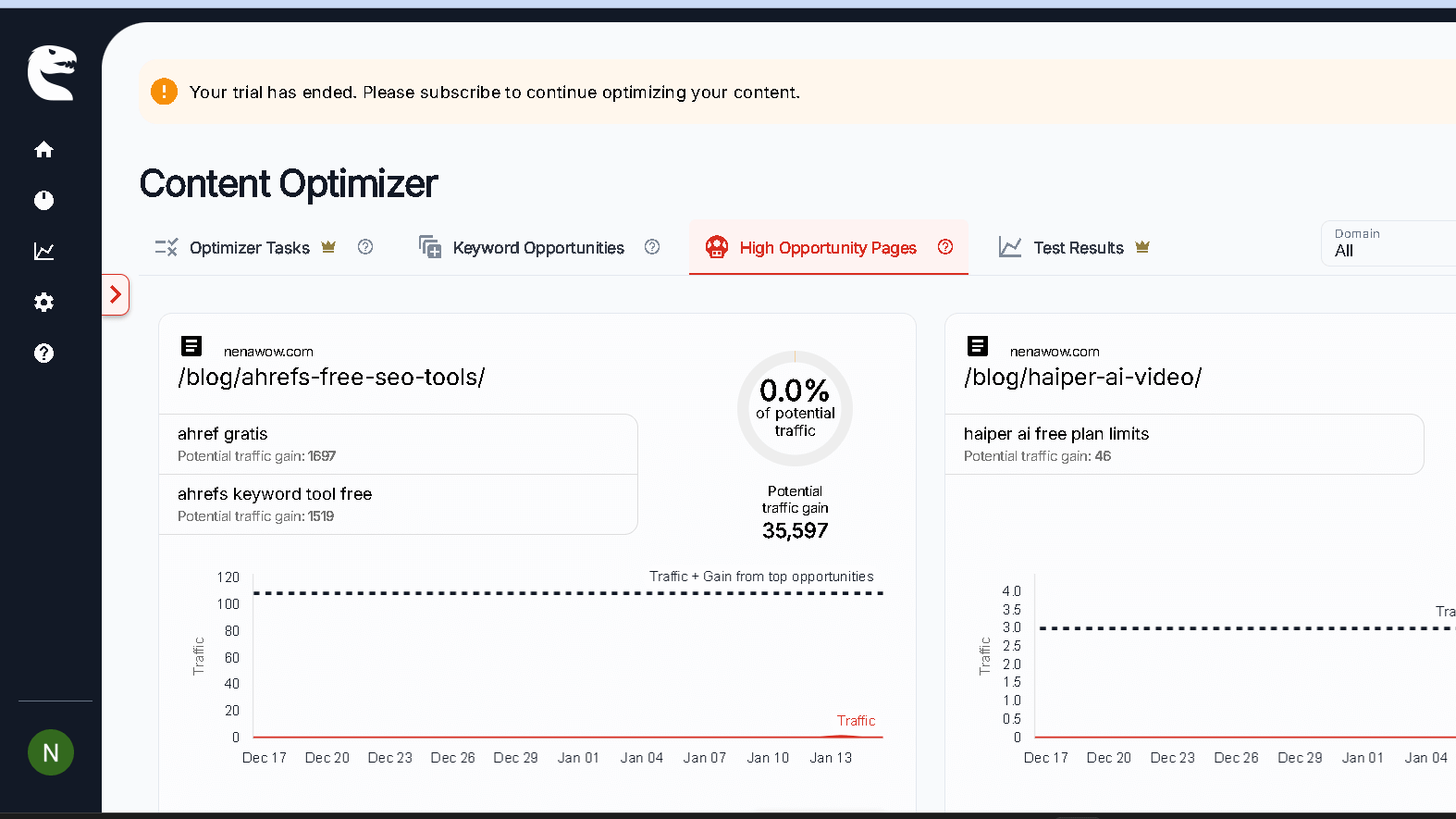
Content Raptor aids teams to identify the most effective keywords and then evaluate their websites against competitors.
It collects actual query data and reveals missing entities to allow users to choose which pages to optimize first.
Keyword Ideas and Opportunity Discovery
Content Raptor uses keyword information taken from Google Search Console and its own data on keywords to determine which queries generate impressions but do not generate clicks.This emphasizes the query hunter’s functions to discover additional opportunities: websites that rank between 8 and 20 that can increase traffic through small changes.
The tool provides suggested terms and suggestions for related entities.
It determines the score of each page using potential traffic and a scoring band.
Users are advised to take actions such as adding an entity that is missing to the beginning paragraph, or inserting keywords into an H2.
The system connects suggestions with real GSC impressions to allow teams to prioritize fixes that impact queries that receive high ratings.
The interface also displays the amount of effort required, for example words added or rewritten.
This allows editors to select the most effective wins first.
Competitor Analysis and SERP Insights
Content Raptor compares a page’s keywords and coverage of the entity against the top-ranked pages.
It shows scores of competitors for the same entity, so users can identify which words competitors are focusing on.
The SERP insight section shows the features that appear in the form of snippets, and People Also Ask, and which competitors have them.
It helps to plan specific edits like creating a Q&A block that can specifically target People Also Ask, or optimising headings to fit the an snippet’s structure.
Competitive analysis also includes the analysis of backlink signals as well as title/meta comparisons, if they are available.
This allows you to spot content gaps that go beyond just simple keyword lists.
Tracking Keyword Variants
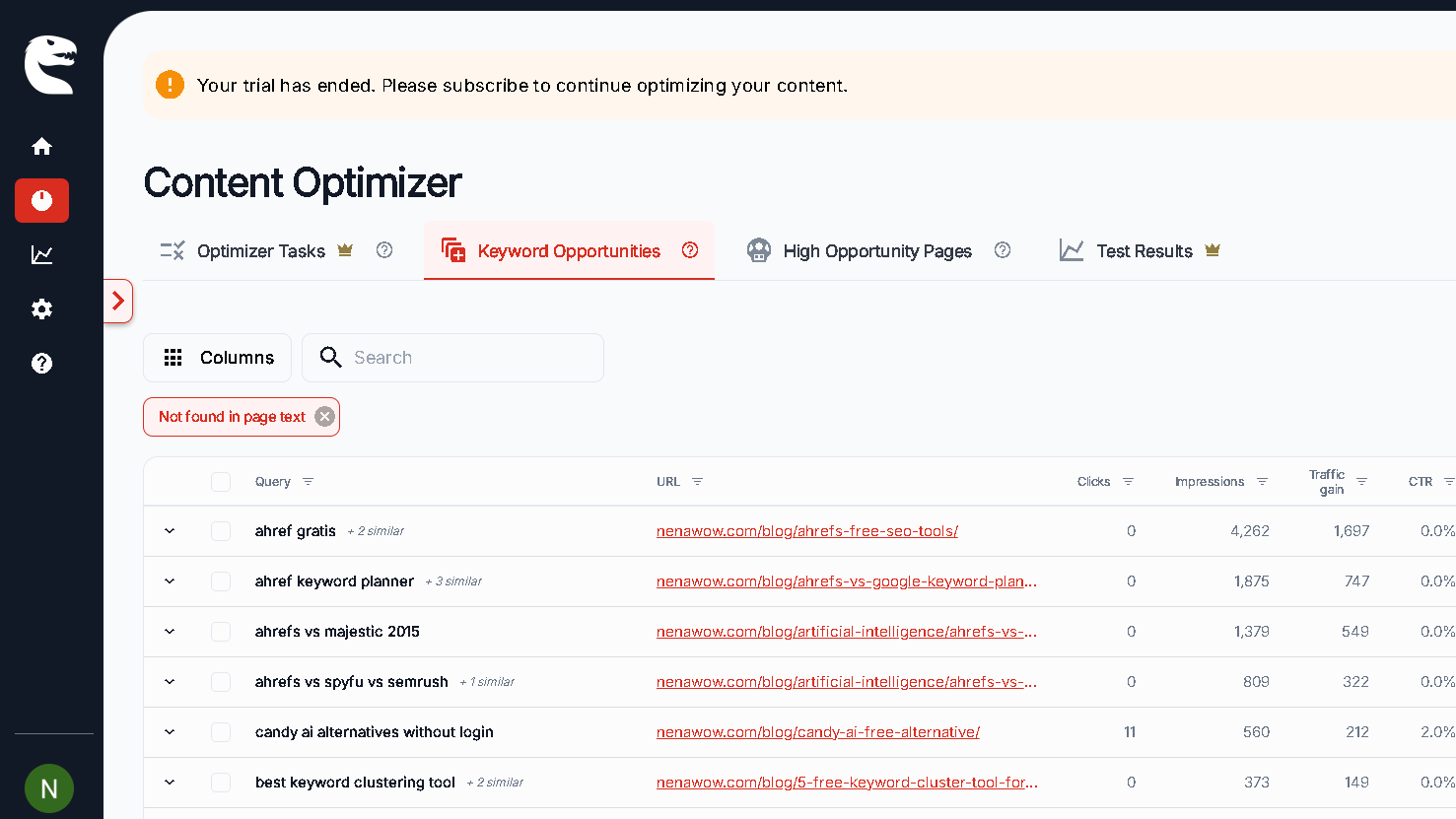
Keyword variants tools follow key keywords and closely related variations across mobile and desktop.
Users can choose keywords per page, and monitor the daily changes to their positions, helping assess the effects of every modification.
Content Raptor detects shifts in the performance of keywords and flags variants close to being in the top 10.
This allows you to identify variants that require minor boosts instead of full changes.
The tool categorizes variants according to intention.
It reveals which entities are missing and have a correlation with ranking drops editors can therefore enhance or broaden coverage of entity to take note of different traffic.
Pricing, Plans, and Alternatives
Content Raptor offers tiered plans as well as a credit-style Pro plan as well as a trial.
Pricing includes keywords monitoring, Search Console integration, and team-based features.
Buyers need to examine limits, rules per-site and determine whether credit or per-site prices are in line with their workflow.
Current Pricing Structure
Content Raptor lists three main categories of pricing with monthly fees that cater to different types of users.
The Starter plan starts at $49/month, and comes with basic optimization tools and Search Console sync and rank tracking for 150 keywords.
The Professional plan is priced at $99 per month and increases the limit on keywords as well as team collaboration and provides faster assistance.
Enterprise costs around $199 per month and provides unlimited tracking API, white-label reports and an individual manager.
Plans differ according to tracks on keywords, user seat and reporting information.
Pricing per site isn’t standard for all tiers. Larger customers frequently negotiate custom bundles or add-ons to several domains.
Companies should verify the the exact limits of keywords.
It is also important to confirm if additional domains charge per-site fees.
Pro Plan and Credits System
The Professional tier employs the credit model or quota system for specific actions.
Credits are available for advanced features such as mass optimizations API calling, as well as additional rank tests.
Customers on Pro get an amount of credit per month.
Unused credits aren’t able to be able to roll over, therefore teams must plan their usage during reporting times.
Agents who manage many client sites should calculate credits per site in order to keep from unexpected expenses.
Content Raptor lets administrators purchase credit top-ups, or upgrade to Enterprise to get unlimited amounts of.
Larger users should evaluate the cost-per-action of credit against per-site prices from other competitors when planning monthly spending.
Free Trial and Value for Money
Content Raptor provides a trial time to experience the platform before purchasing.
The trial period is two weeks and allows users to transfer Search Console data, run speedy optimizations, as well as test rank tracking.
This timeframe is long enough to identify sync issues, or to evaluate how the Kanban workflow and make optimization suggestions.
The value of a team is determined by its size and the goals.
Solo creators might be able to find Starter sufficient, whereas agencies usually require Pro or Enterprise.
Examine the trial experience, and anticipated traffic growth with the monthly fees.
If you are on a budget, check if the vendor offers the 7-day trial or a free trial offer prior to committing.
Comparison With Other Tools
Content Raptor focuses on data-driven optimization and project management. It differs from tools that are focused on a single aspect.
Only for optimization of content tools like Frase or Surfer SEO focus on the workflow of writers and scoring content.
SurferSEO excels in on-page content guidance, whereas Frase integrates brief content descriptions along with AI writing.
For more comprehensive suites, Semrush and Ahrefs offer extensive search engine research and off-page SEO technical SEO, as well as backlink analysis.
They offer site audits at size and in-depth competitors analysis software.
Market managers must consider whether they’ll need Content Raptors’ Search Console integration and Kanban features, or whether they need a competitor’s link and keyword databases.
While there are many options for content raptors that are available, none have the same degree of integration with real-time search console data.
Check pricing, rules for each site and determine if the customizable plans are suitable for multiple clients before making a switch.
More information about customer reviews and pricing variations is available in a thorough Content Raptor review with pricing breakdown.
Frequently Asked Questions
Content Raptor concentrates on finding websites that have the most traffic upside.
It recommends specific edits to content and records the results so that users can determine which edits improve rankings and increase traffic.
What is Content Raptor? Content Raptor help in improving SEO ranking?
Content Raptor draws Google Search Console data to identify queries that generate impressions but fall just below the top spots.
It is a ranking system that ranks “high opportunity” pages and gives the specific keywords, headings, or paragraphs that can be edited so that a page can be moved up in the search results.
The tool compares the most popular pages of competitors and shows what words or entities aren’t there.
Users receive actionable items such as “add X keyword to H2” or “include Y entity in opening paragraph,” that aim to achieve tangible ranking gains.
What is it that makes Content Raptor different from other tools for marketing content?
Content Raptor is a proponent of GSC-driven opportunities over pure model-based models.
It allows users to select pages with a high number of views and push them up positions.
It includes edits to content, trackers of rank and project boards on one dashboard.
This helps reduce tool switching and speeds tests when compared to using different editors, analytics or task tools.
Refer to a hands-on review of its GSC integration and workflow for more detail: Content Raptor Review: In-Depth SEO Tool Analysis & Results (https://nenawow.com/blog/content-raptor-review/).
Does Content Raptor assist with enhancing the E-E-A-T of a website for SEO?
Content Raptor detects any gaps in the topical coverage and suggests adding first-hand knowledge elements and related organizations.
These edits may provide evidence of experience and expert signalling when authors include precise, verified details.
It doesn’t create certificates or citations automatically.
Site owners should add author bios, citations and cases studies, or even original information to significantly increase the trust and authority of their site.
What aspects of Content Raptor help to create the development of a more effective content strategy?
The high-opportunity list of pages on the platform prioritizes pages based on potential traffic along with the rank range.
AI Rewrite and suggestion for entity help speed up precise edits to those pages that are most likely to succeed.
Keywords for rank tracking are linked to specific pages, so teams can see which edits affect positions.
Boards for projects and WordPress integration lets teams assign tasks and send drafts without the need for manual copy-paste.
What is the impact of Content Raptor impact user engagement and trust?
Through recommending content modifications that correspond to user needs, Content Raptor can improve relevancy and reduce bounce rates.
Content that is aligned better tends to keep visitors on the site longer and increase the probability of conversions.
However, engagement increases depend on a human’s review of the tone and the accuracy.
AI revisions usually require editing to ensure accuracy and reliability for readers.
Does Content Raptor suitable for boosting local visibility for businesses?
Content Raptor can surface local keywords to help you optimize landing pages to cater to local queries.
Regional rank tracking as well as GSC data makes it an effective tool to make the local intention adjustments.
Local businesses need local signals — reviews local citations, reviews, and Google Business Profile optimization–to see the most significant results.