

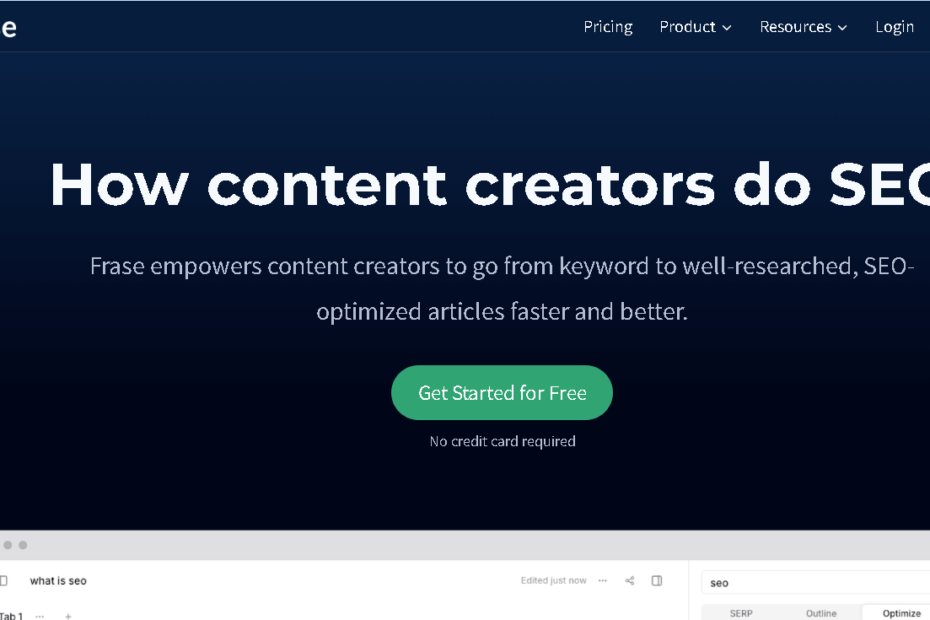
If you want a quick answer: Frase AI gives you an all-in-one way to research, draft, and optimize SEO content using AI tools built around SERP data.
It can speed up brief creation, outline building, and on-page optimization while keeping your content tied to what ranks in search results.
I’ll walk through what Frase does, how its core features fit into a content workflow, where it helps teams, and where it sometimes falls short.
Expect notes on templates, the editor, optimization scores, pricing value, integrations, and real use cases so you can decide if it fits your process.
You’ll see hands-on insights and comparisons with alternatives. I’ll toss in tips for getting the most from Frase’s AI—without overpromising.
What Is FRASE AI?
I will describe what FRASE AI does, who it helps, and why it is unique. The tool leverages AI writing along with SERP-based research, content briefs and optimization capabilities to accelerate work on SEO and guide content decisions.
If you’re new to SEO fundamentals, start with Moz’s Beginner’s Guide before diving into optimization tools
FRASE AI Overview
I’d call FRASE AI a content optimization engine powered by AI to accelerate the creation of content optimized for SEO. The panel reads the top SERP results for the targeted query and pulls out headings, questions, stats, and word-count benchmarks.
I can generate outlines, AI drafts and content briefs from these SERP signals, which the editor lets me create.
Key things I use:
- Panel with top 20 SERP results and competitor headings.
- Content editor that saves in real time and keeps version history.
- AI Write tools for expanding, rewriting, and creating content.
I am now able to turn my research into a ready draft in one workspace thanks to this combo.
FRASE AI for Content Marketers and SEOs
I use FRASE AI to shape briefs, track topic coverage, and improve existing pages. Content marketers are quick briefed with audience questions, keyword clusters, and suggested headers.
Topic scores are logged for SEOs and there is a traffic-light view (red/yellow/green) that indicates topics that need work to match competitors.
Agencies receive document sharing, status labels (Researching, Writing, Optimizing, Published) and folder organization. I can scrape a URL to audit and improve live pages.
The platform is also helpful for workflows using the same brief and metrics for writers, editors, and SEOs.
How FRASE AI Differs from Other AI Writing Tools
I see FRASE AI more heavily rooted in research-driven SEO than in generative writing. Unlike generic AI writers who simply screed copy out of a prompt, FRASE AI matches output to SERP analysis and highlights gaps versus top-ranking pages.
It also has an AI marketplace, and allows me to create my own AI templates and tools.
I use two distinct features:
- SERP Visualizer with competitor metrics and topic coverage.
- Automated content brief generation based on real search results.
- Optimization scoring from my draft to top pages.
These features make FRASE AI a content optimization platform and an AI writer first. That suits teams that value search performance over just producing content.
Key Features and Workflow
I’ll explain how Frase does research, outline creation, writing, and scoring so you can quickly judge fit. The tool merges SERP data, automated briefs, an AI writer, an editor, and topic scoring to get you from keyword to finished draft.
Content Research and SERP Analysis
I begin with a keyword and Frase searches top-ranking pages for facts, headings, and “People Also Ask” items.
The SERP analysis shows what pages rank for the term, common subtopics and types of content (list, how-to, review) on page one.
I get headings, word counts, and backlink signals from Frase for me to see what competitors cover and what they miss. I then use the results to create topic clusters and keyword selection.
This study eliminates the guesswork and keeps my content focused on the intent of the SERP.
AI-Generated Content Briefs and Outlines
After reviewing the data, I generate an automatic content brief including targeted keywords, suggested headings, FAQs, and key words from the top pages.
There is an outline builder that I can edit to move sections up or down and to convert subtopics into main sections in the brief.
The brief outlines content gaps and recommended word counts per section, so I know where to expand.
I can export the brief, or use it directly in the content editor. This step converts raw SERP data into a real plan for writing.
For bulk content generation across marketing channels, Copysmith offers specialized templates and workflow automation
Content Writing and Optimization
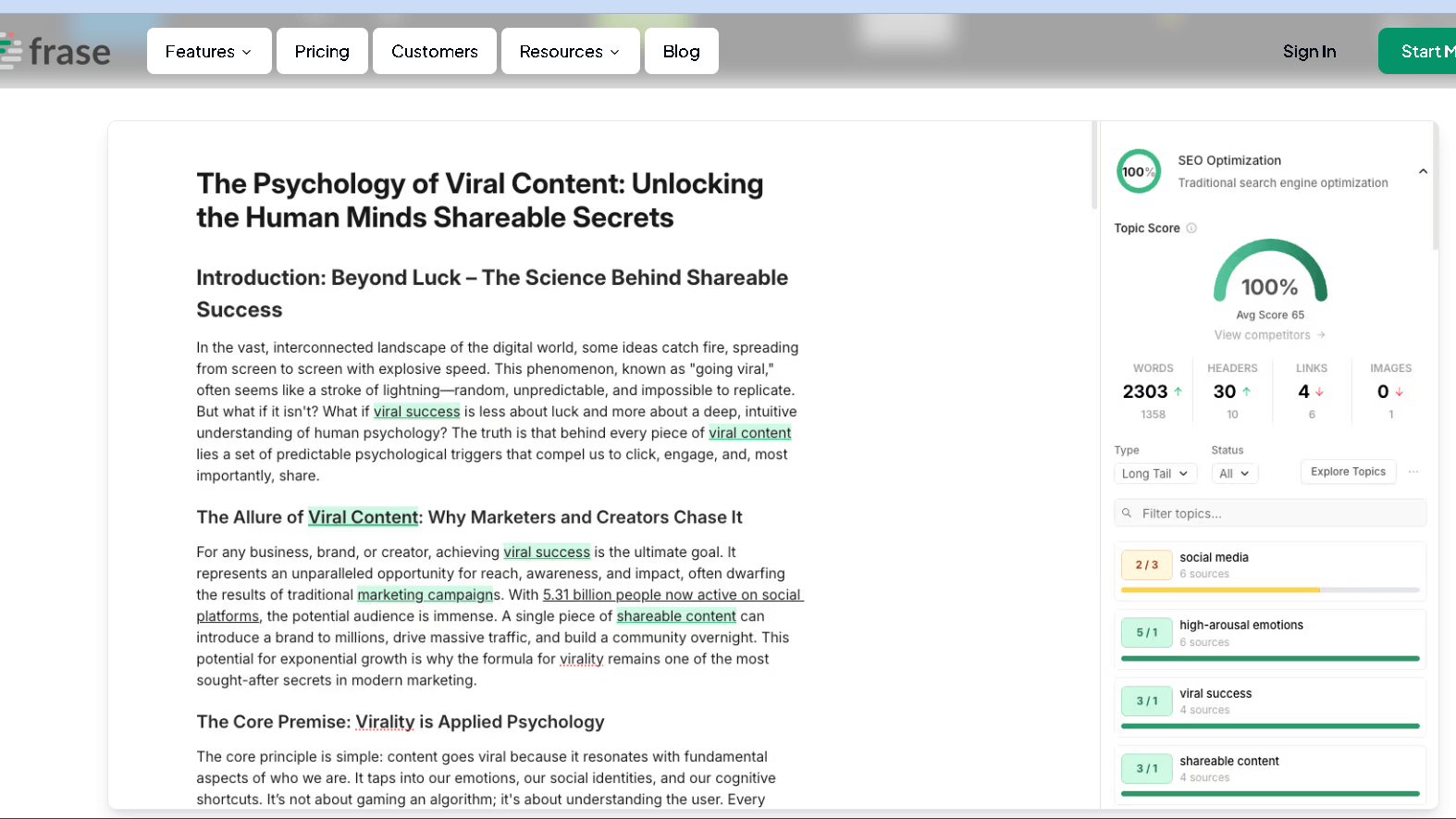
I either write in Frase’s content editor or I use the Frase AI writer to draft sections from the brief. The AI assistant can write paragraphs, edit sentences or turn bullet points into full text but should maintain the outline.
The editor indicates usage of keywords, and I can insert research snippets and source links. I do optimization checks, suggesting change in heading, placement of keywords, and internal linking ideas.
This keeps the content consistent with SEO goals as I write.
Content Scoring and Topic Scores
I use Frase’s content scoring to determine whether my draft meets the SEM values. The topic score scores my content against the top-ranked pages for key phrases, headings and covered subtopics.
Scores are broken down by section with missing topics or overused terms. I prioritize improvements according to the score and suggested items in the brief.
Frase ai Pros and Cons
I find Frase strong at speeding up research and brief creation. Its SERP-driven analysis pulls topics and headings from top pages, which saves me time when building outlines.
I like the content editor and Rank-Ready AI Documents for drafting. They help me produce structured drafts quickly and keep SEO signals visible as I write.
Pros:
- Fast research and brief generation — builds outlines from top-ranking pages.
- SEO-focused tools — content optimization, topic scoring, and GSC integration.
- Brand controls — voice, style guide, and knowledge base improve consistency.
- Useful chatbot — Frase Answers can reduce simple support queries on websites.
I notice limits in polish and some AI writing needs human edits. Intros and conclusions can feel generic, and sometimes there’s repetition that needs fixing.
Cons:
- Needs manual refinement — AI output often requires editing for clarity and tone.
- Feature gaps for advanced SEO — limited backlink analysis and some keyword metrics.
- Price for teams — higher tiers can get costly for agencies or larger teams.
- Occasional AI errors — factual mistakes or awkward phrasing show up in drafts.
Integrations and Collaboration Tools
I focus on tools that connect live performance data to writing workflows, let teams work together inside the editor, and enforce brand rules so content stays consistent and on target.
Google Search Console Integration
I use Frase to connect to Google Search Console (GSC) to see real-world search data coming into the workspace. This sync gives impressions, clicks, and average position for pages and queries.
That information enables me to spot pages dropping in rank or queries sitting on pages 2–3 that may quickly become wins.
In Frase, I can import a URL or query and see GSC metrics along with optimization suggestions. I use filters such as “Opportunity” or “Decay” to sort pages by their relevance.
This makes it possible to turn a performance problem into an edit list: target keyword, current rank, impressions, and suggested semantic topics all show up here.
I also incorporate query-level information into new content briefs. The integration helps to make smarter decisions by linking content edits directly to tangible outcomes in GSC.
Content Team Collaboration
I use Frase’s workspace to give briefs, share drafts and leave inline comments for writers and editors, all in one place. Roll-based access, or role-based access, facilitates the exchange of draft control across editors as writers write and revise content.
I can log changes and revert back if I want through notifications and version history.
I write content briefs in Frase that I send to the coworkers with the due dates and required word counts. This makes sure the editorial workflow is visible – who’s writing, what research was used, and what optimization tasks remain.
Folders and project views on the platform provide guidance on managing multiple campaigns and checking for consistency in content quality across articles.
Comment threads and approval steps help keep the email conversation organized and the feedback in the document from which the change is made.
Brand Voice and Style Guide Support
To keep my brand voice secure, I import style rules, term lists, and reference docs into Frase’s Knowledge Base. Using the Brand Voice feature, I can add tone attributes and sample text so that the AI is aware of the company language when drafting.
That cuts down on tone-based edits and helps all writers maintain quality content.
I also create my own term sets and style guidelines for capitalization, phrasing, and forbidden words. The editor can correct errors and spot discrepancies during writing.
This keeps content in line with our voice, and prevents confusing terminology from slipping into published pages.
Through this combination of brand rules, content briefs and GSC priorities, I make sure each draft meets both SEO needs and the brand’s stylistic standards.
Plans, Pricing, and Value
I studied Frase prices, what each plan cost, and how additional add-ons affect the cost. There are the Solo, Basic, and Team plans, with a Pro add-on to unlock more AI and data features.
Pricing Tiers: Solo, Basic, Team, and Add-Ons
I found three levels of subscription. The Solo plan is the cheapest and has a low monthly article limit.
The Basic plan raises that bar and provides one seat, making it ideal for a solo professional or small business that is looking to produce consistent content.
The Team plan includes several seats, usually three, and aims at unlimited documents and increased throughput for agencies.
A Pro add-on is available for a fee separately per month. These add-ons usually allow unlimited AI generation, keyword volume data in outlines, and enriched SERP metrics like domain authority or backlink info.
Some pricing examples I saw were Solo at $15/month, Basic at $45/month, and Team at $115/month with the Pro add-on around $35/month. These are ballpark numbers, but actual numbers change depending on deals or annual billing.
You can check the latest pricing details and feature breakdowns on Frase’s official pricing page.
Free Trial and Refund Policy
I checked Frase handles trials and refunds. Frase offers often a free trial or short time access so that you can test the core features like briefs, outlines, and the editor.
Trial durations are varied; occasionally a limited-time trial appears for new users.
Frase’s return policy is fairly strict – refunds aren’t always guaranteed and are typically handled case by case. I’ll check the current terms at signup.
If you want to test Frase yourself, go through the trial (test outline generation, optimization scoring, and any AI writing limits) before you commit to a paid plan.
Cost-Effectiveness for Different Users
I try to match value to what you actually need. Still, even if you only write a few pieces per month, the Solo plan could be worth it.
The Basic plan is generally more reasonable for creators who publish more often. Its more document limits and SEO tools will cost more if you are working on content frequently.
Agencies or teams that need collaboration and lots of content usually have the Team plan, but sometimes add the Pro pack for unlimited AI. That is a more expensive combo, but it helps to avoid content bottlenecks.
Lower-level plans have limits and sometimes fees for additional seats or add-ons. On the plus side, integrated SEO briefs and AI-assisted drafting can accelerate production and may cut your spending on other tools.
Alternatives and Competitive Positioning

I look at features, pricing, and how people actually use these tools. That way, you can see when FRASE AI fits and when something else might work better for you.
Comparison With Surfer SEO, Jasper, and MarketMuse
Surfer SEO is known for its on-page, data-based optimization. Keyword scores are directly tied to its editor and SERP analyzer.
Surfer is frequently the choice of teams that want precise tweaks to their SEO and instant guidance.
Jasper (Jasper AI) usually attracts creative and marketing teams. It gives you more control over brand voice, templates for ads and emails, and solid collaboration tools.
If you want to write SEO ready articles , you may check Koala AI.
When I need multiple-channel copy or a consistent tone across campaigns, I tend towards Jasper, though not so much for deep SERP research.
MarketMuse is about content strategy and building topical authority. Its gap analysis and briefs are fairly stringent, particularly for big sites.
When content clusters and research depth matter more than quick drafting, I turn to MarketMuse for strategic planning.
FRASE AI in the Content Optimization Landscape
FRASE is my go-to software for fast SERP analysis and quick brief generation. It takes headings, questions, and competitor structures in no time, and makes highlighting much quicker.
Unlike Clearscope and Copysmith, FRASE attempts to reconcile research and writing on the same page. Copysmith has a focus on bulk content and marketing assets while Clearscope is all about content scoring and keyword coverage.
I think FRASE is in the middle, convenient for writers who need research and built-in drafting. Those teams that publish a lot benefit from FRASE’s integrations and AI-assisted briefs as they save prep time.
For those who care more about deep strategy or brand controls, though, FRASE might outperform other tools.
Strengths and Limitations
For strengths, I like FRASE’s quick SERP-driven outlines, question extraction, and content briefs that really cut down research time. I draft, the editor lets me keep optimization signals in mind.
It also works well with CMS workflows and other optimization tools. On the flip side, FRASE does lack some added brand controls and marketing templates relative to Jasper.
It lacks the single-page optimization detail of Surfer or Clearscope. MarketMuse digs deeper into big-picture topical modeling or content gap analysis.
Copysmith and similar alternatives might be better options if you need bulk publishing or want to keep costs down for mass content. There are trade-offs: FRASE for speed and integrated research, others for deeper SEO or brand features.
Use Cases and Best Practices
I am most interested in how FRASE AI fits into the real world—building search-driven content, spotting gaps, and making edits that help organic traffic. Here are some examples, steps and roles in your team you can try right now.
SEO Content Creation and Optimization
I use FRASE AI to see what top-ranking pages cover before I start writing. I type a target keyword, let FRASE scan page-one results, and draw common headings and People Also Ask stuff into an outline.
This gives me a clear list of subtopics and helps me avoid missing anything important. In the editor I pay close attention to the Content Score to check coverage, but I never jump at a number.
Specifically, I ask true user questions, provide sources and keep the number of words in accordance with the search intent. The Content Opportunities view helps me identify pages that need updates or internal links, and those quick refreshes often boost organic traffic faster than writing something new.
For drafting, I allow FRASE to generate section text to give it a first pass and then fact-check and add brand examples. To keep things consistent, I save outlines as templates for similar topics.
Content Strategy for Agencies and Teams
For agencies I use FRASE AI to create repeatable briefs for writers and clients. I also create outline intent, questions that need answering, internal links and citation targets so each writer knows what’s expected.
This reduces back-and-forth and aligns everything with SEO goals. I assign roles in the agency workflows to strategist make the brief, writer drafts, editor polishes, and SEO handles internal linking.
I also use templates for each client to increase production and keep the voice steady. My competitive analysis in FRASE finds content gaps and suggests new cluster pages or supporting posts.
I report the content performance and plan for updates with FRASE gap reports. This ensures that rankings are not published at random, but that they remain better.
Maximizing FRASE AI’s Potential
Initially FRASE was used as a research and structuring tool, then as a writing assistant. My usual routine: run SERP analysis, export top headings, build a one-page brief, draft with AI, then human-edit for accuracy and brand voice.
That order helps keep quality up. I use FRASE in place of a keyword tool to create longer lists and Content Opportunities to modify existing content.
For scaling, I save my best briefs as templates and use them for content clusters. I do not search for scores, but focus on what readers actually want and highlight specific information to differentiate our pages from the competition.
Frequently Asked Questions
Here are answers to common questions about Frase AI’s tools, costs, user feedback, content safety, review reliability, and how it stacks up against other AI writers. I stick to concrete details like features, pricing tiers, user concerns, and review patterns I’ve noticed.
What are the key features of Frase AI?
Frase really centers on SEO-driven content workflows. It gives you an AI content editor, automated content briefs, and optimization that compares your page to top-ranking results.
You also get SEO analytics through Google Search Console integration, a Brand Voice tool, and an AI Knowledge Base for uploading reference docs and terms. Rank-Ready AI Documents and the Frase Answers chatbot help with drafting and on-site Q&A.
How does Frase AI pricing compare to other AI writing tools?
Frase lists a Starter plan at about $45/month and a Professional plan at around $115/month. Starter is for solo users with a few projects; Professional opens up more users, projects, and brand/knowledge features.
Compared to most pure AI writers, Frase does cost more for its SEO and analytics features. Some tools are cheaper for unlimited writing but don’t have SERP-driven briefs or GSC integrations.
What are users saying about Frase AI on Reddit and other discussion platforms?
I see mixed feedback on forums. People like the SERP analysis, brief generation, and how it speeds up SEO workflows.
Some complain that AI-generated intros or conclusions feel generic and need a human touch. There’s also talk about occasional repetition and needing to double-check facts before publishing.
Can I trust the quality and safety of content generated by Copy AI?
Just to be clear, Copy AI isn’t the same as Frase. Copy AI can spit out decent marketing copy quickly, but you still need to review it for accuracy and brand fit.
Both Copy AI and similar tools, including Frase, can sometimes hallucinate facts or get sensitive topics wrong. I always recommend fact-checking, following a style guide, and using plagiarism and safety checks before publishing.
How reliable are reviews for AI writing assistants like Frase AI?
I take reviews with a grain of salt. Hands-on tests and technical breakdowns show what features actually do, while user comments reveal real pain points.
Watch out for affiliate-driven reviews that hype up the benefits. Check multiple sources, try the tool yourself, and test features that matter to your workflow before you decide.
Which AI writing tool is considered the best for content creation?
I can’t really pick a single “best” tool—everyone’s needs are different, right? For teams focused on SEO, I’d say Frase really shines with its SERP analysis, content briefs, and Google Search Console integration.
If you’re after creative or marketing copy, some other tools might crank out results faster or cost less. My advice? Figure out what matters most to you—SEO features, smooth teamwork, or just churning out content on a budget—and let that guide your choice.
Thanks for sharing. I read many of your blog posts, cool, your blog is very good.
Can you be more specific about the content of your article? After reading it, I still have some doubts. Hope you can help me.
Comments are closed.