

You want tools that actually drive the needle on organic traffic and save your team time creating content. Let’s look at the stack-ups of Scalenut vs Outranking for planning, writing, and optimizing long-form content so you can choose the right one for your workflow and goals.
Scalenut is a step in the right direction if you want a platform that automates research, keyword clustering, and quick AI drafts. If you are more interested in thorough on-page optimization and fine-tuning, Outranking is more interested in audit-driven improvements. Both of these tools automatically generate AI content in order to efficiently produce quality SEO content.
I explain each platform’s SEO optimization, workflow, pricing and support. So you can pair features to your own priorities.
Expect clear comparisons of the core features, real-world trade-offs, and recommendations on which tool will likely be more useful for your situation. The ROI of which tool is best is determined by features like analytics and reporting.
Scalenut vs Outranking: Core Platform Differences
I look specifically at the differences that actually matter when you’re picking a tool: what each platform writes, how it fits into an SEO workflow, and what types of content each supports. Both platforms have developed their AI writing abilities a lot, handling even some tricky niches today.
AI Content Creation and Article Generation
I also test speed, control and factual output of both tools. Their AI writing depends on a variety of models to keep things accurate and relevant.
Scalenut’s Cruise Mode is a powerful AI article writer. It will quickly write a factual first draft and gives you control over outline, NLP terms, and auto-optimization. That makes it pretty easy to knock out long-form articles quickly and stay on topic.
I compare AI models by looking for low perplexity in text generation. Low perplexity means the writing feels more predictable and coherent for readers.
Scalenut is easy to use with more automated writing tools right out of the box and is intended for both short-form content and pillar text. Outranking also generates drafts and emphasizes on-page signals, but is more about editable briefs and step-by-step optimization than a one-click draft.
Scalenut feels geared for full articles and pillar pages that combine research, keyword clusters, and draft generation. Outranking is often the right choice for those teams who prefer to focus on on-page SEO edits and guided briefs.
SEO Workflow and User Experience
I look at the complete chain from brief to publish. Scalenut brings planning, topic research, content briefs, writing, and auto-optimization together in one pipeline.
This simplified approach reduces the manual back-and-forth of editing and optimizing. The interface encourages easy setup and actionable SEO signals, such as NLP terms, featured snippet targeting, and Fix-it auto-optimizer.
Outranking structures are based around steps from research to brief to optimizer. It gives you more granular control over on-page elements for each article.
Its workflow is perfect for users who want a complete audit and stepwise optimization credits model. Scalenut’s user interface is simple, and Outranking’s is useful for those who like a tight grip over each audit and brief of an SEO firm with suggestions on how to improve your rankings.
Both tools provide reports on how your content performs once it’s deployed.
Supported Content Types
I check what each platform creates and publishes. Scalenut supports long-form and short-form content, content briefs, and automated optimization of existing pages.
It is a tool for teams to come up with new ideas for content based on real-time search trends and competitor gap data. You also get integrated WordPress publishing and tools to create pillar pages using clustered keyword data.
Outranking supports similar types of articles, short briefs and on-page audits, but is not based on page-level optimization or structured briefs for writers. Its strengths are clear when you need to improve a page or follow a simple brief workflow.
Upon source data, both platforms work with AI copywriter flows and can use RAG (retrieval-augmented generation) patterns. The tools can use RAG to pull from your own brand docs to help the AI stay on-brand.
Scalenut focuses more on automated draft writing and Outranking on audit-driven editing. For more detailed comparisons, see Scalenut vs Outranking comparison on Scalenut’s site (Scalenut vs. Outranking: Comparing SEO Platforms).
SEO Optimization Capabilities and Methodology
I focus on steps in SEO that I can measure and improve relevance, technical fit, and user intent. The comparing tools use automated suggestions, research based on SERPs, and audit scores to help writers and SEOs make concrete changes that increase organic traffic.
I also consider the depth of research that they offer compared to competitors like Frase.
Content Optimization Features
Both tools have on-page optimizers that align target keywords to page sections. I look for suggestions for NLP terms, content gap spotting, and auto-fix options that inject missing phrases without changing your voice.
These AI writing skills are essential to scaling content without sacrificing quality. Scalenut focuses on auto-optimization and “Fix-it” style changes that insert NLP terms, change headings and automatically update meta tags.
Outranking gives you a little more detailed control in the editor, with suggested key terms and recommendations for snippet targeting. You choose which suggestions to use.
I would like suggestions with expected impact and place terms (H1, H2, intro). A content editor that highlights keyword density, passive-voice flags and makes it easy to export optimized HTML for publishing? That’s a must for me.
SERP and Keyword Research Tools
I need a SERP-based research that aggregates the live SERP data into a group of useable keywords. Good tools pull the top competitors, extract common headings, and surface keyword clusters to build topic authority.
I also have built-in analytics to help me to find keywords that take the time to execute my long-form strategy. Scalenut clusters SERPs for top URLs to provide keyword clustering and traffic information for clusters.
I can then plan my pillar pages and internal linking. Outranking provides advanced SERP analysis with detailed competitor snippets and keywords identified by intent, along with testing other target keywords and observing the effect of changes in SERP features.
I use keyword clusters to outline content and estimate traffic potential. The angle I take for a piece is informed by seeing which pages trigger featured snippets or People Also Ask.
Content Audit and Scoring Systems
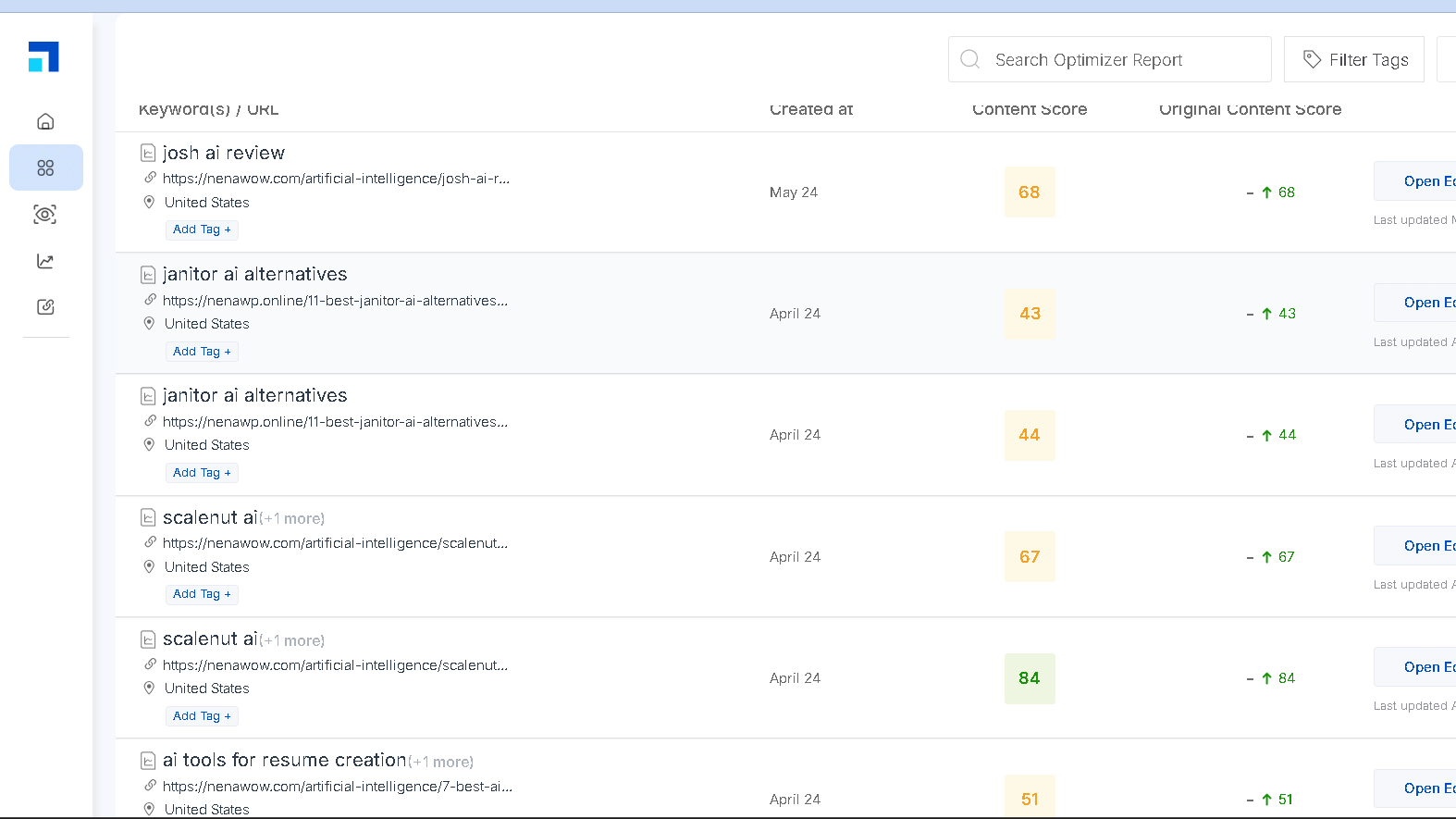
I have a clear SEO scoring system so I can prioritize fixes across a site. I expect audits to combine on-page factors, NLP term coverage, meta tag health, and SERP alignment into a single score.
Further analysis allows me to learn why certain pages are underperforming. Scalenut’s optimizer runs audits and auto-optimizes for things like H-tags, NLP terms, and meta tags.
It marks missing words and suggests a place to add them. Outranking provides audit reports with a scoring system and line-item recommendations, but many suggestions need to be applied manually, and I have to keep tabs on changes.
I prefer audit outputs that can be exported as task lists for writers based on severity levels and estimated traffic uplift. That lets us more easily plan what pages to fix first.
On-Page SEO and Suggestions
Meta title and description, structured data hints, internal linking, and featured snippet targeting should be suggestions on the page. I look for checks that match the current SERP layout and show how to capture rich features.
Scalenut points to meta tags and offers optimization for interlinking with recommended anchor text from its analysis. It also addresses featured snippets by offering short answer blocks and heading structures.
Outranking enables you to find snippet-ready responses and gives specific sentence-length and placement tips to increase snippet chances. Both tools show keywords in the first 100 words and how to format lists or tables for matching the top results.
I use those suggestions to rewrite intros, add FAQ blocks, or add short definition paragraphs to grab snippets and increase visibility.
Scalenut vs Outranking-Pricing Models and Value
| Feature | Scalenut | Outranking |
|---|---|---|
| Starting Price | $39/month ($19/year) | $59/month ($49/year) |
| Free Trial | 7 days | 7 days |
| SEO Content Focus | ✅ Yes | ✅ Yes |
| AI Writing | ✅ Yes | ✅ Yes |
| SERP Analysis | ✅ Yes | ✅ Yes |
| Content Briefs | ✅ Yes | ✅ Yes |
| Best For | Budget-conscious users & agencies | Premium SEO content creation |
I focus on how each product charges, what you get for the price, and whether a trial lets you test the core features without risk. Looking at Scalenut pricing versus Outranking tiers helps you figure out which fits your budget.
Scalenut Pricing Structure
I like the tiered plan offered by Scalenut for writers and small teams. Scalenut pricing adapted to fit your content needs.
Scalenut pricing is viewed by many as a more attractive entry point for small agencies than enterprise tools that offer high level of functionality. Most plans set limits for monthly words, projects, and SEO credits.
Higher tiers include more monthly word count, team seats and advanced SEO tools like keyword clustering and auto-optimization. Often, Scalenut shares AI writing credits with SEO tools, so you pay for content generation and optimization workflows.
If you crank out lots of long-form posts, you’ll want higher-word plans. Lower levels are less expensive but still offer keyword research and basic optimization for lighter use.
Typically, the monthly and annual prices are clear at Scalenut; annual billing often lowers the monthly cost.
Outranking Pricing Tiers
I see Outranking targeting users who want data-driven SEO plus AI writing. Its tiers are based on credits for AI runs, SERP analyses, and the number of active projects or content briefs.
At the bottom and top levels, you get additional SERP information, advanced NLP terms, and additional users or workspaces. The value of outranking comes from deeper analytics per credit.
A higher tier is appropriate if you need large-scale SERP audits and frequent content briefs. The lower tier is usually sufficient for occasional single-article optimization, but may limit the number of competitive analyses you can run every month.
Pricing pages have clear tier differences so you can match a plan to the number of briefs and SERP looks you expect to run. Compare this to Scalenut pricing to see which credit system fits your content creation volume.
Free Trial and Plan Comparison
I always test both tools with their free trials before I commit. Scalenut usually offers a free trial or small free trial that includes some SEO credits and basic AI writing.
That’s enough for me to check content generation and cruise-mode features of a few articles. Outranking also offers a free trial, usually with a couple credits toward SERP research and content briefs.
This helps me to check for the depth of suggestions made on-page and recommendations made using terms from NLP. I also compare plans by looking at monthly AI word limits, SERP/analysis credits, and user counts.
Use the trial to see how many briefs and optimizations you’ll need per month, then choose the tier that covers that without spending extra credits. If you find these tools a bit complex, you might also want to see how they compare to Frase or other tools.
Suitability, Usability, and Support
I compare platforms on the speed at which I can get tasks done, their fit into my content workflow, and the reliability of their help. I shall briefly expand on the clarity of the interface, how each tool integrates into a content marketing strategy, and what types of support and community resources to expect.
Ease of Use and UI Evaluation
I like how Scalenut handles research, writing, optimizing, and tracking. Menus and templates guide me through keyword clustering and outline generation without hunting for features.
The auto-optimizer and “Fix-it” controls allow me to put NLP terms and meta updates in a few clicks. Outranking examines on-page SEO workflows and provides audits and SERP signals.
Its UI exposes many technical fields, which I like to control, but can feel denser than tools like Jasper or Surfer. Different learning curves occur—content teams new to advanced SEO will likely prefer Scalenut‘s task flows, while SEO specialists may prefer Outranking’s layout.
Both platforms provide editors for headings, snippets, and internal linking. For collaboration, I wish there were clear options for versioning and export.
Scalenut is a tendent to be easier to hand off to writers when content is being created. If I need videos or visuals in briefs, I check the tool for embedding or linking to external video docs.
Content Marketing Strategy Integration
Keyword clusters and topic research form the backbone of content strategy. Scalenut‘s top-30 URL outlines and SERP-based clustering complement pillar-cluster models and content calendars.
That helps me write long-form posts, FAQs and interlinked pages that have backlinks and topical authority. The strength of outranking is evident in the on-page optimization and audit outputs I can feed into editorial checklists.
I use those outputs to narrow headings, search for featured snippets, and follow NLP-related terms for relevance. Both are also able to export briefs for writers, and can work together with WordPress to publish in a single click.
When working on authority-focused content, I use the content tool as well as backlink outreach and reference checks. When I need alternative topic angles or deeper language analysis, I also compare outputs to tools like Frase, MarketMuse, and Surfer.
I choose the tool that works for my workflow: Scalenut for fast brief-to-draft cycles; Outranking for detail-heavy optimization.
Customer Support and Community
I expect rapid and clear support, and that documentation is actually helpful. Scalenut promises 1:1 onboarding and proactive support for all plans, as well as pretty detailed knowledge base. They explain Cruise Mode and auto-optimization.
This makes it easier for teams to get started without long training sessions. On the other hand, outranking provides technical docs and audit explanations that are really helpful when I’m deep-diveling into SEO signals or tweaking advanced settings.
Community is big for me. I look for active forums, user groups, and video walkthroughs that show how people use the tools in real life. Scalenut tends to provide more onboarding calls and tutorial videos while Outranking has more linear content and is a bit more geared toward power users.
I care the most about how quickly support replies, how clear their answers are, and if they actually tell me what to do next if I hit a blocker. Templates created by users and briefs shared with others are gold, because they save me time and solve specific problems far faster than generic help articles.
Frequently Asked Questions
Here are some common questions about features, price, integrations, collaboration, AI writing, and user feedback. I’m aiming for clear, practical answers that highlight the differences you’ll actually notice when picking a tool.
How do Scalenut and Outranking differ in content optimization features?
Scalenut comes with an auto-optimization tool. It will add NLP terms, change headings, and suggest meta changes on its own. There is also a “Fix-it” optimizer so you can make changes without committing to any hoops.
Outranking relies more on on-page audits and guidance, but you have to fix most things manually. It uses a credit-based system for actions, which can take longer than Scalenut’s automation.
What are the pricing differences between Scalenut and Outranking?
Scalenut usually starts at a lower price and includes research, writing, and optimization in its plans. Plans have imposed article or word limits, and higher plans sometimes allow unlimited AI words.
Outranking is performed on a credit or add-on model. Additional audits and SERP analysis can add up to credits, if you do a lot of optimization or analysis.
Can Scalenut and Outranking be integrated with other SEO or content marketing tools?
Scalenut supports direct publishing to WordPress and offers traffic insights that tie into your SEO work. It aims to cover planning, writing, and tracking in one place, so you don’t have to juggle a bunch of separate tools.
It may be easier to compare their results with Frase AI when building outlines. Meanwhile, outranking is primarily a matter of on-page SEO workflows and SERP research. You can copy its outputs into other tracking or publishing systems you already have.
Which platform, Scalenut or Outranking, offers better support for team collaboration?
Scalenut has some team-friendly features like shared SEO docs, keyword cluster credits, and a collaborative editor. Those are great tools for multi-user content teams. They also promote onboarding and premium support for all plans.
Outranking also aids in collaborative work, with shared projects and audit reports. Some folks say you get less personalized onboarding and more specialized support when you’re on a higher level.
How do the AI writing assistant capabilities compare between Scalenut and Outranking?
Scalenut really pushes fast long-form content. Cruise Mode writes quick SEO-first content in a few minutes. Its AI writing is based on high-end models with low perplexity and high readability, at least theoretically.
Outranking also uses AI for writing and optimization, but gives writers SERP insights rather than just cranking out a finished draft. Both tools can use RAG to enhance factual accuracy, which is nice if you care about that sort of thing.
What are the user experiences and reviews for Scalenut versus Outranking?
Scalenut is commonly praised for its ease of use. It really speeds up the creation of long-form content and the customer support team is quick to assist you.
It is used frequently by users for topic research, keyword clustering, and auto-optimization features. These tools save you a surprising amount of time, honestly.
Its strong on-page SEO guidance is attractive to outranking fans. The detailed statistics are stunning, although some folks complain about higher costs when credits start to pile up.
Some reviewers indicate they use Outranking and other tools like Frase. That combo is useful when they need more specific analysis or when they want a smoother workflow.


