


RankIQ is an SEO tool built for bloggers who want to find profitable, low-competition keywords and boost their Google rankings. In my experience, RankIQ stands out by offering genuinely easy-to-use features like a huge keyword library, content grading, and SEO briefs that actually save time and help traffic grow.
But what really piqued my interest is that RankIQ specifically formats its tools for bloggers, unlike others. It offers done-for-you keyword research and done-for-you content optimization… takes the pain out of blogging.
It’s not ideal if you are requiring backlink options, and traffic reports, but it has the SEO basics down great .
If you need something to help steer your blog posts with intelligent keyword selections and SEO advice, RankIQ might be a good fit.
In this Rankiq review learn more about features, pricing, pros and cons.
Quick Overview Table for RankIQ
| Category | Details |
|---|---|
| Tool Type | SEO & Content Optimization Platform |
| Primary Use Case | Helps bloggers identify low-competition keywords and optimize content to rank faster in Google |
| Main Keyword Strategy | Pre-vetted, low-competition keywords with ranking potential |
| Keyword Libraries | Curated keyword libraries organized by niche |
| Keyword Metrics Provided | Search volume, ranking difficulty score, competition insights |
| Competition Analysis | SERP analysis showing top-ranking pages and weaknesses |
| Content Optimizer | AI-assisted content optimization with recommended terms and headings |
| Optimization Score | Yes (content scoring to measure SEO completeness) |
| Search Intent Guidance | Yes (suggested content structure and intent alignment) |
| Content Length Guidance | Suggested word count based on top-ranking pages |
| AI Writing | Limited (focuses on optimization, not full article generation) |
| Website Audits | No |
| Backlink Analysis | No |
| Rank Tracking | No |
| Technical SEO Tools | No |
| Data Sources | Google SERPs & internal keyword database |
| Ease of Use | Very user-friendly, minimal learning curve |
| Dashboard & UI | Clean, blogger-focused interface |
| Pricing Model | Subscription (monthly & annual plans) |
| Price Range | Typically ~$49–$99/month (depending on plan & promotions) |
| Free Trial | No free trial (sample reports available) |
| Educational Resources | SEO tutorials, blogging guides, training videos |
| Primary Strengths | Fast keyword research, simplicity, blogger-centric approach |
| Limitations | Lacks backlinks, technical SEO, and rank tracking |
| Best For | Bloggers focused on content-driven SEO growth |
| Top Alternatives | Ahrefs, SEMrush, Surfer SEO, LowFruits |
| (Unique Selling Point) | Hand-picked low-competition keywords for faster rankings |
What Is RankIQ?
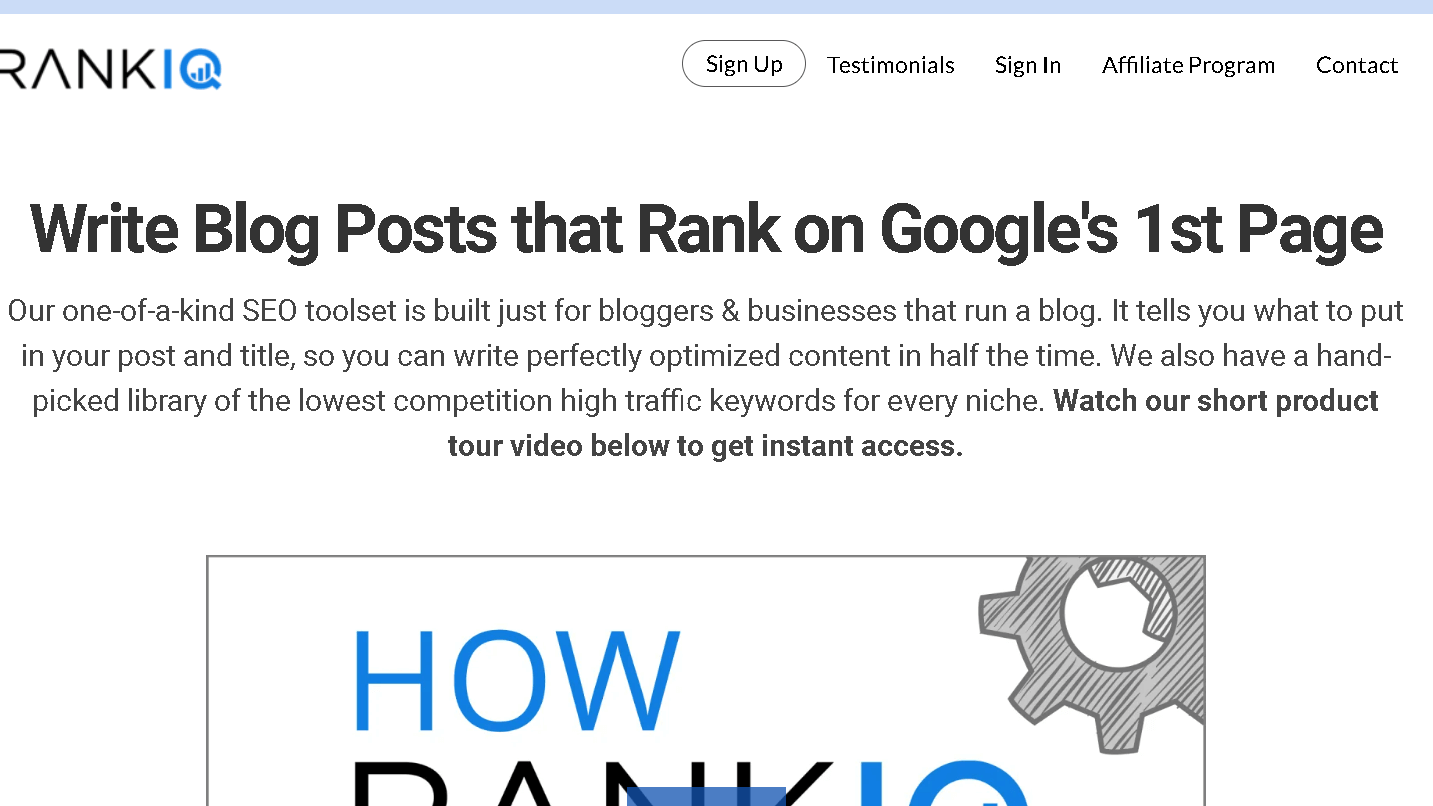
RankIQ is an AI-powered SEO tool that helps bloggers and content creators nail the right keywords and optimize posts for higher Google rankings. It uses smart analysis to spot low-competition keywords that can bring more visitors to your blog.
The tool suggests the ideal word count and topics to include so your content matches what Google wants. Its design makes SEO quicker and less painful, especially if keyword research isn’t your favorite thing or you’re fixing up old posts.
Brandon Gaille, the founder, built RankIQ around proven blogging strategies—basically trying to bottle up his own success and share it through automated SEO help.
How RankIQ Works
RankIQ leans on artificial intelligence to dig into thousands of factors for your target keywords.
When you type in a keyword, it runs over 6,000 calculations to figure out which terms and topics will help your blog post rise in the rankings.
The tool spits out two main reports: one with the best low-competition keywords, and another showing the exact topics Google likes for that keyword.
It also predicts the ideal post length based on top-ranking content. The content optimizer suggests related LSI keywords, which help search engines get what your article’s about.
RankIQ scores your writing and gives clear steps to improve it. This really cuts down on manual keyword hunting and replaces guesswork with data-backed advice.
The Philosophy Behind RankIQ
RankIQ aims to take the frustration out of SEO for bloggers.
Instead of spending ages on keyword research, it hands you a ready-made list of high-traffic, low-competition keywords.
The idea is simple: give bloggers easy, actionable SEO advice so they can focus on actually writing.
It encourages optimizing both new and old posts for Google’s ranking factors. By targeting easier keywords, bloggers have a better shot at landing on Google’s first page—without getting lost in complicated strategies.
Who Created RankIQ
Brandon Gaille, a successful blogger with a knack for getting sites to rank on Google, created RankIQ.
He also runs The Blogging Millionaire Podcast, where he shares SEO tips, keyword strategies, and advice on growing blog traffic.
He based RankIQ on his own experience growing blogs to over 53,000 first-page Google rankings.
His goal?
Build a tool anyone can use to get similar results without needing deep SEO expertise.
Brandon’s background as a content creator and marketer gave him a real sense of what bloggers actually want.
The straightforward, AI-powered SEO tool that makes the process less overwhelming and more effective.
Core Features of RankIQ
RankIQ gives me a toolkit for finding strong keywords and crafting content that does well on Google.
Its features focus on practical help—choosing the right keywords, optimizing posts as I write, and scoring my content against SEO standards.
The tool’s insights push me to tweak every part of my posts, from titles to keyword use. Honestly, it’s made my workflow smoother.
Curated Keyword Library
The keyword library is easily one of RankIQ’s best features.
It offers a handpicked list of keywords that have low competition but solid search traffic. This means I don’t waste time chasing impossible keywords or battling for overly popular terms.
The library covers over 60 niches, with keywords sorted by competition level and estimated ranking speed.
This filtering saves me research hours and gives me confidence that each keyword fits my topic and audience.
Each entry shows search volumes and difficulty scores, so I can focus on terms that actually deliver traffic.
AI Content Optimizer

RankIQ’s AI Content Optimizer helps me shape my writing to rank higher in Google searches.
As I write or paste content, it analyzes my text in real time and gives feedback on missing keywords, word count, and optimization tips.
It guides me to include related LSI keywords, which are terms Google expects to see alongside my main keywords.
This helps improve my content’s relevance and depth, but without keyword stuffing.
The tool also sets clear word count goals based on what’s ranking now, so I know how detailed my article should be.
The interactive scoring and suggestions keep me motivated to keep tweaking until I hit an optimal grade.
AI SEO Reports & Content Grading
RankIQ generates AI SEO reports that grade my content based on SEO best practices.
Each report highlights areas for improvement, like missing keywords or weak coverage, so I know exactly what to fix.
The content grading system uses letter scores and shows which terms are underused, which boosts my confidence in the overall quality of my post.
These reports look at more than just keyword density.
They check structure, readability, and keyword placement. Watching content grades improve over time helps me keep my posts up to standard and makes new content stronger.
Title Analysis & Suggestions

A strong title is huge for getting clicks, and RankIQ helps me nail it.
The title analysis compares my headline with top-ranking posts, looking at structure, keyword placement, and length.
The tool suggests titles based on what’s working in my niche.
It points out things Google likes, like putting target keywords upfront or using action words to make the title pop.
This saves me from endless guesswork and helps me create titles that are both SEO-friendly and catchy.
Testing different options has definitely helped my posts rank faster and attract more readers.
RankIQ for Bloggers and Content
Creators RankIQ offers tools that let bloggers and content creators focus on writing, while it handles keyword research and SEO headaches.
Its features are designed to save time and improve rankings by giving clear advice on keywords and structure.
Benefits for New Bloggers
For new bloggers, RankIQ makes SEO way less intimidating.
It gives you pre-curated keyword lists with low competition and decent traffic potential, so you can skip hours of research and start writing right away.
The content grader shows how well your article matches what Google wants.
It also recommends the right word count and relevant topics, which takes a lot of the guesswork out of publishing.
The ‘Time to Rank’ metric helps me focus on keywords that can bring quicker results, which is important when starting out.
Support from the RankIQ team and its active community also makes getting help easier.
Support for Experienced Bloggers
RankIQ isn’t just for beginners.
As someone with more experience, I use it to analyze older posts with Google Search Console data and spot articles that could regain or boost traffic.
The AI SEO reports give me detailed suggestions on missing subtopics and keywords.
I can optimize content without slogging through manual research, which makes updating posts so much faster.
RankIQ’s niche-specific keyword library helps me find fresh ideas, even in crowded spaces.
While there’s a limit on reports per month, it still speeds up my workflow and cuts down on time spent on SEO tasks.
Results for Food and Travel Bloggers
For food and travel bloggers , RankIQ finds specific low-competition keywords that matter in these niches.
The focused keyword lists, sorted by niche, save a ton of time and deliver actionable topics.
Using the content optimizer, I can work in key phrases like ‘recipe variations’ or ‘best Bali attractions’ that Google loves, boosting my blog’s chances to hit page one.
This brings in more organic traffic from people searching those topics.
RankIQ also helps Mediavine blogs by making content SEO-friendly and more appealing to advertisers through higher traffic.
Its simple interface lets you focus on creating recipes or travel guides, not getting bogged down in SEO details.
Keyword Research and Planning with RankIQ

RankIQ streamlines the process of finding the right keywords and planning content that can actually rank.
It offers tools for spotting low-competition keywords, clear analysis metrics, and a content planner to help organize posts efficiently.
Finding Low-Competition Keywords
One of RankIQ’s biggest strengths is how quickly it helps me find low-competition keywords.
The curated keyword library spans thousands of terms across 200+ niches and sub-niches, so I don’t have to guess what might work.
RankIQ highlights keywords where it’s easier to rank, which is crucial since going after these terms gives me a real chance to show up on Google.
The tool also suggests related keywords that expand my options without losing focus.
By sticking with low-competition keywords, I don’t waste energy on impossible ones that might never rank.
Keyword Metrics and Analysis
RankIQ gives me clear metrics to guide my keyword choices—search volume, competition, and how similar content performs.
This data helps me figure out which keywords are actually worth my time.
I usually compare keywords side by side, looking at how many results show up and the average quality of those results.
This way, I can pick keywords with a good balance of traffic and ranking potential.
The research tool also surfaces trending keywords, which keeps my content fresh and sometimes uncovers opportunities I’d otherwise miss.
Content Briefs and Planner
RankIQ’s content briefs are super helpful for shaping my articles.
Each brief pulls together the top 20 Google results for a keyword and highlights common subtopics, user intent, and key questions to answer.
This works as a roadmap, showing me what readers expect and what Google’s algorithm seems to like.
I don’t have to guess anymore—the brief reveals what’s working now.
The content planner organizes all this info in a way that helps me map out my post structure and keep my writing focused and optimized from the start.
It’s saved me from endless rewrites and really improved my posts’ quality.
SEO Optimization and Reporting

RankIQ gives me detailed tools to improve my content for search engines and track how my posts perform.
It zeros in on practical on-page SEO, clear reports, and works well with Google Search Console so I can actually see what’s working.
On-Page SEO Optimization
RankIQ’s content optimizer is a feature I lean on for on-page SEO.
It checks my draft against top-ranking pages for my keyword and suggests related keywords and topics I should add to cover what Google expects.
It also recommends an ideal word count based on the competition.
No more guessing how long my post should be.
The system points out where I’m missing important terms or topics, making it easier to fill in gaps and improve my chances of ranking—without overdoing the keywords.
SEO Reports and Ranking Insights
After I enter my keyword, RankIQ creates a detailed SEO report with an easy-to-read letter grade.
The report shows where my post meets or misses Google’s standards.
It offers tips for better titles, recommended subtopics, and keyword density.
Getting feedback as I write lets me adjust on the fly, instead of waiting weeks to see if something’s working.
I can also audit old posts and update them to boost traffic.
Integration with Google Search Console

RankIQ integrates nicely with Google Search Console, which I find essential for tracking real search results.
This connection lets me import data and compare SEO reports with actual rankings and clicks.
Using both together gives me a clearer view of what’s working and what needs tweaking.
I can spot which keywords and pages are winning and fine-tune my strategy based on real user behavior.
This kind of integration just saves me time and makes managing SEO less of a headache.
Comparing RankIQ to Other SEO Tools
RankIQ really focuses on making keyword research and content optimization easy.
It caters more to bloggers and beginners than most tools, though it skips some of the broader features you’ll find elsewhere.
RankIQ vs Surfer SEO and Clearscope
Surfer SEO and Clearscope both lean hard into content optimization.
Surfer SEO digs into on-page SEO factors like keyword density, page structure, and competitor analysis, which is handy if you’re deep into tweaking content.
Clearscope zeroes in on content relevance, helping big teams match their writing to what users want and what ranks.
It’s pretty enterprise-focused.
RankIQ, on the other hand, keeps things simple.
It hands you curated keyword lists and AI-powered writing tips, so beginners won’t feel lost.
The interface feels way less intimidating, but you won’t get the same technical details or live data as Surfer SEO.
Clearscope’s pricing and features are really meant for big companies, while RankIQ is more for solo creators and small blogs that just want to rank content without a fuss.
RankIQ vs Semrush and Ahrefs

Semrush and Ahrefs give you the whole SEO toolbox: backlink analysis, site audits, keyword tracking, and competitor research.
Their databases are massive, and the real-time data is a dream for agencies or pros.
RankIQ doesn’t try to do it all. It’s built for content-focused keyword research and quick Google rankings.
You won’t find backlink analysis or in-depth site audits here.
If your main goal is to track backlinks or dig into competitor link profiles, Semrush or Ahrefs make more sense.
RankIQ stays simple and affordable, which is honestly what a lot of bloggers want.

Alternatives and Complementary Tools
Other tools can fill in the gaps or work alongside RankIQ.
Frase shines with its AI content briefs and research features, so it’s great for planning.
KeySearch keeps keyword research affordable, but it doesn’t have the AI content help RankIQ does.
If you want the whole SEO package, Semrush or Ahrefs cover what RankIQ misses.
For deeper content optimization, Surfer SEO or Clearscope are stronger choices.
Some people mix RankIQ’s curated keywords and content reports with other tools for backlink data or audits, which gives a more complete SEO picture.

Pricing, Plans & User Experience
RankIQ comes with several pricing tiers for everyone from solo bloggers to agencies.
Plans mostly differ by features and how much access you get, and the prices are pretty straightforward.
Getting started on the platform is easy, and the support team, plus a helpful community, usually jump in quickly when you hit a snag.
RankIQ Pricing Breakdown
The Blogger plan starts at $49 per month—good for newbies or anyone just dipping a toe in.
The Standard plan runs $99 per month or $1,188 per year, and it’s popular with serious content creators.
Need more?
The Pro plan jumps to $199 per month for bigger needs.
The Agency plan doesn’t have a set price; it’s custom, usually with team access and extra perks.
There’s talk of an Enterprise plan, but details are scarce—probably only for large companies or power users.
Every plan gives you a different level of keyword research, AI tools, and optimization features, so you can pick what fits your content strategy and budget best.
Plan Features: Blogger, Pro, Agency, Enterprise
The Blogger plan covers the basics: keyword libraries, AI SEO reports, and some optimization tools.
It’s plenty for beginners or small blogs.
The Standard plan bumps up your keyword access, usage limits, and gives you better optimization insights.
Lots of bloggers upgrade for the extra reach.
The Pro plan adds even more—extra AI reports, deeper competitor analysis, and bigger keyword libraries. It’s aimed at folks or small businesses ramping up content marketing.
The Agency plan is for teams juggling multiple clients, offering collaboration tools and priority support.
The Enterprise plan is rare and aimed at big corporations who need full customization and dedicated service.
User-Friendly Interface & Support
RankIQ’s interface is genuinely easy to use, no matter your skill level.
I found the navigation simple, with menus that actually make sense and suggestions you can act on right away.
The AI tools walk you through optimization step by step, which makes the learning curve feel a lot less steep.
Support is available by email and through a Facebook community where users swap tips or get quick answers.
This combo of responsive help and a friendly user base makes RankIQ a safe pick for both newbies and seasoned folks.
The focus on simplicity really does keep things running smoothly.
Pros and Cons of RankIQ

RankIQ brings some real perks for marketers, agencies, and small business owners who want to do SEO with less trial and error.
Still, it’s got a few downsides you should weigh before jumping in.
Rankiq Pros
RankIQ’s best feature is likely the handpicked keyword library.
It also saves you time by directing you to keywords having a low level of competition that people actually search for.
This is a big win for marketers or agencies who are working with multiple clients and need to have quick, focused SEO wins.
Also a highlight is the AI SEO report.
It scores your content and offers optimization advice for word count, and subtopics so that your posts are structured properly to rank.
For small business owners that are not SEO aficionados, this is straight forward process.
It marries well keyword research with content planning and I love that, that you can improve from new to older blog posts .
That’s not something you see very often in one tool.
It isn’t priced as high as some suites such as SEMrush so small teams can actually afford to use it.
Potential Drawbacks and Limitations

Having to log in every time is annoying and disrupts your work flow.
Nor does the content editor handle Word pasted text and in my experience pasting from WordPress is better.
The keyword analysis can sometimes take several minutes, so be prepared for some waiting if you are in a hurry.
The keyword library is vast, but – that doesn’t mean that it is all encompassing or that every weird niche will be properly understood.
It seems like you occasionally have to go to the founder to get what you need.
RankIQ is more catered towards blogging and content SEO.
Final Thoughts on RankIQ’s Value
There’s no doubt that RankIQ does scratch a particular itch in the world of SEO and content.
It points you towards the right keywords and can liven up your blog posts to give them a good fighting chance at search.
It allows for easier optimization of content, which is has been pretty important in order to keep organic traffic stable.
Best Use Cases and Who Should Use RankIQ
I would recommend RankIQ to newer bloggers, small business owners, or niche market creatives seeking easy to understand and follow SEO help without having to look into the technical.
This is particularly useful for those who struggle to understand keyword research, as the library of low comp keywords are handpicked which saves a lot of time.
These niche keyword ideas allow travel, food, and tech bloggers to increase traffic from sources that are actually meaningful to their readers .
It’s also useful if you wish to recycle old posts to get improved search engine rankings and continual blog traffic.
If you’d prefer to be writing rather than worrying about SEO, RankIQ is the way to go.
How RankIQ Fits Into Your SEO Strategy
The function of RankIQ in your SEO process centers on content quality and the right use of targeted keywords.
I’ve used its AI to scrape high ranking pages and extract the best topics and word counts and I base my blog posts on its data-driven suggestions.
The content grading system allows my posts to remain current, or in accordance with what Google appears to require.
I can then attack new content and other old articles that I have to start building the organic traffic.
It’s definitely not a substitute for in-depth, SEO techniques but it is an added layer that will help improve your blog traffic and visibility over time.
Frequently Asked Questions
RankIQ offers tools for keyword research, content optimization, and covers a wide range of niches. Pricing depends on the plan, and the features are designed to be easy to use. Here’s what you might want to know about its benefits for bloggers, ease of use, pricing, niche coverage, and support.
What benefits does RankIQ offer bloggers?
RankIQ saves bloggers time with ready-made keyword research and SEO content briefs. The title grader and content optimizer help you climb search rankings faster.
It also makes it easier to update old posts, helping you keep your content fresh without starting over.
Can RankIQ help improve website traffic effectively?
RankIQ is designed to help with SEO, so you will also see an increase of organic traffic over time. Because your content is well optimized for the first place on Google it will not have trouble finding it.
It provides no site traffic reports, but the point of all the SEO advice it offers, eventually, is attracting more viewers with good placement of content.
What is the range of pricing for RankIQ’s plans?
Plans are based on how many reports you need each month.
The Lite plan is $29 for 8 reports.
Standard costs $49 for 16 reports.
Pro is $99 for 36, and Agency is $199 for 80 reports monthly.
There’s something here for everyone, from solo bloggers to bigger teams.
Are newcomers able to easily navigate the RankIQ platform?
Yes. I agree that it is easy to use; the interface is intuitive.
Newcomers will appreciate the beginner friendly resources and easy to use tools – you don’t need to be already familiar with SEO.
This works great to help new bloggers get started on content optimization quickly.
Does RankIQ’s functionality cover multiple industry niches?
RankIQ covers over 200 main niches with lots of sub-niches like blogging, health, pets, and tech.
This broad coverage helps all kinds of bloggers find relevant keywords and content ideas tailored to their space.
What support options are available for RankIQ users?
From a user support perspective – RankIQ does provide you with some strong support in terms of navigating through the software and using its features.
It’s also not very difficult to ask for help either or stressful to ask for help.
And for new or seasoned it makes a huge difference to have that support right there.