

Search is changing. AI now decides which answers show up first, which snippets get highlighted, and which pages get ignored. AI SEO means shaping your content so AI systems can find, trust, and use it when they pull answers for search engines and chat tools. People are starting to call this generative engine optimization, or just “aio.”
Modern search settings such as SGE rely on these optimizations to produce precise summary reports. In the event that you have optimized your data properly machines will be able to interpret your data in the correct way.
Understanding how AI and SEO interact is a an essential step to take if you wish to remain prominent. A strong technical SEO foundation ensures your website is accessible to the many bots that are complex.
Utilize an easy structure, exact facts and consistent naming, so that your site appears in AI answers, summaries and references. It’s not only about ranking, it’s about being mentioned by AI.
We’ll go over practical techniques and tools that will help you improve your SEO abilities and continue to increase traffic regardless of the changes in the world.
Key Takeaways
- Make your content easy to understand and easy to find so that AI systems can make use of it.
- Keep in line with organizations, ensure that facts are accurate and present information in a an organized manner.
- Consider AI visibility as a supplementary element of traditional SEO however, make sure you adapt your strategy to the current times.
- Concentrate on semantic relevance to align user intentions and the context.
What Is AI SEO and Why Does It Matter?
AI SEO is about shaping the content of your website and transforming technical signals to ensure that AI algorithms and the latest search engine can highlight, cite and display your website. The use of AI for SEO can help you process data on the scale you couldn’t before.
The constant evolution of the relationship between ai and SEO helps your strategy to keep pace with the constant algorithmic changes. This way, businesses can expand their organic reach more quickly and also automate the entire process of content creation.
It helps keep your website relevant in a time when AI search can provide instant responses. Nowadays visibility is the key to gaining specific answers, brand mentions and crawlable content over simply keyword stuffing.
How AI SEO Differs From Traditional SEO
Traditional SEO attempts to rank websites on search results based on keywords, links, as well as website health. It’s still a factor but it’s now joined by data-driven insight.
This means that your content strategy must change and adapt to future trends in search. AI SEO still cares about basic factors like page speed and users’ experience, but it analyzes how ranking factors are weighted differently in dynamic search.
Optimization of engines in the generation process makes it easy for LLMs to pull and to cite. Making solid pillar pages is almost essential.
It is important to look at the competition more frequently to determine how they’re getting referenced. A high crawlability indicates that AI bots have access to your content quickly, otherwise you’ll be missing out on AI overviews.
Write self-contained sections and give brief, direct answers and include clear headers. Brand mentions and citations — even ones that do not contain links are important as AI tools pull information from the entire internet to create answers.
Keyword research is evolving into rapid research, which is longer and more conversational questions that sound similar to how people ask queries during Chat as well as AI Mode.
The measurement process is evolving too. Alongside traffic and rankings teams now monitor AI visibility by analyzing references in AI response, the number of citations and the share of voice within AI tools. There will be new dashboards and tools to show AI-driven activity alongside the usual statistics.
The Role of Artificial Intelligence and Machine Learning
Machine learning and artificial intelligence examine billions of documents in order to provide answers. Models such as RankBrain, MUM, and LLMs take and combine information small snippets.
They track user behaviour to determine how information is presented. Websites that are clear, truthful and well-structured content are frequent use.
Crawlability of technical information is vital so these models can index your data effectively. Large-scale language models are becoming better at recognizing the subtleties when it comes to technical issues.
MUM allows search engines to understand information across formats and languages that provides better results. ML can also influence personalization and inference. AI can discern the purpose of a prompt and present succinct summaries instead of hyperlinks.
This makes authority from the field and firsthand knowledge even more valuable since models are looking for authentic signals to determine E-E-A-T. The technical setup is important: AI crawlers need access to HTML that is readable.
Impact on Search Visibility in 2026

By 2026, a lot of search experiences such as SGE combine classic SERPs with AI Chat answers and overviews. SGE seeks to synthesize data and provide users with a clear answer.
The majority of traffic comes from blue-links clicked and users who view an AI report and do not visit the website. Monitoring trends in global search helps you adapt your AI strategies for search as the habits change in the face of increasing numbers of people who are using AI Mode to do their daily tasks.
Conversational search is on the rise and queries are becoming more natural and complex. AI visibility can increase brand search results and traffic from referrals when tools refer to you or mention your name.
This makes it all the more vital to create material that machines can understand and display to people. Publishers that optimize their content for AI have two advantages traditional organic clicks as well as appearances within AI answers.
To aid in this, write concise and standalone responses under clear headings, and keep your contents crawlable and earn brand mentions across websites. Monitor both SERPs as well as AI indicators of visibility in order to find out the areas where your content is performing or in need of improvement.
Core Components and Technologies Behind AI SEO
This section explains the fundamental technology that drives AI SEO in detail, and it explains how this impacts the way that keywords are researched, content is created, and audits of sites. It explains the tools and data that teams utilize to aid AI-driven searches discover and verify your website’s pages.
Natural Language Processing (NLP) and Semantic Search
Natural language processing allows machines to recognize the meaning of texts and not only match words. It breaks queries down in intent, entity and relationships, so that search engines can find results that match what the users actually want.
Semantic search is a technology that drives the market currently. It allows content optimization to concentrate on how subjects relate to one another, not only keywords.
Search engines today care more about semantic relevancy than matching words. This means that your content’s context must be in line to what your user requires.
Algorithms such as BERT employ NLP to determine the subtle meanings of each sentence you compose. To be able to use SEO your content, it must to be able to explain the concepts, questions that are related to them and also synonyms.
Schema markup and structured content aid in labelling things such as individuals, products or dates so that AI can quickly parse them. Clear and concise headings, definitions and FAQ sections increase your chances of appearing on AI overviews and snippets of information that are featured.
NLP-powered tools organize related keywords into subjects and show you areas how much coverage you have. Teams make use of this to design pages that are more encompassing in their goals.
Strategic internal linking can help search engines to navigate through related topics to make your site’s structure and authority overall.
Large Language Models and Generative AI
Large language models (LLMs) produce and summarize information as well as answer questions and offer outline suggestions. They’ve altered the way AI systems extract and display details in search results as well as chat responses.
These LLMs are now in the middle of contemporary workflows for content. Generative AI lets marketers create outline and drafts quickly while maintaining an ongoing publishing rate.
Teams improve these drafts using their own data to make the their content original. SEO teams employ LLMs to create content briefs for drafting, as well as ongoing optimization.
LLMs examine readability to make sure that your content is suitable for an audience of all ages. The clear writing of these models helps them make your points clear while ensuring that they read well. AI tools will be able to extract your most valuable insights.
They also aid in the production of structured content, such as schema snippets and meta descriptions quickly. Search engines might rely on LLM outputs to provide AI overviews, which is why clear sources, original research and E-E-A -T signals are more important than ever before if you wish to become a top citation source.
Automation and Scalability for SEO Workflows
Automation utilizes AI SEO instruments to manage the research of keywords as well as technical audits and internal linking at a high-volume. This helps you avoid repetitive tasks and speeds up your workflow.
AI tools allow you to manage thousands of websites at a time. The automated SEO for technical searchers scans the web for crawl mistakes, Core Web Vitals issues broken links, and crawl errors, and then prioritizes repairs.
It will automatically generate alt text, meta descriptions and schemas for a variety of pages, ensuring your seo technical consistent. Automated internal link suggestions can help keep your site in a stable structure while your content grows.
Scalability is the ability to continuously monitor. Automated systems monitor the rankings of your pages, their content decay, and the latest trends in topics so that you can make changes to pages before the traffic decreases.
The combination of human and automation ensures that the quality is maintained. This method should always place the users first. The use of advanced data analysis to improve your workflows can help keep your content competitive in the search engine changes.
Key AI SEO Strategies and Applications

AI accelerates research and improves quality of content and uncovers gaps in your competitor’s content that you may have missed. It assists teams in identifying the right keywords to create searchable answers and adapt content to questions that are conversational or voice-based. There are a lot of benefits of AI SEO.
AI-Powered Keyword Research and Clustering
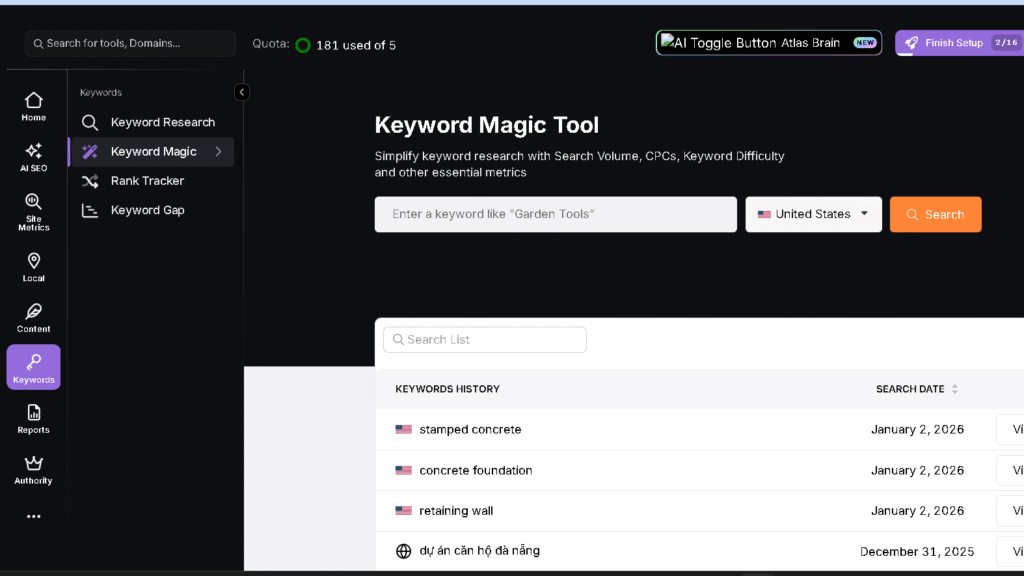
AI tools sift through massive query sets to find opportunities-rich keywords and long-tails that correspond to the real intent of users. They organize similar queries in topic clusters, and reveal which keywords are driving clicks, not just impressions.
Keyword clustering is a method used by teams to create the pillar pages as well as articles that highlight gaps in content that rivals haven’t addressed yet. Platforms such as The Keyword Magic Tool detect these clusters in a way which makes research easier.
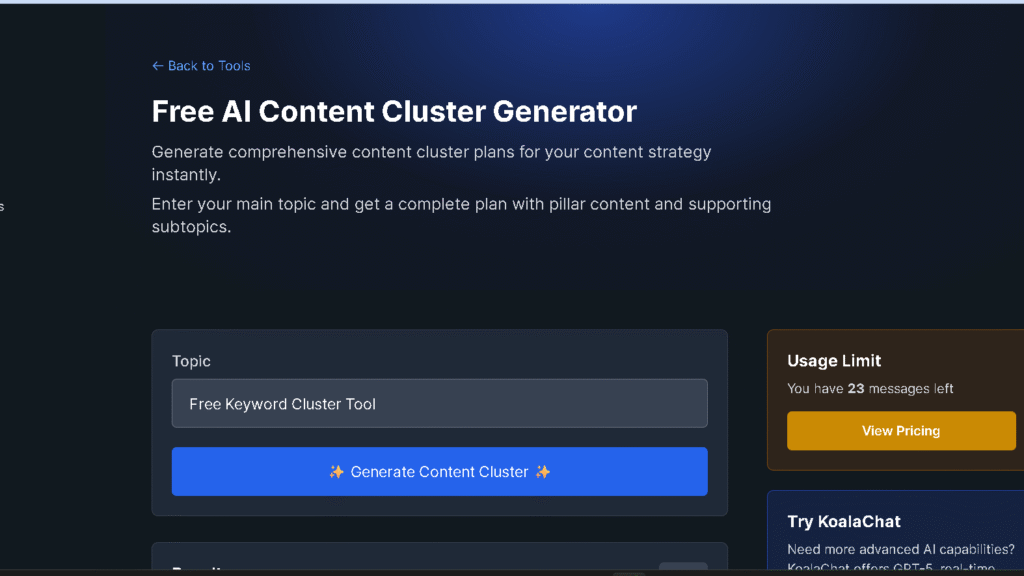
These tools combine search intensity and volume to let search engines understand your content’s depth. The use of long-tail keywords within these clusters can bring in more targeted and high-intent traffic.
Strategic internal linking links related subjects, assisting search engines comprehend your site and locate your most valuable content. This increases authority on your topic and accelerates the process of bot search engine discovery.
Outputs include prioritized lists of keywords as well as search volume and intent labels. AI detects gaps in low competition by analysing the quality of content across SERPs. Tools typically produce CSVs or cluster maps, so marketers can devise strategies that are in line with the latest SEO guidelines.
AI Content Optimization and Creation Using AI Tools
AI creates outline, drafts tags, and outline suggestions. AI then polishes content to improve clarity and coverage. It scans your website quickly to identify gaps in your site in your site where competitors are making gains.
Tools such as INK as well as Surfer SEO can help to fill in those gaps. In niches that are difficult this type of optimization of content is necessary.
On-page SEO involves tuning each element, from title tags to keywords and ensuring all information flows smoothly for both humans and bots. AI proposes titles, entities and locations to define or provide instances to satisfy search-related intent.
Editors must still verify the facts, use firsthand experiences and improve E-E-A-T by connecting sources and incorporating bios. Humans can spot mistakes and helps build confidence. To optimize, AI measures semantic coverage in comparison to pages with the highest ranking and provides suggestions for schema and internal linking (FAQ, How To).
SERP Analysis and Competitor Insights
Conducting a deep-serp analysis will reveal the way AI tools process different types of intentions. This analysis reveals the reasons why some competitors appear in AI summary reports while others don’t.
AI examines SERPs and shows the features (snippets of content, panels, video) are displayed and what competitors have the highest rank in your clusters. It evaluates competitors on the basis of the depth of content, backlinks and on-page signals. This lets you choose the most relevant updates or topics.
If AI discovers lots of no-click AI Overviews, you could make concise, fact-filled blocks that are designed to be cited. Reports contain win/loss matrices as well as suggested kinds of content, and monitor the changes in ranking. Based on these insights SEOs can determine whether to design new pillars, refresh old ones, or pursue links.
Personalization, Voice, and Conversational Search
AI allows for personalization of content by comparing variations on pages to user segments and previous behaviors. This increases the relevance and the level of engagement. This feeds into rankings.
AI analyzes geo signals to ensure the answers are in line with the location of the user which makes Geo extremely important to local business. For conversational and voice searches, AI optimizes for how people actually communicate.
The right way to conduct a voice search is knowing how people phrase their questions loudly. Teams design short lead answers and more detailed sections for those looking for more details.
Optimizing for conversational search also entails dealing with the form of questions along with long-tail keywords as well as schemas that help assistants find the answers. This increases your visibility in both traditional SERPs and results driven by assistants.
Your content is better suited to being mentioned by LLMs and is genuinely beneficial to the public. If you expect conversations the content will be accessible even when searching hands-free.
Top AI SEO Tools and Future Trends
AI tools are now tackling analysis and audits, content briefs and schema tasks much faster than they did before. They aid in keyword discovery as well as content creation and monitoring the places where pages appear in AI-driven features such as Google AI Overviews and highlighted snippets of content.
Popular AI SEO Platforms and Solutions
Semrush, Surfer SEO, and Ahrefs are the leaders in reviews and research on keywords. Surfer SEO aligns your writing with the top-performing websites in your area of expertise.
Surfer provides headings and suggestions for keyword use to improve the quality of the quality of content. Content-creation tools such as Jasper, INK, and ChatGPT make outline drafts, create AI summary, and create FAQ Schema text.
INK stands out due to its semantic optimization. Perplexity and Claude are able to handle quick research and checking citations.
Gemini and the Claude style models provide deeper research into content as well as answer-generation for FAQs as well as schema markup. Website owners typically utilize these AI tools in conjunction An SEO audit using Semrush and an Surfer Content Brief, ChatGPT or Jasper for drafts, and then Ahrefs to verify the backlinks and rankings.
This workflow speedes things up and increases quality while keeping E-E A-T and firsthand experience in the back of your mind.
AI Overviews, Zero-Click, and Featured Snippets
Search engines are now showing AI Overviews as well as featured snippets that can reduce click-through rate. Google AI Overviews draw information, summarizes, and suggested sources.
A snippet of text or providing accurate schema markup–such as FAQ schemas can still be a way to gain visibility even if people do not click. To get these spots, you must have clarity in your structured data, precise responses, and authentic sources.
Surfer and Semrush recommend editing the page to target snippets. ChatGPT or Gemini create quick, precise answers while Perplexity reviews sources lines.
E-E-A T signals – author information as well as citations, firsthand experiences are more crucial in establishing credibility than pure AI output. Zero-click visibility still can increase brand awareness and converts but in a different method.
Teams should optimize their efforts on both conventional rankings as well as AI-driven results formats. A strong web page for pillars can also boost the odds of getting prominently featured in these spots with high visibility.
Emerging Challenges and Best Practices
AI tools have the potential for dangers like hallucinations and thin content and over-optimization. Automated summaries and drafts generated by ChatGPT, INK, or Jasper require human supervision to identify errors and preserve real-time experiences in tact.
relying too heavily on created content may weaken E.E.A.T and harm rankings. A well-balanced SEO plan should always focus on the highest-quality, human-reviewed content first.
Run an SEO audit (Semrush, Ahrefs) before making big changes. Utilize Surfer to align your content with the most popular SERP signals and then add schema markups for FAQs and other key facts.
Connect your most trusted websites by using clever internal linking. Always verify claims made by AI using primary sources and reference them.
Focus on the content that actual users require and their real-world experiences. Keep track of the placements of the featured snippets of content and AI Overviews and adjust when needed.
Frequently Asked Questions
This section tackles practical questions about how AI changes SEO, the steps to optimize for AI-driven search, tools that can help, the skills you’ll need, and whether businesses should invest in AI SEO services. Each answer offers clear, actionable points based on current practices and tool types.
How does AI impact search engine optimization strategies?
AI changes SEO away from searching for exact keywords to focusing on the user intent. The use of AI to improve SEO allows you to concentrate on the quality of your content and its context instead of just cramming up keywords.
It’s an essential part in modern SEO. Search systems employ machine learning and artificial intelligence (AI) to create generative AI to discover the meaning of an AI search-based environment.
AI can add speed and the ability to scale keyword clustering and technical examinations. It can detect patterns in the data that human eyes could miss, and helps to improve your research on a topic.
It also places greater emphasis on engagement topics, depth of topic, structured data, and accuracy. AI systems are able to extract and provide short answers to pages and advanced competitor analysis lets you understand which content formats perform best today.
What steps are involved in optimizing a website for AI-driven search?
Start by conducting an audit of the technical side to correct issues with mobile indexing and mobile. Increase the speed of your website for both users as well as AI crawlers.
Be sure that you have an internal link structure that allows bots easily navigate. The content should be mapped to the searcher’s intention and provide easy-to-read, scannable responses to the most frequently asked questions.
Make use of headlines, paragraphs that are short and FAQ schemas to make content simple for users to read. This is especially important for conversational and voice search.
Create structured data (Article or FAQ and Product) and entity references to aid AI systems identify information and sources. Make sure that author information and citations are current to ensure credibility.
Tools such as MUM help for engine developers to join these information points. Track AI effectiveness by using tools that measure highlighted answers, zero-click impressions and citation-like mentions.
Make adjustments to your pages based on these signals, and also what the users actually do. A regular analysis of competitors helps keep you ahead of the pack when AI standards change.
Can AI SEO tools improve website ranking, and which are available for free?
Yes they are able to. AI tools can speed up research, enhance content and identify technical issues more quickly than manual methods.
They provide more precise SEO on the web by suggesting improvements in real-time and assist you in deciding on improvements that actually make a difference. Utilizing AI tools to help with SEO can drastically reduce the amount of time you devote to creating content.
They can also assist in enhancing your generative optimization to get more impact. The free options include Google Search Console to collect performance information and Google’s PageSpeed Insights for speed improvements and basic keyword suggestions that are available from AnswerThePublic and the no-cost levels of Ubersuggest.
Open-source and browser extensions can aid in on-page check-ups. Paid software can help automate tasks large-scale clustering and briefings of content.
Start using free tools to detect problems and then consider paying tools when you’re looking to expand your AI to work on SEO.
What specialized skills are required to effectively utilize AI in SEO?
Analytical reasoning and data literacy is crucial. It is essential to understand reports, recognize patterns, and connect the metrics to your content decisions.
Understanding how large models of language interpret text is becoming a crucial knowledge. It is still important to understand technical SEO in terms of site architecture as well as structured data and log analysis aid in helping AI systems find and properly cite your content.
Content editors need to write concise, factual responses and also add credibility by adhering to the highest standards of content. The management of projects and experiments help teams to test AI suggestions, determine what is working and stay clear of publishing unchecked AI outputs that are faulty.
Being able to use AI tools to link internal links and analysis of competitors is an enormous benefit.
Is investing in AI-powered SEO services beneficial for online businesses?
The investment can be worthwhile in the event that you require the capacity or know-how. Platforms and agencies conduct audits, create AI-assisted workflows, and accelerate production of content.
This usually means creating an pillar page for every product or service. Smaller websites should weigh the cost against results that are clear: resolve the technical problems first. enhance the pages that are most important, and then test AI tools with a small sample before committing to a full.
Larger websites with a lot of pages typically see more ROI with AI-powered AI tools. Always make sure that you have a human reviewing AI outputs to ensure accuracy, E.E.A.T signals and the voice of your brand.
Mixing the human and automated ensures that your search engine optimization is authentic.
How can I leverage AI to enhance my website’s search engine performance?
Use AI to identify gaps in topic and organize your keywords. AI can also create short content briefs based on data, which results in less guesswork and more attention to websites that may actually rise up the ranks.
Let AI manage the ongoing audits of your site and keep an watch for any technical issues, so you can quickly fix any issues. Automate boring stuff like meta updates or internal linking suggestions–honestly, who wants to do that by hand?
A well-designed internal link spreads authority throughout your site and makes it more accessible the search engine to index. This is an enormous benefit to an general SEO strategy.
Combine AI-generated concepts with your own editing, actual experience, and reliable sources. This combination builds confidence and renders your work at ease for AI-driven search tools and models of language.
Make sure you keep an eye on your competitors right now and later. It will help to keep you informed of the trends in your field currently.


