

The subject of AI-generated content has been trending in the SEO world. Many people ask if it actually helps with search ranking.
In my experience and in my research, AI-generated content is good for SEO, so long as it is of a high quality, original, and genuinely adds value for readers. Google is more concerned with whether the content is useful than how it was created.
AI content as magic bullet, however, is not either. It generally requires human curation to correct errors, provide insights, and maintain some semblance of accuracy.
If you do not take the above measures, the AI content you end up with can be too generic and possibly obsolete, and could even negatively affect your SEO.
What Is AI-Generated Content?
The actual AI data is produced by AI systems that assist in the writing or creation of digital materials. It’s meant to facilitate rapid content production, while attempting to maintain quality.
Various kinds exist as well as various tools, and being aware of this may give you an insight into how AI has influenced SEO.
Types of AI-Generated Content

AI can generate a multitude of content types based on what it is you want to do. A few examples are:
- Articles and blog posts: AI drafts outlines or even full articles.Articles and blog posts: outlines of articles, and even entire articles, written by AI.
- Product descriptions: It quickly writes detailed e-commerce descriptions.Product descriptions: It generates detailed e-commerce product descriptions at an unbelievable pace.
- Social media captions: AI crafts short, catchy text for posts.Social media captions: AI can generate short, witty text for posts.
- Videos and podcasts: Some tools generate scripts or suggest topics.A few tools automatically generate scripts or topic ideas for videos or podcasts .Each type has a different marketing or communication function. AI, it seems, likes educational books or how many articles on how to. Personal narrative or opinion? These types are still hard for AI to crack because they require a real human voice.
Popular AI Writing Tools
A few common AI writing tools that many people are highly accustomed to at this point include:
| Tool | Main Use | Notable Feature |
|---|---|---|
| ChatGPT | Versatile content drafts | Great for brainstorming and outlines |
| Jasper | Marketing and sales copy | Offers templates and tone control |
| Writesonic | Blog posts and ads | Includes SEO-focused tools |
These tools use large language models to generate text. Each one has its own strengths—maybe faster idea generation or more control over tone. Personally, I get the best results when I mix these tools with real human editing.
Read more about Jasper vs ChatGPT .
How AI Content Is Created
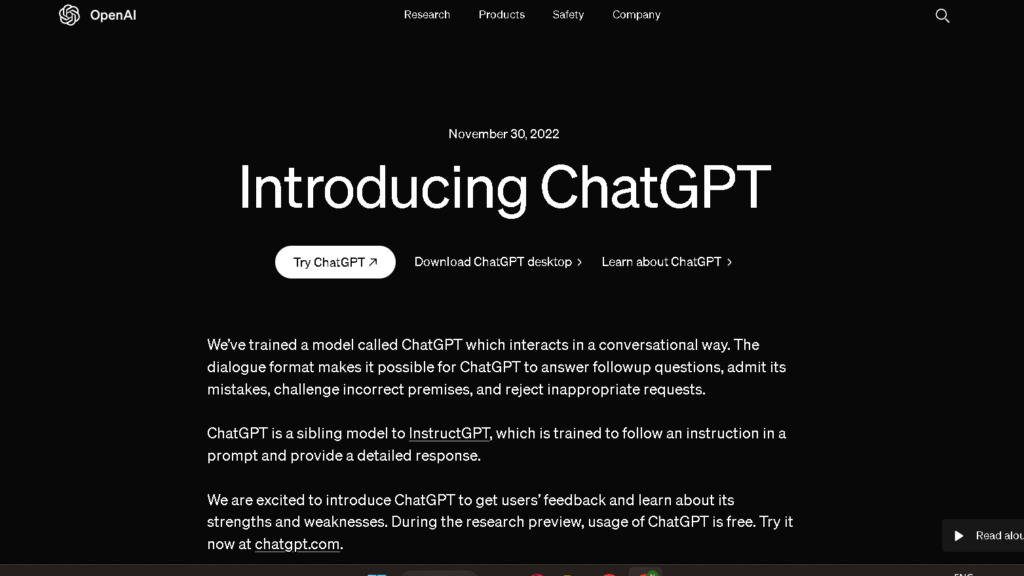
The process of generating AI content begins when you input information such as keywords, outlines, or prompts into an AI model. The model generates text from patterns it’s learned in massive datasets.
The usual process runs along these lines:
- Data input: You enter keywords, questions, or topic ideas.
- Draft generation: The AI generates the first version.
- Human review: Editors tweak for accuracy, tone, and originality.
- Data input: You enter keywords, questions, or topic ideas.Data input: You feed in keywords, questions or topic ideas.
- Draft generation: The AI generates the first version.
- Human review: Editors tweak for accuracy, tone, and originality.
- Editors refine for accuracy tone and originality. All of this is to say that for the most part AIs will not be able to verify whether something are truth and up-to-date. Which is why human oversight is so important. The editing process will also inject your brand’s voice and unique value, two things AIs cannot do on their own.
How AI-Generated Content Impacts SEO?

Automated content produced by AI is altering our approach to how we make and optimize for search engines. It accelerates production and it is useful for keyword targeting, but it also has its dangers.
Ultimately, its value is subjective based on the quality, uniqueness, and relevance of that content to your overarching SEO strategy.
Benefits of Using AI for SEO
AI tools speed up the process of content marketing, they can be used to research key words, come up with ideas, and even write outlines, this not only saves a lot of time.
For example, AI can be useful in educational content such as how-to guides, which tends to lead to searches; AI can also perform dynamic A/B testing on headlines and meta descriptions, which can help to improve CTR’s.
It allows me to focus on content and strategy rather than menial SEO tasks. Intelligently applied, it allows me to scale up content without losing its relevance or focus.
Risks and Potential Drawbacks
If left un-edited, AI content can be inaccurate and/or uninspired. AI models may also retrieve information from older or biased sources that can negatively impact your rankings.
Copycat content is another significant threat. Content that appears to many other sites wouldn’t necessarily hurt your page in search results unless other pages actually use the exact AI output.
Relying too heavily on AI can also suck the life out of the voice and the authority that are necessary for great content marketing. AI is no good at personal narratives or perspectives the way a human is.
Lacking checkpoints, content produced by AI could fail to measure up to Google’s quality standards or that which users expect.
Learn more about SEO in my starter guide.
Impact on Search Rankings
Google’s official line is that it doesn’t punish AI content as long as it is useful, unique and relevant. Rankings are ultimately based on quality, not on the method with which your content was generated.
AI mixed with strong SEO is more successful for those who adopt it. But it isn’t guaranteed.
Some marketers experience better rankings with AI while others experience no change or a decline. Whether they will be successful for you depends on how good you are at following SEO best practices – such as your optimization for keywords and content gaps, and a good solid human edit.
Effect on E-E-A-T and Trustworthiness

E-A-T (Experience, Expertise, Authoritativeness, Trustworthiness) is important for good SEO. Because it lacks lived experience and a point of view, AI finds it difficult to generate content that is genuinely expert or authentic.
It has a distancing effect and makes content seem more generic and less trustworthy. I inject my own insights, expert quotes, and examples into AI drafts. Transparency around the fact that AI is used can also work towards resignifying the relationship with readers in a more honest and trusting way.
Sites with strong E-A-T signals are particularly obvious and noticiable now that AI-generated content is increasingly ubiquitous.
Best Practices for Leveraging AI Content in SEO
AI applied to SEO can allow content to be written faster and more efficiently. You should, however, find a good balance between automation and human.
These are the main important factors that will help us to use AI in the right way and not kill SEO, it is about quality, originality, knowing what users want.
Balancing AI Efficiency With Human Creativity
AI tools allow me to generate drafts, outlines and headlines quickly. It quickens my work process and I am seldom adopted by writer’s block.
I always come back around and inject human creativity into the ideas for overhauling them for the sake of some personality in the content. AI simply cannot generate original, novel perspectives, or stories that truly resonate with people.
I use AI to execute the routine like keyword research, or first drafts. I then edit for clarity, tone, and relevance. That combo allows everything to be efficient while still keeping it true to my expertise and brand voice.
Ensuring Originality and Content Quality
Having unique content is important for ranking well. AI text can be written very quickly, but it tends to generate from what is already in existence as a sort of found/poached language, and so it is relatively likely, if not guaranteed, that it will be repetitive.
I give each piece a once-over look at the AI output to fact check, and to provide some supplemental unique information or examples to help the piece be unique. Editing isn’t just about grammar. I concentrate on good readability, related links, good metadata, and on ensuring the information is appropriate for my readership.
Because search engines value user experience above all else, that attracts the search engine because the content is valuable and reliable content by virtue of the attention itself.
Addressing User Intent and Search Intent
AI can propose keywords and topics, but it does not always understand what people actually desire. I mine for their needs or what they are seeking to address those needs in terms of content.
Matching user intent provides either clear answers, actionable tips, or in-depth guides . Knowing that search intent guides me to the correct format – ie: how-to, comparison, or list style – and ultimately informs me which keywords I should be targeting.
This approach helps to make AI content more relevant and increases its potential for rank.
Optimizing AI-Generated Content for Search Engines
My approach for optimizing AI-generated content for SEO involves three key considerations: the selection and handling of keywords, well-written metadata, and structuring content for featured snippets.
All these specifics assist search engine in noticing the content and getting it to the correct audience.
Keyword Research and Integration
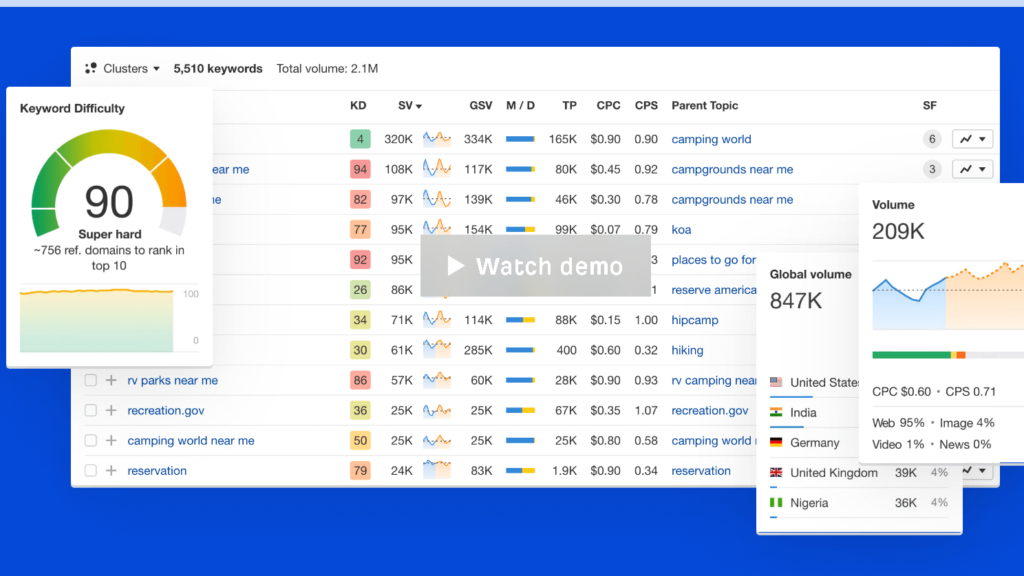
I begin with SEO tools looking for strong keywords, and particularly long-tail keywords. These individual terms are typically less competitive, and bring in more focused traffic.
I maintain the application of good sound sentence and paragraph construction and use it to test various placements of keywords quickly via AI writing tools. I put keywords in the headings, the intro, and in my copy – but I don’t stuff it .
It is a bad idea to just stuff your keywords everywhere as search engines will penalize you for doing so. My goal is to write this as clearly and helpfully as I can, and so I only insert keywords where it seems appropriate to do so.
The better the keyword research, the more effectively AI creates content that aligns with what people are searching for. This is a way to get the right traffic.
Creating Metadata, Meta Titles, and Meta Descriptions
Though not visible on the page, metadata matters for SEO. I employ meta titles to categorize the content of less than 60 characters, all of which appear in search results.
Meta titles that are smart will have the main keywords used, but will also make them sound natural and click-worthy. Meta descriptions are a brief summary of the page, at about 150-160 characters. They must be clear, interesting, and include key words.
Though not a direct ranking factor, high quality meta descriptions can help increase click-through rates and indicate value to search engines. I often let AI write titles, but I always tweak and edit to match my content’s tone and details.
Clean metadata is also helpful because search engines but also users looking at search results can quickly know what the page is about.
Structuring Content for Featured Snippets
Featured snippets appear at the top of google’s search results and can do wonders in terms of visibility. So, to catch them, I ensure that the answers are short and easy to read.
That includes short paragraphs, bullet points, and lists with numbers. I ask direct questions or make clear statements in my headings, and I respond with direct answers – typically 40-60 words.
I use AI to assist in the writing of them, but always adjust the sentences for clarity and correctness. Tables or step-by-step instructions are also useful, particularly for how-to or comparison content.
Formatting helps the content be pulled for content snippets (table cell) such as those that are used by search engines, which is important for SEO.
Common Pitfalls and How to Avoid Them

However, there are also downsides to using AI when creating SEO content. When unmeasured this can result in poor quality pages, keyword stuffing or in the worst case scenario getting penalized by the search engines.
Thin Content and Duplicate Content
Thin content is a major offender – pages that simply provide too little good information or original utility. AI is great at generating high volume, low quality pages quickly, but when all it does is repeating some basic facts, it doesn’t really serve a useful purpose .
Thin content is recognized by Google’s algorithms and can be penalized with lower rankings. There is also a risk of duplicate content as most AI tools draw for similar sources, with the result that the texts in various sites are practically the same.
I try to correct for this by heavily editing the work and loading it with my own ideas or examples.
Keyword Stuffing and Over-Optimization
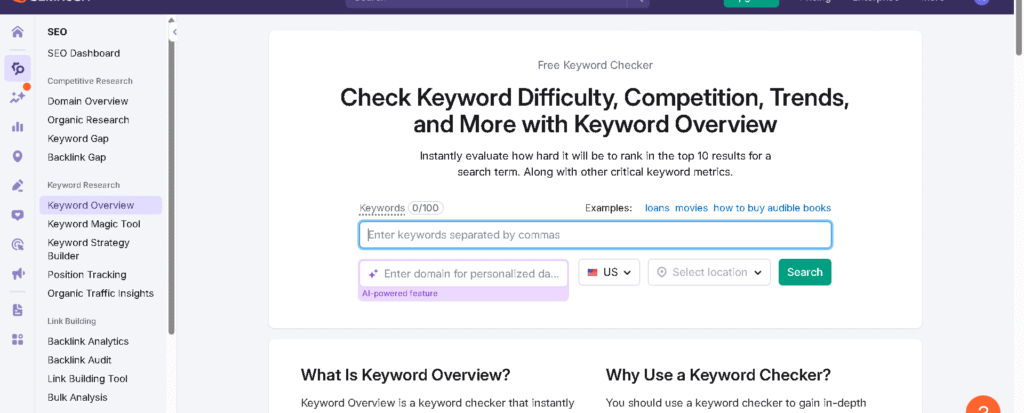
A pitfall to avoid is keyword stuffing. That’s called keyword stuffing, putting as many keywords in your text as possible just to get a higher ranking. One of the drawbacks of the focus on computational optimization in AI is that it tends to replicate keywords in ways that are unnatural.
Content will sound unnatural, and you may face Google penalties for over-optimizing. I hope to be natural in my use of keywords. Starting there also makes your site more secure from the beginning.
Staying Clear of Google Penalties
Google doesn’t penalize content for being made by AI. The problem is, of course, one of quality and purpose.
If you have an AI program creating content that is low quality, spammy, or there just to manipulate search then either Google’s algorithms or manual reviewers will penalize your site. In order to avoid that I attempt to produce content that is useful, accurate and well edited.
I don’t splurge on shedloads of unreviewed AI content at any one time. In 2024 and 2025, Google made updates that now make quality matter even more. The best way to ensure your rankings are not affected is to stick to their guidelines.
Strategic Applications of AI Content in Digital Marketing

I can write faster and more efficiently with the help of AI content tools. It allows me to generate more without sacrificing quality.
It also helps me come up with better descriptions of products and social media posts to get the word about engaging, clear ideas. In combination with planning and human editing, AI, as applied thus far, is a useful element of my SEO strategy.
Scaling Content Production
I can churn out an enormous amount of content quickly with the help of AI. Which is a lifesaver when I need to fill blogs, newsletters, websites, etc. with new content .
It writes articles, suggests headlines, it even writes articles for me. It accelerates everything, but it’s not magic, there’s always more to it.
I do always edit the AI output, of course, because it needs to be factually correct and to “sound like” me, however this is accomplished. If all I did was copy and paste I think it would be repetitive and dull, and that’s not what search engines are looking for.
It means that by blending the AI with my own knowledge I keep it valuable and tuned for my readers. I rely heavily on tutorials and “how to” guides, because those are things that AI can do if you steer it in the right way.
It lets me be more prolific without compromising the quality. I have to be careful about this obviously, but it is ok for my content marketing.
Enhancing Product Descriptions and Social Media

In terms of product descriptions, I get at least a fair draft of one from my AI. It’s rapid and general, so I’m not looking at a blank page.
The catch is, those drafts are kind of generic. They don’t always have a sense of personality for the brand or don’t so anything that sets the product apart .
I prefer instead a mixed one. AI does the prep work and then my team or I come in and inject the actual details – things that would make it feel handmade and personal.
This also helps for SEO. Better content, more trustworthy content, always wins out.
Off of social media, AI can help me with my caption brainstorming and tone trying. I can A/B test headlines and posts pretty quickly, seeing what resonates with people.
However I prefer to do final cleaning also. And in order to keep the voice consistent and the connection real, that is the only way to do it.
Integrating AI Into Overall SEO Strategy

I view AI as part of my broader SEO strategy but I don’t view is at a substitute for human labor. I personally use it for keyword research, content audits, and spotting gaps I might have missed.
Then I can take all that data and help focus in on issues that are important and begin to streamline my site structure. AI also outputs meta descriptions and titles quickly, so I can test which ones drive more clicks.
I also still monitor performance and hand tweak things. Brand objectives don’t have an alternate to human judgment.
Ridding myself of outdated or unnecessary content is a regular practice now. AI focuses on what isn’t working and I focus on what actually brings traffic and ranks.
This blend of AI and human has produced for me stronger SEO – at least so far it has for me.
Frequently Asked Questions
You can use AI-generated content in SEO, but you have to at least be reviewing and editing it. It must be helpful, it must be unique, and it actually has to answer what people are looking. Google focuses not only upon the making of content but also its quality.
Can AI-generated content improve my website’s SEO rankings?
Yes, AI can help improve ranking if the content is good, on topic and cleaned and cleared for accuracy. The AI I use is useful because it enables writing to go more quickly and allows for a helping guide to structure drafts, but frankly AI, itself, can hardly replicate the kind of depth a human writer provides .
Does Google have a specific policy regarding the use of AI-generated content for SEO in 2025?
Simply put, Google does not penalize content simply because AI created it. It is important for writers to produce work that is useful, interesting, and centered on people. It’s always content to strive for quality, usefulness and trust – regardless of who (or what) writes it.
Are there any risks associated with using AI to generate content from an SEO perspective?
Yes, there is some risk. You could produce “garbage” type low quality, highly redundant or bland material that actually negatively impacts your ranking. If you over- keyword stuff, or you don’t do your research correctly, you may stumble over spam filters. Just the use of AI can seriously compromise your credibility as well.
How does Google’s algorithm respond to content generated by AI?
AI content is largely interpreted as any other type of content by Google’s algorithm. It does so by rewarding authentic experience, expertise, authority, and trust factors. Content that is thin, non-original, or manipulative? That gets subsumed, however it came into being.
What are effective strategies for incorporating AI-generated content without harming SEO?
I let AI do drafts, outlines, and the repetitive stuff. I then go through, edit, and add my own thoughts. The AI text is most successful when combined with real world experience and ideas, however. I am also very cautious to allow AI to publish content without it going through a rigorous quality control because the stakes are high.
How can I ensure that my AI-generated content maintains quality for SEO purposes?
Be mindful when editing your AI drafts. Ensure the tone is appropriate to your intended audience and focus on accuracy.


