
New AI SEO vs the old SEO approach makes a huge difference. Incorporating AI in your marketing through digital changes the way you communicate with customers on the internet. You’ll get time savings and more precise results by letting AI do the work of SEO for search engines. Benefits of AI SEO strategy is out of the question!
Many businesses are using AI SEO services to scale their online presence and improve their SEO strategy in general. AI recognizes opportunities for keywords and fixes technical issues and molds content to ensure it will rank higher without slowing down your team.
Tools for SEO powered by AI accelerate search and optimization, while keeping the results real and quantifiable.
These tools allow you to tune your content to the user’s needs as well as track competitors. They also incorporate fixes into the AI SEO workflow of your website. You will notice more visible improvements and more consistent with what users actually look for.
Clearer data guides decisions across every department. This lets you react faster to market trends and changes to search engine algorithms.
Key Takeaways
- Make use of AI to find quickly and narrow down the most relevant potential for your search.
- Let AI automate the technical fixes and content changes to speed up the process.
- Mix AI insights with a focused effort to boost constant traffic and assure an observable performance.
Table of Contents
Benefits of AI SEO for Businesses at a Glance
| Benefit Area | How AI Helps | Business Value |
| Keyword Research | Automates discovery and groups terms by intent. | Faster, more precise audience targeting. |
| Content Creation | Generates briefs and optimizes for semantic relevance. | Higher search rankings and topical authority. |
| Technical SEO | Scans for errors and prioritizes high-impact fixes. | Improved site health and crawl performance. |
| Competitor Insights | Identifies content gaps and backlink opportunities. | Stronger strategy against market rivals. |
| User Experience | Personalizes content and monitors Core Web Vitals. | Better engagement and conversion rates. |
Benefits of AI SEO for Business Visibility
AI SEO facilitates the optimization process, making the brands more noticeable in new ways. By employing AI in the SEO, the brands can achieve the expansion of the scope of the brands, which was not possible before.
This approach offers an in-depth view of the searchers’ behaviors, including those of the different groups. Using predictive analytics, the brands can even predict the changes in the market.
Moreover, the AI assistants can even impact the presentation of the results in the search engine results. The algorithm adjusts according to the ranking signals generated by the users’ behaviors, as well as the content.
In order to keep pace with the trends and make the required adjustments, the brands can hold the position in the growing list of the search in the competitive world.
Shifting From Manual to Automated Optimization
These tools are able to scan websites and identify technical problems in minutes, not days. This is a level of efficiency that ensures nothing is overlooked when you are carrying out routine maintenance.
Tech teams can focus on the advanced SEO tactics rather than carrying out manual audits. Tools like Ahrefs and BrightEdge are now able to forecast trends in search and automate the audit process, helping teams quickly pick out changes that have a high impact.
They can automate the process of keyword identification by analyzing trends in search, intent, and competition to develop priority lists of tasks. This way, teams are able to spend less time carrying out manual audits and more time developing content strategies and link-building.
Automation also takes care of on-page tasks such as schema markup, meta tags, and internal linking. These tools can even develop A/B test versions of headlines and short snippets to boost click-through rates.
For local businesses, AI keeps listings consistent across directories. This is a huge benefit for local SEO and helps to increase visibility in local packs and maps.
AI-Driven Search and Zero-Click Results
More concise answers are provided by AI, which also allows for summarization. This results in more zero-click searches where users are able to retrieve information without visiting your website. Companies who offer clear and organized content are most likely to make it into these answers.
Conversational search snippets and knowledge panels are important for visibility in today’s search engine results. In order to optimize your website for these search engine queries, it’s important to understand the intent behind users at a more basic level.
The latest platforms, such as Perplexity, are focusing on providing direct answers from reputable sources. In order to be successful in providing these answers, companies need to ensure that there is accurate natural language processing.
The ability to create concise and accurate content in a format that is suitable for AI is important. Consider providing answers in a FAQ format, providing comparisons in a table format, and providing definitions.
It’s also important to keep an eye out for these in AI assistants. Then, it’s important to start optimizing for platforms like chatbots or virtual agents. This will ensure that you are relevant and not just in traditional search engine results.
The Role of Machine Learning in Ranking Signals
Machine learning models are constantly learning from huge amounts of user behavior data to refine these rankings signals. Google’s RankBrain was the first use of machine interpretation of search intent.
These signals, including hover time and clicking patterns as well as refinements to a query, are fed into machine learning models to decide which pages to display. And this is why AI-driven SEO is so important to remain visible in today’s search engine results pages.
Predictive modeling can also identify a risk to future changes to search engine rankings before they actually happen. AI-driven SEO picks up on these signals and uses them to recommend updates to a piece of content based on real-time engagement metrics.
Machine learning algorithms assess authority on a topic as well as semantic relevance along with structured and logical data when evaluating a page for a search engine result page. Ultimately, publishing authoritative content increases AI confidence signals.
SEOs use AI to model user queries and test out variations on a piece of content to measure the effect on organic traffic and conversions more precisely.
Benefits of AI SEO for Keyword Research and Intent Targeting

AI speeds up the process of finding relevant keywords, organizes them based on topics, and helps in finding the content that matches what users actually require. AI has the ability to spot opportunities in niches and predict what questions will rise in the future before they become popular.
Keyword targeting is essential to reach the target audience at the right time. The application of AI in SEO enables businesses to locate high-value keywords with absolute precision.
This approach involves analyzing data constantly to stay ahead of trends. AI can also provide tips on how to develop content that will attract more clicks and conversions. It also ensures that each piece of content has a real purpose in the user’s journey.
Data-Driven Keyword Discovery
AI tools analyze millions of searches and click data to identify keywords that have real-time traffic potential. Advanced analysis determines which keywords can generate the most the most revenue for your business.
Keywords are ranked using metrics such as the volume of search, the difficulty, and probable conversion impact. This helps teams concentrate on the terms that advance towards business objectives rather than just numbers for traffic.
Many platforms utilize natural language processing (NLP) to analyze search patterns and create keyword clusters. It groups similar terms, so content can be targeted at a specific number of phrases rather than simply one keyword.
Predictive analytics allows software to flag queries that are growing in popularity so that teams can react before the competition gets heated.
AI automatizes repetitive tasks such as searching for keywords and filtering them by intent signals. It cuts research time down while keeping keyword targeting in line with actual behavior of the user.
Understanding and Matching User Intent
AI analyzes the context of a search to identify intent types: transactional, commercial, informational and navigational. This makes mapping web pages to the correct intention much simpler.
A proper mapping can prevent mistakes that can hurt engagement and ranking. By using the use of semantic analysis and session data, AI can spot intent shifts within the industry.
For instance, a rise for “best” plus a product name suggests commercial research. AI detects this is a reference as well as buying guidebooks, and teams can be aligned with the page’s format.
AI-powered intent targeting guides the metadata and headings that match the way people phrase their questions. It increases click-through rate and reduces the chance of bouncing.
Leveraging Long-Tail and Semantic Keywords
AI excels at identifying long-tail keywords, i.e. those phrases that have less volume, but with higher chances of conversion. They often indicate clearly defined transaction intentions or niche demands.
Semantic analysis goes beyond single keywords to identify the concepts that are related and also synonyms. AI proposes semantically rich terms to be incorporated into content, so that websites rank for entire topics and not just one word.
This supports content depth as well as E-E A-T signals. Teams can make use of AI to determine the priority of long-tail clusters according to conversion probabilities and gap with competitors and then create targeted websites or sections to answer the most specific questions.
This will result in steady, consistent traffic instead of occasional spikes that don’t last.
AI-Powered Content Optimization for Maximum Results
AI improves audit efficiency and fills in content gaps. Advanced optimization optimizes pages to meet the needs of users and search-related signals.
These AI-powered tools offer an outline for long-term organic success. Making content more efficient through AI can help you to keep a strong online marketing presence.
The interplay of AI and SEO aids in creating clear content briefs, and increases the semantic value. AI tools can also prompt users to use shorter paragraphs that are easy to read.
Automated Content Audits and Content Briefs
AI runs site-wide audits fast. It flags weak pages as duplicate content, duplicate pages, and metadata that is not present, and prioritizing fixes based on conversion and traffic impact.
Teams receive a ranked list of pages that need to be updated and concentrate on winnings with the highest value first. AI creates content briefs based on high-ranking pages as well as information about search intent.
A concise list of keywords, headings that are required and the ideal word count and other related questions. Writers receive clear direction and can reduce writing time and alignment mistakes.
With the help of generative AI briefs, they could include sample opening paragraphs or title concepts. Human editors are still in charge of an end product however it is much faster.
Semantic Relevance and Topic Authority
AI analyzes co-occurring words and entity relations among top-ranked pages. It suggests topic clusters as well as relevant subtopics which search engines are expected to detect.
This helps fill in gaps in content and improves semantic relevancy. The mapping of internally-generated content with topic clusters aids teams establish measurable authority on topics.
AI finds missing subpages It also suggests pillar pages and identifies content that should be combined or split. This reduces the amount of keywords that can be reabsorbed and provides more clear signals to search engines.
On-page AI modifications could include the addition of semantically related terms, as well as FAQ suggestions for schema. These changes make websites more trustworthy for intent-rich queries.
Benefits of AI SEO for Personalization and Content Adaptation
AI sorts visitors according to their behaviour, intention and location, allowing them to provide specific content variants. For instance, websites will display promotions specific to regions according to user information.
Blog posts could show different CTAs according to the source of referral. This type of personalization increases the engagement of visitors and increases convert rates throughout your website.
Content adaptation can be automated to include A/B tests. AI can create headline and intro variations as well as run tests and send the most efficient version to the market.
It also identifies slowing performance and recommends refreshes to ensure pages are in the game. Editors must always double-check the information to ensure that content is consistent with trustworthiness of the brand.
Transforming Content Creation With AI SEO
AI assists teams in identifying better content topics, write drafts faster, and help improve metadata on the page, such as schema and meta tags. The process of creating content is streamlined, which keeps your publishing schedule in line and is a significant part of the fight.
Utilizing AI to improve SEO allows writers to produce more relevant content without compromising quality. This integration can really streamline the process and helps strengthen the effectiveness of your SEO efforts. There are tools like SE Ranking or NeuronWriter to help you.
AI-Assisted Content Ideation
AI tools accelerate the research process by scanning for patterns, competitor websites, and gaps in keyword usage. They provide specific ideas for articles and questions related to them that correspond with the actual intent of the user.
Teams can utilize prompts in ChatGPT, Claude, or Gemini to create topics as well as FAQs. Tools such as Frase and Surfer analyze SERPs to suggest headings, titles, and titles.
AI assists in determining the best ideas based on estimation of traffic, difficulty and the possibility of conversion. This way content marketing is focused on the actual the goals of business.
Drafting High-Quality SEO Content
Content generated by AI is capable of producing first drafts, outlines, and section-level content quickly. The addition of AI to the process enables room for creativity exploration.
Content writers refine their work to make it accurate, with voice and personal experience, to make sure they are in line with E-E A-T guidelines. This is important in ensuring that the content is not sloppy or inaccurate.
Draft optimization tools such as Clearscope and Surfer are incorporated into the draft to show the most relevant phrases. The writer needs to refine the AI-generated content to make it exclusive with data and quotes.
Create a review process that involves fact-checking and aligning the headings with the purpose of the keyword. This ensures that progress is being made quickly while also ensuring brand quality.
Improving Meta Descriptions and Structured Data
AI can produce well-written meta descriptions that are well-targeted at the chosen key words and click triggers. A well-written meta description is one that includes the chosen keyword, as well as a value statement.
AI can aid in the creation of schema markups for articles, products, as well as FAQs and local business information. Tools can produce JSON-LD fragments, including author details and headlines.
It is important to test the schemas and metas using tools before publication, as this will reduce errors, thereby keeping the optimization in line.
Streamlining Technical SEO and Site Performance

AI enhances audits, resolves issues with the index and crawl, and boosts the speed of your website and mobile experience. The new AI SEO tools are essential in making sure that your website’s structure is well-organized.
With the use of SEO automation, businesses can ensure that their technical health is in good condition without putting in much effort. This method uses data analysis to detect issues before they negatively impact rankings.
A good SEO campaign needs the same level of technological sophistication in particular, as the world is always changing online.
Automated Technical Audits and Issue Detection
The AI tools examine websites and highlight specific SEO problems, like broken links or meta tags that are duplicated. They also examine websites to identify which Core Web Vitals need attention.
Reports prioritize fixes according to their impact on conversions and traffic, not just how bad the problem is. This allows teams to focus on websites that drive visitors and sales.
Diagnostic results usually show where code changes are needed and offer straightforward steps to solve problems. Developers can use machine-readable reports to make changes quickly.
Monitoring in real time detects any sign of regression and sends alerts if indexability worsens. This approach prevents small technical errors from becoming big ranking problems.
Optimizing Crawlability, Indexing, and Internal Linking
AI SEO tool examines site structure to improve crawling efficiency and coverage. It determines navigation paths and identifies “orphan” sites that may be skipped by search engines.
Also, the software provides recommendations for improving robots.txt and sitemaps, as well as pages that need consolidation. It detects pages that are hard for search engines to render, making it difficult for search engines to understand content.
Internal linking is a great strategy. AI tools offer recommendations for improving anchor text and placement of links to improve authority. AI tools simulate a search engine crawler to show which links are crawled by search engines.
Enhancing User Experience and Mobile Usability
In addition, AI checks the speed of pages that are connected via the Core Web Vitals. It also provides suggestions for fixing the problems. This could be done by compressing images or improving the way the resources are loaded.
For mobile devices, the AI checks the viewsport settings, touch targets, and the stability of the layout. It also checks the navigation patterns that could cause confusion to the users or make the site difficult to use, especially when using small screens.
Some of the suggestions could be the simplicity of the menus. The performance dashboards provide connections between UX or mobile metrics and conversions that are business-oriented.
Boosting Link Building and Competitor Analysis
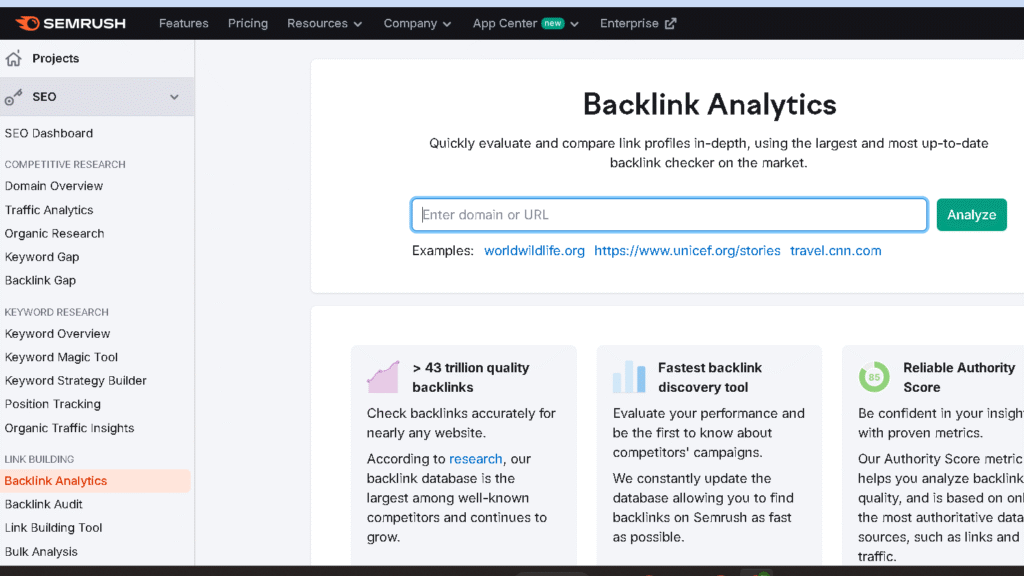
AI accelerates the search for high-quality backlink targets and identifies holes in competitor content. A thorough analysis of competitors aids teams to identify top-quality opportunities and streamline outreach lists.
Marketers can evaluate which sites get the most links or traffic. This way the efforts to build links go to the areas that will have the greatest impact.
Benefits of AI SEO for AI-Powered Backlink Analysis
It also helps to analyze thousands of backlinks within a short period of time and identify which backlinks are important for a particular site. For instance, it uses metrics like traffic and domain authority to identify which sites rank at the top.
It is also quick to identify harmful sites to eliminate and sites that are attracting natural backlinks. Additionally, AI can also provide suggestions for anchor text based on user behavior and context.
There are various tools available to facilitate faster link creation through outreach workflows. For instance, marketers can focus on building relationships to generate links naturally.
Identifying and Closing Competitive Content Gaps
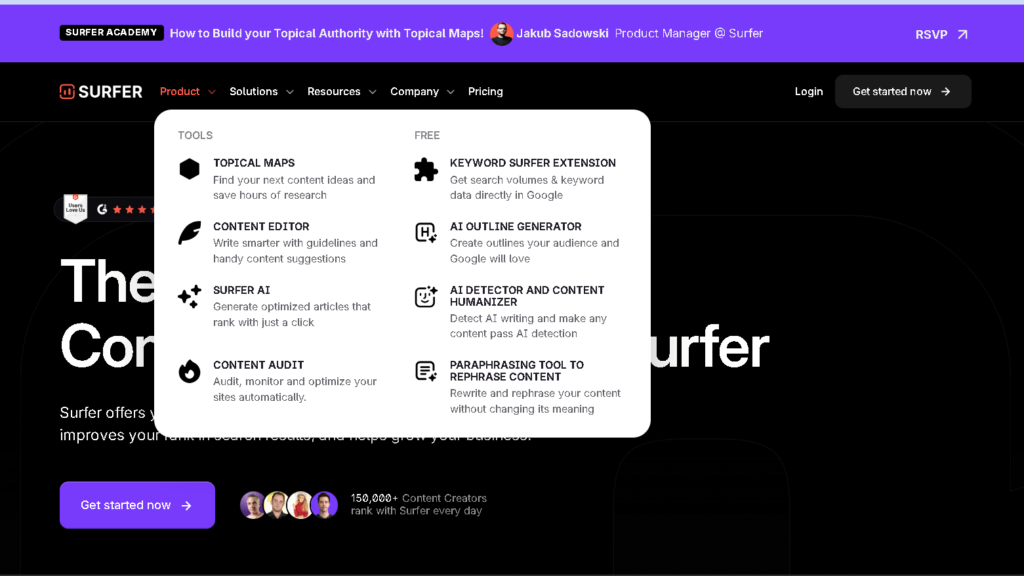
AI examines your content in comparison to your competitors to identify subjects and keywords angles. It examines the top-ranking competitor articles to find relevant subtopics.
With the help of tools such as Surfer SEO and Semrush, AI creates a ranking list of gaps in content. Marketers can take clear steps to develop data-driven guides or to add expert-sourced quotes.
AI calculates likely traffic gains by filling every gap. So teams can concentrate on projects that have the highest impact instead of seeking low-return keywords.
Elevating Local SEO and Multi-Platform Search Visibility
Companies must ensure that their listings are current and update their pages with specific locations. Collecting reviews from social and map apps helps build trust among users.
It’s a smart idea to determine the level of how well each platform performs and modify content to suit various search types. That’s why you should think about both traditional search and the newer conversational AI platforms.
Optimizing for Local Search and Geo-Targeted Results
The process of claiming and filling out an Google Business Profile is vital to ensure local visibility. Utilize precise business information to avoid conflicts with citations that could harm local rankings.
Create pages for each location that clearly display geo-signals, such as city names appearing in the titles. Add local content–neighborhood guides, case studies, anything that shows firsthand experience.
Keep track of rankings with local rank trackers to monitor changes based on coordinates. Repair NAP inconsistentness and keep a close eye on local trends as well as competitor listings each month.
Preparing for AI-Driven and Conversational Search
Optimize your content to provide short and factual responses that AI overviews adore. Break it down into easy and scannable blocks: FAQs bullet lists, questions and the like.
Concentrate on signals from entities as well as structured information. Make use of schemas for your products and services to ensure that models such as MUM and BERT can connect things in a correct manner.
Check out the way AI devices and engines give solutions. Find snippets of featured and mentioned mentions and then modify text to reflect the phrasing that is used in conversations.

Frequently Asked Questions
This section answers practical questions about how AI tools are changing SEO work. You’ll find info on content strategy, technical fixes, and keyword research methods.
How can AI tools enhance the content strategy for SEO improvement?
AI analyses top-ranked webpages and users’ queries to identify gaps in subtopics, as well as common queries. It suggests headings and outline that correspond to search intention.
AI can assist in scaling production of content through the creation of first documents and meta tags. Humans must still edit content to ensure the voice of the brand and have firsthand knowledge to ensure the integrity of the content.
It will test headlines to boost click-through rate. AI also detects the gaps in content so that teams can design pillar pages that meet the needs of users.
What impact will AI has on SEO technical and problem resolution?
AI-powered crawlers detect broken links and slow websites more quickly than manual inspections. They can prioritize repairs based on estimates of traffic impact and risk to rank.
AI tools recommend changes to configuration to enhance the crawlability of your site and improve user experience. Engineers must validate and apply these fixes to the live website.
Certain AI systems can monitor surfaces and logs in real-time. Teams can detect regressions that occur after updates and cut down on the time it takes to fix crucial pages.
What ways can AI aid in more efficient keyword research?
AI sorts similar search terms according to semantic and intent creating organized sets for topics. This reduces manually completing spreadsheets.
It generates long-tail keyword phrases that correspond to voice search as well as conversations. Teams can match the keywords to websites or generate new ideas.
Based on actual information from the query, AI estimates ranking difficulty and the potential for traffic. It helps you decide the keywords that should be targeted to maximize return on investment.
How do AI-driven strategies compare with traditional SEO approaches?
AI accelerates the repetitive analysis process and helps scale up tasks such as SERP audits. Traditional methods are based on manual research and lengthy reviews of competitors.
AI provides data-driven recommendations, however, it can be a bit sloppy with the product-specific nuance. Traditional SEO knowledge still drives the strategy, branding voice and high-risk choices.
The most successful teams combine both of these: utilize AI for pattern and volume detection, and rely on human judgment to create the strategy and unique insights.
What role does AI play in building high-quality links for SEO?
AI assists in identifying relevant link opportunities by studying the domain’s authority and topical fit. It ranks potential prospects according to ROI and difficulty of outreach.
It can create personalized templates for outreach to increase reply rates. Humans still have to modify the messages they send out and maintain relationships in order to get places.
AI detects links acquired for any changes and informs teams if important links fail. This makes it easier to maintain a solid backlink profile throughout time.
How can businesses make use of AI to boost organic traffic?
Businesses frequently turn to AI to examine their content libraries. They make sure that they update their pages with new information that can help to increase and even recover traffic without having to recreate everything from scratch.
AI-driven topic planning can help create authority by creating the pillar and cluster pages. When combined with targeted outreach, and some technical adjustments, you’ll notice steady improvements over time.
It is crucial for teams to keep track of engagement and conversions carefully. They must keep making adjustments and testing changes to the content according to what actual users are doing.